
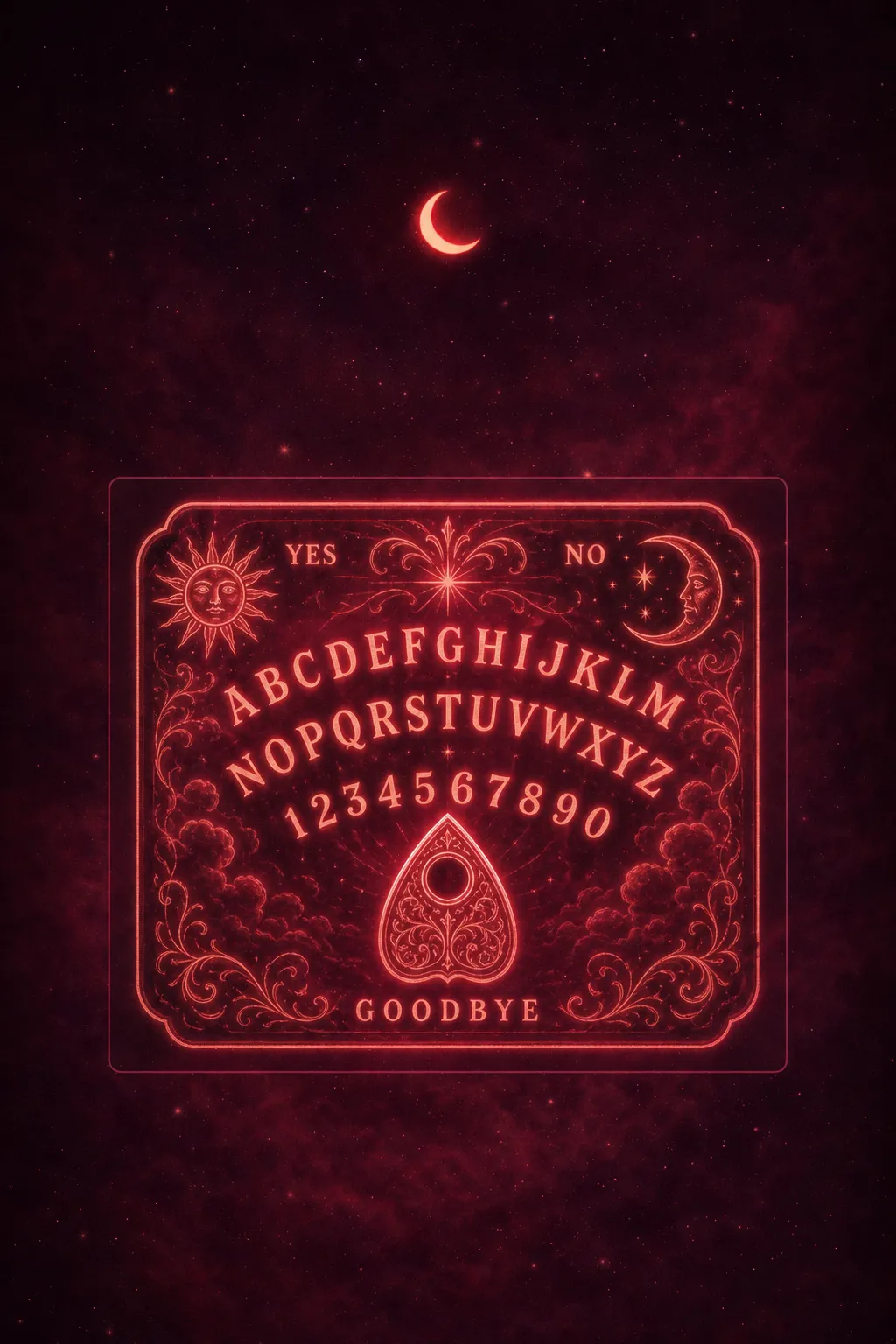

A ouija board in a dream meaning centers on your desire to communicate with the unknown or unresolved parts of yourself, often reflecting deep curiosity, fear of hidden truths, or a need to confront suppressed emotions and questions you feel unable to ask the living people in your waking life.
In under a minute you could read what your exact dream means for you, and see a picture of it. Free.
Bad dream? See exactly what you dreamed — turned into a picture.
Just describe it and Dream Book paints your dream as a real image, plus a reading of what it means for you. Free, and it takes under a minute.


A dream still on your mind? Get your personal reading.
Describe your dream in a line or two. In seconds you get a reading of your exact dream, a picture drawn from your own words, and every symbol explained.
Free. No sign-up. Takes 10 seconds. Your dream stays private.
0%
Analyzing your dream…
Something went wrong. Please try again in a moment.
Your dreams deserve more than a dictionary
Common Ouija Board Dream Scenarios and What They Mean
The specific shape a ouija board dream takes matters as much as the symbol itself. Each variation points to a different tension between conscious control and whatever the mind is trying to surface.
Dreaming of using the ouija board completely alone
Sitting at the board without anyone else present suggests you are wrestling with a buried question or unresolved grief entirely on your own — no support system, no witness. It often reflects the modern anxiety of feeling isolated while processing something you haven't yet put into words.
A bad dream isn't a bad sign.
Dreaming of using it with a group or friends
The key question here is who is actually moving the planchette. This scenario frequently mirrors social pressure and shared anxiety — a decision being steered by group dynamics rather than your own judgment.
Dreaming that the planchette moves on its own or spells a message
This is the unconscious pushing past your defenses. Something you have been consciously resisting is demanding acknowledgment.
Dreaming of receiving a name, date, or warning through the board
Your mind is flagging a specific unresolved concern — a particular person, a looming deadline, or a fear you keep postponing.
Dreaming that the board stays completely silent
Blocked communication and frustration with uncertainty; the answers you want are simply not coming yet.
Dreaming of refusing or being afraid to touch the board
Far from weakness, this reflects a healthy respect for a boundary — moral, emotional, or spiritual — that part of you knows should not be crossed.
But what does your version mean?
Dreaming you are unable to end the session or say goodbye
A strong signal that you feel stuck in a stressful chapter you cannot close, haunted by something left unresolved.
Dreaming that contact turns frightening or malevolent
Overwhelm has set in — you sense you have opened more than you can manage, and guilt or dread is now driving the narrative.
Across all these variants, the central thread is control: whether you hold it, share it, lose it, or deliberately refuse it shapes what the dream is working through.
What this dream could look like
Tap an image to open it full screen
Example images. Only you can see what you write in Dream Book.
The Psychological Reading: Control, Repression, and Hidden Answers
From a psychological standpoint, dreaming of a ouija board often signals that the unconscious mind is pressing buried or unresolved material toward the surface. The board itself becomes a neat metaphor for the ideomotor effect — the real-world phenomenon where a person's own subtle muscle movements guide the planchette while the conscious mind experiences the answers as arriving from somewhere else entirely. In a dream, this translates powerfully: what feels like an external, possibly threatening "message" is frequently a truth the dreamer already holds but has been reluctant to own. The dread that often colors these dreams is not really about outside forces; it is the anxiety of confronting what one already knows.
Modern stress and uncertainty amplify this dynamic considerably. When life feels unpredictable — a career shift, a strained relationship, a health worry — the mind hungers for certainty. The ouija board in a dream embodies that locus-of-control tension: the desire to extract a clear answer from a situation that refuses to yield one. For those with a Christian background, guilt or internalized prohibition may intensify the discomfort, framing the act of "asking" as boundary-crossing, which itself reflects the dreamer's ambivalence about seeking knowledge that feels forbidden or destabilizing.
- Grief processing: The board can serve as a stand-in for unfinished emotional business — a subconscious rehearsal of questions one never got to ask someone who is gone.
- Suggestibility anxiety: Being led by others at the board may reflect worry about peer pressure or losing one's own judgment within a group.
- Self-knowledge: Ultimately, the image invites honest reflection — the "spirit" answering may simply be the part of yourself you have not yet listened to.
General meanings end here. Read your own dream.
Describe your dream in a line or two. In seconds you get a reading of your exact dream, a picture drawn from your own words, and every symbol explained.
Free. No sign-up. Takes 10 seconds. Your dream stays private.
0%
Analyzing your dream…
Something went wrong. Please try again in a moment.
Your dreams deserve more than a dictionary
Every dream you log starts to connect.
Dream Book keeps your dreams in one place and reveals the threads between them over time — your private dream journal. Free to start.
Cultural and Traditional Readings of the Ouija Board Dream
In mainstream Western culture, the ouija board occupies a uniquely uneasy position: it was mass-marketed as a parlor game yet almost universally treated as a forbidden object. That tension — toy on the shelf, taboo in practice — has made it a durable cultural shorthand for meddling with forces best left alone. When the board appears in a dream, many people instinctively read it through the lens of horror films and slumber-party dares, where curiosity tips into dread the moment the planchette moves on its own. The dream taps directly into that inherited anxiety.
From a US Christian folk perspective, the ouija board sits close to the boundary of what is considered spiritually dangerous territory — a doorway that, once opened, is hard to close. Even outside strictly religious households, this cultural residue shapes how dreamers feel upon waking: unsettled, as though they crossed a line. That sense of transgression is itself meaningful, pointing to questions about which boundaries the dreamer feels they are currently testing in waking life.
Was yours a sign? Find out.
Modern anxiety culture has layered additional meaning onto the symbol. Key cultural themes the dream may be reflecting include:
- Loss of control: fear that events or emotions are moving without your direction, much like a planchette guided by an unseen hand
- Curiosity about hidden information: a culturally familiar ritual for seeking answers that feel otherwise inaccessible
- Thrill versus consequence: the classic slumber-party framing of a risk that feels exciting until it suddenly feels real
The Spiritual Reading: Forbidden Thresholds and the Question of Trust
For dreamers shaped by a Christian worldview, a ouija board appearing in a dream rarely feels neutral. Scripture draws a firm line around divination and consulting spirits — passages such as Leviticus 19:31 and Deuteronomy 18:10–12 treat such practices as a violation of trust in God's guidance, and the cautionary story of Saul seeking the medium of Endor (1 Samuel 28) frames the act as a desperation move that ends badly. Dreaming of the board through this lens often functions less as a literal haunting and more as a conscience signal: the dream may be asking whether you are seeking answers through channels that bypass patience, prayer, or honest discernment — a caution against boundary-crossing rather than evidence of supernatural contact.
From a broader spiritual standpoint, the board represents the human impulse to reach past ordinary awareness for hidden knowledge, especially under pressure. Modern anxiety sharpens that impulse: when life feels unpredictable and self-control seems fragile, the idea of a direct channel to answers — any answers — becomes seductive. The spiritual reading honors that longing while flagging the ambivalence baked into the symbol itself: the dreamer cannot fully verify who or what is guiding the planchette, which mirrors real-life uncertainty about which voices to trust when anxiety is driving the search.
- Conscience and temptation: the dream may surface guilt or unease about a shortcut you are considering.
- Misplaced trust: spiritually, the image can prompt reflection on where you are actually anchoring your sense of guidance.
- Surrendering control: the board requires releasing the hand — spiritually, the dream may ask whether that surrender is faithful openness or reckless avoidance of responsibility.
Related Dream Meanings
nightmares
Dead Relative: Meaning and Interpretation
5 min read
nightmares
Haunted House Dream Meaning: Fears, Trauma & Healing
5 min read
animals
Snakes Dream Meaning: Fear, Change & Hidden Threats
5 min read

nightmares
Speaking With Dead Dream Meaning: Grief & Guidance
6 min read

nightmares
Sinking Ship Meaning - Symbolism & Interpretation
5 min read

nightmares
Dead Grandfather Meaning - Symbolism & Interpretation
6 min read

nightmares
Dreaming of Dead Uncle Meaning - Dream Interpretation Guide
6 min read
nightmares
What Does It Mean When You Dream About a Dead Aunt
5 min read
Practical Takeaways: What to Do After This Dream
Because a ouija board dream centers on loosened control and buried material pressing for attention, the most useful first step is simply naming what you have been avoiding. Pull out a journal and write down the one question you have been afraid to ask yourself — about a relationship, a decision, or a direction in life. The dream is signaling that the avoidance itself is generating anxiety, and that acknowledging the question is safer than letting it work on you from the background.
- Audit your stress load. These dreams often spike during periods of high uncertainty. Identify one area where you feel you have lost your grip — finances, a career shift, a strained relationship — and break it into a single small action you can take this week.
- Check your information diet. If you have been obsessively researching an outcome you cannot control, scale back. Replace one scroll session with a brief grounding practice: slow breathing, a short walk, or a few minutes of prayer if that fits your framework.
- Set a conscious boundary. The board in the dream often represents something you are consulting compulsively — another person's opinion, social media validation, anxious "what if" thinking. Naming that habit and placing a deliberate limit on it restores a sense of agency the dream is telling you that you need.
A bad dream isn't a bad sign.
The core message is practical: you already hold more answers than you are giving yourself credit for. The dream is less a caution against boundary-crossing and more a prompt to ask questions directly, consciously, and on your own terms.
If it keeps coming back, the app helps you understand the pattern.
Log each recurring dream and the free app shows you what's underneath — calmly, over time. Free to start.
People Also Ask
Dreaming of a Ouija board often signals that you are seeking answers from unknown sources or feel uncertain about a major life decision. It can reflect anxiety about hidden truths, fear of the unknown, or a sense that outside forces are influencing your path. Pay attention to the emotions felt during the dream.
Divine warning dreams typically feel unusually vivid, urgent, and emotionally intense. They often carry a clear moral tone, a sense of being guided away from danger, or a repeated message. If a Ouija board appears in such a dream, it may symbolize a caution against seeking guidance from unreliable or spiritually risky sources.
Dreams involving strong warnings, recurring symbols, or deeply unsettling imagery deserve serious reflection. A Ouija board dream falls into this category, as it often points to unresolved fears, boundary violations, or dangerous curiosity. Dreams featuring intense dread, spiritual confrontation, or clear symbolic danger are your subconscious urging you to pay close attention.
Many people associate Ouija boards with occult or supernatural practices, so dreaming of one can reflect cultural fears or personal beliefs about forbidden knowledge. The dream rarely predicts real supernatural events but instead mirrors inner conflict about trust, control, and the temptation to seek quick answers outside conventional or spiritually accepted boundaries.
Curious what your dream would look like?