
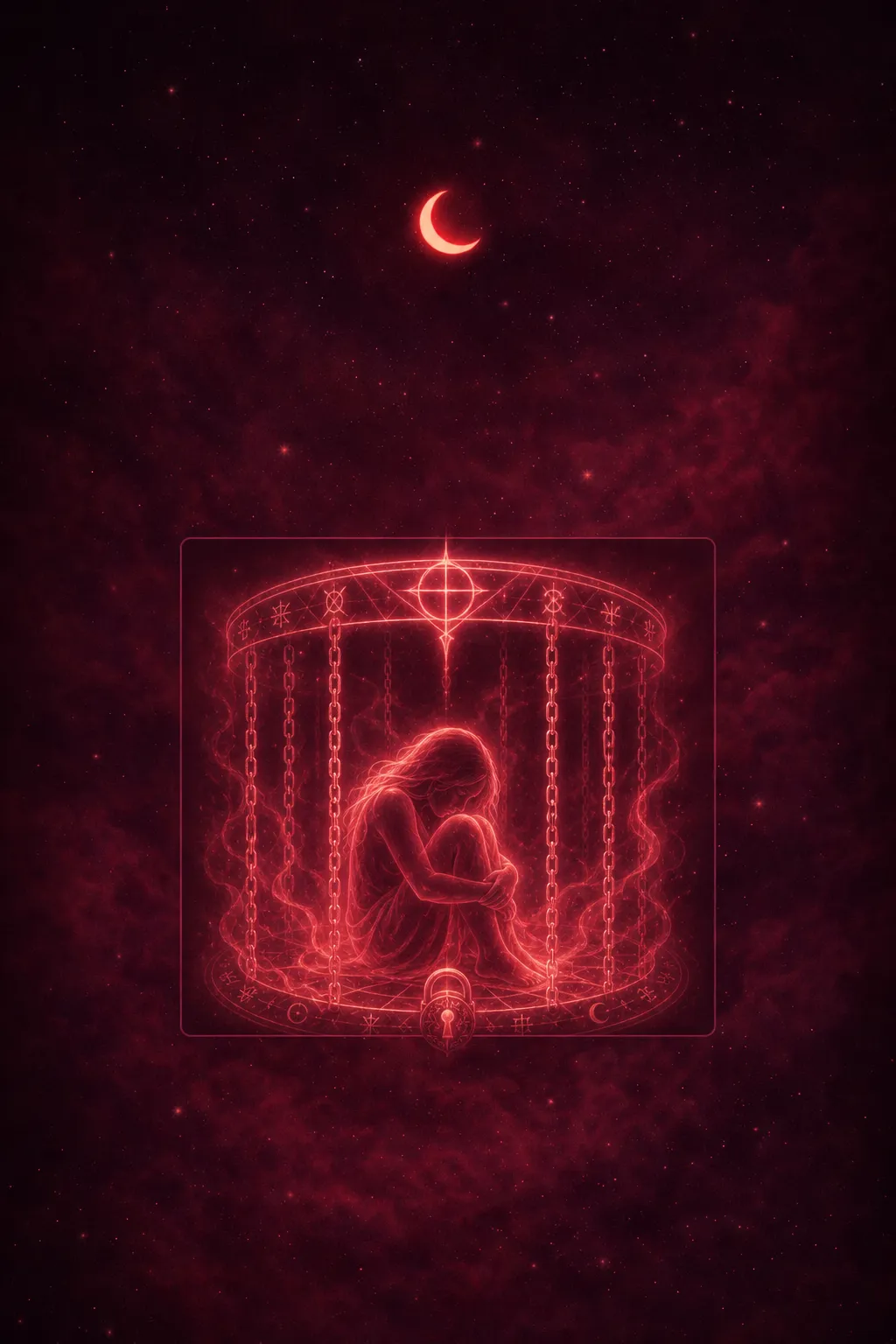

Dreaming about being trapped typically reflects feelings of helplessness, anxiety, or being stuck in a real-life situation—such as a relationship, job, or personal struggle—where you feel unable to move forward, much like dreams of being chased, and you cannot escape pressure or reclaim control over your own choices and direction.
In under a minute you could read what your exact dream means for you, and see a picture of it. Free.
Bad dream? See exactly what you dreamed — turned into a picture.
Just describe it and Dream Book paints your dream as a real image, plus a reading of what it means for you. Free, and it takes under a minute.


A dream still on your mind? Get your personal reading.
Describe your dream in a line or two. In seconds you get a reading of your exact dream, a picture drawn from your own words, and every symbol explained.
Free. No sign-up. Takes 10 seconds. Your dream stays private.
0%
Analyzing your dream…
Something went wrong. Please try again in a moment.
Your dreams deserve more than a dictionary
Common Trapped Dream Scenarios and What They Mean
The specific shape of your confinement carries its own message. Being locked inside a building you cannot escape — doors that won't open, corridors that loop back — typically mirrors a job or relationship that once felt like shelter but now feels like a cage; your mind is actively searching for options it can't yet find. A smaller, tighter space — a box, a cage, a shrinking room — intensifies that signal, pointing to a particular area of life where pressure has built to the point of feeling suffocating. When your dream fixates on a locked door, the focus sharpens further: something specific is being withheld, or a choice is being blocked, either by outside forces or by your own hesitation.
- Body frozen, limbs won't move: Classic decision paralysis — you feel overwhelmed and your agency has stalled. Note that this can also overlap with sleep paralysis, a physical phenomenon, so context matters.
- Trapped underground or in a collapsing tunnel: Buried anxieties or emotions you've been suppressing are pressing upward; circumstances feel smothering at a deeper level than day-to-day stress.
- Held captive by a person: Points toward a controlling relationship or authority figure; your sense of autonomy feels genuinely violated.
- Rising water closing in: Emotions are mounting faster than you can manage them, with a strong undercurrent of time pressure.
- Trapped in a maze, keep looping: Rumination and repeated failed attempts to resolve the same problem — a sign that a fresh perspective, not more effort, may be what's needed.
- Trapped in a car or elevator: Life's forward momentum feels stalled or out of your hands entirely.
- Glass wall or invisible barrier: You can see the life or connection you want but feel cut off from it — a loneliness of proximity.
- Trapped, then finding a way out: The most encouraging variant. It suggests your mind is actively working toward resolution and your sense of control is beginning to recover.
A bad dream isn't a bad sign.
Across all these variants, the unifying thread is the gap between where you are and where you feel you should be able to go. Tracking which setting recurs most often can help you identify the specific waking-life pressure — a relationship, a career, a habit, an unspoken obligation — that most needs your attention.
What this dream could look like
Tap an image to open it full screen
Example images. Only you can see what you write in Dream Book.
What Your Mind Is Really Processing
From a psychological standpoint, dreaming of being trapped is your subconscious sending up a distress flare about a waking situation where you feel you have run out of choices. Mainstream psychology frames it as a stress-response: when the pressures of work, finances, or a difficult relationship push your sense of control to its limit, the sleeping brain translates that pressure into a vivid physical image — locked walls, shrinking rooms, immovable obstacles. The emotion you wake with — anxiety, frustration, helplessness — is not random noise; it is an accurate readout of feelings you may have been suppressing during the day. Much like dreams of being chased, confinement imagery tends to intensify whenever avoidance of a real-life problem reaches a tipping point.
At a deeper level, the dream often points to an internal conflict between what you desire and what you feel obligated to do. Guilt and resentment are particularly common culprits: you may feel morally or relationally "trapped" long before the dream appears. In a broadly Christian cultural frame, this can surface as a conviction that leaving a situation — a marriage, a caregiving role, a community — is simply not permitted, even when it is causing genuine harm. The dream does not pass judgment; it simply makes the tension impossible to ignore. A recurring locked-door dream is frequently the mind's way of insisting that a decision you have been avoiding can no longer be postponed.
But what does your version mean?
- Perceived lack of options: your mind is rehearsing escape routes it has not yet found in waking life.
- Decision paralysis: avoidance of a hard choice often converts into literal immobility in dreams.
- Unresolved emotion: guilt or resentment can act as invisible walls, keeping you psychologically confined.
- Modern overload: chronic stress from always-on work culture is a leading trigger for confinement imagery.
General meanings end here. Read your own dream.
Describe your dream in a line or two. In seconds you get a reading of your exact dream, a picture drawn from your own words, and every symbol explained.
Free. No sign-up. Takes 10 seconds. Your dream stays private.
0%
Analyzing your dream…
Something went wrong. Please try again in a moment.
Your dreams deserve more than a dictionary
Every dream you log starts to connect.
Dream Book keeps your dreams in one place and reveals the threads between them over time — your private dream journal. Free to start.
Cultural and Traditional Readings of Being Trapped
Across Western folk tradition, dreams of confinement have long been read as warnings rather than random noise. In older English and American frontier culture, waking up from a trapped dream was often taken as a sign to pause before signing a contract, entering a partnership, or making a major move — the body, people believed, knew things the conscious mind had not yet admitted. That instinct maps neatly onto the modern-anxiety framing: in an era of economic pressure and relentless obligation, the sleeping mind stages a literal version of the invisible walls many people feel closing in during waking hours.
Within the US Christian tradition, entrapment imagery carries a modest but meaningful resonance. Scriptural themes of bondage and liberation — from Exodus to Paul's letters on spiritual freedom — give many believers a ready framework: a trapped dream can prompt honest self-examination about whether a current path aligns with one's values, and whether fear or pride is blocking a necessary change. This is less a prophecy than a prompt toward self-knowledge. A dream of a locked door sits in the same symbolic family, reinforcing the sense that an exit exists but something internal is keeping it shut. Similarly, dreams of being chased share this same undercurrent of inescapability, suggesting the psyche is rehearsing its response to pressure it cannot yet outrun.
- Folk warning tradition: confinement dreams signal a real-life situation that needs confronting, not avoiding.
- Control and agency: culturally, the dreamer is rarely seen as powerless — the trap is understood as temporary and escapable with deliberate action.
- Modern stress culture: therapists and popular wellness writers increasingly treat these dreams as the psyche's pressure valve, a culturally normalized signal to reassess overcommitment.
Spiritual Meaning of Being Trapped in a Dream
Within a broadly Christian spiritual framework, confinement imagery in dreams has long pointed to what Scripture calls bondage — not merely a physical state but a condition of the soul. Psalm 142:7 pleads, "Bring my soul out of prison," treating inner captivity as a genuine spiritual reality, while Galatians 5:1 urges believers to stand firm in freedom and refuse to return to a yoke of bondage. If your dream of being held in a prison leaves a heavy spiritual weight on waking, many in the US Christian tradition would read that as an invitation to examine whether guilt, resentment, or an unconfessed burden is functioning as a hidden stronghold — holding you in place even when no external wall exists. John 8:36 offers the counter-promise: genuine freedom is available, but it requires honest self-examination first. Notably, dreamers who report standing before a locked door they cannot open often describe the same suffocating spiritual heaviness, suggesting the imagery and its deeper meaning run closely together.
Was yours a sign? Find out.
From a modern-anxiety perspective, this spiritual reading complements rather than replaces the psychological one. The feeling that something larger than circumstance has you locked down — that your choices have somehow been taken from you — can signal a crisis of meaning as much as a crisis of control. Spiritually oriented dreamers often find it useful to ask not just what is trapping them, but why they have stayed. Whether framed as a stronghold, a karmic pattern, or simply an unexamined obligation, the dream invites the same courageous self-knowledge: name what holds you, and you begin to loosen its grip.
Related Dream Meanings
common dreams
Locked Door Dream Meaning: Blocked Desires & Hidden Fears
5 min read

common dreams
Water Dream Meaning: Emotions, Intuition & Growth
5 min read

nightmares
Being Chased Dream Meaning: Anxiety & Avoidance
5 min read
nightmares
Prison Dream Meaning: Confinement, Freedom & Inner Struggle
5 min read

nightmares
Dead Father Meaning - Symbolism & Interpretation
6 min read

nightmares
Killing Someone Dream Meaning: Repression & Change
5 min read

nightmares
Car Accident Dream Meaning: Loss of Control & Fear
5 min read

nightmares
Can't Wake Up Dream Meaning: Trapped & Overwhelmed
5 min read
Practical Steps When Trapped Dreams Keep Recurring
Because these dreams track closely with waking feelings of powerlessness, the most useful first move is a simple pressure audit. Write down the area of life that felt most suffocating in the 48 hours before the dream — work deadlines, a relationship dynamic, a financial bind — and ask honestly whether you have been avoiding a decision there. Often the dream stops recurring once you acknowledge the real-world constraint and take even a small, concrete step toward addressing it. If the imagery shifts to being chased, that is usually a signal the avoided pressure is escalating rather than resolving.
- Name the cage. Journal the specific situation draining your sense of control. Vague stress is harder to act on than a labeled one.
- Find one exit, however small. Trapped feelings thrive on the belief that no options exist. Brainstorm three micro-actions — a conversation, a boundary set, a task delegated — to prove yourself wrong.
- Check for avoidance patterns. If a locked-door dream is a fixture of your nights, consider whether a habit of putting off hard conversations is keeping you stuck during the day.
- Use the anxiety as data, not diagnosis. The discomfort is your mind flagging that something needs attention, not proof that you are permanently without choices.
A bad dream isn't a bad sign.
If the dreams persist despite self-reflection, speaking with a therapist — particularly one familiar with cognitive approaches to anxiety — can help you untangle whether guilt, resentment, or long-standing obligation is the deeper lock that needs addressing.
If it keeps coming back, the app helps you understand the pattern.
Log each recurring dream and the free app shows you what's underneath — calmly, over time. Free to start.
People Also Ask
Dreams of being trapped often reflect real-life feelings of helplessness, stress, or being stuck in a situation you cannot easily escape — a job, relationship, or obligation. Your subconscious uses this imagery to signal that something in your waking life feels restrictive and that you may need to seek change or reclaim control.
This experience is sometimes called a 'confinement dream' or 'entrapment dream.' When paired with an inability to move, it may overlap with sleep paralysis, a phenomenon where the body remains temporarily immobile during waking. Both experiences feel intensely real and are commonly linked to anxiety or high stress levels, much like dreams about falling.
Being unable to escape a place in a dream typically symbolizes feeling cornered or overwhelmed in real life. It may reflect a difficult decision, a toxic environment, or a personal limitation holding you back. The specific location — a room, building, or maze — can offer further clues about which area of life feels most restricting, similar to being-chased dreams.
The feeling of being trapped in a dream is your mind's emotional response to pressure, fear, or lack of freedom in your waking world. Unresolved conflict, looming deadlines, or suppressed emotions can all trigger this sensation. It is your subconscious urging you to confront what is keeping you confined and to take meaningful action.
Curious what your dream would look like?