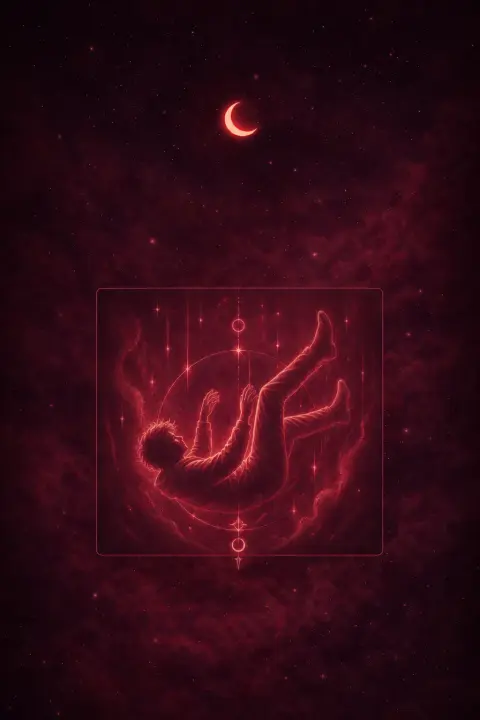
Dream interpretation means reading the images, emotions, and half-formed stories your mind puts together while you sleep, and asking what they point to. The idea is simple. A dream is rarely random static. Something you felt or left unfinished during the day comes back at night wearing a disguise, and interpretation is how you lift the disguise. You look at the symbols, you notice the mood you woke up in, you set both against what is actually going on in your life. No single method has the whole answer. Even so, psychology, neuroscience, and centuries of spiritual practice keep landing on the same quiet point. Your dreams are worth listening to.
It is 3 a.m. and your heart is going like a drum. The dream is already slipping away, but some part of you is certain it mattered. That instinct is not silly. It is your mind doing the thing it never really stops doing, which is trying to make sense of what you have lived through, even after you have turned off the lights.
People have read dreams as prophecy. They have read them as therapy, as the whisper of the unconscious, and as nothing more than the brain tidying up overnight. Each of those readings is holding a real piece of the thing. Take a dream about the stomach-drop of falling. A neuroscientist can explain it, a Jungian analyst can unpack it, and it can still feel spiritually loaded to the person who lived through it. These views are not in a cage match. They are separate lenses pointed at one odd, vivid image.
A few symbols turn up so stubbornly, in so many places and eras, that they have collected their own long history of interpretation. The sense of being chased through a dream shows up in Calvin Hall's study of tens of thousands of dream reports. It shows up in Freud's case notes. It shows up in the writings of Ibn Sirin in the 8th century. When one image travels that far without changing shape, it is telling you something deeply human. And that is really where interpretation starts. Not with a fixed dictionary you obey, but with a question. What does this symbol mean to you, weighed against everything it has meant to everyone before you?
Freud thought your dreams were a smuggling operation. Everything you will not let yourself want while awake gets past the guard at night, though it still has to travel in costume so you do not jolt upright in shock. He called it wish fulfillment. The sleeping mind loosens its grip on the censor just enough for a buried desire to slip through, wrapped in a symbol. To Freud, a snake moving through your dream was never only a snake. It was desire itself, coiled up and coded, asking to be seen.
Jung took that same raw stuff and opened it out. Where Freud found private shame pushed down out of sight, Jung found a door into the collective unconscious, a shared layer of the mind that runs underneath all of human history. The figures who wander through your dreams belong to that layer. The shadow stalking you down a hallway, the wise stranger, the trickster, these are archetypes. They did not come from your childhood photo album. They are far older than you. For Jung, dreaming was the psyche coaxing you toward what he called individuation, a slow process of becoming more whole by reclaiming the parts of yourself you had disowned.
Ernest Hartmann approached the whole thing from somewhere else. To him a dream works like emotional processing done overnight. The sleeping brain grabs the feeling at the heart of something recent and hooks it up to older memories that carry a similar charge. This is why dreams about your teeth crumbling and falling out almost never arrive on a peaceful Tuesday. They gather around stretches of real anxiety, because the dreaming mind is busy working the feeling through rather than just pressing replay.
Calvin Hall spent decades gathering dream reports, more than fifty thousand of them, and that pile of data gave the theory some solid floor to stand on. He found that dreams are usually more ordinary than people expect, closer to daily life than to surrealism. The themes that keep recurring, falling or being chased or losing your grip on things, tracked closely with the worries people brought to bed with them. In Hall's reading, a dream is a direct continuation of how you think while awake. The symbols are personal. They grow out of your particular life instead of floating somewhere above it.
Every dream speaks in symbols
Snakes, teeth, water, a locked door. Look up what yours are trying to say.
What Cultures and Faith Traditions Made of the Night
Long before sleep labs existed, people already treated dreams as messages that deserved decoding. Ancient Egyptians would sleep on sacred ground, hoping a god might come speak to them in the dark. Early Christians argued for centuries over whether a dream carried a warning from heaven or a lure from somewhere lower. Across North America, many Indigenous traditions saw the dream world as a real place you could walk into on purpose and return from carrying knowledge for your community. One conviction runs under all of it. What happens behind your closed eyes is not empty. It is saying something.
Ibn Sirin, the eighth-century Islamic scholar, assembled one of the most detailed dream systems ever put on paper, and there is a strange precision to it even now. He read a snake in a dream as a hidden enemy, someone near you whose real intentions stay concealed. The nastier the snake behaves, the more urgent the warning. Context carried enormous weight for him. A snake you manage to kill points to a conflict you will come out of on top, while a snake that sinks its teeth into you suggests the betrayal is already underway. If you want to sit with that image longer, the meaning behind dreaming of snakes runs deep across many cultures and carries far more than Ibn Sirin's reading on its own.
Western folk custom used dreams in its own way. Medieval Europeans kept dream almanacs much the way people today keep horoscopes, plain-language guides for ordinary folk trying to read the omens in their sleep. To fall in a dream was widely taken as a sign of a moral or social slip, a nudge to steady your footing while awake. In Chinese and Japanese folk belief the emphasis landed somewhere different, on the emotional tone of the dream more than its literal picture. A frightening scene that somehow felt calm meant one thing. A gentle image soaked through with dread meant something else completely. In every one of these traditions the feeling you carry out of sleep is treated as part of the message rather than a leftover.
There is also a Dream Book app
It reads your own dream in full and keeps the ones that matter. You can see how it works.
Your dreaming mind loves a pattern. When one image keeps coming back, a snake in the corner, water climbing past your ankles, a mirror that refuses to show your face, that image is turning into a symbol. Not a mass-produced universal one, but a private shorthand your unconscious picked because it holds exactly the right emotional weight for you and no one else.
Snakes make a good test case. Freud tied them to desire and to whatever we shove out of conscious view. Jung read the snake as the Shadow Self coming up for air, the old instinctual part of the psyche demanding a hearing. Ibn Sirin, back in the 8th century, often read it as a hidden enemy. Every one of these is plausible. None of them lands on your dream automatically. If you grew up with a corn snake curled in a tank on your desk, the snake in your dream is probably no threat whatsoever. It might be comfort. It might be plain curiosity, or the memory of something you once loved. Our guide on what it means to dream of snakes lays out the whole spread of what that image can hold, so you can find the reading that fits your actual life.
The same rule holds for something as bodily as the teeth falling out dream. Calvin Hall combed through tens of thousands of reports and found this among the most frequently recurring images anywhere. The raw frequency is striking. Yet the meaning still shifts with the dreamer. For one person it shows up during interview season, all of it about how they think they come across to others. For another it follows a loss, a felt sense of something gone that will not be coming back.
This is exactly why a symbol dictionary is a place to begin and never a final ruling. The image hands you a question. Your own associations, your history, the mood you woke up holding, those are what turn a generic symbol into an answer that is genuinely yours.
How to Read Your Own Dream
No outside source can just hand you the finished meaning. The symbols in your dream get filtered through your memories, your worries, your very specific Tuesday afternoon. What you can do is slow down, pay real attention, and ask better questions. Here is a process that holds up in practice.
Write it down inside the first five minutes. Dreams evaporate fast. Keep a notebook or your phone on the nightstand and grab the raw details before your waking mind starts quietly editing the whole thing into a version that makes tidier sense. Fragments are completely fine. A single feeling scrawled in awful handwriting beats a polished summary written an hour later.
Catch the emotion before the plot. The storyline of a dream is often just the delivery van. The real cargo is how you felt while you were inside it. Were you terrified, relieved, oddly at peace? That emotional texture is the thing your mind is genuinely working on, and it points to the waking issue more directly than any object ever will.
Find the one image that will not leave. Something always lingers after the rest fades. A face, a room, a specific object on a table. That image is hardly ever random. Sit with it and ask where it turns up in your waking life. What does it remind you of? Let the association surface on its own instead of forcing it.
Look the symbol up, then run it through your life. General meanings give you a foothold. If you dreamed of falling, reading about what falling in a dream usually points to can surface an angle you had not considered. Always hold that meaning up against your current situation, though. The symbol means what it means because of you, not in spite of you.
Ask what is actually happening in your life right now. Ernest Hartmann's research showed that dreams tend to process the feelings attached to whatever is weighing on you most heavily. A looming deadline, a strained relationship, a decision you keep pushing to next week. The dream is seldom about the dream. It is nearly always about something real.
Watch for repeats across several nights. One dream is a single data point. A symbol or scenario that keeps returning is a conversation your mind is trying to start with you. If the same image comes back again and again, your inner life is waving a flag over something still unresolved.
Dreams that refuse to let go of you deserve more than a quick search bar. If a dream keeps resurfacing, or carries a weight you cannot quite put into words, Dream Book lets you describe what you went through in your own language and ask follow-up questions, so you can work out what it might mean for your particular situation.
I built Dream Book after years of wanting a dream resource that was both psychologically rigorous and actually readable. I have a background in product and technology, and I spend a lot of time studying how sleep science, depth psychology, and cultural symbolism overlap. Every interpretation on this site goes through my editorial review before it is published.
Dream interpretation is the practice of finding meaning in the images, feelings, and events that surface while you sleep. Every dream carries a personal layer, shaped by your own history and by what you want or fear. Dream Book helps you unpack that layer so the message lands in a way that fits your life rather than a generic template.
Can a dream interpretation actually be accurate?
That depends on how you use it. What a symbol means shifts with your personal history, your current mood, and the full context of the dream, so a one-size-fits-all answer rarely hits home. The reading that turns out to be accurate is the one that resonates with you, not the one that happens to match a dictionary entry.
Why do I keep having the same dream on repeat?
A recurring dream is usually your mind flagging something still unresolved. It might be a fear, a lingering conflict, or a need you have not addressed yet. These dreams tend to fade once you acknowledge whatever is driving them and start working it through. Think of the repetition as your inner self turning up the volume until you finally listen.
How do I interpret my own dreams?
Start by writing the dream down the second you wake up, and capture the emotions as carefully as the images. Then ask what each key element reminds you of in your waking life, because the connections are usually more personal than they are symbolic. Over time you will notice patterns, and those patterns show you how your mind digests your everyday world.
Does everyone really dream every single night?
Yes. Every person who sleeps moves through REM sleep several times a night, and that is when vivid dreaming happens. Plenty of people are convinced they never dream, but usually they are just waking up outside a REM window, so the memory fades within a couple of minutes. Keeping a notebook by the bed is the fastest way to start catching them before they slip off.