
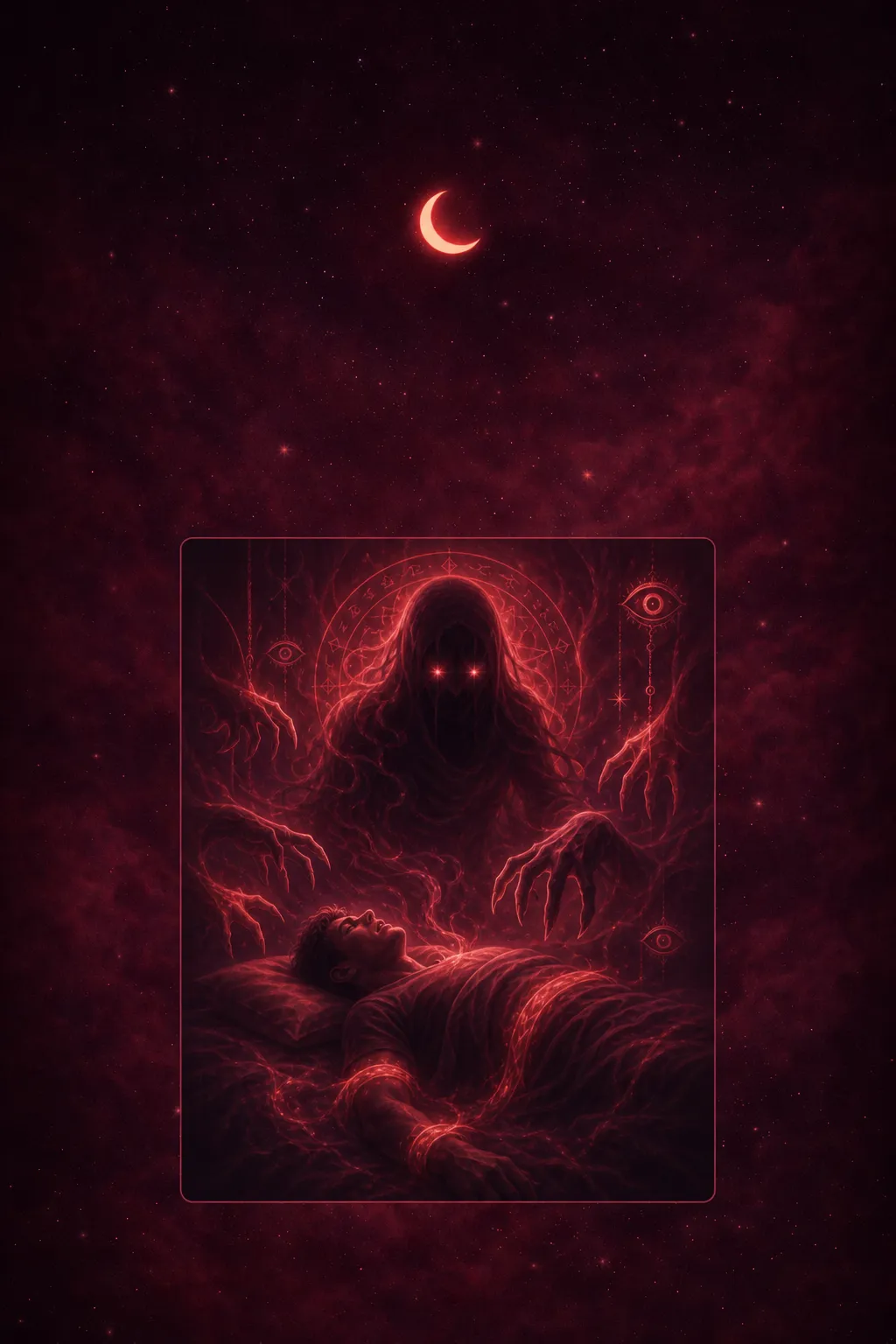

Sleep paralysis dreams often symbolize feelings of helplessness and anxiety. Understanding their meaning can provide insights into your emotional state.
In under a minute you could read what your exact dream means for you, and see a picture of it. Free.
Bad dream? See exactly what you dreamed — turned into a picture.
Just describe it and Dream Book paints your dream as a real image, plus a reading of what it means for you. Free, and it takes under a minute.


A dream still on your mind? Get your personal reading.
Describe your dream in a line or two. In seconds you get a reading of your exact dream, a picture drawn from your own words, and every symbol explained.
Free. No sign-up. Takes 10 seconds. Your dream stays private.
0%
Analyzing your dream…
Something went wrong. Please try again in a moment.
Your dreams deserve more than a dictionary
Common Sleep Paralysis Dream Scenarios
Dreaming of Being Attacked
Imagine lying in bed, unable to move, as a dark figure looms over you. This terrifying scenario often symbolizes feelings of vulnerability or fear in your waking life. Perhaps there’s a situation or relationship that feels oppressive, leaving you feeling trapped and unable to escape. In this state, you might also experience a sensation of weight on your chest or a pressure that feels all too real. The inability to cry out or defend yourself can reflect deep-seated anxieties, like being chased in your dreams, where the pursuer represents unresolved stress or obligations that seem relentless and inescapable.A bad dream isn't a bad sign.
Dreaming of Screaming but No Sound
You find yourself in a nightmare, desperate to call for help, yet no sound escapes your lips. This frustrating experience reveals your struggle to express yourself or communicate a vital truth in your life. It may echo feelings of isolation, where you feel unheard or dismissed. Freud emphasized the importance of repressed emotions in dreams, and this scenario could be a manifestation of your subconscious urging you to confront something you’re avoiding. If you often feel like you’re running but can’t move forward in your waking life, this dream speaks to that paralysis, both physically and emotionally.But what does your version mean?
Dreaming of Being Trapped
Picture a dark room with no way out, your heart racing as you realize you're stuck. The sensation of confinement in your sleep can mirror feelings of entrapment in a situation or relationship. Maybe it’s a job that stifles your creativity or a personal connection that drains your spirit. Carl Jung would see this as an invitation to confront your Shadow Self—the parts of you that you might be avoiding or denying. Feeling trapped in a dream can also resonate with the experience of feeling like you’re drowning in your waking life, where the weight of responsibilities feels overwhelming.What this dream could look like
Tap an image to open it full screen
Example images. Only you can see what you write in Dream Book.
Psychological Interpretation
Freud believed sleep paralysis dreams often stem from repressed desires and fears, manifesting as a struggle between your unconscious mind and your waking anxieties. He viewed these dreams as a way for your subconscious to express what you might be pushing aside in your daily life. The tension often reflects internal conflicts, where your desires clash with societal or personal restrictions. Jung expanded this understanding by suggesting that these dreams might reveal vital aspects of your psyche—the Shadow lurking in the corners of your mind. Your experience of paralysis may symbolize aspects of yourself that you are not fully acknowledging, urging you to integrate these parts for personal growth. Calvin Hall’s analysis of dream reports showed that nightmares, including sleep paralysis, often relate to real-life stressors. His findings indicate that recurring themes in dreams can provide insight into your emotional state, where the sensation of being trapped aligns with feelings of helplessness in waking life. Ernest Hartmann viewed dreams as a means of processing emotional memories, and your sleep paralysis could indicate unresolved feelings that your mind is struggling to process. Hobson and McCarley proposed the activation-synthesis hypothesis, which suggests that dreams are the brain's way of making sense of random neural firings. In this light, your sleep paralysis might be your mind's attempt to weave together emotional fragments, echoing the fears and anxieties that linger beneath the surface.General meanings end here. Read your own dream.
Describe your dream in a line or two. In seconds you get a reading of your exact dream, a picture drawn from your own words, and every symbol explained.
Free. No sign-up. Takes 10 seconds. Your dream stays private.
0%
Analyzing your dream…
Something went wrong. Please try again in a moment.
Your dreams deserve more than a dictionary
Every dream you log starts to connect.
Dream Book keeps your dreams in one place and reveals the threads between them over time — your private dream journal. Free to start.
Cultural & Spiritual Meaning
Culturally, sleep paralysis has been interpreted in various ways. In Western contexts, it’s often seen as a medical phenomenon, a product of disrupted sleep cycles. However, in many Indigenous cultures, it might be viewed as a spiritual encounter, where the dreamer is believed to be caught between realms, experiencing a visitation from spirits or entities. In Islamic tradition, Ibn Sirin offered nuanced interpretations of sleep paralysis. He might suggest that being unable to move or speak in your dream could symbolize a cautionary message or an indication of feeling oppressed by external forces. He emphasized the importance of understanding the emotional context of such dreams, as they often reveal deeper truths about one’s life circumstances. From an Eastern perspective, sleep paralysis can also symbolize an imbalance in one’s life energy. It may suggest that you need to realign yourself, perhaps through meditation or mindfulness practices. The shared thread across cultures is the recognition of these dreams as significant, often pointing to inner conflicts or spiritual awakenings that beckon your attention.Related Dream Meanings

nightmares
Paralyzed Dream Meaning: Powerlessness & Feeling Stuck
5 min read

nightmares
What Does It Mean When You Dream About Being Possessed
6 min read

nightmares
What Does It Mean to Dream About a Witch
6 min read

nightmares
What Does Dreaming About Past Life Mean - Dream Interpretation
5 min read

nightmares
Invisible Dream Meaning: Vulnerability & Hidden Freedom
5 min read

nightmares
Skull Dream Meaning: Transformation, Fear & Change
5 min read

nightmares
Skeleton Dream Meaning: What It Reveals About Your Inner Self
5 min read

nightmares
What Does It Mean to Dream About Being Stalked
5 min read
What to Do After This Dream
Experiencing sleep paralysis can be disorienting, but it also offers a chance for reflection. Take a moment to consider what aspects of your life feel constricting or overwhelming. Journaling about the emotions that surface can provide clarity and help you process what your subconscious is trying to reveal. If this dream keeps returning, it's worth exploring with a personalized interpretation — Dream Book lets you describe your dream and ask follow-up questions to understand what your subconscious is really saying. Engaging with these feelings can help you find your voice and reclaim your power. Understanding your sleep-paralysis dream is the first step. The next is asking what it means for your life right now — that's where a personalized interpretation goes deeper than any dictionary.If it keeps coming back, the app helps you understand the pattern.
Log each recurring dream and the free app shows you what's underneath — calmly, over time. Free to start.
People Also Ask
Sleep paralysis is a phenomenon where you find yourself unable to move or speak while falling asleep or waking up. It can often be accompanied by hallucinations and a feeling of pressure on the chest.
While sleep paralysis can be frightening, it is not considered dangerous. It usually lasts for a few seconds to a couple of minutes and is not harmful to your health.
Improving your sleep hygiene, such as maintaining a regular sleep schedule, reducing stress, and avoiding sleep deprivation, can help prevent sleep paralysis episodes.
Many people experience sleep paralysis at least once in their lives, and those who are prone to it may have recurrent episodes, often tied to stress or anxiety.
Curious what your dream would look like?