
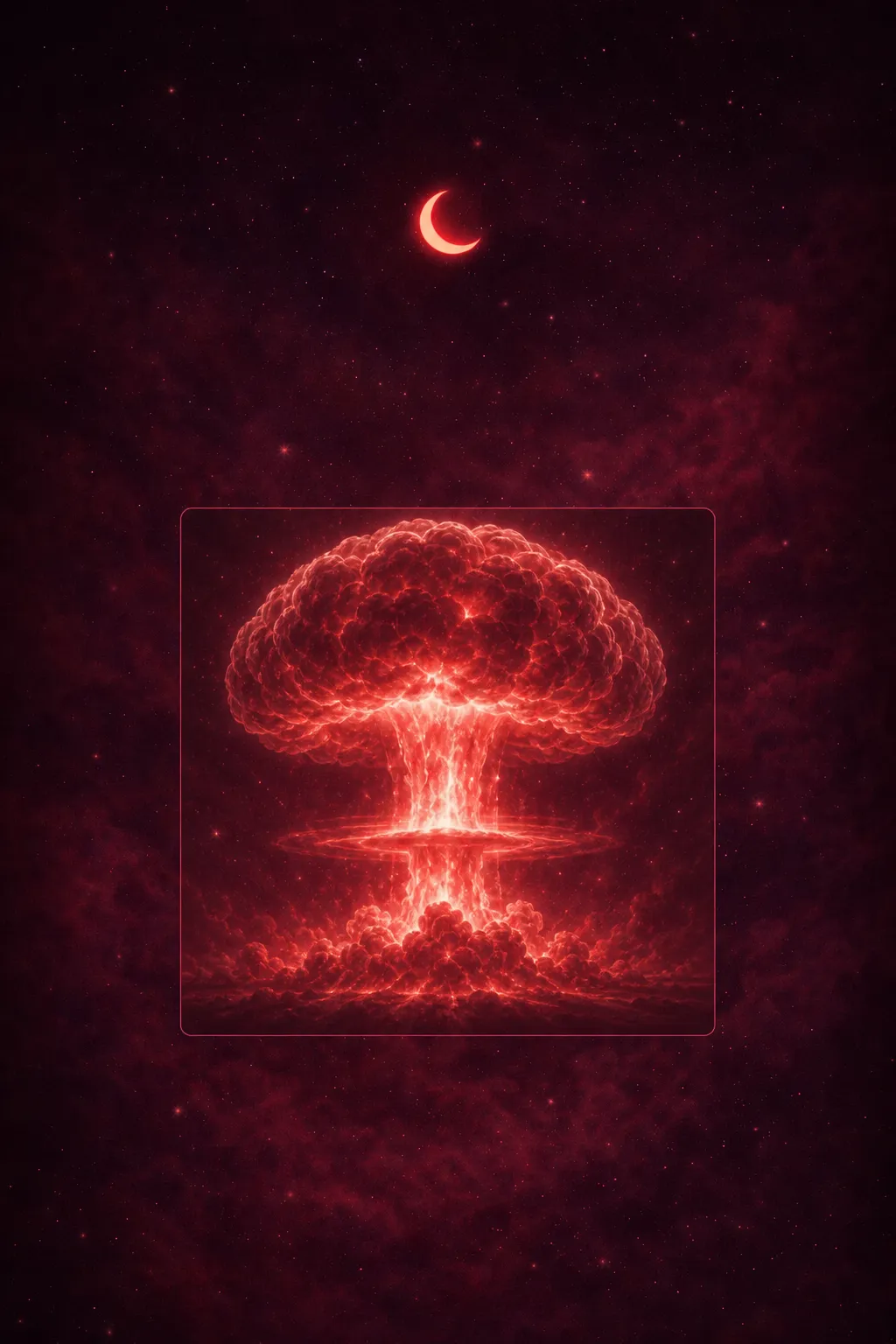

A nuclear explosion in a dream meaning points to overwhelming, sudden change or emotional devastation you fear—symbolizing feelings of powerlessness before forces beyond your control, a need to confront deep anxiety about catastrophic loss, radical transformation, or the collapse of something central to your life, urging you to address what feels dangerously unstable before it erupts.
In under a minute you could read what your exact dream means for you, and see a picture of it. Free.
A dream still on your mind? Get your personal reading.
Describe your dream in a line or two. In seconds you get a reading of your exact dream, a picture drawn from your own words, and every symbol explained.
Free. No sign-up. Takes 10 seconds. Your dream stays private.
Add who was there and how you felt, and the reading will be about your dream.
0%
Analyzing your dream…
Something went wrong. Please try again in a moment.
Your dreams deserve more than a dictionary
Common Nuclear Explosion Dream Scenarios
The specific shape a nuclear explosion takes in your dream carries its own meaning. The most frequently reported variant — watching a distant mushroom cloud rise on the horizon — tends to reflect a waking sense of helplessness: you can see trouble coming but feel entirely outside its control. This is a classic modern-anxiety image, often surfacing when world news feels relentless or when a destabilizing situation at work or home is unfolding just beyond your reach. A closely related scenario involves a countdown or warning siren before the blast, which psychologists associate with hypervigilance and anticipatory dread — your mind signaling that something in your daily life is quietly building toward an unavoidable breaking point.
- Surviving the fallout: Wandering through a ruined landscape after the explosion points to resilience tested by upheaval already underway — fear not of the event itself but of lasting, invisible damage it leaves behind.
- Shielding loved ones from the blast: Throwing yourself over family or friends reflects acute responsibility anxiety — the distressing sense that you may not be able to protect the people who depend on you.
- The blinding flash or instant vaporization: Rather than catastrophe, this can symbolize a sudden, total ending — the psyche rehearsing an abrupt change or, from a biblical perspective, confronting mortality and the fragility of everything familiar.
- Triggering the explosion yourself: This unsettling variant often surfaces alongside guilt or repressed anger, suggesting fear that your own choices could produce consequences far beyond what you intended — a powerful prompt toward honest self-reflection about destructive impulses.
What this dream could look like
Tap an image to open it full screen
Open a frame to see the details
Example images. Only you can see what you write in Dream Book.
The Psychological Reading: Pressure, Control, and the Breaking Point
From a psychological standpoint, dreaming of a nuclear explosion is the mind's most dramatic way of signaling that internal pressure has crossed a threshold. Much like dreaming of teeth falling out, it surfaces when the psyche registers a loss of control so severe that only a catastrophic image can contain it. Accumulated stress — workplace burnout, relationship strain, relentless news cycles saturated with real-world threat — compresses over time until the unconscious detonates it into a single overwhelming scene. The explosion isn't the danger itself; it is the emotional overload that has finally found a form.
A bad dream isn't a bad sign.
Psychologically, the blast often stands in for repressed anger or grief that the dreamer has been unwilling or unable to express consciously. The irreversibility of a nuclear event mirrors the dreamer's fear that certain decisions, losses, or conflicts have gone too far to be undone. This connects to a broader modern-anxiety pattern: a felt sense that external forces — economic instability, political upheaval, environmental change — are operating on a scale the individual simply cannot influence. The dream externalizes that helplessness, making the invisible weight of daily dread suddenly, terribly visible.
- Accumulated stress: Long-suppressed tension reaching an emotional breaking point.
- Loss of control: Fear that circumstances have moved beyond any personal ability to redirect them.
- Repressed anger: Rage or grief that has not been consciously acknowledged now detonating symbolically.
- Transformation threshold: Psychologically, destruction on this scale can also signal readiness for radical inner change — the old self dismantled before something new can be built.
Every dream you log starts to connect.
Dream Book keeps your dreams in one place and reveals the threads between them over time — your private dream journal. Free to start.


Cultural and Traditional Readings of Nuclear Explosion Dreams
Unlike ancient dream symbols rooted in centuries of folklore, the nuclear explosion is a distinctly modern image — one that entered the collective imagination only after the mid-twentieth century. Cold War culture embedded the mushroom cloud into public consciousness as the ultimate emblem of irreversible catastrophe, and that cultural imprint lingers. Dreaming of nuclear destruction today still carries that inherited weight: a visceral shorthand for a world gone permanently, irrevocably wrong. In broadly Christian-influenced Western culture, such imagery can brush up against apocalyptic tradition — echoes of Revelation's end-times fire and judgment — though most dreamers process it less as prophecy and more as a gut-level alarm about forces beyond personal control.
But what does your version mean?
Folk psychology in the English-speaking world has long held that disaster dreams function as pressure-release valves, and the nuclear explosion fits squarely into that tradition. Popular belief treats these dreams as the mind's way of dramatizing what waking life politely conceals: that something — a relationship, a career, a long-held sense of safety — is on the verge of collapse. Key cultural threads woven around this symbol include:
- The helplessness motif: Culturally, nuclear war represents the clearest example of a threat ordinary people cannot individually prevent, reinforcing feelings of powerlessness tied to modern anxiety.
- The news-cycle effect: Heavy exposure to global crisis coverage is widely acknowledged in popular culture as a trigger for catastrophe dreaming.
- A call to self-knowledge: Folk wisdom consistently reframes such nightmares as useful warnings — signals that something in waking life urgently needs acknowledgment before it truly detonates.
The Spiritual Reading: Judgment, Refining Fire, and the Search for Readiness
Within a US Christian frame, cataclysmic imagery has long carried a prophetic charge. Passages describing consuming fire, the shaking of heavens and earth, and sudden divine judgment — from the prophets through Revelation — give many believers a ready vocabulary for overwhelming destruction. Dreaming of a nuclear explosion can land inside that vocabulary, prompting a quiet interior question: Am I spiritually prepared for what feels irreversible? This is less a prediction of literal end-times events and more an invitation to self-examination — the dream using apocalyptic imagery the way a sermon might, to press the soul toward honest reckoning. Those who feel this resonance may find it worth sitting with, rather than dismissing it as mere anxiety.
Across broader spiritual traditions, sudden catastrophic imagery is often read as a threshold moment — the psyche and spirit together signaling that something old must be utterly cleared away before new ground can be found. Fire, even devastating fire, carries a long association with purification and transformation. Seen this way, the nuclear explosion in a dream need not be purely a symbol of dread; it may point toward a profound sense of ending that, spiritually, precedes renewal. The helplessness the dream evokes can serve as a nudge toward surrender — not passivity, but the recognition that some forces exceed personal control, and that faith or inner trust must carry weight where willpower alone cannot.
Related Dream Meanings

nightmares
Explosion in a Dream: Spiritual Meaning, Inner Turmoil
5 min read

body health
Teeth Falling Out Dream: Anxiety, Loss & Vulnerability
5 min read

nightmares
Dreaming of the Apocalypse: War, Zombies, Floods
5 min read

nightmares
What a Bomb Dream Means: Pressure Ready to Erupt
5 min read

nightmares
Dream of No Reflection in Mirror - Meaning and Interpretation
6 min read

nightmares
What Does It Mean to Dream About Rotten Food? Interpretation and Meaning
6 min read

nightmares
Eating Glass: Swallowing Something Painful
6 min read

nightmares
What Does It Mean to Dream About a Dark Forest
5 min read
Practical Takeaways: Turning a Nightmare Into a Wake-Up Call
When a nuclear explosion jolts you awake, the most useful first step is to treat the dream as a stress audit rather than a prophecy. Ask yourself honestly: where in your life has pressure been quietly building? Work deadlines, a fraying relationship, financial strain, or relentless doomscrolling can all accumulate below conscious awareness until the sleeping mind detonates them in spectacular fashion. Naming the specific source matters — vague anxiety is harder to address than a concrete stressor you can actually do something about.
Was yours a sign? Find out.
Once you've identified the pressure point, focus on the one variable most nuclear explosion dreams circle back to: control. You rarely need control over everything — you need to reclaim a foothold in at least one area. Consider these grounded steps:
- Reduce your news intake deliberately. Set a firm daily limit on consuming distressing headlines; ambient catastrophe coverage feeds exactly the kind of helplessness these dreams reflect.
- Write out your worst-case scenario. Spelling it out on paper often deflates its psychological charge and reveals which fears are manageable and which genuinely need a plan.
- Identify one small, concrete action you can take this week toward the stressor — even a minor move restores a sense of agency.
- Check your anger. If the explosion felt satisfying rather than terrifying, long-suppressed frustration may need a healthy outlet before it finds one on its own.
A bad dream isn't a bad sign.
If these dreams recur or leave you anxious well into the day, that pattern itself is worth raising with a therapist. Recurring catastrophic imagery is one of the cleaner signals that stress has moved beyond normal range and deserves direct, professional attention.
If it keeps coming back, the app helps you understand the pattern.
Log each recurring dream and the free app shows you what's underneath — calmly, over time. Free to start.
People Also Ask
Dreaming of a bomb explosion often reflects overwhelming stress, suppressed emotions, or a situation in your waking life that feels ready to blow up. It can signal that tensions — whether personal, professional, or emotional — have reached a breaking point and your mind is urging you to address them before they escalate further.
Dreams of being bombed typically represent feeling under attack in real life — perhaps by criticism, conflict, or circumstances beyond your control. They can also reflect collective anxiety about world events or personal vulnerability. Your subconscious may be processing a deep sense of threat or helplessness that you haven't fully acknowledged while awake.
A nuclear explosion in a dream symbolizes radical, irreversible change. It may point to a fear of total destruction — of a relationship, career, or identity — or a desire to wipe the slate completely clean. It can also represent the enormous, uncontrollable power of emotions or events that feel too vast to manage alone.
Dreaming of a missile attack often suggests you feel targeted or ambushed by someone or something in your life. It may reflect anxiety about a specific confrontation heading your way. The missile's precision symbolizes a direct, unavoidable threat, urging you to prepare emotionally or practically for a challenging situation you sense is approaching.
Curious what your dream would look like?