
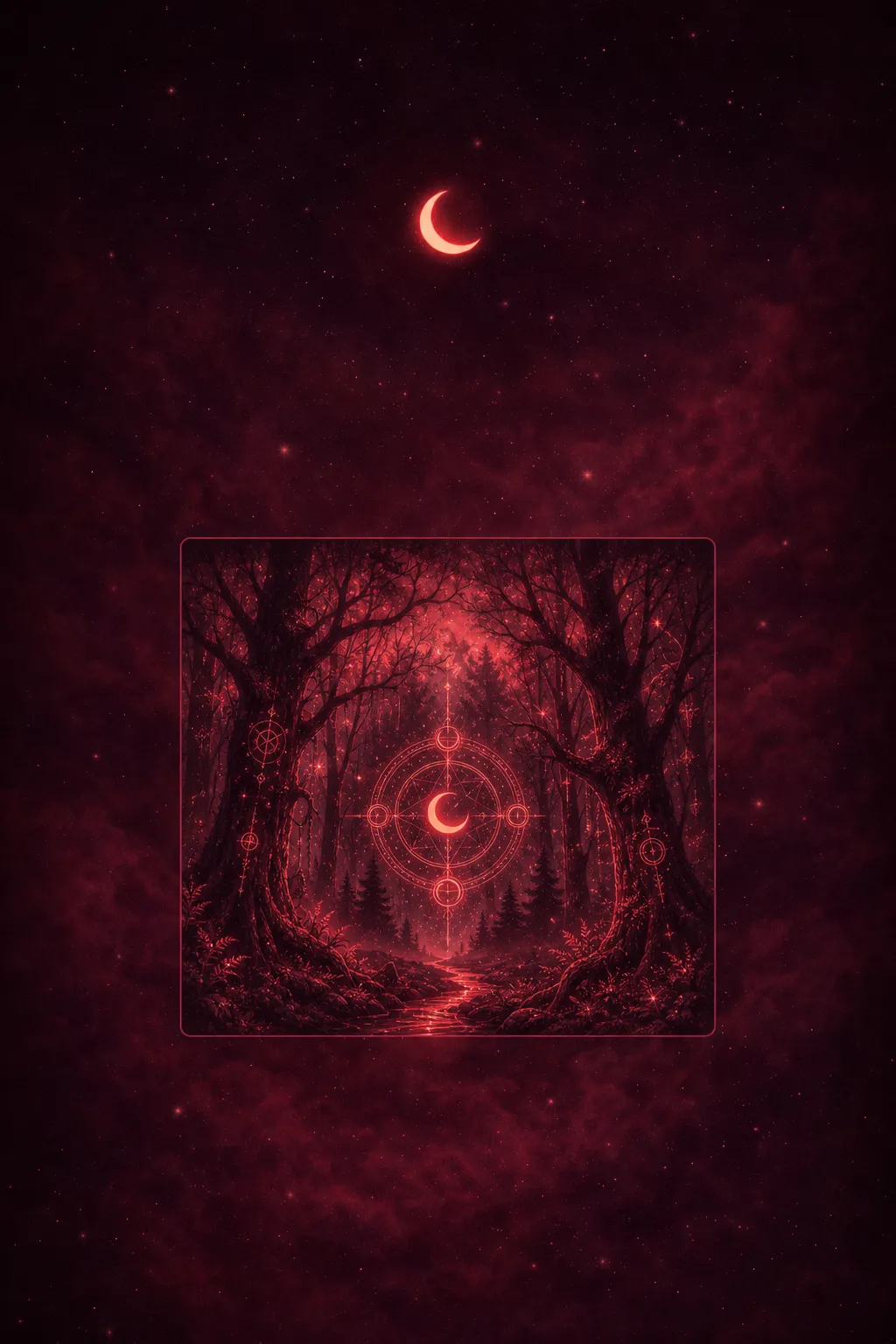

Dreaming about a dark forest typically means you are navigating uncertainty, fear, or the unknown aspects of your subconscious mind, where the dense, shadowy trees symbolize hidden emotions, unresolved challenges, or a transformative journey through confusion toward self-discovery and inner clarity.
In under a minute you could read what your exact dream means for you, and see a picture of it. Free.
Bad dream? See exactly what you dreamed — turned into a picture.
Just describe it and Dream Book paints your dream as a real image, plus a reading of what it means for you. Free, and it takes under a minute.


A dream still on your mind? Get your personal reading.
Describe your dream in a line or two. In seconds you get a reading of your exact dream, a picture drawn from your own words, and every symbol explained.
Free. No sign-up. Takes 10 seconds. Your dream stays private.
0%
Analyzing your dream…
Something went wrong. Please try again in a moment.
Your dreams deserve more than a dictionary
Common Dark Forest Dream Scenarios
The specific details of your dark forest dream shift its meaning considerably. The most frequently reported scenario — being lost with no way out — reflects real-life disorientation: a career crossroads, a relationship in flux, or the creeping modern sense that every path forward looks equally unclear. If you feel lost without direction in waking life, this dream is essentially your psyche filing a report. The call is not to panic but to slow down and reorient before pushing forward.
- Walking toward a light or clearing: You are mid-transition. Fear is present, but so is agency — the dream signals that movement through difficulty is already underway and resolution is ahead.
- Being chased or sensing something in the trees: An avoided anxiety or unresolved threat is demanding attention. The unseen pursuer rarely stays hidden forever; the dream is pressuring you to face it consciously.
- Finding a path or trail: Even without a full view, structure is emerging. This scenario reflects growing trust in a decision or guide, even when the destination remains out of sight.
- Alone vs. accompanied: A companion or guide alongside you points to an available support resource — a person, a faith, or an inner strength. Solitude underscores self-reliance, or a sense of carrying a burden without help.
- Darkness deepening, feeling trapped: Escalating overwhelm; a problem feels larger than your current resources can manage.
- Dark but calm and sheltering: Here the forest offers retreat rather than threat — a signal that withdrawal and quiet reflection are genuinely needed right now.
What this dream could look like
Tap an image to open it full screen
Example images. Only you can see what you write in Dream Book.
Psychological Meaning of the Dark Forest Dream
From a Jungian standpoint, the forest represents the unconscious mind, and its darkness signals contents that have not yet been brought into conscious awareness. When you dream of moving through a dark forest, your psyche is likely staging a confrontation with the shadow — the unacknowledged fears, desires, or unresolved conflicts you carry beneath everyday awareness. Rather than a threat to flee, this imagery is an invitation: the forest's depth is proportional to how much inner territory remains unexplored.
A bad dream isn't a bad sign.
Modern anxiety culture adds a sharper edge to this symbolism. Reduced visibility in the dream maps neatly onto the felt experience of losing control — over a career direction, a relationship, or a health concern — where every step forward feels unverified and risky. The crowding trees of a Gestalt reading reinforce this: surrounding pressures narrow perspective until forward movement feels impossible, mirroring decision-paralysis in waking life. In this sense, dreaming of being lost is the mind's honest diagram of its own overwhelm.
- Loss of control: darkness as a metaphor for life areas where clarity and agency feel out of reach.
- Threshold moment: the forest marks a developmental crossing between an old and a new identity or life stage.
- Shadow work: what lurks unseen may represent repressed emotion or an unacknowledged aspect of the self pressing for recognition.
- Cognitive load: the inability to map the terrain reflects real decision-fatigue or information overload.
Psychologically, passing through — rather than escaping — the dark forest is the transformative act. The dreamer who presses forward and reaches a clearing is symbolically integrating unconscious material, emerging with greater self-knowledge and a recalibrated sense of direction.
General meanings end here. Read your own dream.
Describe your dream in a line or two. In seconds you get a reading of your exact dream, a picture drawn from your own words, and every symbol explained.
Free. No sign-up. Takes 10 seconds. Your dream stays private.
0%
Analyzing your dream…
Something went wrong. Please try again in a moment.
Your dreams deserve more than a dictionary
Every dream you log starts to connect.
Dream Book keeps your dreams in one place and reveals the threads between them over time — your private dream journal. Free to start.
Cultural and Traditional Readings of the Dark Forest Dream
In Anglo-European folklore and fairy tale tradition, the dark forest has long served as the classic threshold between the ordinary world and the unknown. From Hansel and Gretel to Little Red Riding Hood, characters who enter the woods are tested, stripped of their bearings, and forced to rely on inner resources they did not know they had. The pattern is consistent: getting lost is not the end of the story but the beginning of transformation. Folk wisdom encoded in these tales treated the forest as a place where the familiar rules of village life stopped applying — a liminal zone where identity could be unmade and remade.
But what does your version mean?
A mild Christian undercurrent reinforces this reading. Scriptural imagery of wandering in the wilderness — from the Israelites in the desert to the valley of the shadow of death — frames disorientation as a precondition for faith, growth, and eventual clarity. The dark forest in a dream, seen through this lens, is less a punishment than a passage: you are between where you were and where you are meant to be.
- Modern anxiety framing: today the dark forest also maps onto the sense of information overload and loss of control that characterizes contemporary life — the feeling that the landscape is too complex to navigate confidently.
- Wilderness as relief and threat: culturally, untamed nature simultaneously promises escape from structured demands and triggers fear of the ungoverned, reflecting tension between the desire for freedom and the need for control.
- Self-knowledge angle: folk tradition consistently implies that only by moving through — not around — the dark forest can the traveler discover what they are truly capable of.
Spiritual Meaning of the Dark Forest Dream
Within a broadly Christian spiritual frame, the dark forest carries the weight of the biblical wilderness motif — those long, disorienting stretches of desert and shadow that precede breakthrough. Scripture repeatedly positions darkness not as abandonment but as formation: the Israelites wandered before they arrived, Jesus withdrew into the wilderness before his public ministry began. Psalm 23's image of walking through the valley of deep shadow while a shepherd's presence persists is perhaps the closest biblical parallel to dreaming of a darkness you cannot navigate alone. If your dream left you feeling guided despite the fear, many believers read that as spiritual reassurance — a reminder that orientation can be inward and faith-based even when external landmarks vanish.
Beyond explicitly Christian readings, many dreamers recognize in the dark forest what contemplative traditions call the dark night of the soul — a season of obscurity that strips away false certainty and forces a deeper kind of self-knowledge. In this view, the forest is not punishment but threshold: the disorientation is the point, clearing space for a renewal that clarity alone could never produce. Modern anxiety sharpens the experience — when daily life already feels like a loss of control, the dream amplifies that pressure into pure symbol — but the spiritual interpretation reframes it as purposeful passage rather than random suffering.
Was yours a sign? Find out.
- Testing before breakthrough: darkness as a necessary stage, not a dead end.
- Hidden guidance: the sense that something accompanies you even when unseen.
- Soul-level renewal: obscurity dissolving old certainties so new clarity can take root.
Related Dream Meanings
common dreams
Being Lost Dream Meaning: Confusion & Direction
5 min read
nightmares
Darkness Dream Meaning: Fear, Uncertainty & Hidden Self
5 min read
nightmares
Death Dream Meaning: Transformation, Loss & Change
5 min read
nightmares
Being Chased Dream Meaning: Anxiety & Avoidance
5 min read
nightmares
Drowning Dream Meaning: Overwhelm, Fear & Hidden Stress
5 min read
nightmares
Dying Dream Meaning: Transformation, Fear & Change
5 min read
nightmares
Someone Dying Dream Meaning: Change & Fear of Loss
5 min read
nightmares
Dead Person Dream Meaning: Closure & Unresolved Loss
5 min read
What to Do After a Dark Forest Dream
Rather than waiting for the symbolism to resolve itself, treat the dream as a prompt for concrete reflection. Start by identifying the specific area of your waking life that feels most unmapped right now — a job decision, a relationship you haven't addressed, a habit you keep avoiding. Dreams of feeling lost tend to intensify when real uncertainty goes unacknowledged, so naming the source out loud (or in writing) already reduces its grip.
From a modern-anxiety standpoint, the dark forest often appears when you're trying to control outcomes that genuinely can't be controlled yet. A useful counter-move is to separate what you can act on from what you simply need to tolerate. Try this after a dark forest dream:
- Journal the emotional texture: Were you panicked, curious, resigned? That emotional tone often mirrors how you're actually coping with your current uncertainty.
- List one small, concrete step you've been postponing in the area of life that feels most like uncharted territory.
- Limit information overload: Anxiety-driven research into every possible outcome deepens the psychological "forest." Set a boundary on how long you spend analyzing the uncertain situation each day.
- Talk it through: A trusted friend, counselor, or pastor can serve as a figurative torch — not solving the path, but making it feel less isolating.
A bad dream isn't a bad sign.
Self-knowledge grows incrementally at the forest's edge. The dream isn't demanding that you solve everything overnight; it's signaling that the next step — even a small one — is overdue.
If it keeps coming back, the app helps you understand the pattern.
Log each recurring dream and the free app shows you what's underneath — calmly, over time. Free to start.
People Also Ask
A dark forest typically symbolizes the unknown, fear, or unresolved emotions lurking in your subconscious. It can represent feeling lost, overwhelmed, or uncertain about your path in life. The darkness amplifies feelings of isolation or hidden anxieties, urging you to confront what you have been avoiding in your waking life.
Forests in dreams broadly represent the subconscious mind, personal growth, and life's journey. A lush forest can signal abundance and self-discovery, while a dense or tangled one suggests confusion and emotional complexity. Forests often reflect your inner world, including instincts, hidden desires, and the parts of yourself you have yet to fully explore.
Fully lucid dreams where the dreamer controls the entire narrative are considered among the rarest experiences. Precognitive dreams that appear to predict real events are also exceptionally uncommon. Most people report these only a handful of times in their lives, making them memorable and often deeply meaningful to those fortunate enough to experience them.
A spiritually significant warning dream often feels unusually vivid, emotionally intense, and impossible to forget upon waking. Recurring themes, clear symbolic messages, or a profound sense of urgency are common signs. Many people report feeling a deep inner conviction that the dream carried meaning beyond the ordinary, prompting them to reflect carefully on their current choices.
Curious what your dream would look like?