
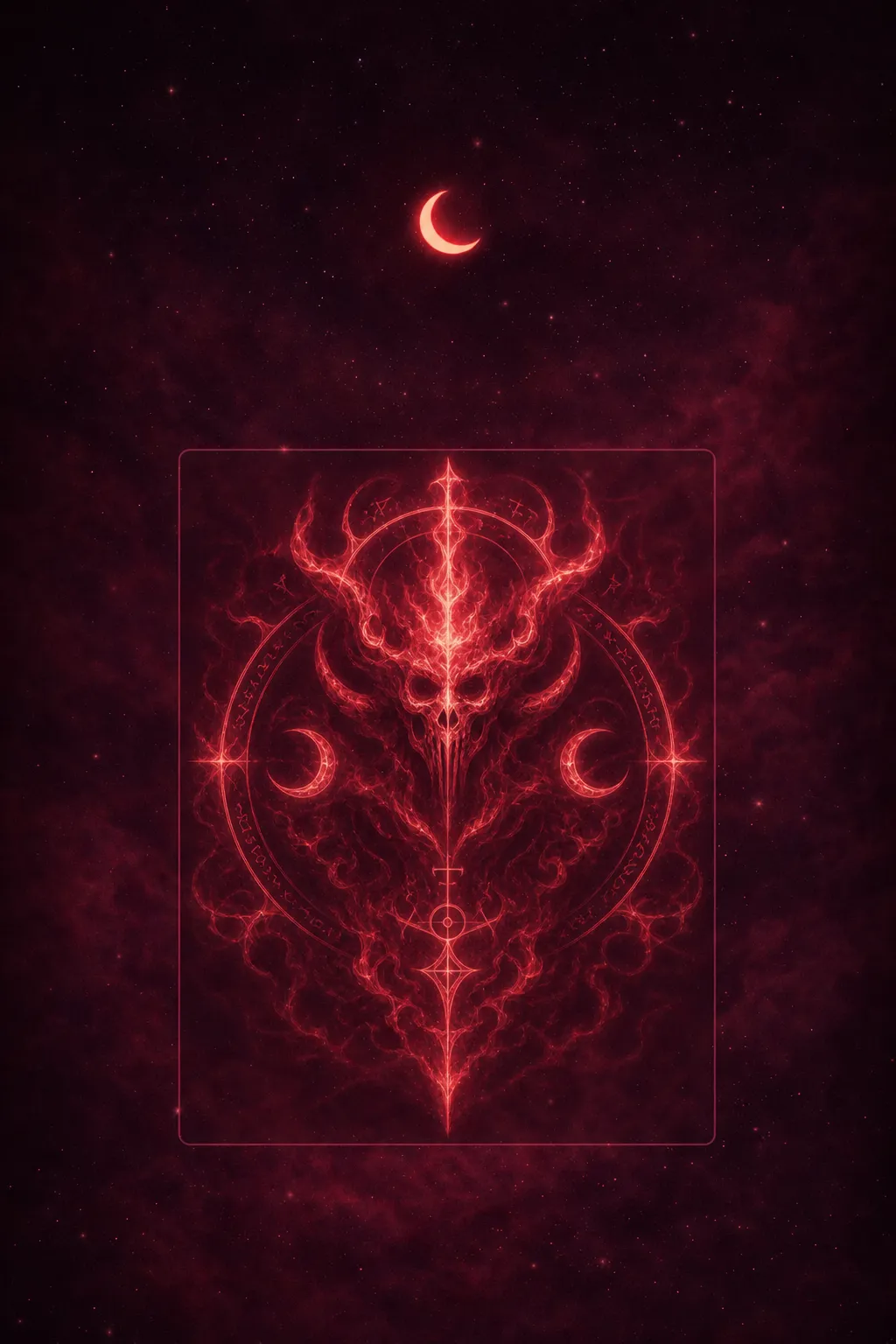

Dreaming of an evil spirit often reflects inner conflict, deep-seated fear, or a sense that something threatening is lurking in your waking life. It can symbolize repressed emotions, guilt, or a toxic influence you feel powerless against. Understanding the context of the dream can help you identify and confront what is weighing on your psyche.
In under a minute you could read what your exact dream means for you, and see a picture of it. Free.
If they came to you in that dream, you already know it felt like more than a dream.
This page can't tell you what the visit meant for you. The free app gives you the warm, spiritual reading of your own dream — gently, in plain words.


A dream still on your mind? Get your personal reading.
Describe your dream in a line or two. In seconds you get a reading of your exact dream, a picture drawn from your own words, and every symbol explained.
Free. No sign-up. Takes 10 seconds. Your dream stays private.
0%
Analyzing your dream…
Something went wrong. Please try again in a moment.
Your dreams deserve more than a dictionary
Common Evil Spirit Dream Scenarios
An Evil Spirit Chasing or Attacking You
You're running, but the thing behind you is faster. It doesn't need doors. This is one of the most viscerally terrifying versions of the dream — and one of the most revealing. When an evil spirit chases you, the dream is almost always about avoidance. Something in your life is gaining on you, and you've been refusing to turn around.
The feeling of being hunted maps directly onto real psychological pressure: a confrontation you're avoiding, a decision you keep postponing, a truth you're not ready to face. Much like being chased in dreams generally, the spirit version adds a layer of dread that goes beyond the physical — it feels like your soul is at stake, not just your body. That's the dream's way of telling you the stakes feel existential.
Was yours a sign? Find out.
An Evil Spirit Possessing You or Someone Else
Possession dreams are uniquely unsettling because the threat is internal. Watching someone you love become something monstrous — or feeling yourself lose control of your own body — taps into a fear of losing the self. If the spirit possesses you, the dream often points to a situation where you've been acting against your own values, or where something external (a relationship, a job, an addiction) has started to colonize your identity.
If the spirit possesses someone else, look at who that person is. A partner? A parent? A child? The possession is rarely literal — it's your mind's way of expressing that this person feels different, unreachable, or threatening. Dreams of shadow figures and possessing presences often share this same emotional root: the terror of the familiar becoming alien.
An Evil Spirit in Your Home
Houses in dreams represent the self — your rooms, your floors, your locked doors are all parts of your inner world. An evil spirit haunting your home is a powerful image of something wrong at the core of who you are or how you live. It might be a secret you're keeping, a wound that hasn't healed, or a dynamic in your household that feels poisonous but unspoken.
Pay attention to where in the house the spirit appears. A basement suggests buried memories or repressed fears. An upstairs room points to thoughts and beliefs you haven't examined. The feeling of death hovering in a familiar space — your childhood home, your bedroom — signals that something once safe now feels threatened. That shift is worth sitting with.
An Evil Spirit Whispering or Speaking to You
When the spirit has a voice, the dream becomes even more specific. What does it say? Even if you wake up unable to remember the exact words, the emotional tone lingers. Whispering spirits often represent the inner critic — that corrosive voice that tells you you're not enough, that you're guilty, that something terrible is coming. Freud would call it the superego turned malevolent.
Sometimes the whisper is a warning your waking mind has been too busy to hear. If the spirit speaks and you feel compelled to listen, the dream may be surfacing something your intuition already knows. Notice whether the voice feels external or strangely familiar — that distinction matters enormously.
What a dream about an evil spirit could look like
Tap an image to open it full screen
Example images. Only you can see what you write in Dream Book.
Psychological Interpretation
Freud saw nightmares not as random torment but as wish-fulfillment gone wrong — or more precisely, as the return of repressed material that the sleeping mind can no longer hold back. An evil spirit in a dream, for Freud, would represent exactly what you've exiled from conscious thought: forbidden desires, unacknowledged rage, guilt that has nowhere to go. The "evil" is yours. The spirit is just the costume it wears when it finally breaks through.
Jung took this further and gave it a name: the Shadow. Every person carries a Shadow Self — the collection of traits, impulses, and memories we've deemed unacceptable and buried. Jung believed that when the Shadow appears in dreams, it often takes a threatening, inhuman form precisely because we've refused to integrate it. The evil spirit isn't your enemy; it's the part of yourself you've been most afraid to meet. This is why drowning dreams and evil spirit dreams often carry the same emotional signature — both are about being overwhelmed by what you've tried to keep submerged. Jung's prescription was radical: don't flee the spirit. Face it. Ask what it wants.
But what does your version mean?
Calvin Hall's content analysis of over 50,000 dream reports found that nightmares involving threatening figures — whether human or supernatural — were far more common in people experiencing interpersonal conflict or unresolved anxiety in waking life. The threatening figure, Hall argued, almost always corresponds to a real emotional situation, not a supernatural one. The evil spirit is the mind's dramatic shorthand for something that genuinely frightens you. Ernest Hartmann's research adds another layer: he found that nightmares serve a therapeutic function, helping the brain process overwhelming emotions by weaving them into narrative. The horror of the evil spirit dream may actually be your mind doing its healing work — containing the fear inside a story so it becomes manageable.
Hobson and McCarley's activation-synthesis model offers the neuroscience perspective: during REM sleep, the brain's limbic system (the emotional core) fires intensely while the prefrontal cortex — responsible for rational thought — goes quiet. The result is raw emotion in search of a story. Fear, dread, and threat signals get stitched together into the most coherent narrative the sleeping brain can construct. Sometimes that narrative is an evil spirit. The feeling came first; the image followed. That doesn't make the dream meaningless — it makes the emotion the real message. If you also experience being bitten or stabbed in dreams, the same emotional flooding is likely at work.
General meanings end here. Read your own dream.
Describe your dream in a line or two. In seconds you get a reading of your exact dream, a picture drawn from your own words, and every symbol explained.
Free. No sign-up. Takes 10 seconds. Your dream stays private.
0%
Analyzing your dream…
Something went wrong. Please try again in a moment.
Your dreams deserve more than a dictionary
Every dream you log starts to connect.
Dream Book keeps your dreams in one place and reveals the threads between them over time — your private dream journal. Free to start.
Cultural & Spiritual Meaning
In Western Christian tradition, evil spirits in dreams have long been treated as spiritually significant — either as genuine demonic visitation or as tests of faith. Medieval dream interpreters distinguished between dreams sent by God, dreams sent by demons, and dreams arising from the body. An evil spirit dream was taken seriously as a possible warning, and prayer was the prescribed response. This framework still resonates for many people today, particularly when the dream carries an overwhelming sense of presence — the feeling that something real just visited.
Ibn Sirin, the eighth-century Islamic scholar whose dream interpretations remain widely consulted across the Muslim world, taught that dreams of evil spirits or devils often signify the presence of envy, deception, or spiritual negligence in the dreamer's life. Specifically, he interpreted a devil appearing in a dream as a warning about enemies who operate through manipulation and hidden harm — people in your circle who wish you ill. His guidance was to respond with increased prayer, charity, and self-examination. The dream, in his framework, is a mercy: a chance to see what waking life conceals.
A bad dream isn't a bad sign.
In many Indigenous traditions across Africa, the Americas, and the Pacific, spirits in dreams — whether benevolent or malevolent — are understood as genuine communications from the spirit world. A threatening spirit might be an ancestor expressing displeasure, a warning about a community rupture, or a signal that a ritual has been neglected. The appropriate response is not analysis but ceremony. Eastern traditions, particularly in Taoist and Hindu frameworks, similarly treat evil spirit dreams as indicators of spiritual imbalance — too much yin, blocked energy, or the influence of negative forces that can be addressed through specific practices. Across all of these traditions, the dream is never dismissed. It is always listened to.
Related Dream Meanings
nightmares
Being Chased Dream Meaning: Anxiety & Avoidance
5 min read
nightmares
Shadow Person in Dreams: What It Means When You See Them
5 min read
nightmares
Death Dream Meaning: Transformation, Loss & Change
5 min read
nightmares
Drowning Dream Meaning: Overwhelm, Fear & Hidden Stress
5 min read
nightmares
Dog Biting Me in Dream Meaning: Interpretation and Symbolism
6 min read
nightmares
Being Stabbed Dream Meaning: Betrayal, Pain & Change
6 min read
nightmares
Falling Off Cliff Dream Meaning: Fear & Loss of Control
5 min read
nightmares
Paralyzed Dream Meaning: Powerlessness & Feeling Stuck
5 min read
What to Do After This Dream
First: don't push it away. The instinct after a nightmare is to shake it off and get on with your day, but evil spirit dreams tend to return if you ignore them. Give yourself five minutes in the morning to sit with what you felt — not what you saw, but what you felt. Fear? Guilt? A strange pull toward the spirit rather than away from it? That emotional texture is your real data.
Write it down. The act of putting the dream into words forces your waking mind to engage with material that usually stays just below the surface. Note where the spirit appeared, what it wanted, and — crucially — whether any part of you recognized it. Jung's question is worth borrowing: what would this spirit say if it could speak freely? What would it ask of you?
If the dream keeps returning, that repetition is significant. Recurring evil spirit dreams often point to something unresolved that isn't going away on its own — a relationship, a grief, a pattern of behavior you've been avoiding. Dream Book lets you describe your dream in detail and ask follow-up questions, helping you move from the raw image to what it actually means for your life right now. A personalized interpretation can surface connections that a general dictionary can't.
Finally, consider what the spirit represents rather than what it is. The most useful question isn't "was this real?" but "what in my life feels like this?" That reframe — from supernatural threat to psychological signal — is usually where the dream starts to lose its power over you.
Was yours a sign? Find out.
Understanding your evil spirit dream is the first step. The next is asking what it means for your life right now — that's where a personalized interpretation goes deeper than any dictionary.
Keep the ones that matter close.
The free app saves your most meaningful dreams and reads the signs across them — so a visit or a sign is never lost. Free to start.
People Also Ask
Dreaming of an evil spirit attacking you usually points to something in your waking life that feels threatening, overwhelming, or out of your control — a conflict, a fear, or a repressed emotion that's finally breaking through. Jung would say the 'attacker' is often a part of yourself you've refused to acknowledge. The attack is the mind's way of forcing a confrontation you've been avoiding.
In many cultural traditions, including Islamic dream interpretation as described by Ibn Sirin, an evil spirit dream is a warning rather than a curse — a signal to examine your relationships, your spiritual state, or hidden threats in your environment. Psychologically, it's rarely a bad omen and more often a sign that your mind is processing intense fear or unresolved emotion. The dream is a message, not a sentence.
Recurring evil spirit dreams almost always point to something unresolved — an emotion, a relationship, or a situation your waking mind keeps pushing aside. Ernest Hartmann's research on emotional processing suggests that the brain uses recurring nightmares to keep surfacing material that hasn't been fully integrated. The repetition is the dream asking you to pay attention to something specific.
A speaking evil spirit in a dream often represents your inner critic or a suppressed truth your waking mind has been reluctant to face. Freud connected this kind of voice to the superego — the internalized judge that carries guilt and shame. The content of what the spirit says, even if vague upon waking, usually reflects a fear or belief you hold about yourself that deserves closer examination.
Curious what your dream would look like?