
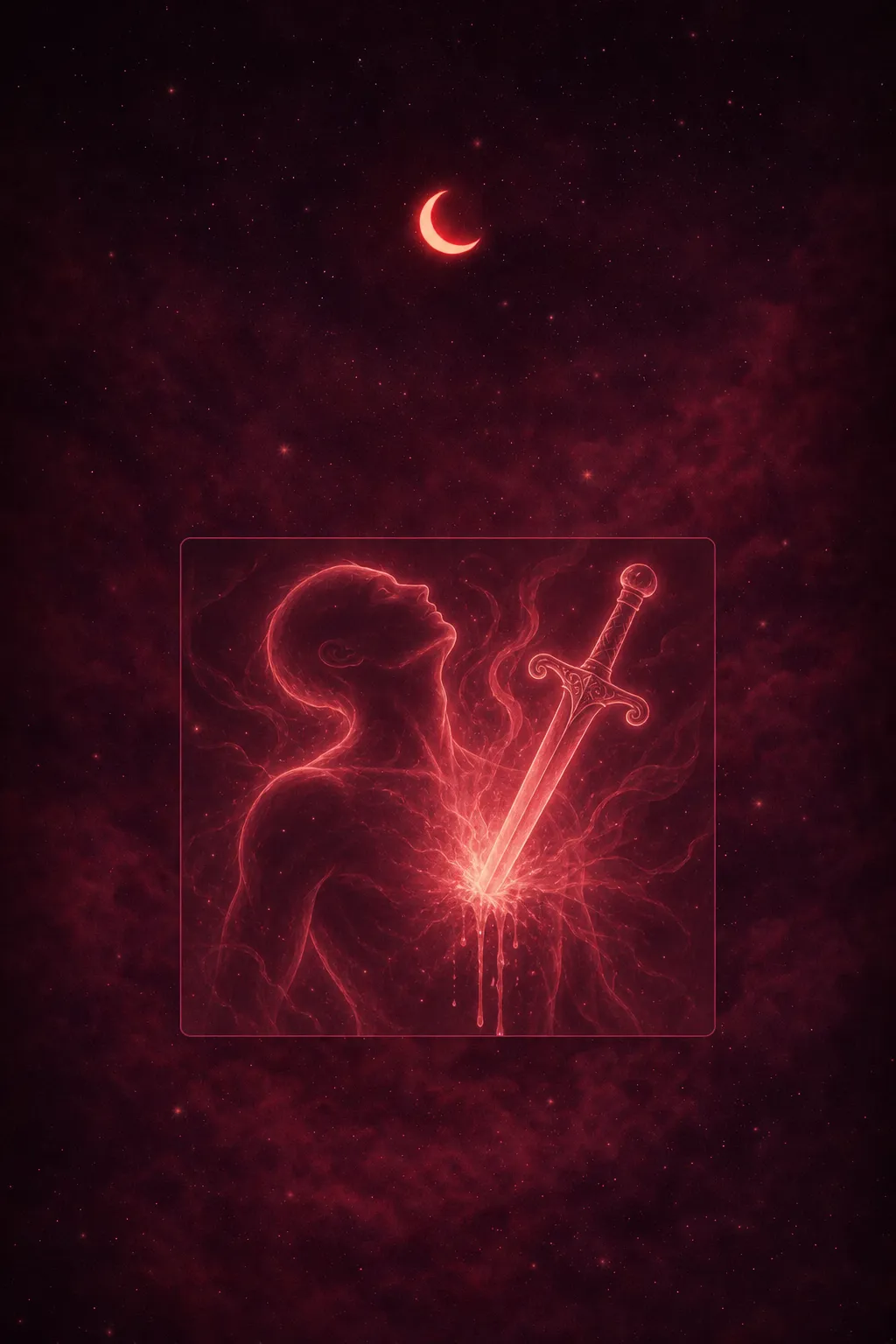

Dreaming of being stabbed often reflects feelings of betrayal, emotional wounding, or a sudden loss of trust in someone close to you. It can also symbolize a painful but transformative change forcing its way into your life. The location of the wound and who holds the knife can offer deeper clues about where you feel most vulnerable.
In under a minute you could read what your exact dream means for you, and see a picture of it. Free.
Bad dream? See exactly what you dreamed — turned into a picture.
Just describe it and Dream Book paints your dream as a real image, plus a reading of what it means for you. Free, and it takes under a minute.


A dream still on your mind? Get your personal reading.
Describe your dream in a line or two. In seconds you get a reading of your exact dream, a picture drawn from your own words, and every symbol explained.
Free. No sign-up. Takes 10 seconds. Your dream stays private.
0%
Analyzing your dream…
Something went wrong. Please try again in a moment.
Your dreams deserve more than a dictionary
Common Being Stabbed Dream Scenarios
Stabbed in the Back
This is the most emotionally loaded variation. When the blade comes from behind, your dreaming mind is pointing directly at betrayal — someone you trusted, someone who had access to your blind spots. The image is almost too literal: you didn't see it coming because you weren't looking in that direction.
Think about who in your waking life has recently disappointed you, undermined you, or said one thing to your face and another behind your back. The dream isn't predicting anything — it's processing a wound that's already happened, or a fear that it might. If you've also been dreaming about being chased, the two together often point to a relationship dynamic where you feel both hunted and exposed.
A bad dream isn't a bad sign.
Stabbed in the Chest or Heart
The chest holds everything we associate with love, courage, and emotional core. A dream where the blade lands here is rarely about physical danger — it's about grief, heartbreak, or a love that feels like it's killing you slowly. This version often visits people in the aftermath of a breakup, a friendship ending, or a family rupture.
There's a particular intensity when the person holding the knife is someone you love. If your ex-partner appears in this dream, your subconscious is doing exactly what it's supposed to do — working through the pain of that loss in the only theater where it's safe to feel everything at once.
Stabbed and Dying or Dead
Watching yourself die from a stab wound in a dream is disturbing, but it almost never means what it looks like. Dreams of dying after violence are frequently about transformation — one version of you ending so another can begin. The death is symbolic: a relationship, a job, an identity you've been carrying too long.
Some people wake from this dream feeling strangely calm, even relieved. That's worth paying attention to. The part of you that died in the dream may be the part you were ready to let go of.
Being Stabbed by a Stranger
When the attacker has no face — or is someone you don't recognize — the knife may be coming from inside the house. Jung would call this the Shadow: the parts of yourself you've suppressed, the anger you won't admit to, the self-sabotage you haven't named yet. A faceless attacker is often you, in disguise.
This scenario also appears when people feel threatened by circumstances rather than individuals — a job that feels hostile, a city that doesn't feel safe, a life that seems to be closing in. If you've been dreaming about death or drowning alongside this image, the emotional pressure in your waking life may need urgent attention.
What a dream about being stabbed could look like
Tap an image to open it full screen
Example images. Only you can see what you write in Dream Book.
Psychological Interpretation
Freud saw violence in dreams as a displacement of desire and aggression — emotions too dangerous to express directly in waking life, so the mind stages them as drama while you sleep. A stabbing, in his framework, is often about power: who has it, who's taking it, and what you're doing with your own rage. He was particularly interested in the way the body becomes a battlefield in dreams, each wound a map of emotional injury the conscious mind refuses to acknowledge.
Jung pushed deeper. For him, the attacker in a stabbing dream is almost always an aspect of the dreamer's own psyche — the Shadow, the rejected self, the parts you've locked in the basement of your personality. Being stabbed by someone you know could mean that person represents a quality in yourself you're at war with. Being stabbed by a stranger almost certainly does. His concept of individuation — the lifelong process of becoming whole — suggests that these violent dream encounters are invitations to look at what you've been avoiding. The knife is a call to consciousness.
But what does your version mean?
Calvin Hall spent decades analyzing over 50,000 dream reports and found that aggression dreams — including being attacked and wounded — appear with striking regularity, especially in people navigating conflict in their waking relationships. His content analysis showed that the dreamer is more often the victim than the aggressor, and that the attacker is usually known to them. This lines up with the emotional logic of the stabbed-in-the-back dream: the wound is most devastating when it comes from someone familiar. Ernest Hartmann's emotional processing theory adds another layer — he argued that dreams like this are essentially the brain's therapy sessions, using vivid imagery to help us metabolize experiences that are too intense to process while awake. The stabbing dream, in Hartmann's view, isn't a symptom. It's a treatment.
Hobson and McCarley's activation-synthesis model offers the neurological angle: during REM sleep, the brain generates random bursts of neural activity, and the cortex scrambles to build a coherent narrative around them. Threat imagery — including violence — is one of the most common narrative frameworks the sleeping brain reaches for. This doesn't mean the dream is meaningless, but it does mean that some stabbing dreams are the mind's attempt to make a story out of physiological arousal, particularly if you fell asleep anxious or overstimulated. If you've been experiencing sleep paralysis alongside these dreams, the nervous system connection is worth exploring with a doctor.
General meanings end here. Read your own dream.
Describe your dream in a line or two. In seconds you get a reading of your exact dream, a picture drawn from your own words, and every symbol explained.
Free. No sign-up. Takes 10 seconds. Your dream stays private.
0%
Analyzing your dream…
Something went wrong. Please try again in a moment.
Your dreams deserve more than a dictionary
Every dream you log starts to connect.
Dream Book keeps your dreams in one place and reveals the threads between them over time — your private dream journal. Free to start.
Cultural & Spiritual Meaning
In Western dream traditions, being stabbed has long been read as a warning about enemies — real or internal. Medieval dream manuals treated the knife as a symbol of severed bonds, and the dream of being wounded was often interpreted as a sign that a friendship or alliance was about to break. That intuition maps surprisingly well onto what modern psychology has confirmed: the dream often precedes a conscious recognition of betrayal, as if the subconscious clocks the danger before the waking mind is ready to admit it.
Ibn Sirin, the 8th-century Islamic dream interpreter whose work remains one of the most referenced in the Islamic world, interpreted a dream of being stabbed with a knife as a sign of harsh words being spoken against you — a verbal wound dressed in physical imagery. He was specific: if the wound bleeds in the dream, the harm is already done; if it does not bleed, the threat has not yet fully landed. He also noted that surviving the stabbing in the dream was a positive sign, indicating resilience and the capacity to overcome whatever opposition was coming. This reading feels remarkably aligned with the emotional truth most people report when they wake from this dream — shaken, but still standing.
Was yours a sign? Find out.
In many Indigenous and Eastern traditions, a wound in a dream is treated as a message from the spirit world about where healing is needed. The location of the wound matters: a cut to the hands suggests work or creativity under threat; a wound to the throat points toward silenced speech or unexpressed truth. Some traditions see surviving a violent dream as a form of initiation — you've passed through the fire and emerged changed. If you've been dreaming of blood alongside the stabbing, that symbol carries its own layered meaning worth sitting with.
Related Dream Meanings
nightmares
Being Chased Dream Meaning: Anxiety & Avoidance
5 min read

people
Ex Partner Dream Meaning: What Your Dreams About Former Lovers Reveal
6 min read

nightmares
Dying Dream Meaning: Transformation, Fear & Change
5 min read

nightmares
Death Dream Meaning: Transformation, Loss & Change
5 min read
nightmares
Drowning Dream Meaning: Overwhelm, Fear & Hidden Stress
5 min read

nightmares
Sleep Paralysis Dream Meaning: Helplessness & Anxiety
5 min read

body health
Blood Dream Meaning: Loss, Vitality & Transformation
5 min read
nightmares
Ghosts Dream Meaning: Unresolved Emotions & the Past
5 min read
What to Do After This Dream
First: don't dismiss it. A stabbing dream is your subconscious shouting something it hasn't been able to say quietly. Before you get out of bed, try to recall who held the knife, where the wound landed, and how you felt when you woke up. Those three details will tell you more than any dictionary can.
Write it down. Not a novel — just the emotional core. "I felt betrayed." "I felt powerless." "I felt relieved it was over." Then ask yourself where in your waking life you feel that same emotion. The dream is almost always pointing at something real.
If this dream keeps returning, it's worth exploring with a personalized interpretation. Dream Book lets you describe your dream in detail and ask follow-up questions to understand what your subconscious is actually working through — which is often more specific and more useful than any general meaning.
Consider whether there's a conversation you've been avoiding, a boundary you haven't set, or a relationship that's been quietly draining you. The knife in the dream is often the thing you haven't said out loud yet. Sometimes the most powerful response to a stabbing dream is a difficult but honest conversation in waking life — one that finally names the wound.
A bad dream isn't a bad sign.
Understanding your being stabbed dream is the first step. The next is asking what it means for your life right now — that's where a personalized interpretation goes deeper than any dictionary.
If it keeps coming back, the app helps you understand the pattern.
Log each recurring dream and the free app shows you what's underneath — calmly, over time. Free to start.
People Also Ask
Dreaming of being stabbed by someone you know almost always points to feelings of betrayal, hurt, or conflict with that person — or what they represent to you. It doesn't mean they intend you harm; it means some part of your relationship feels wounding. Pay attention to where the knife lands, as the location often reveals what aspect of your life feels most threatened.
Most dream traditions, including Ibn Sirin's Islamic interpretation, treat surviving a stabbing dream as a positive sign — one of resilience and the ability to overcome opposition. Psychologically, the dream is more about processing emotional pain than predicting real danger. It's your mind doing necessary work, not a warning about the future.
Recurring stabbing dreams usually mean there's an unresolved emotional wound or ongoing source of stress that your mind keeps returning to because it hasn't been processed yet. The repetition is the dream asking you to pay attention to something you've been avoiding in waking life — often a relationship, a boundary, or an unexpressed feeling.
A stab wound to the chest in a dream typically points to emotional or romantic pain — heartbreak, grief, or a love that feels like it's costing you too much. This version of the dream is especially common after a breakup or a deep friendship rupture. It's the subconscious making the invisible wound visible.
Curious what your dream would look like?