
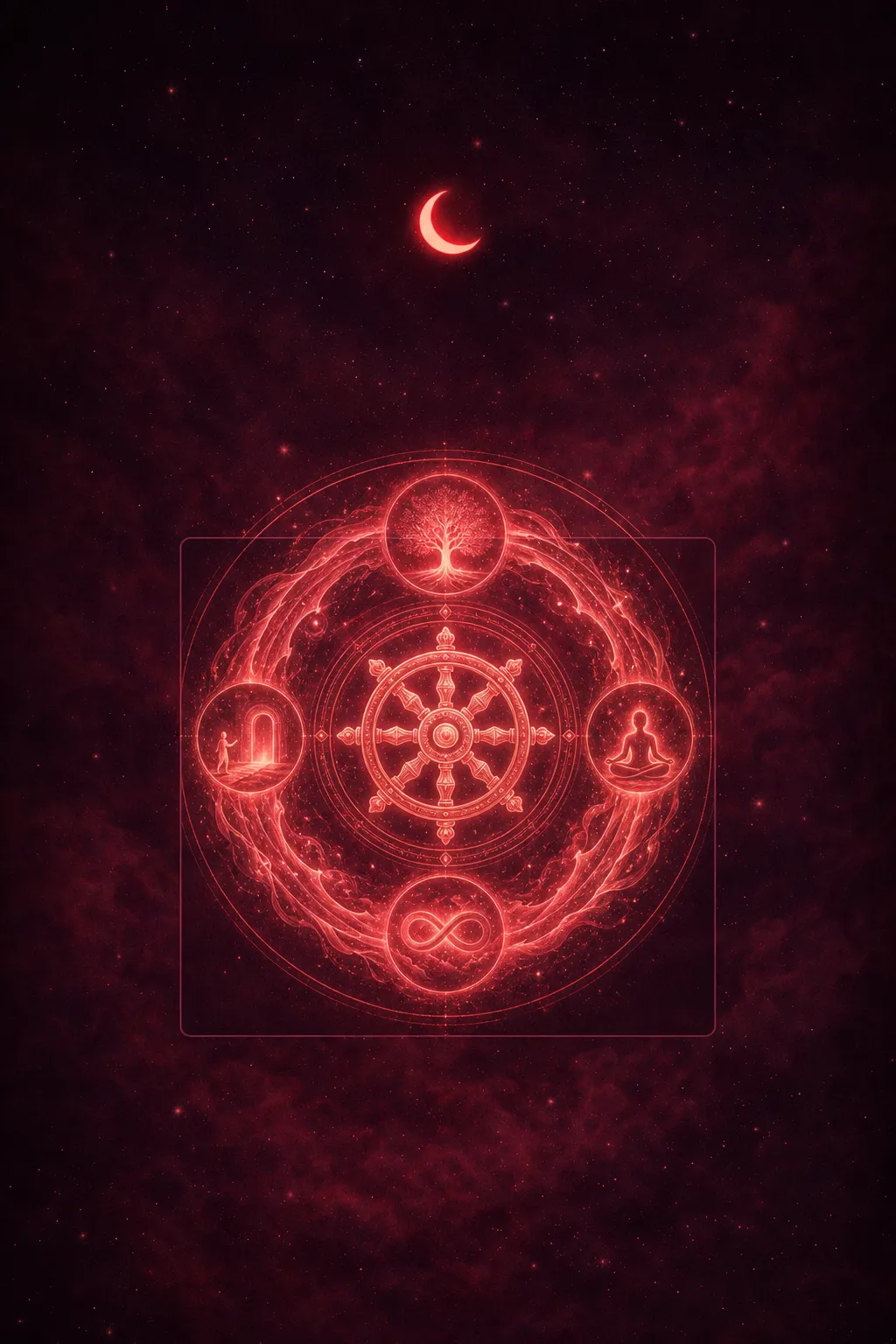

Dreaming of karma often reflects a deep awareness of cause and effect in your waking life — a sense that past actions are catching up with you or that justice is near. It can signal guilt over something unresolved, a longing for fairness, or a subconscious nudge to make amends. These dreams usually invite you to reflect on personal responsibility and the energy you put into the world.
In under a minute you could read what your exact dream means for you, and see a picture of it. Free.
A dream still on your mind? Get your personal reading.
Describe your dream in a line or two. In seconds you get a reading of your exact dream, a picture drawn from your own words, and every symbol explained.
Free. No sign-up. Takes 10 seconds. Your dream stays private.
0%
Analyzing your dream…
Something went wrong. Please try again in a moment.
Your dreams deserve more than a dictionary
Common Karma Dream Scenarios
Receiving Punishment or Consequences in a Dream
You did something — maybe years ago, maybe in the dream itself — and now something is coming for you. The punishment rarely looks like a courtroom. It's a locked door that won't open, a relentless chase through streets you don't recognize, or watching everything you built quietly collapse. The feeling is unmistakable: this is deserved.
This scenario tends to surface when you're carrying guilt you haven't spoken out loud. The dream isn't sentencing you — it's surfacing what you've been quietly trying to bury. The subconscious is a patient bookkeeper.
But what does your version mean?
Witnessing Someone Else Face Karmic Consequences
Sometimes the dream isn't about you at all. You watch someone who wronged you — an ex, a former friend, a colleague — face their reckoning. Maybe they're being chased, or something they prized is crumbling in their hands, the way teeth fall out in that particular dream logic that feels absolutely real. You feel something watching it — relief, grief, or a guilt about the relief.
This dream often speaks to a justice wound. Something happened to you that was never acknowledged, never corrected. Your dreaming mind is staging the resolution your waking life never delivered.
Breaking a Karmic Cycle
This one feels different — lighter. You're in a situation you've been in before, but this time you choose differently. You walk away from the argument. You don't send the message. There's a sense of a thread being cut, a cycle ending. Some dreamers describe it as standing at a crossroads and finally knowing which road is theirs.
This is the rarest karma dream, and the most hopeful. It tends to arrive when you're genuinely on the edge of change — when you've done enough inner work that your subconscious is rehearsing a new pattern before you live it.
Being Cursed or Marked
Some karma dreams carry a darker texture — a sense that something has been placed on you. A curse, a mark, an evil eye that follows you from scene to scene. You didn't do anything wrong in the dream, but the weight is there anyway. This particular dream often reflects inherited guilt — family shame, generational wounds, a burden you picked up without choosing it.
It can also signal that you've internalized someone else's judgment so deeply it now feels like cosmic law. The dream is asking you to examine whether the punishment you're carrying was ever actually yours to hold.
What this dream could look like
Tap an image to open it full screen
Example images. Only you can see what you write in Dream Book.
Psychological Interpretation
Freud would have been skeptical of karma as a concept, but not of what it produces in dreams. For him, dreams of punishment and consequence are the superego — the internalized voice of morality — staging its case while the ego sleeps. The guilt doesn't need to be rational. It needs to be real to you, and that's enough for the dreaming mind to build an entire trial around it. Freud saw wish fulfillment as the engine of most dreams, which means even a punishment dream can be a wish: for accountability, for closure, for the world to make moral sense.
Jung would have recognized karma dreams immediately as Shadow work. The Shadow — the parts of yourself you refuse to integrate — doesn't disappear when ignored. It accumulates. When it finally surfaces in dreams, it often arrives as consequence: something pursuing you, something demanding to be seen. Jung believed the goal of individuation was to bring the Shadow into conscious relationship, not to defeat it. A karma dream, in Jungian terms, is the psyche insisting you look at what you've been turning away from. He'd also note that dreaming of past lives or karmic debt touches the collective unconscious — patterns that belong not just to you but to the whole human story.
Was yours a sign? Find out.
Calvin Hall's content analysis of over 50,000 dream reports found that themes of misfortune, guilt, and moral failure appear far more frequently in dreams than themes of reward or success. We dream about what troubles us. Hall's work suggests karma dreams aren't spiritually special — they're cognitively predictable. When you carry unresolved moral tension into sleep, your dreaming mind processes it through narrative. The story of karma is simply the story your mind reaches for when it needs to dramatize cause and effect.
Ernest Hartmann's research adds another layer. He argued that dreams function as emotional memory processing — a kind of nightly therapy where the brain connects new emotional experiences to older, stored ones. A karma dream, by this reading, is your mind linking a recent event (a betrayal, a regret, a fear of reincarnation or spiritual consequence) to a deeper emotional template. The dream isn't predicting your fate. It's helping you metabolize a feeling that hasn't yet found its place. Hobson and McCarley's activation-synthesis hypothesis would add that the brain's random neural firing during REM sleep gets shaped into narrative by the cortex — and when guilt or moral anxiety is emotionally dominant, the brain reaches for the closest available story structure. Karma is one of humanity's oldest story structures for consequence.
Every dream you log starts to connect.
Dream Book keeps your dreams in one place and reveals the threads between them over time — your private dream journal. Free to start.


Cultural & Spiritual Meaning
In Hindu and Buddhist traditions, karma is not metaphor — it's mechanics. To dream of karmic consequence in these frameworks is to receive genuine information about the state of your soul across lifetimes. A dream in which you're paying a debt you don't remember incurring may be understood as a past life memory surfacing, a reminder that the ledger extends further back than this single incarnation. The dream is less a warning than a map — showing you where the knot is so you can begin to untangle it.
In Western spiritual traditions, karma dreams often get interpreted through the lens of moral reckoning — heaven, hell, divine justice. The imagery shifts but the emotional logic is the same: actions have weight, and that weight eventually lands somewhere. Ibn Sirin, the 8th-century Islamic scholar whose dream interpretations remain authoritative across much of the Islamic world, wrote that dreams of divine punishment or moral consequence are among the most significant a person can receive. He interpreted such dreams not as condemnation but as mercy — a private warning given in sleep so the dreamer has time to correct course before consequences arrive in waking life. For Ibn Sirin, the dream is a gift, not a verdict.
A bad dream isn't a bad sign.
Indigenous traditions across many cultures share a related understanding: that dreams are a space where the moral order of the world becomes visible. Ancestors appear to correct, to guide, to hold the dreamer accountable. A karma dream in this context might involve a visit from ancestors who carry a message about a pattern that needs breaking — not just for you, but for the generations that follow. The dream isn't personal. It's relational, extending backward and forward in time.
Related Dream Meanings

nightmares
Being Chased Dream Meaning: Anxiety & Avoidance
5 min read

nightmares
Being Chased by a Snake Dream: Anxiety & Hidden Fear
5 min read

body health
Teeth Falling Out Dream: Anxiety, Loss & Vulnerability
5 min read
common dreams
Crossroads Dream Meaning: Decision, Conflict & Choice
6 min read
nightmares
What Does It Mean to Dream About Being Cursed
5 min read
nightmares
Evil Eye Dream Meaning: What It Reveals About Your Subconscious
6 min read
nightmares
What Does Dreaming About Past Life Mean - Dream Interpretation
5 min read
nightmares
What Does Dreaming About Reincarnation Mean
6 min read
What to Do After This Dream
Start by sitting with the emotional residue. Karma dreams rarely arrive without a specific feeling attached — guilt, relief, dread, hope. That feeling is the real message. Write it down before you analyze the imagery. The emotion is the signal; the story is just the delivery system.
Ask yourself honestly: is there something you've done that you haven't fully reckoned with? Not punished yourself for — reckoned with. There's a difference between guilt and accountability. Guilt loops. Accountability moves. If this dream is pointing to something real, the move is toward repair or release, not rumination.
If the dream is about someone else's karma — if you're watching a reckoning you didn't cause — consider whether you're holding onto a justice wound that's costing you more than it's costing them. The dream may be less about them and more about your readiness to put it down.
If this dream keeps returning, it's worth exploring with a personalized interpretation. Dream Book lets you describe your dream in detail and ask follow-up questions to understand what your subconscious is actually processing — because a karma dream that visits you three times in a month is asking for more than a dictionary definition can give.
But what does your version mean?
Understanding your karma dream is the first step. The next is asking what it means for your life right now — that's where a personalized interpretation goes deeper than any dictionary.
One dream is never the whole picture.
The free app remembers your dreams, draws them, and connects the threads over time — so the next one means even more. Free to start.
People Also Ask
This dream usually reflects a justice wound — something that was done to you that was never acknowledged or corrected. Your subconscious is staging the resolution your waking life never delivered. It's worth asking whether holding onto this expectation of cosmic payback is keeping you stuck.
Many traditions, including Ibn Sirin's Islamic dream interpretation, treat karma-style consequence dreams as merciful warnings — a chance to correct course before consequences arrive in waking life. Psychologically, they reflect unresolved guilt or moral tension your mind is trying to process.
Recurring dreams about past mistakes are your mind's way of flagging unprocessed emotional material. Ernest Hartmann's research suggests these dreams are the brain's attempt to integrate guilt or regret into your emotional memory. The repetition usually stops when you take some form of conscious action — repair, forgiveness, or genuine release.
Most psychological frameworks say no — karma dreams reflect your current emotional and moral state, not future events. Spiritually, some traditions interpret them as guidance rather than prediction: a signal about what needs attention, not a fixed outcome.
Curious what your dream would look like?