
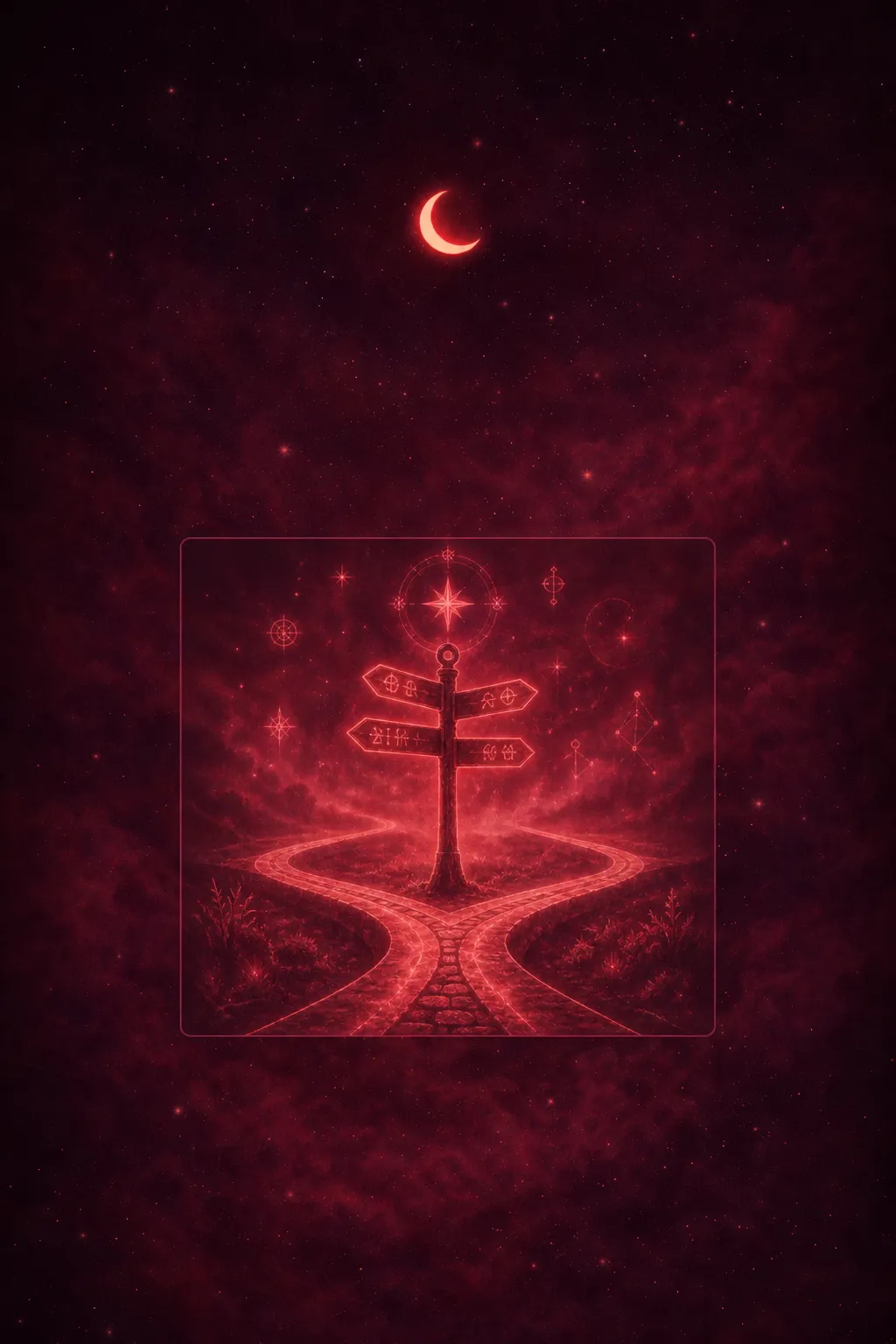

Dreaming of a crossroads often reflects a real-life decision or turning point you're facing — or avoiding. It can speak to inner conflict between two paths, values, or versions of yourself. Your subconscious may be urging you to pause, trust your instincts, and choose.
In under a minute you could read what your exact dream means for you, and see a picture of it. Free.
You read what it can mean. But what did yours mean?
General meanings stop here. In the free app, tell Dream Book your exact dream and get a reading that actually makes sense for you.


A dream still on your mind? Get your personal reading.
Describe your dream in a line or two. In seconds you get a reading of your exact dream, a picture drawn from your own words, and every symbol explained.
Free. No sign-up. Takes 10 seconds. Your dream stays private.
0%
Analyzing your dream…
Something went wrong. Please try again in a moment.
Your dreams deserve more than a dictionary
Common Crossroads Dream Scenarios
Standing at the Crossroads, Unable to Choose
You're standing where two roads meet — or three, or four — and your feet won't move. The paths stretch out ahead of you, each one disappearing into its own kind of distance. This is the most reported version of the crossroads dream, and it almost always arrives during waking periods of real, pressing indecision.
The paralysis is the message. Your dreaming mind isn't just staging a metaphor for a choice — it's showing you the emotional weight you're carrying around that choice. If you feel dread standing there, that dread belongs to your waking life too. If you feel a strange calm, pay attention: your subconscious may already know which path you want to take.
People who find themselves lost in their dreams often report crossroads imagery alongside it — the two are closely related, both circling the same fear of not knowing where you're going.
But what does your version mean?
Walking Confidently Down One Road
Sometimes the crossroads dream doesn't freeze you. You arrive, you look, and you walk — one direction, no hesitation. These dreams tend to feel clean and vivid, almost cinematic. You wake up with a residue of certainty that can be disorienting if your waking life feels anything but certain.
This version is often less about the choice itself and more about your relationship with commitment. Your subconscious is rehearsing decisiveness, showing you what it feels like to move forward without looking back. Think of it as your inner life doing a dry run.
A Stranger or Figure at the Crossroads
In some crossroads dreams, you're not alone. A figure stands there — sometimes offering directions, sometimes simply watching, sometimes blocking the way entirely. This stranger carries enormous symbolic weight. Jung would recognize them immediately as an archetypal presence, a guide or a gatekeeper emerging from the collective unconscious.
If the figure feels threatening, your dream may be processing an external pressure on a real decision — someone in your life whose influence you resent or fear. If they feel wise or comforting, you may be reaching for guidance your waking mind hasn't found yet. Pay attention to whether they speak, and what they say. Dreams that include a door or threshold nearby often deepen this encounter, suggesting you're right at the edge of a significant transition.
The Crossroads at Night or in a Storm
A crossroads in daylight feels like a puzzle. A crossroads at night, or wrapped in fog, or lashed by a storm, feels like a threat. The emotional atmosphere your dreaming mind builds around the symbol matters as much as the symbol itself.
Darkness at the crossroads often points to decisions being made without enough information — the feeling that you can't see clearly where any path leads. A storm adds urgency: you're being forced to choose before you feel ready. If you've been delaying a significant life decision, this dream is your psyche's way of turning up the pressure.
Dreams set in a maze carry a similar energy — the sense of being trapped inside a choice rather than standing freely before it.
What this dream could look like
Tap an image to open it full screen
Example images. Only you can see what you write in Dream Book.
Psychological Interpretation
Freud read crossroads dreams through the lens of desire and conflict. For him, the fork in the road was almost always a disguised representation of competing drives — the things we want clashing with the things we've been taught to suppress. The inability to choose, in Freud's framework, wasn't weakness. It was the dream's way of staging the war between the conscious self and everything buried beneath it. The path not taken often represented the repressed wish.
Jung took a wider view. He saw the crossroads as one of the oldest archetypal images in the human psyche — a symbol of individuation, the lifelong process of becoming fully yourself. Standing at a crossroads in a dream, for Jung, meant you were at a genuine threshold in your psychological development. The paths weren't just life choices; they were different versions of who you could become. He'd also note that the crossroads is a place where the Shadow tends to appear — that stranger blocking the road might be the part of yourself you've been avoiding.
Was yours a sign? Find out.
Calvin Hall's decades of content analysis — cataloguing over 50,000 dream reports — found that dreams of choice and navigation appeared with striking regularity during periods of life transition: new jobs, relationship changes, relocations. Hall's cognitive theory frames the crossroads dream not as mystical but as the mind rehearsing decision-making, running simulations of possible futures. His data showed that dreamers rarely chose randomly in these scenarios — their dream-choices often mirrored the direction they were already leaning in waking life, suggesting the dream was confirming rather than creating the decision. If you've been having dreams about being late alongside the crossroads imagery, Hall's framework would read both as the same underlying anxiety about timing and consequence.
Ernest Hartmann's emotional processing theory adds another layer. Hartmann argued that dreams function like therapy — they take the raw, unprocessed emotion of your waking life and weave it into imagery that makes it easier to metabolize. The crossroads, in this reading, isn't just representing your decision. It's helping you feel it safely, at a remove, so that when you wake up, the emotional charge around the choice is a little less overwhelming. Hobson and McCarley's activation-synthesis model offers the counterpoint: the crossroads may simply be the brain's narrative engine making meaning out of random neural activation — pulling a culturally resonant image from memory to organize the signal. Even if that's true, the image the brain chooses is never entirely random. It reaches for what's emotionally live.
General meanings end here. Read your own dream.
Describe your dream in a line or two. In seconds you get a reading of your exact dream, a picture drawn from your own words, and every symbol explained.
Free. No sign-up. Takes 10 seconds. Your dream stays private.
0%
Analyzing your dream…
Something went wrong. Please try again in a moment.
Your dreams deserve more than a dictionary
Every dream you log starts to connect.
Dream Book keeps your dreams in one place and reveals the threads between them over time — your private dream journal. Free to start.
Cultural & Spiritual Meaning
The crossroads has been a charged symbol across almost every human culture for as long as people have been recording their dreams. In Western folklore, it was the place where the ordinary world and the spirit world touched — where deals were made, where the dead were buried to confuse their ghosts, where witches gathered. The blues mythology of Robert Johnson selling his soul at a Mississippi crossroads is just one echo of a far older belief: that the crossroads is a liminal space, neither here nor there, where normal rules don't apply. To dream of it is to dream of standing in that in-between.
In West African and African diaspora traditions — particularly in Vodou and Candomblé — the crossroads is the domain of Eshu or Legba, the divine messenger who stands between the human and the sacred. A crossroads dream in these traditions isn't anxiety; it's an invitation. The spirit of the crossroads is being invoked, and the dreamer is being asked to pay attention to what's being offered. Indigenous traditions across the Americas similarly read the crossroads as a place of spiritual power, a location where ancestors and guides can make contact.
Ibn Sirin, the 8th-century Islamic scholar whose dream interpretations remain influential across the Muslim world, wrote specifically about roads and paths in dreams. He interpreted a clear, wide road as a sign of righteous direction and divine guidance, while a confusing or blocked path suggested the dreamer was straying from their purpose or facing a test of faith. A crossroads, in his framework, would represent a moment of divine trial — God presenting the soul with a genuine choice between paths of differing moral weight. The dreamer's emotional response in the dream was key: fear suggested unreadiness, while calm suggested spiritual alignment. Eastern traditions, particularly in Chinese dream interpretation, read road imagery similarly — the direction you face at the crossroads (north, south, east, west) carries specific elemental meaning, with east generally indicating new beginnings and west suggesting completion or endings.
Related Dream Meanings
common dreams
Being Lost Dream Meaning: Confusion & Direction
5 min read
common dreams
Door Dream Meaning: Opportunities, Transitions & Choices
5 min read
common dreams
Storm Dream Meaning: Turmoil, Anxiety & Change
5 min read
common dreams
What Does Dreaming About a Maze Mean? Dream Interpretation Guide
6 min read
common dreams
Being Late Dream Meaning: Anxiety, Fear & Missed Chances
5 min read
common dreams
Bridge Dream Meaning: Transition, Change & New Starts
5 min read
common dreams
Falling Dream Meaning: Insecurity, Fear & Loss of Control
5 min read
common dreams
Finding a New Room Dream: Growth & Hidden Potential
5 min read
What to Do After This Dream
First: write it down before the details dissolve. The specific details matter more than you might think — which direction you were facing, what the paths looked like, whether it was day or night, who else was there. These aren't decorative. They're the dream's vocabulary.
A bad dream isn't a bad sign.
Then sit with the obvious question: what decision is actually in front of you right now? The crossroads dream is rarely subtle about its subject. Most people who have this dream know immediately, on waking, what the crossroads refers to. The harder question is why your subconscious is staging it this way — with this atmosphere, this cast of characters, this particular emotional texture.
Notice whether the dream recurs. A one-time crossroads dream might be processing a specific moment of pressure. A recurring one is your psyche returning to something unresolved, circling it the way your tongue circles a sore tooth. If it keeps coming back, that's not a sign of being stuck — it's a sign that the decision carries more emotional weight than you've allowed yourself to acknowledge while awake.
If you're feeling lost in the dream's aftermath and want to go deeper, Dream Book lets you describe exactly what you experienced — the atmosphere, the figures, the feeling in your body — and asks follow-up questions to help you understand what your subconscious is actually working through. Sometimes the most useful thing isn't a definition but a conversation.
And if this dream arrives alongside others — crossing a bridge, falling, or finding yourself standing before a door you can't open — treat them as a cluster. Your dreaming mind is building a case, not just sending a single signal.
But what does your version mean?
Understanding your crossroads dream is the first step. The next is asking what it means for your life right now — that's where a personalized interpretation goes deeper than any dictionary.
One dream is never the whole picture.
The free app remembers your dreams, draws them, and connects the threads over time — so the next one means even more. Free to start.
People Also Ask
A crossroads dream almost always reflects a real decision or transition you're facing in waking life. The emotional atmosphere of the dream — whether you feel paralyzed, calm, or pressured — gives you important information about how you're actually feeling about that choice, beneath the surface.
Not at all. Across most cultural traditions, the crossroads represents possibility and transition rather than danger. It signals that you're at a genuine turning point — which can feel uncomfortable, but is rarely negative in meaning.
Recurring crossroads dreams usually point to an unresolved decision or a transition you've been avoiding. Your subconscious keeps returning to the image because the emotional weight around the choice hasn't been fully processed yet.
Spiritually, the crossroads is one of the oldest liminal symbols in human culture — a place between worlds, where guidance and revelation become possible. Ibn Sirin interpreted road imagery in dreams as a test of the soul's direction, while African diaspora traditions associate the crossroads with divine messengers and spiritual communication.
Curious what your dream would look like?