
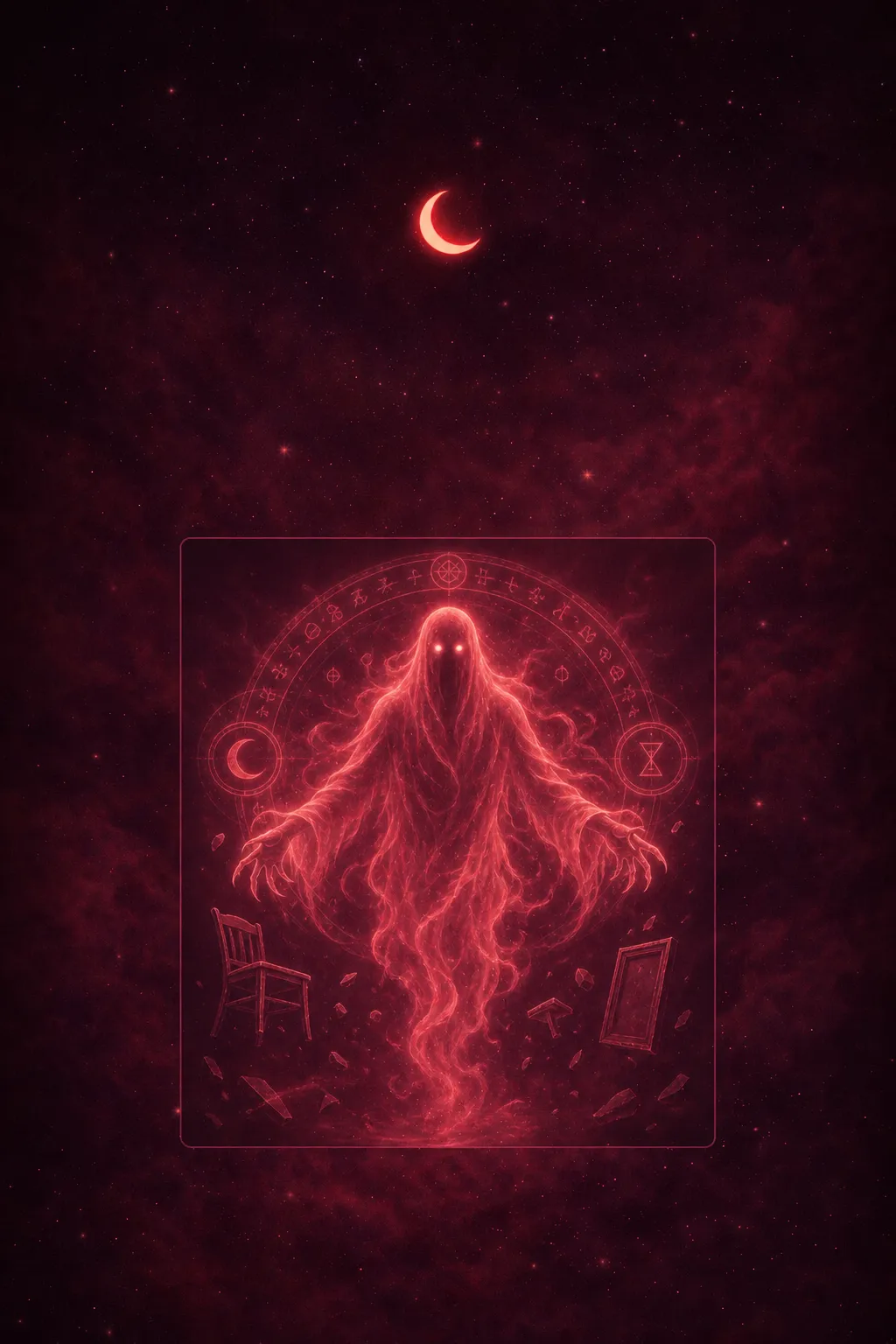

Dreaming of a poltergeist usually reflects repressed emotions, unresolved stress, or a situation in waking life that feels chaotic and out of control. The invisible, disruptive force of a poltergeist often mirrors inner turmoil you may be struggling to acknowledge. It can also signal anxiety about external forces — people or circumstances — that feel threatening or unpredictable.
In under a minute you could read what your exact dream means for you, and see a picture of it. Free.
A dream still on your mind? Get your personal reading.
Describe your dream in a line or two. In seconds you get a reading of your exact dream, a picture drawn from your own words, and every symbol explained.
Free. No sign-up. Takes 10 seconds. Your dream stays private.
0%
Analyzing your dream…
Something went wrong. Please try again in a moment.
Your dreams deserve more than a dictionary
Common Poltergeist Dream Scenarios
Objects Moving or Flying Around You
You're standing in a room — your kitchen, your childhood bedroom, somewhere familiar — and things start moving on their own. A chair slides. A glass shatters against the wall. Nothing touches you, but the violence in the air is unmistakable.
This scenario almost always reflects displaced emotion. The objects aren't random; they're yours. Your environment is the one erupting. Something you've been containing — grief, rage, resentment — has started leaking out in ways you can no longer manage quietly. The poltergeist isn't haunting you. It is you.
A bad dream isn't a bad sign.
Being Attacked or Physically Threatened by a Poltergeist
When the force turns on you — scratches appearing, being shoved, feeling pinned — the dream shifts from environmental chaos to direct threat. This is the dark entity made personal. It has found you specifically.
Dreams like this tend to surface when you feel victimized by something invisible in real life: a toxic dynamic at work, a relationship where the damage is hard to name, a pattern you keep falling into without understanding why. The poltergeist gives a shape to what has felt shapeless. That's actually the dream doing you a favor.
A Poltergeist in Your Childhood Home
There's a particular dread to finding an evil spirit in the home you grew up in. The place that was supposed to be safe, foundational, yours — now occupied by something hostile and unseen.
This variation often connects to unresolved family dynamics or old wounds you thought were long buried. Visiting your childhood home in dreams is already significant on its own; add a poltergeist and the dream is telling you something from that chapter of your life is still active, still moving things around in your psyche whether you invited it to or not.
Watching a Poltergeist Haunt Someone Else
You're the observer. The chaos is happening to another person — a friend, a stranger, sometimes someone you love — and you're watching helplessly or from a distance.
This scenario often reflects projected anxiety. You may be witnessing someone in your waking life spiral or suffer, and you feel unable to intervene. It can also signal guilt — a sense that your own unaddressed emotional static is affecting the people around you, even if they can't name the source. The presence in the room you're dreaming about may be the weight of what you haven't said.
What this dream could look like
Tap an image to open it full screen
Example images. Only you can see what you write in Dream Book.
Psychological Interpretation
Freud would have been fascinated by the poltergeist dream — and not because he believed in ghosts. For him, the unseen force causing destruction is a textbook image of the repressed unconscious. Everything you've pushed out of conscious thought doesn't disappear; it builds pressure. In Freudian terms, the flying objects and slamming doors are the return of the repressed, wish-fulfillment twisted into something terrifying because the original desire was never allowed expression.
Jung took a different angle. He saw the poltergeist as a manifestation of the Shadow — the part of the self that contains everything you've rejected, denied, or refused to integrate. The Shadow doesn't ask permission to show up. It erupts. Jung noted that the more rigidly we maintain our conscious self-image, the more violently the Shadow expresses itself when it finally breaks through. A poltergeist dream, in Jungian terms, is the Shadow throwing furniture. The work isn't to banish it — it's to finally turn around and look at it. This connects directly to spirit possession imagery, which Jung saw as symbolic of the ego being overwhelmed by an unintegrated complex.
But what does your version mean?
Calvin Hall's content analysis of over 50,000 dream reports found that threatening presences in dreams overwhelmingly correlate with real-life feelings of powerlessness and anxiety about loss of control. Hall was methodical about this: the dreamer rarely fights back effectively against these forces, which mirrors how people feel about the stressors driving the dream. The poltergeist — invisible, irrational, destructive — is a near-perfect symbol for the kind of threat that has no face you can confront.
Ernest Hartmann's emotional memory processing theory adds another layer. Hartmann argued that nightmares, especially recurring ones with powerful threatening imagery, are the brain's attempt to process and contextualize intense emotion — essentially running emotional simulations to find a way through. A poltergeist nightmare isn't a malfunction. It's your mind working hard on something that hasn't been resolved yet. Hobson and McCarley's activation-synthesis model would frame it differently — the brain's random neural firing during REM sleep, with the cortex reaching for the most emotionally resonant narrative to explain the signals. But even in that model, why a poltergeist? Because the raw material — the emotional charge — was already there waiting.
Every dream you log starts to connect.
Dream Book keeps your dreams in one place and reveals the threads between them over time — your private dream journal. Free to start.


Cultural & Spiritual Meaning
In Western folklore, poltergeists have always been associated with adolescent energy and emotional turbulence — the word itself is German for "noisy ghost," and historical accounts cluster around households with teenagers, particularly those under stress. The cultural intuition was always there: this kind of haunting is connected to human emotion, not external spirits. Modern Western spiritual traditions often interpret poltergeist dreams as a sign that unresolved emotional energy has built up to a breaking point and needs deliberate release.
Ibn Sirin, the 8th-century Islamic scholar whose dream interpretations remain among the most consulted in the Muslim world, wrote specifically about dreams involving invisible destructive forces. He interpreted such dreams as warnings — not of supernatural attack, but of hidden enemies or internal corruption that the dreamer has been unwilling to confront. For Ibn Sirin, the destruction in the dream was proportional to the scale of what was being ignored in waking life. The dream is mercy, not condemnation: it shows you what is already happening so you can act.
In many Indigenous traditions across the Americas and Africa, a dream of chaotic, disembodied force is taken as a signal that the dreamer's relationship with their ancestors or community has become disrupted — that something in the relational field needs tending. The poltergeist isn't evil so much as it is displaced. Healing the dream means healing the relationship that's been severed or neglected.
Related Dream Meanings
nightmares
Haunted House Dream Meaning: Fears, Trauma & Healing
5 min read

nightmares
Dark Entity Dream Meaning: Fear, Shadow & Hidden Self
6 min read
nightmares
Evil Spirit Dream Meaning: Fear, Inner Conflict & Shadow
6 min read

common dreams
Dreaming About Childhood Home Meaning - Dream Interpretation
5 min read

nightmares
Feeling Someone in Room Dream Meaning
5 min read

nightmares
What Does It Mean When You Dream About Being Possessed
6 min read

nightmares
Paralysis Dream Meaning: Helplessness & Loss of Control
5 min read

nightmares
Anger Dream Meaning: Stress, Conflict & Need for Change
5 min read
What to Do After This Dream
First: don't dismiss it. Poltergeist dreams have a way of returning, louder and more insistent, when you try to shake them off over morning coffee. They're asking for attention, not reassurance.
Was yours a sign? Find out.
Sit with the location of the dream. Was it your current home, your parents' house, somewhere from your past? The setting is a clue to the chapter of your life the dream is addressing. If the chaos centered on a specific room, ask yourself what that room represents — the kitchen (nourishment, family), the bedroom (intimacy, rest), the basement (the unconscious, what's hidden).
Write down what was being thrown or broken. Objects in poltergeist dreams are rarely random. A shattered mirror carries different weight than a toppled bookcase. Your instinctive associations with those objects matter more than any dictionary definition.
If this dream keeps returning, it's worth exploring with a personalized interpretation — Dream Book lets you describe your dream in detail and ask follow-up questions to understand what your subconscious is actually working through, not just what poltergeists mean in general.
Consider what you've been containing. Poltergeist dreams tend to spike during periods of prolonged stress, unspoken conflict, or grief that hasn't been allowed full expression. The dream isn't telling you something is wrong with you. It's telling you something inside you is ready to move.
A bad dream isn't a bad sign.
Understanding your poltergeist dream is the first step. The next is asking what it means for your life right now — that's where a personalized interpretation goes deeper than any dictionary.
If it keeps coming back, the app helps you understand the pattern.
Log each recurring dream and the free app shows you what's underneath — calmly, over time. Free to start.
People Also Ask
Dreaming about a poltergeist usually points to suppressed emotions — anger, grief, or anxiety — that have built up to the point of erupting in ways you can't control. The poltergeist is rarely an external threat; it most often represents something internal that demands your attention. Pay close attention to where the haunting takes place and what gets destroyed.
Not necessarily. While poltergeist dreams are unsettling, they're more often a signal than a warning — your mind flagging unresolved emotional tension that needs to be addressed. Many dream traditions, including Ibn Sirin's Islamic interpretations, view such dreams as a form of guidance rather than a curse.
Recurring poltergeist nightmares suggest the underlying emotional issue hasn't been resolved yet. Ernest Hartmann's research on nightmares found that the brain repeats threatening imagery until the emotional charge behind it is processed. Journaling, therapy, or exploring the dream in depth can help break the cycle.
A poltergeist in your childhood home points to unresolved wounds or dynamics from your early life that are still active in your psyche. It suggests something from that period — a family conflict, an old fear, an unprocessed loss — hasn't been fully integrated and is now demanding attention.
Curious what your dream would look like?