
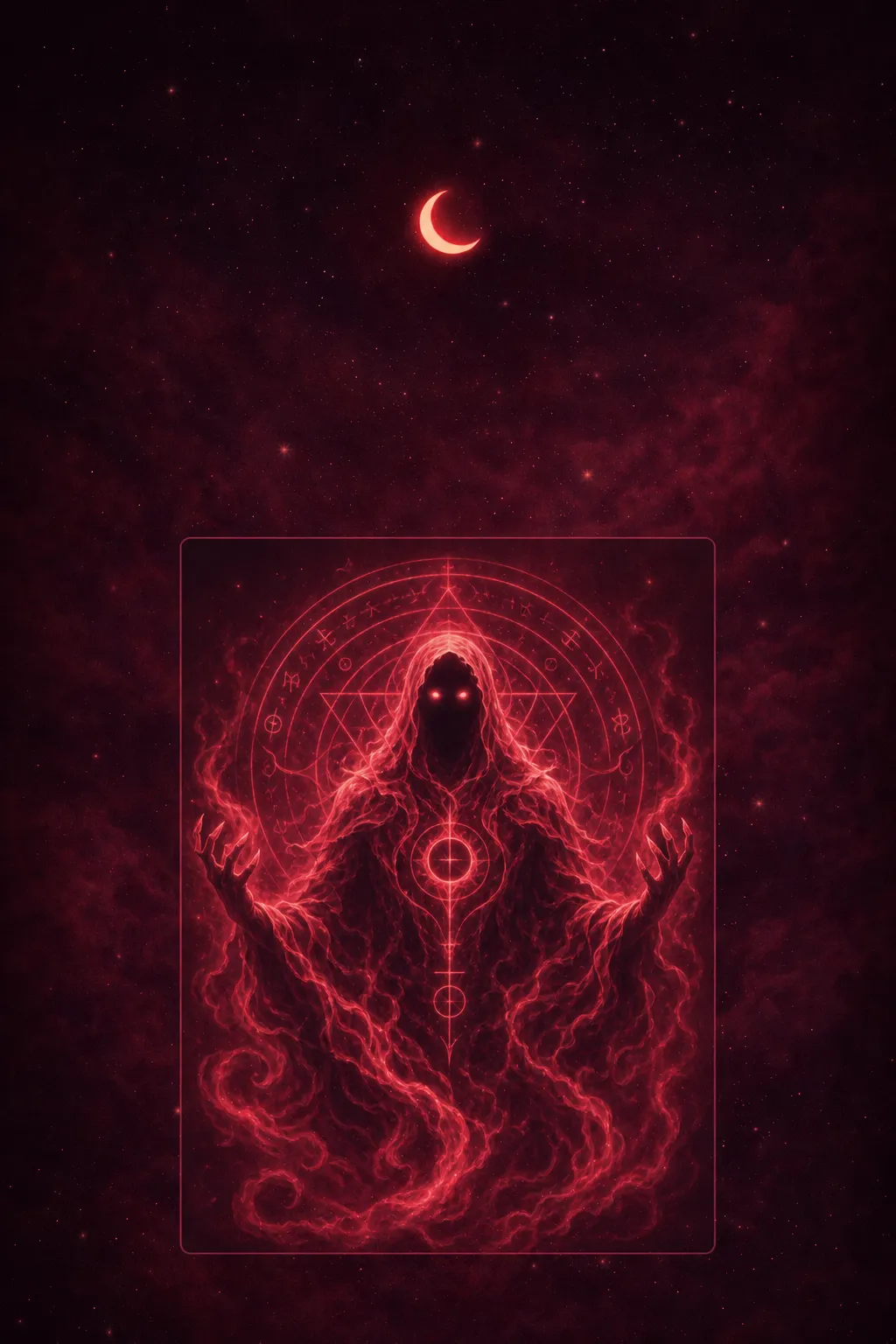

Dreaming of a dark entity often reflects suppressed emotions, unresolved fears, or an aspect of yourself you haven't fully acknowledged. It can speak to feelings of being overwhelmed, threatened, or controlled by something in your waking life. Rather than a bad omen, it may be an invitation to face what you've been avoiding.
In under a minute you could read what your exact dream means for you, and see a picture of it. Free.
Bad dream? See exactly what you dreamed — turned into a picture.
Just describe it and Dream Book paints your dream as a real image, plus a reading of what it means for you. Free, and it takes under a minute.


A dream still on your mind? Get your personal reading.
Describe your dream in a line or two. In seconds you get a reading of your exact dream, a picture drawn from your own words, and every symbol explained.
Free. No sign-up. Takes 10 seconds. Your dream stays private.
0%
Analyzing your dream…
Something went wrong. Please try again in a moment.
Your dreams deserve more than a dictionary
Common Dark Entity Dream Scenarios
A Dark Figure Standing at the Edge of the Room
You wake up — or you think you do — and something is standing in the corner. It doesn't move. It doesn't speak. But you feel it watching you with an attention that's almost physical, like pressure against your chest. This is one of the most reported nightmare experiences, and it tends to leave a residue that follows you into the morning.
This scenario is closely linked to what dreamers describe as a presence in the room — that creeping certainty that you are not alone. The figure rarely does anything dramatic. Its power is entirely in its stillness, its refusal to be named or explained. That's the point. Whatever this entity represents in your waking life, it hasn't been confronted yet.
A bad dream isn't a bad sign.
Being Chased or Cornered by a Dark Entity
Now the figure is moving. You're running — or trying to — and the entity is behind you. Your legs don't cooperate the way they should. The hallway stretches. The door won't open. If you've ever experienced that specific horror of running but being unable to move, you know how viscerally real this feels even after waking.
When a dark entity chases you, the dream is rarely about the entity itself. It's about what you're refusing to face. The shadow behind you moves at exactly the speed you run — it never overtakes you, but it never falls behind. That's your mind telling you something: whatever this represents, avoidance isn't working.
A Dark Entity Holding You Down
This variation crosses directly into sleep paralysis territory — you're frozen, pinned, and something dark is pressing down on you or crouching at the foot of the bed. You try to scream and the sound dies before it leaves your throat, the way it does in screaming-but-no-sound dreams. The terror is total.
Neurologically, this experience has a clear explanation — but that doesn't make it less disturbing. What's worth noting is that the entity in these dreams almost always feels intentional, like it chose you specifically. That feeling of being singled out by something malevolent is worth sitting with when you're fully awake and safe.
A Dark Entity That Looks Like Someone You Know
Sometimes the entity has a face — or almost has one. It wears the shape of a person you recognize, a family member, an ex-partner, a friend, but something is wrong. The eyes are wrong. The voice is wrong. The person is there and not there at the same time. This is one of the most unsettling variations because it implicates someone real.
Dreams like this often surface when a relationship has shifted into territory you haven't fully processed — betrayal, grief, anger you haven't let yourself feel. The dark entity borrows a familiar face because your mind is trying to attach a feeling to a source. It's not a literal indictment of that person. It's a map of your own unresolved emotional landscape.
What this dream could look like
Tap an image to open it full screen
Example images. Only you can see what you write in Dream Book.
Psychological Interpretation
Freud would look at a dark entity dream and ask what it's keeping hidden. In his framework, the threatening figure in a nightmare is often a distorted stand-in for a repressed wish or a forbidden impulse — the psyche's way of dramatizing internal conflict without letting it surface cleanly. The darkness isn't evil; it's the censor. What you can't look at directly gets dressed in shadow and placed at the edge of your dream.
Jung took the shadow literally. For him, the dark entity is almost a direct manifestation of what he called the Shadow Self — the parts of your personality you've disowned, suppressed, or refused to integrate. The entity's power grows in proportion to how hard you've worked to ignore it. Jung believed that when the Shadow appears in dreams as an external threat, it's an invitation: not to flee, but to turn around and look. He saw demons attacking in dreams not as signs of psychological damage but as the psyche's urgent push toward wholeness. The confrontation is the healing.
But what does your version mean?
Calvin Hall spent decades analyzing over 50,000 dream reports and found that threatening figures — strangers, monsters, shadowy presences — appear far more frequently in nightmares than any other type of character. His content analysis showed that these figures tend to cluster around periods of waking-life stress and unresolved interpersonal conflict. The dark entity, in Hall's data, isn't random. It correlates. It shows up when something in your daily life has reached a pressure point you haven't addressed.
Ernest Hartmann's emotional processing theory adds another layer. Hartmann argued that dreams — especially vivid, frightening ones — function like emotional therapy. The mind takes a feeling that's too large or too raw to process consciously and builds an image around it. A dark entity is often the dream's way of giving shape to something formless: dread, grief, shame, a threat you can't quite name. Hobson and McCarley's activation-synthesis model offers the neuroscience side: during REM sleep, the brain's limbic system fires intensely while the prefrontal cortex goes quiet. The emotional brain runs the show, and it reaches for the most potent imagery it has. Dark entities are what fear looks like when the rational mind steps out of the room. Both explanations are true, and neither cancels the other out.
General meanings end here. Read your own dream.
Describe your dream in a line or two. In seconds you get a reading of your exact dream, a picture drawn from your own words, and every symbol explained.
Free. No sign-up. Takes 10 seconds. Your dream stays private.
0%
Analyzing your dream…
Something went wrong. Please try again in a moment.
Your dreams deserve more than a dictionary
Every dream you log starts to connect.
Dream Book keeps your dreams in one place and reveals the threads between them over time — your private dream journal. Free to start.
Cultural & Spiritual Meaning
In Western esoteric and Christian traditions, dark entities in dreams have long been understood as spiritual adversaries — demons, fallen angels, or manifestations of evil testing the dreamer's faith or moral resolve. The evil spirit appearing at night is one of the oldest recorded dream fears in European history, documented from medieval dream manuals through to early modern theology. Whether you hold this framework literally or metaphorically, it captures something psychologically real: the sense that what appears in the dream is not neutral, that it carries intention.
Ibn Sirin, the 8th-century Islamic scholar whose dream interpretation tradition remains influential across the Muslim world, wrote specifically about dark and threatening figures in dreams. He interpreted a dark entity or malevolent presence as a warning — often pointing to an enemy in the dreamer's waking life, a hidden deception, or a spiritual vulnerability that needed attention through prayer and reflection. Crucially, Ibn Sirin also taught that the dreamer's emotional state during the dream matters enormously: if you faced the entity with courage, the outcome was considered favorable. If you fled in pure terror, the dream called for immediate spiritual examination.
Indigenous traditions across many cultures — from the Iroquois dream practices of North America to Aboriginal Australian dream cosmology — treat dark figures in dreams not as purely internal phenomena but as encounters with forces that exist beyond the individual self. In some traditions, the dark entity is an ancestor who hasn't been properly honored, or a spirit carrying a message the community needs to hear. The dreamer who encounters such a figure is often seen as someone with heightened perceptual sensitivity, not someone to be feared or pitied. What the West calls a nightmare, other traditions might call a calling.
Related Dream Meanings
nightmares
Feeling Someone in Room Dream Meaning
5 min read
nightmares
Running But Can't Move: Meaning and Interpretation
5 min read
nightmares
Sleep Paralysis Dream Meaning: Helplessness & Anxiety
5 min read
nightmares
Screaming But No Sound Dream Meaning: Helplessness & Silence
5 min read
people
Ex Partner Dream Meaning: What Your Dreams About Former Lovers Reveal
6 min read
nightmares
What Does It Mean When Demons Attack You in a Dream
6 min read
nightmares
Evil Spirit Dream Meaning: Fear, Inner Conflict & Shadow
6 min read
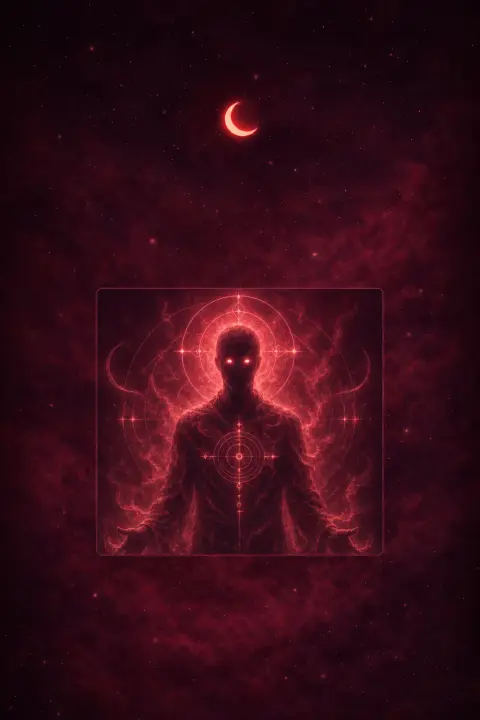
nightmares
Shadow Person in Dreams: What It Means When You See Them
5 min read
What to Do After This Dream
First: don't dismiss it as "just a bad dream." The dark entity dream is one of the most emotionally intense experiences the sleeping mind produces, and that intensity is information. Something in you generated this. That's worth respecting.
Was yours a sign? Find out.
Write it down immediately — not just the image, but the feeling. Where in your body did the fear live? Was it dread, shame, rage, grief? The emotion is usually more specific than the image, and it points more directly toward what's actually happening in your waking life. If the entity had a face or a quality that reminded you of something real, follow that thread.
Ask yourself what you've been avoiding. Dark entity dreams almost always surface during periods of suppression — when you're pushing something down hard enough that it has to find another exit. That could be a difficult conversation, a decision you're delaying, a feeling about yourself you haven't been willing to look at. The entity isn't there to destroy you. It's there because you haven't turned around yet.
If this dream keeps returning — same figure, same feeling, same paralysis — it's worth exploring with a personalized interpretation. Dream Book lets you describe exactly what you saw and felt, then ask follow-up questions to understand what your subconscious is actually working through. A recurring dark entity dream rarely means the same thing twice in a row; the details shift as the underlying issue evolves.
Consider the shadow person traditions in dream work: many therapists who work with nightmares encourage dreamers to re-enter the dream imaginatively while awake and ask the entity what it wants. This sounds counterintuitive — why would you want to face it again? Because in the waking re-entry, you have agency you didn't have in the dream. You can ask. You can listen. Often, what the entity "says" is something your own mind already knows.
A bad dream isn't a bad sign.
Understanding your dark entity dream is the first step. The next is asking what it means for your life right now — that's where a personalized interpretation goes deeper than any dictionary.
If it keeps coming back, the app helps you understand the pattern.
Log each recurring dream and the free app shows you what's underneath — calmly, over time. Free to start.
People Also Ask
A dark entity in a dream typically represents something unacknowledged in your own psychology — a repressed emotion, an unresolved conflict, or a part of yourself you've been avoiding. Jung called this the Shadow Self, and its appearance as a threatening figure is often the mind's way of demanding attention. The dream isn't a sign of danger; it's a sign that something internal has reached a pressure point.
In many spiritual traditions, including Islamic dream interpretation as recorded by Ibn Sirin, a dark entity signals a hidden threat, a spiritual vulnerability, or an enemy in waking life. Whether you approach this literally or symbolically, the core message is consistent: something in your environment or inner life requires honest examination. Pay attention to the emotional tone of the dream — fear mixed with a sense of being singled out is often the clearest signal.
Recurring dark figure dreams usually indicate an ongoing unresolved issue rather than a single event. The figure returns because the underlying emotional content — anxiety, suppressed anger, unprocessed grief — hasn't been addressed. Ernest Hartmann's research on emotional processing in dreams suggests that the mind will keep returning to the same image until the feeling it represents has been properly integrated.
Yes — the two frequently overlap. During sleep paralysis, the brain is partially awake while the body remains in REM-induced muscle atonia, and the limbic system generates intense, fear-based imagery. The dark figure pressing down or standing at the bedside is one of the most universally reported sleep paralysis hallucinations across cultures. Hobson and McCarley's activation-synthesis model explains this as the emotional brain constructing a narrative around the physical sensation of paralysis.
Curious what your dream would look like?