
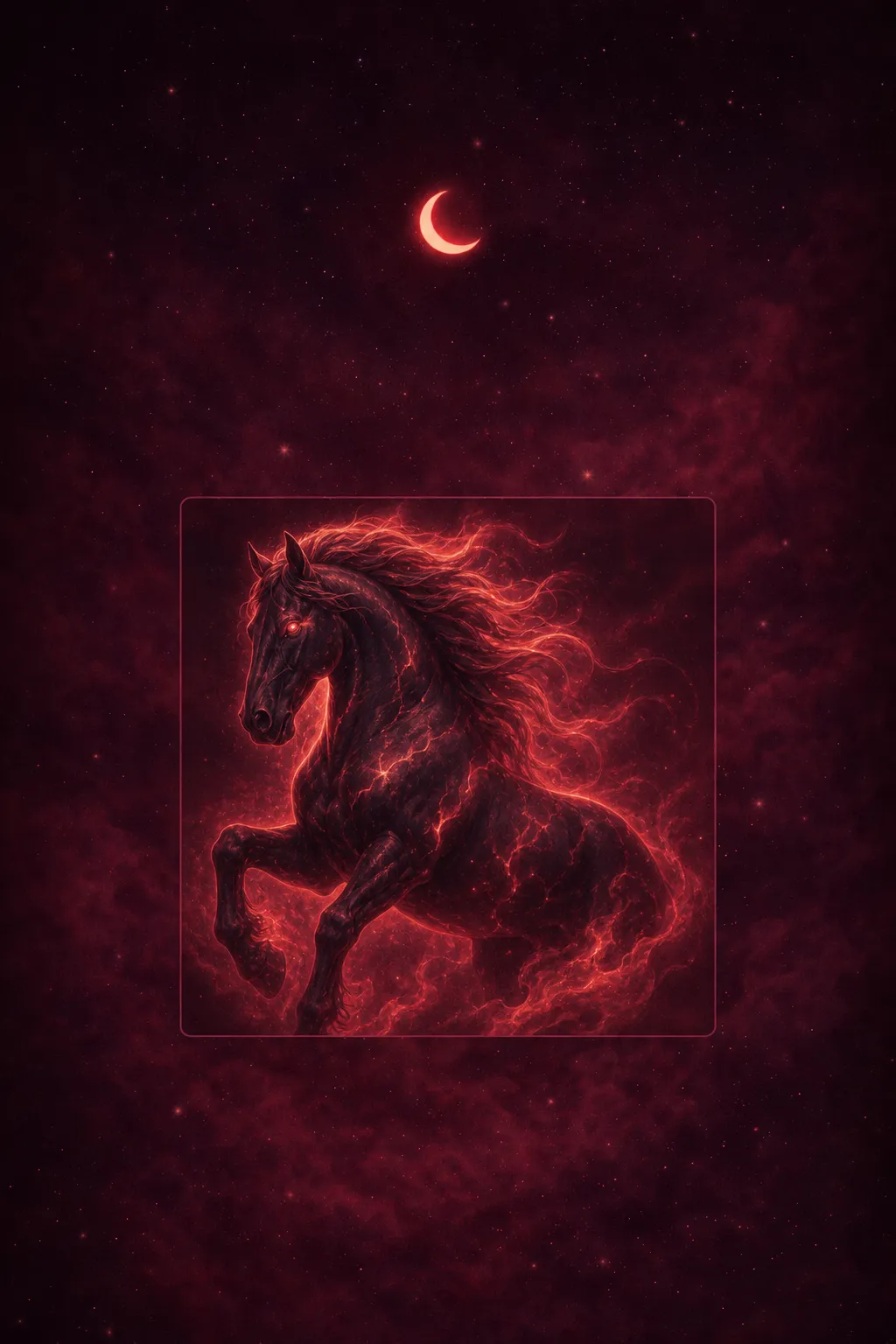

A black horse in a dream symbolizes raw power, mystery, and untamed freedom, often reflecting your subconscious drive to break free from constraints, embrace your shadow self, or harness hidden strength, and its appearance may signal a transformative period in which bold, instinct-driven decisions will shape your path forward.
In under a minute you could read what your exact dream means for you, and see a picture of it. Free.
A dream still on your mind? Get your personal reading.
Describe your dream in a line or two. In seconds you get a reading of your exact dream, a picture drawn from your own words, and every symbol explained.
Free. No sign-up. Takes 10 seconds. Your dream stays private.
0%
Analyzing your dream…
Something went wrong. Please try again in a moment.
Your dreams deserve more than a dictionary
Common Black Horse Dream Scenarios
The specific events surrounding the black horse shape its meaning considerably. The most frequently reported scenario — riding a black horse — centers on control. A smooth, confident ride suggests you are channeling a powerful ambition or desire effectively; a rough, unsteady one signals that a part of you fears your own intensity. If you dream of a black horse galloping wild or running away, the image captures unbridled energy that feels either thrilling or threatening depending on your waking relationship with spontaneity and change. Modern anxiety often surfaces here: the horse bolting can mirror a deadline spiraling out of reach or a life change that feels bigger than your ability to manage it.
- Black horse chasing you: An avoided emotion — anger, desire, or fierce ambition — is demanding attention. Much like other being-chased dreams, the pursuer typically represents something within rather than a genuine outside threat.
- A calm, still black horse standing at a distance: Latent strength waiting to be engaged. This scenario often arrives when you sense an untapped capacity in yourself but haven't yet committed to it.
- An injured or dead black horse: Points to burnout or the collapse of a driving goal — grief and fatigue are the dominant feelings, and the image asks you to acknowledge what has been lost rather than push through.
- Owning or caring for a black horse: Reflects a conscious, ongoing relationship with your own power — a sign of growing self-knowledge and a willingness to accept responsibility for your stronger instincts.
But what does your version mean?
Across all variants, the key interpretive question is the same: are you directing this energy, fleeing it, or simply witnessing it from a safe distance? Your answer in the dream usually mirrors where you stand in waking life.
What a dream about a black horse could look like
Tap an image to open it full screen
Example images. Only you can see what you write in Dream Book.
The Psychological Reading: Shadow, Drive, and the Unconscious
In psychological terms, the black horse is a near-perfect image of what Carl Jung called the shadow — the reservoir of impulses, desires, and raw energy that the conscious mind would rather not acknowledge. When this animal appears in a dream, your subconscious is almost certainly surfacing something powerful that waking life has been suppressing: unchecked ambition, repressed anger, sexual energy, or a drive toward freedom that daily responsibilities keep tightly reined in. The color black deepens that reading, signaling not evil but the unfamiliar — the part of yourself you haven't yet learned to name.
Modern anxiety adds a sharp edge to this symbolism. In an era defined by pressure to stay productive, predictable, and in control, the black horse can crystallize a core fear: that some force inside you — passion, grief, desire — is stronger than your ability to manage it. If the dream leaves you feeling pursued rather than empowered, the psychological message often points to avoidance: you may be running from an emotion or life change rather than integrating it. Common psychological themes the black horse tends to surface include:
- Suppressed ambition — a goal you want but feel guilty or afraid to pursue openly
- Unprocessed grief or loss — black historically signals mourning, and the horse may carry emotional weight you haven't sat with
- Fear of losing control — particularly relevant during major life transitions or periods of high stress
- Emerging self-knowledge — the horse appearing calm can signal readiness to own a part of yourself you once denied
Was yours a sign? Find out.
From a broadly Christian-influenced perspective, this kind of dream can function as an internal call toward honest self-examination — an invitation to bring what is hidden into the light rather than let unnamed drives steer your choices without your awareness.
Every dream you log starts to connect.
Dream Book keeps your dreams in one place and reveals the threads between them over time — your private dream journal. Free to start.


Cultural and Folk Traditions: The Black Horse as Omen and Icon
In Western cultural tradition, the black horse occupies a striking dual position — simultaneously heroic and foreboding. From the noble black steed of Romantic-era literature to the pale horse's dark companion in the Book of Revelation, this image has always carried both grandeur and unease. That biblical thread remains meaningful for many dreamers in a Christian context, where a black horse can prompt reflection on mortality or spiritual reckoning, though most modern readers treat it as one layer of meaning rather than a straightforward warning from above.
Anglo folk belief has long associated the color black with mourning and loss, which can tint a dream of a death-adjacent symbol like a black horse with grief or anticipatory anxiety. Yet that same tradition equally codes black as elegance, mystery, and latent power — think of the prestige attached to a sleek black stallion in equestrian culture. The older, minority folk tradition that reads a black horse strictly as a death omen has largely faded in everyday interpretation, surviving mainly as atmospheric flavor rather than a prediction anyone takes literally.
- Heroic coding: the black horse as a symbol of rare strength and independence, admired precisely because it is hard to tame.
- Mourning inflection: black's association with loss can signal grief or the end of a life chapter rather than literal death.
- Modern-anxiety layer: culturally, the untameable black horse resonates with contemporary fears about losing control — of circumstances, ambitions, or drives that feel larger than oneself.
Spiritual Meaning: Trial, Warning, and Sacred Power
For readers with a Christian frame of reference, the black horse carries unmistakable biblical weight. In Revelation 6:5, the Third Seal releases a black horse associated with scarcity and hardship — an image that lodges itself in the cultural memory even for those who are not deeply observant. Encountering this symbol in a dream can feel like a warning, and many believers instinctively read it as a call to examine where their sense of security is placed. Yet the broader Christian interpretive tradition encourages a less alarmed response: the powerful trial represented by the black horse is meant to be met with faith rather than dread, functioning as a test of character rather than a sentence of doom.
A bad dream isn't a bad sign.
Beyond scripture, many spiritually minded dreamers understand the black horse as a messenger from a deeper, less visible layer of the self — an invitation to honest self-examination. Its color links it to the symbolism of darkness, which in spiritual terms rarely means evil outright; more often it signals the hidden, the unacknowledged, or the not-yet-understood. Seen this way, the dream is less a threat and more a sacred prompt: something potent is asking to be recognized and integrated.
- Warning to reflect: A sense of looming scarcity or loss in waking life may be heightening the biblical resonance of this image.
- Test of faith or character: The horse's raw power mirrors an inner force that spiritual growth asks you to work with, not suppress.
- Hidden strength: Black in many spiritual traditions also represents latent power — the dream may be affirming reserves you have not yet drawn on.
Related Dream Meanings
nightmares
Being Chased Dream Meaning: Anxiety & Avoidance
5 min read
nightmares
Death Dream Meaning: Transformation, Loss & Change
5 min read
nightmares
Darkness Dream Meaning: Fear, Uncertainty & Hidden Self
5 min read

animals
Puppies Dream Meaning: What Your Dreams About Puppies Reveal
5 min read
animals
Dream of Centipedes: Meaning and Interpretation
5 min read
animals
Crabs: Meaning and Interpretation
5 min read
animals
Octopus Dream Meaning: What Your Subconscious Is Telling You
5 min read
animals
Dream of Peacock: Meaning and Symbolism in Dreams
5 min read
What to Do After a Black Horse Dream
Rather than brushing the dream off or catastrophizing it, treat it as a prompt for honest self-inventory. The black horse typically surfaces when a powerful drive — ambition, anger, desire, grief — has been running quietly beneath your daily awareness. A useful first step is to write down, immediately after waking, the single strongest emotion the dream left you with. That feeling is the thread worth pulling.
- Map what feels out of control. If the ride felt wild or frightening, identify one area of your waking life where you feel you are losing your grip — a deadline, a relationship, a habit. Name it specifically rather than letting the anxiety stay abstract.
- Locate the suppressed drive. If the horse felt thrilling rather than threatening, ask what ambition or desire you have been quietly shelving. Dreaming of raw power is often the mind's way of nudging you toward action you have been avoiding.
- Check your stress load. Modern life excels at burying instinctive warning signals under routine. A recurring black horse dream — much like a dream of being chased — is frequently a sign that sustained pressure needs a practical outlet: structured rest, a difficult conversation, or a boundary set.
- Sit with the unknown rather than rushing to resolve it. Not every shadow element needs immediate fixing. Sometimes the healthiest response is simply acknowledging that a part of you is stirring, and giving it room to clarify over days.
But what does your version mean?
In short, use the dream as a dashboard light — not a verdict, but reliable information that something beneath the surface deserves your attention.
One dream is never the whole picture.
The free app remembers your dreams, draws them, and connects the threads over time — so the next one means even more. Free to start.
People Also Ask
Spiritually, a black horse represents mystery, hidden power, and transformation. It often signals that unconscious forces are at work in your life, urging you to explore deeper truths. Many traditions view it as a symbol of untamed strength and independence, suggesting you are entering a period of profound personal change.
In Revelation 6:5, a black horse appears ridden by a figure holding scales, symbolizing famine and economic hardship. It is the third of the Four Horsemen. Dreaming of a black horse may therefore reflect subconscious fears about scarcity, injustice, or imbalance in your waking life circumstances.
Dreaming of a horse is generally considered positive, symbolizing freedom, vitality, and personal drive. The experience leans negative only when the horse appears threatening or out of control. Context matters enormously — a calm horse signals confidence and progress, while a wild or dark horse may warn of suppressed emotions needing attention.
Black in dreams spiritually represents the unknown, the subconscious, and hidden potential. It is not inherently negative; rather, it points to depth and mystery. Black can signal a threshold moment — something unacknowledged is ready to surface. Combined with a powerful animal like a horse, it amplifies themes of raw, transformative inner energy.
Curious what your dream would look like?