
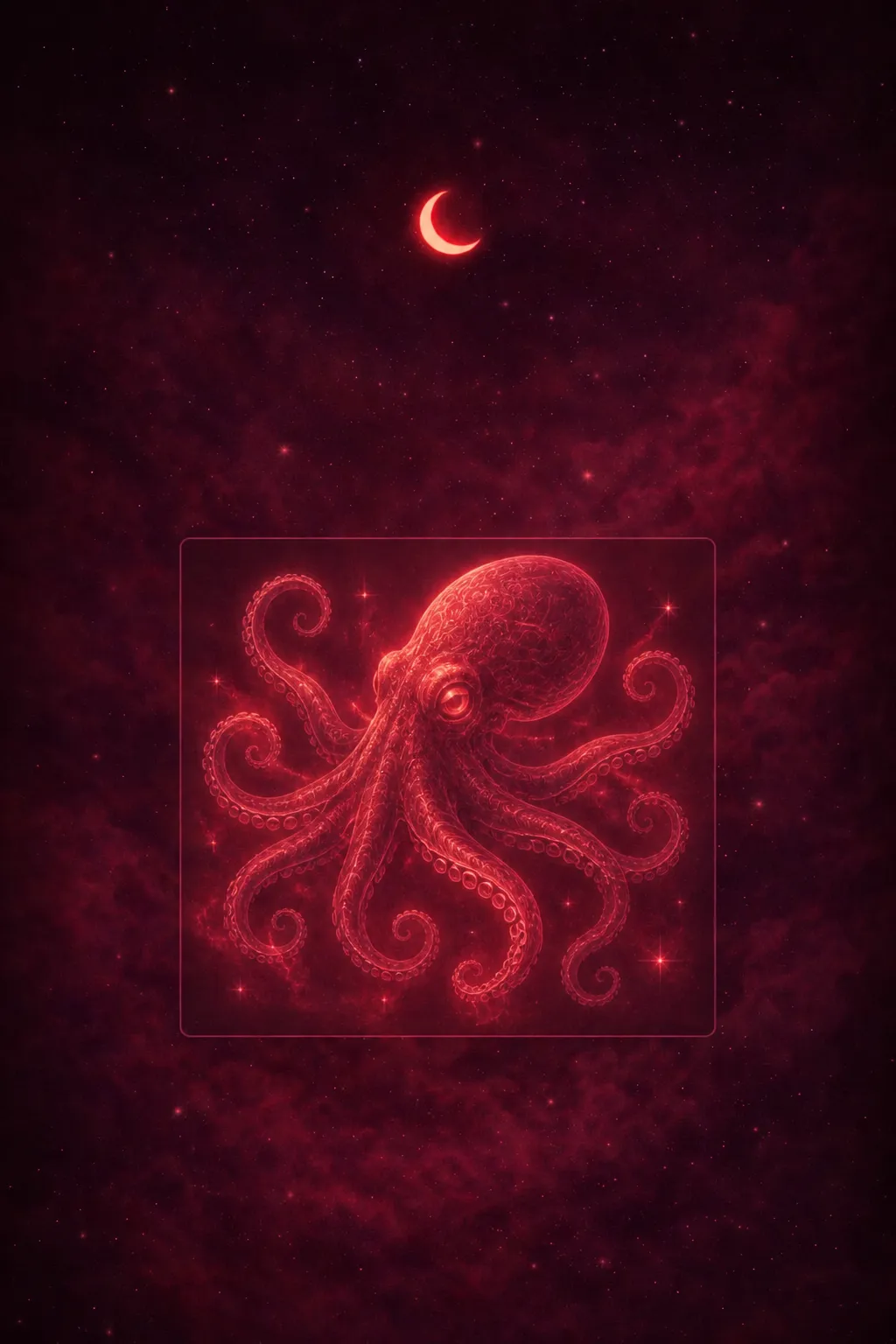

An octopus in a dream symbolizes complexity, adaptability, and the ability to handle many situations at once, often reflecting a dreamer's need to manage multiple responsibilities, emotional entanglements, or hidden influences pulling them in different directions simultaneously.
In under a minute you could read what your exact dream means for you, and see a picture of it. Free.
You read what it can mean. But what did yours mean?
General meanings stop here. In the free app, tell Dream Book your exact dream and get a reading that actually makes sense for you.


Common Octopus Dream Scenarios
The specific way an octopus appears in your dream shifts its meaning considerably. Pay attention to whether you felt trapped, fascinated, or in control — that emotional texture is often the real message. At Dream Book we explore this symbol in depth.
- An octopus grabbing or wrapping around you: This is one of the most unsettling variants and typically reflects feeling emotionally engulfed — by a demanding relationship, a job, or an obligation you can't easily escape. It maps directly onto enmeshment and control dynamics, asking whose grip you're currently under.
- Watching an octopus use many arms at once: A classic modern-anxiety image. The dream is holding up a mirror to your overloaded schedule — too many responsibilities pulling in too many directions, with a quiet fear that something will slip through the cracks.
- An octopus moving calmly underwater: A more reassuring scene. Gliding peacefully through a complex, fluid environment suggests you're handling competing demands with genuine adaptability rather than being overwhelmed by them.
- An octopus releasing ink or hiding: Points to concealment — either you're clouding an issue to avoid a difficult conversation, or someone around you is being deliberately evasive. Something is being obscured that may need to surface.
- A giant octopus or kraken rising from the deep: When the creature is monstrous in scale, it usually represents a fear or problem your waking mind has been avoiding. Its sheer size signals that the issue feels beyond your current capacity to handle.
- Eating or cooking octopus: An encouraging sign — symbolically, you're taking in and mastering something that once felt overwhelming, turning complexity into something you can work with.
But what does your version mean?
Across all these variants, the central question is the same: are you the one reaching, or are you the one being held?
What this dream could look like
Tap an image to open it full screen
Example images. Only you can see what you write in Dream Book.
The Psychological Reading: Divided Attention, Hidden Stress, and the Stretched Self
From a psychological standpoint, an octopus in a dream is a vivid externalization of cognitive and emotional overload. Its eight arms are a near-perfect metaphor for the modern anxiety of being pulled in too many directions at once — deadlines, relationships, roles, and responsibilities each claiming a separate limb of your attention. When the unconscious reaches for this image, it is often signaling that your inner resources are spread dangerously thin. The dreaming mind is not being dramatic; it is translating a genuine stress load into a symbol you cannot ignore.
The creature's intelligence and adaptability carry a more hopeful undercurrent. Jung's framework of the shadow fits neatly here: the octopus may represent a capable, resourceful part of yourself that operates below the surface — concealed, like an animal that hides in ink. If you felt fascination rather than dread during the dream, the unconscious may be nudging you toward greater self-knowledge, inviting you to own your own complexity rather than suppress it. In a broadly Christian-influenced reading, this concealment can also evoke a call to honesty — to stop camouflaging struggles and bring hidden burdens into the light.
Boundary and control are the psychological heart of this symbol. The grasping tentacles can represent either your own tendency to cling — to people, outcomes, or a need to manage everything — or the feeling that something external is refusing to let go. Key questions worth sitting with after this dream:
Was yours a sign? Find out.
- Where in waking life do you feel overwhelmed and unable to surface for air?
- Are you the one overreaching, or do you feel another person or situation is clutching you too tightly?
- What are you concealing — from others, or from yourself — under the ink of busyness or deflection?
General meanings end here. Read your own dream.
Describe your dream in a line or two. In seconds you get a reading of your exact dream, a picture drawn from your own words, and every symbol explained.
Free. No sign-up. Takes 10 seconds. Your dream stays private.
0%
Analyzing your dream…
Something went wrong. Please try again in a moment.
Your dreams deserve more than a dictionary
Cultural Traditions and Folk Beliefs: The Many-Armed Omen
Across seafaring cultures, the octopus has long carried a dual reputation — at once a creature of remarkable cunning and a symbol of something dangerously entangling. In Norse-influenced northern European folklore, echoes of the Kraken myth cast any tentacled sea creature as an agent of chaos lurking beneath a calm surface, much like anxieties that build quietly before pulling a person under. That image of being seized from below maps neatly onto the modern dread of obligations that accumulate unseen until they feel overwhelming — a culturally inherited way of picturing stress that has lost none of its force.
Within American folk spirituality and broadly Christian reading of nature symbolism, the octopus rarely appears in scripture directly, but its traits — concealment, grasping reach, the ability to escape through misdirection — have been interpreted as cautions against deception, both in others and in oneself. Dreaming of one can prompt reflection on where a person may be deflecting accountability or hiding their true emotional state from those closest to them.
- Sailor superstition: Spotting an octopus was historically an ambivalent omen — admired for its intelligence yet feared for its grip, suggesting a situation requiring respect rather than recklessness.
- Control and reach: Folk wisdom in coastal communities often used the octopus as shorthand for an authority figure — a landlord, creditor, or employer — whose influence seemed to extend everywhere at once.
- Hidden depths: Much like dreams set in the open ocean, octopus imagery in traditional belief pointed to matters concealed beneath a composed exterior, urging the dreamer toward honest self-examination.
The Spiritual Reading: Stewardship, Hidden Depths, and the Entangled Soul
From a spiritual perspective, the octopus touches on themes of stewardship and the soul's capacity to spread itself too thin. In a broadly Christian reading, the creature's many arms can evoke the warning woven through Proverbs and the Epistles against anxious striving — the sense that grasping at too many things at once signals a failure to trust and surrender control. If the dream leaves you feeling overwhelmed or ensnared, it may be read as an invitation to examine where willpower has outrun wisdom, and whether certain "arms" of your life are reaching beyond what is spiritually sustainable.
A bad dream isn't a bad sign.
The octopus's talent for concealment adds another layer. Its ink-cloud defense maps onto the spiritual tradition of hidden sin or self-deception — the things we camouflage even from ourselves. Many prayer and contemplative traditions hold that genuine self-knowledge requires bringing concealed burdens into the light rather than retreating behind a defensive fog. Dreaming of murky water surrounding an octopus can feel like an echo of that challenge, not unlike the fear of being overwhelmed that surfaces in other water-centered dreams.
- Overextension as a spiritual signal: too many commitments may be crowding out stillness and discernment.
- Grasping imagery: spiritually points to attachment — clinging to outcomes, relationships, or control rather than releasing them.
- Concealment and light: the ink-cloud motif invites honest self-examination and confession of what is being hidden.
- Adaptability as grace: the octopus's intelligence also hints at spiritual flexibility — the capacity to respond to change with creativity rather than fear.
Related Dream Meanings
common dreams
Ocean Dream Meaning: Emotions, Change & the Subconscious
5 min read
nightmares
Drowning Dream Meaning: Overwhelm, Fear & Hidden Stress
5 min read
animals
Dreaming of Elephants Meaning: What Your Dream Reveals
5 min read
animals
Black Cat Dream Meaning: Intuition, Mystery & Bad Luck
5 min read
animals
Ants Dream Meaning: Hard Work, Teamwork & Community
5 min read
animals
Crows Dream Meaning: Transformation, Intuition & Messages
5 min read
animals
Owls Dream Meaning: Wisdom, Intuition & Hidden Knowledge
5 min read
animals
Dragons Dream Meaning: Power, Fear & Transformation
5 min read
Practical Takeaways: What to Do After an Octopus Dream
Rather than letting the image fade by morning, use it as a concrete prompt for an honest audit of your current load. Grab a notepad and list every commitment, relationship, or obligation pulling at your attention right now — then ask which ones you genuinely chose and which ones crept in through habit, guilt, or people-pleasing. The octopus dream tends to surface when that distinction has blurred dangerously.
- Map your "arms": Write out the five to eight roles or responsibilities dominating your week. Circle any that feel more like a grip on you than a choice you're making. That circle is where to start negotiating, delegating, or saying no.
- Check for concealment: The octopus hides behind ink. Ask yourself whether you've been downplaying stress — to your boss, your family, or yourself. Naming the pressure out loud, even in a journal, breaks the evasion loop.
- Set one hard boundary this week: Not five — one. Overextension usually worsens because people try to reform everything at once, then give up entirely.
- Notice who or what feels "grasping": If the dream involved being held rather than holding, explore whether a relationship dynamic (not just a workload) needs a direct, calm conversation about space and limits.
But what does your version mean?
If the sense of being overwhelmed in the dream was intense and recurs across different symbols in your sleep, that pattern is worth raising with a therapist — not because the dreams are dangerous, but because recurring imagery of engulfment is one of the mind's clearest signals that waking-life stress has crossed a threshold worth addressing professionally.
One dream is never the whole picture.
The free app remembers your dreams, draws them, and connects the threads over time — so the next one means even more. Free to start.
People Also Ask
Spiritually, the octopus represents adaptability, mystery, and hidden wisdom. Its eight arms symbolize the ability to reach into multiple realms simultaneously. Many traditions associate it with psychic awareness, depth of intuition, and the unconscious mind — encouraging you to explore what lies beneath the surface of everyday awareness.
Dreaming of an octopus attacking you often signals feeling overwhelmed, controlled, or suffocated in waking life. Someone or something may be clinging to you with too many demands at once. It can reflect a toxic relationship, workplace pressure, or an inner fear of losing your independence and personal boundaries.
Octopuses commonly symbolize complexity, intelligence, and multitasking. They can represent a situation with many moving parts, a person who is difficult to pin down, or your own capacity to juggle multiple responsibilities. They also carry themes of camouflage, suggesting hidden emotions or truths you — or others — are concealing.
A calm, non-threatening octopus in a dream suggests you are coming to terms with complexity in your life. It signals creative problem-solving, emotional flexibility, and confidence in handling multiple challenges at once. This dream often appears when you are learning to embrace uncertainty and trust your own resourcefulness and adaptability.
Curious what your dream would look like?