
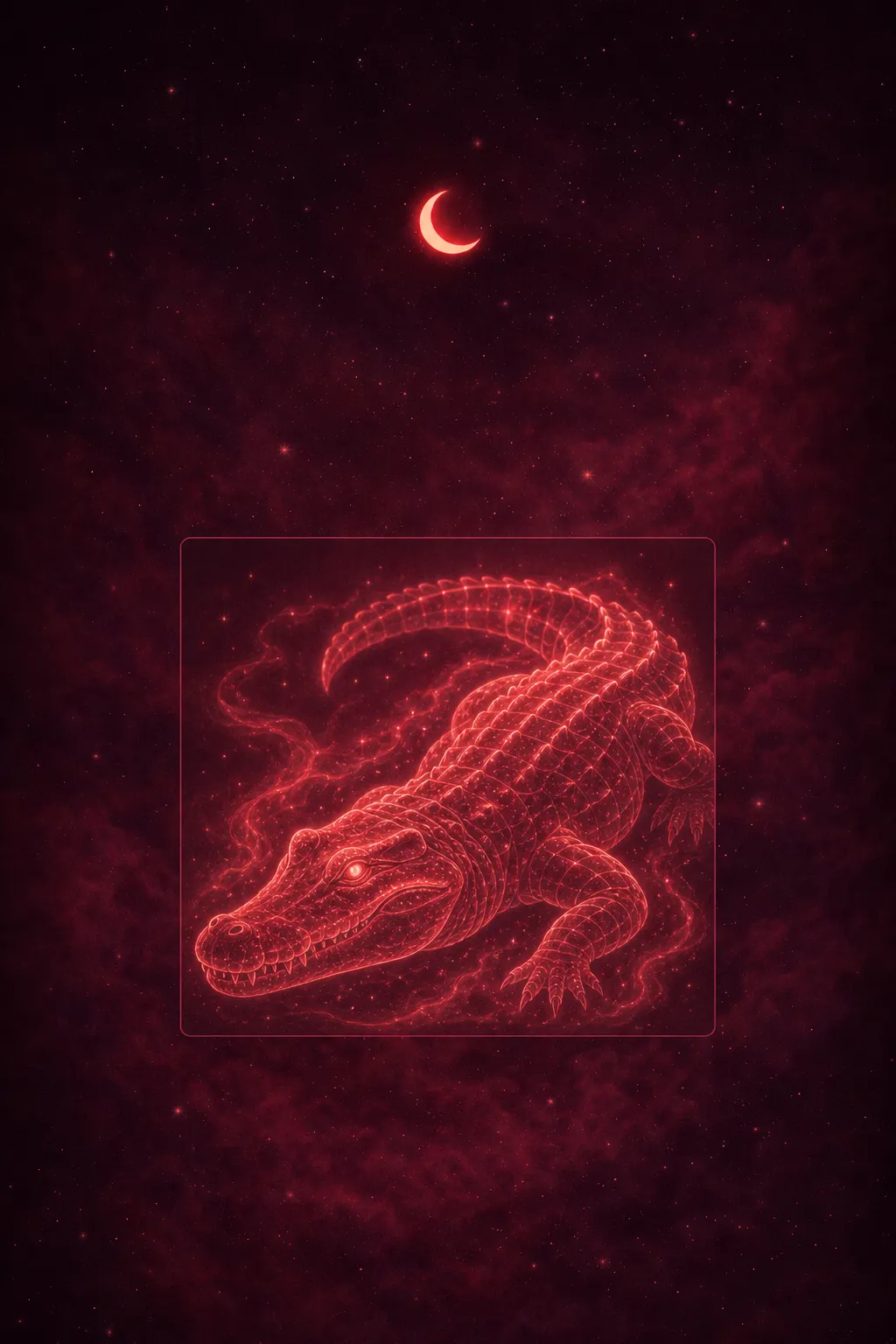

A crocodile in a dream meaning points to hidden danger, primal instincts, or a deceptive threat lurking beneath the surface of your waking life, often urging you to trust your gut, stay alert to betrayal, and confront fears or powerful emotions you may have been avoiding.
In under a minute you could read what your exact dream means for you, and see a picture of it. Free.
You read what it can mean. But what did yours mean?
General meanings stop here. In the free app, tell Dream Book your exact dream and get a reading that actually makes sense for you.


A dream still on your mind? Get your personal reading.
Describe your dream in a line or two. In seconds you get a reading of your exact dream, a picture drawn from your own words, and every symbol explained.
Free. No sign-up. Takes 10 seconds. Your dream stays private.
0%
Analyzing your dream…
Something went wrong. Please try again in a moment.
Your dreams deserve more than a dictionary
Common Crocodile Dream Scenarios and What They Mean
The specific details of your crocodile dream shift its message considerably. A crocodile submerged in murky water, eyes just above the surface, typically reflects a threat you can sense but not fully see — a tense work situation, a strained relationship, or a creeping anxiety that hasn't yet broken into the open. If the crocodile attacks or chases you, the pressure has become harder to ignore; much like dreams of being chased, this scenario points to feeling overwhelmed by a conflict or a person whose aggression you can no longer sidestep. Being bitten carries a sharper sting: something you assumed was safe has turned on you, suggesting betrayal or a consequence you failed to anticipate.
- Escaping a crocodile — a sign of resilience; you are finding ways to cope and narrowly avoiding real harm, even if the stress hasn't fully resolved.
- Killing or taming the crocodile — one of the more empowering outcomes; you are reclaiming control over a fear, an angry impulse, or a threatening situation that once felt larger than you.
- A crocodile basking calmly on land — deceptive stillness; the danger is dormant but very much present, urging you not to let your guard down prematurely.
- Multiple crocodiles — feeling surrounded by stressors or hostile people, with no clear escape route.
- A baby crocodile — a small problem currently easy to dismiss, but one that carries real potential to grow if left unaddressed.
But what does your version mean?
Across all these variants, the central question your dreaming mind is raising is one of awareness and agency: have you acknowledged what is lurking beneath the surface of your waking life, and do you feel equipped to handle it?
What a dream about a crocodile could look like
Tap an image to open it full screen
Example images. Only you can see what you write in Dream Book.
What Your Psyche Is Really Saying
From a psychological standpoint, dreaming of a crocodile almost always points to something lurking in the unconscious that you haven't fully acknowledged — raw anger, resentment, or a craving you've been keeping just below the surface. Jung would frame the creature as classic shadow material: a primal, reptilian drive that hasn't been integrated into your waking self-image. Freud would go further and read it as repressed aggression turning back on the dreamer — the fear of being consumed by an appetite or impulse you'd rather not own. Either way, the emotional logic is the same: the crocodile is the part of you that feels dangerous, and the dream is the mind's way of forcing a confrontation with it.
Modern anxiety adds another layer. In a culture where stress often comes from situations that appear stable but feel perpetually precarious — a job that could vanish, a relationship that runs hot and cold — the crocodile becomes a near-perfect symbol of hypervigilance. You know the threat is there; you just can't pin it down. That half-seen quality mirrors the way water in dreams often represents the partly conscious: emotions you're aware of but haven't let yourself fully feel. If the crocodile in your dream belonged to someone else, or seemed falsely docile, your subconscious may be flagging a two-faced figure in your life — someone whose apparent calm masks manipulation, the classic "crocodile tears" dynamic.
- Unprocessed anger: The crocodile often surfaces when long-suppressed resentment is finally demanding attention.
- Loss of control: Fear of being overwhelmed by an instinct, habit, or external pressure you can't manage.
- Interpersonal distrust: A subconscious warning about insincerity or hidden aggression in someone close to you.
- Empowerment signal: Subduing or taming the crocodile in a dream suggests growing confidence in handling your own shadow impulses.
General meanings end here. Read your own dream.
Describe your dream in a line or two. In seconds you get a reading of your exact dream, a picture drawn from your own words, and every symbol explained.
Free. No sign-up. Takes 10 seconds. Your dream stays private.
0%
Analyzing your dream…
Something went wrong. Please try again in a moment.
Your dreams deserve more than a dictionary
Every dream you log starts to connect.
Dream Book keeps your dreams in one place and reveals the threads between them over time — your private dream journal. Free to start.
Crocodile Dreams in Culture and Folk Belief
In English-speaking cultures, the crocodile carries a rich symbolic weight that goes well beyond wildlife documentaries. The idiom crocodile tears — false grief performed to deceive — is so deeply embedded in everyday speech that it colors how many people instinctively read a crocodile dream: as a warning about insincerity, manipulation, or someone in your waking life who projects calm while concealing selfish motives. If a dream leaves you unsettled but you can't immediately name the threat, folk intuition often points toward a person rather than a situation — someone whose friendly surface masks a readiness to strike.
Was yours a sign? Find out.
Wider popular culture reinforces the apex-predator image through decades of wildlife programming and sensational news coverage of crocodile attacks. That media drumbeat has lodged the creature firmly in the collective imagination as the embodiment of sudden, lethal ambush — danger that waits with absolute patience before erupting without warning. This maps neatly onto modern-anxiety concerns: an unpredictable job market, a relationship that feels stable until it doesn't, or the low-grade dread of threats you can sense but not control. Much like dreams of being chased, a crocodile encounter often externalizes pressures that feel relentless and just out of reach.
From a broadly spiritual angle shared across many Western traditions, the crocodile also represents ancient, primal power — something older and less governable than the rational mind. In that light, subduing or escaping the animal in a dream can be read as a culturally affirming sign: a signal that you are reclaiming control over whatever hidden force has been running quietly beneath your everyday life.
The Crocodile as Spiritual Warning
Within a Christian reading, the crocodile's hidden, patient menace maps naturally onto biblical imagery of devouring evil. Job 41 describes Leviathan — a sea beast of overwhelming, unchallengeable power — as a symbol of chaos that only God can restrain. First Peter 5:8 warns that the adversary prowls like a predator seeking someone to devour, and the crocodile's signature stillness before it strikes fits that portrait uncomfortably well. If your dream left you with a sense of spiritual unease rather than simple fear, many believers would read it as a prompt to examine what unseen influence — a toxic relationship, a compromising habit, a slow drift from your values — may be lying just below the surface of your daily life, much as snake dreams carry their own warnings of hidden deceit.
A bad dream isn't a bad sign.
Beyond explicitly Christian frameworks, a broader spiritual lens treats the crocodile as a call to discernment. The creature does not announce itself; it waits. In an era defined by information overload and constant low-grade anxiety, that image resonates as a reminder to trust your instincts about situations or people that feel deceptively calm. Spiritually, the dream may be asking whether you are exercising enough watchfulness — not paranoia, but the grounded, clear-eyed attention that allows you to sense a threat before it surfaces.
- Leviathan / serpent echoes: a force of deceit or chaos you are being called to resist, not ignore.
- Discernment: the dream as a nudge to pray, reflect, or seek counsel about something that feels spiritually "off."
- Self-mastery: subduing the crocodile in a dream can signal growing control over your own destructive impulses — a spiritually positive sign.
Related Dream Meanings
nightmares
Being Chased Dream Meaning: Anxiety & Avoidance
5 min read
common dreams
Water Dream Meaning: Emotions, Intuition & Growth
5 min read
animals
Snakes Dream Meaning: Fear, Change & Hidden Threats
5 min read
animals
Black Cat Dream Meaning: Intuition, Mystery & Bad Luck
5 min read
animals
Ants Dream Meaning: Hard Work, Teamwork & Community
5 min read
animals
Crows Dream Meaning: Transformation, Intuition & Messages
5 min read
animals
Owls Dream Meaning: Wisdom, Intuition & Hidden Knowledge
5 min read
animals
Dragons Dream Meaning: Power, Fear & Transformation
5 min read
What to Do After a Crocodile Dream
Because the crocodile almost always signals something hidden building under the surface, the most useful first step is a brief, honest audit of your waking life. Ask yourself where you've been sensing tension without naming it — a colleague whose friendliness feels forced, a financial pressure you've been postponing, or your own irritability that keeps leaking out in small ways. Writing it down the morning after the dream is often enough to convert a vague, anxious feeling into a specific problem you can actually address.
- Name the hidden stressor. Crocodile dreams thrive on avoidance. Identify the one situation you've been circling rather than confronting.
- Check your anger levels. If you've been suppressing frustration at work or in a close relationship, find a low-stakes outlet — exercise, journaling, or a direct but calm conversation — before it surfaces in a less controlled way.
- Assess who around you seems calm but feels off. If the dream featured someone else alongside the crocodile, trust that instinct enough to set clearer personal boundaries with that person.
- Reduce ambient anxiety. Recurring chase-and-threat dreams often cluster when overall stress is high; improving sleep hygiene and cutting doomscrolling can lower the frequency.
But what does your version mean?
The goal isn't to over-analyze a single dream but to use it as a prompt for the kind of self-check you were probably already overdue for.
One dream is never the whole picture.
The free app remembers your dreams, draws them, and connects the threads over time — so the next one means even more. Free to start.
People Also Ask
Crocodiles in dreams can be both. They often warn of hidden danger, deceit, or a threatening person in your life. However, they can also signal raw power, survival instincts, and resilience. Context matters greatly — a calm crocodile suggests controlled strength, while an attacking one points to unresolved fear or a genuine threat approaching.
Spiritually, the crocodile represents primal energy, ancient wisdom, and the shadow self. It guards the threshold between the conscious and unconscious mind. Seeing one urges you to confront hidden truths, embrace transformation, or acknowledge powerful emotions you have been suppressing. Many traditions view it as a symbol of both destruction and regeneration.
Biblically, the crocodile is linked to Leviathan — a fearsome creature symbolizing chaos, evil, and forces opposed to God. Dreaming of one may reflect spiritual warfare, moral danger, or a situation where deception is at work. It can serve as a divine warning to stay spiritually alert and guard against corrupting influences in your life.
In Hindu tradition, the crocodile or 'makara' is sacred and associated with Varuna, god of water and cosmic order. Dreaming of one can indicate powerful karmic forces at work, a test of courage, or an ancestral message. It may also warn of enemies hiding beneath a calm surface, urging careful discernment in relationships and decisions.
Curious what your dream would look like?