
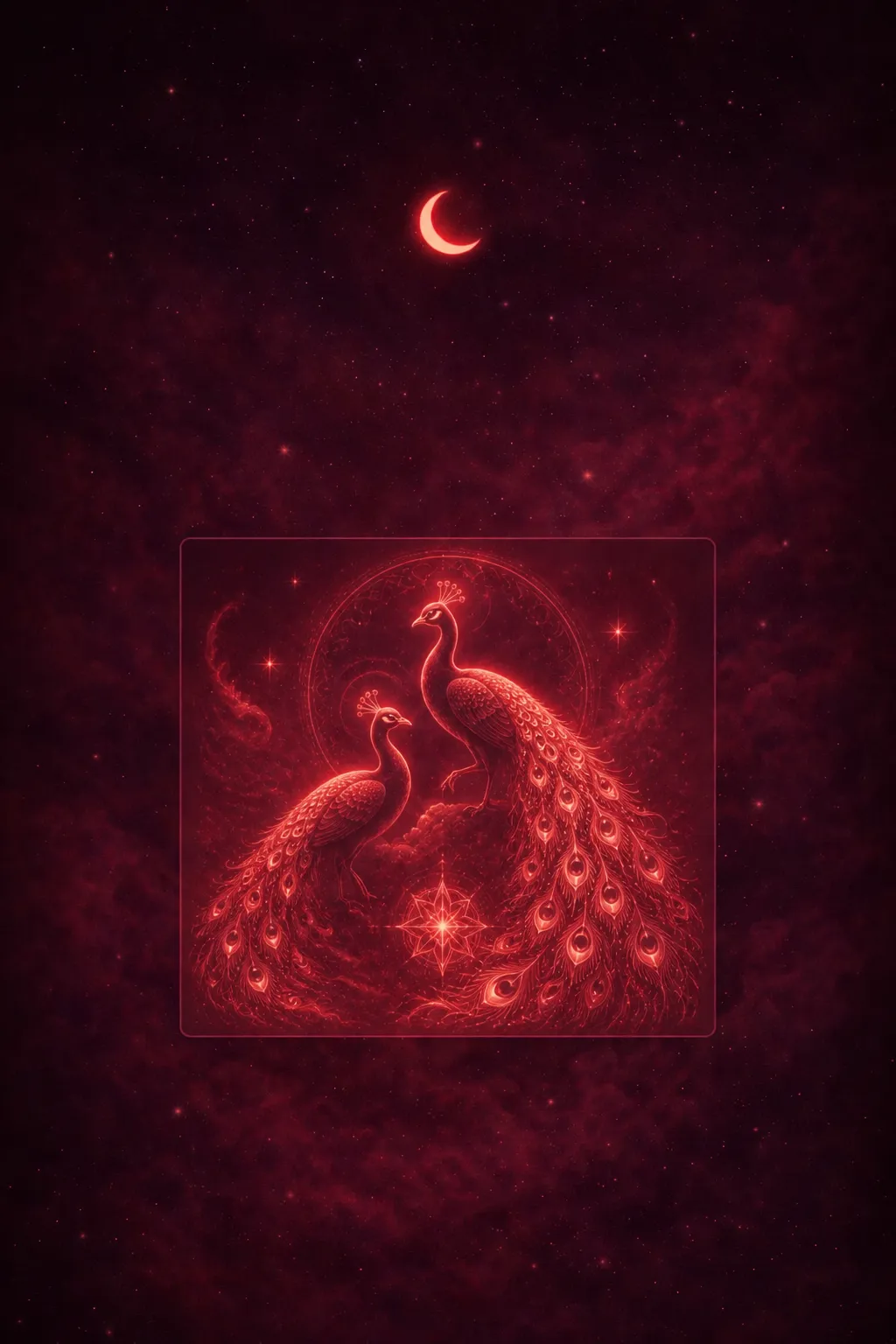

Dreaming of a peacock symbolizes pride, confidence, and self-expression, suggesting that you are stepping into your own power, embracing your unique gifts, and inviting others to recognize your true worth, though it can also caution against vanity or the fear that your outward beauty masks deeper insecurities.
In under a minute you could read what your exact dream means for you, and see a picture of it. Free.
You read what it can mean. But what did yours mean?
General meanings stop here. In the free app, tell Dream Book your exact dream and get a reading that actually makes sense for you.


Common Peacock Dream Scenarios and Their Meanings
The scenario in which a peacock appears shifts the interpretation considerably. A calm, serene peacock simply crossing your path often signals emerging confidence — your mind is beginning to accept your own value without apology. In contrast, a peacock fanning its full tail directly at you carries a more ambivalent charge: it can feel thrilling yet exposed, pointing to the tension between wanting recognition and fearing that visibility invites criticism. In an age of social media and constant comparison, this scenario frequently surfaces when waking life demands you put yourself forward — a presentation, a creative risk, a public role — and anxiety about how you will be judged is running high. At Dream Book we explore this symbol in depth.
- Peacock displaying its tail: Desire for recognition meeting fear of overexposure; examine whether your self-presentation feels authentic or performed.
- Peacock screeching loudly: A disruptive bid for attention — yours or someone else's — signaling conflict or an urgent need to be heard.
- White or unusually colored peacock: A sense of standing apart; may carry a quiet spiritual undertone of renewal or purity of purpose.
- Peacock chasing or attacking you: Pride — your own or another person's — feels threatening; social judgment has turned aggressive in the dream space.
- Dead, injured, or caged peacock: Suppressed self-expression or wounded confidence; something is preventing your sense of worth from being seen.
- A single peacock feather as the central image: Beauty distilled to a fragment — but note the feather's eye-like pattern, which can signal a feeling of being watched or quietly judged.
But what does your version mean?
Across all these variants, the key psychological question is the same: how much control do you feel over how you are seen? Dreams of peacocks rarely let that question rest unanswered.
What this dream could look like
Tap an image to open it full screen
Example images. Only you can see what you write in Dream Book.
Psychological Meaning of Peacocks in Dreams
From a psychological standpoint, dreaming of a peacock almost always circles back to the tension between how you genuinely feel about yourself and the image you project to the world. Impression management sits at the heart of this symbol: your subconscious may be surfacing a quiet anxiety about whether the version of you that others see is authentic or carefully constructed. When the bird spreads its tail in a dream, it can act as a kind of mirror — forcing you to ask whether the display reflects real confidence or a compensation for underlying insecurity.
Modern life amplifies this tension considerably. Social comparison, curated online personas, and the constant pressure to stand out in professional or social circles can generate exactly the psychological noise a peacock dream dramatizes. If the bird in your dream feels threatening or overwhelming rather than beautiful, that discomfort may be pointing to ego inflation anxiety — a fear of being perceived as arrogant — or equally, a fear of being seen at all. A Christian-influenced sense of pride as moral risk can layer into this, making the dream feel like an internal warning rather than a celebration.
- Over-display as a red flag: A frantically fanning peacock may signal that waking-life self-promotion is masking self-doubt.
- Individuation signal: A peacock emerging from shadow can represent a colorful, expressive part of your identity finally being integrated rather than suppressed.
- Recognition hunger: Dreaming of others admiring the bird often reflects an unmet need for validation in group, workplace, or family dynamics.
- Control and exposure: Feeling watched by the peacock's eye-spotted feathers echoes social-anxiety themes — the sense that judgment is inescapable.
General meanings end here. Read your own dream.
Describe your dream in a line or two. In seconds you get a reading of your exact dream, a picture drawn from your own words, and every symbol explained.
Free. No sign-up. Takes 10 seconds. Your dream stays private.
0%
Analyzing your dream…
Something went wrong. Please try again in a moment.
Your dreams deserve more than a dictionary
Cultural and Traditional Meanings of Peacocks in Dreams
In Anglo-American folk tradition, the peacock has long served as the defining emblem of pride and ostentatious display — "proud as a peacock" remains one of the most enduring idioms in the English language. That cultural weight doesn't disappear when the bird walks into your dreams. Historically, the peacock's extravagant plumage was read as a warning against vanity, a thread that runs through Western Christian moralizing where pride tops the list of deadly sins. Dreaming of a peacock can therefore carry a gentle cultural nudge: the tradition is asking whether your desire to be seen is rooted in genuine confidence or in a performance staged for others' approval.
Was yours a sign? Find out.
The striking eye-like markings on the peacock's tail add another layer of folk symbolism. Many traditions associate those eyespots with watchfulness — the sense of being observed from all directions. In an era defined by social media and constant visibility, that motif lands with particular force. The cultural memory of the peacock as an all-seeing, all-displaying creature maps neatly onto modern anxieties about public image, comparison, and the pressure to stand out without overstepping.
- Pride and vanity: A longstanding Western caution against display that outpaces genuine worth.
- Luxury and status: Peacocks historically adorned royal gardens, linking the bird to ambition and social aspiration.
- Watchfulness: The eyespot motif connects to folk ideas about being seen, judged, or exposed.
- Flamboyance: Standing apart from the crowd — admired in some cultural moments, suspect in others.
Spiritual Meaning of Peacocks in Dreams
Within a Christian spiritual frame, the peacock carries a genuinely double-edged message. Early church iconography embraced the bird as a symbol of immortality and renewal — its feathers were seen to "die" each winter and return in even greater splendor, a natural echo of resurrection and God's capacity to restore what is lost. If the peacock in your dream feels luminous rather than threatening, that older, hopeful reading may be the one worth sitting with: something in your spirit is being renewed, not simply put on display.
A bad dream isn't a bad sign.
Yet the dominant spiritual caution the peacock raises is the classic pride-versus-humility tension that runs through Proverbs and the New Testament alike. Vanity — performing worth rather than receiving it as grace — is treated in Christian tradition as a subtle spiritual trap precisely because it mimics genuine confidence so closely. In an era of curated social feeds and constant visibility, that warning feels newly urgent: the dream may be nudging you to examine whether your need for recognition has quietly edged into territory that crowds out authentic faith, gratitude, or self-knowledge. Gazing at a reflection that only shows you at your best is not the same as truly knowing yourself.
- Peacock in full display: A call to check whether pride is masking deeper insecurity rather than expressing genuine worthiness.
- Peacock with dull or damaged feathers: Spiritually, a prompt toward humility — worth does not depend on outward brilliance.
- Peacock at rest, feathers folded: Inner renewal quietly underway; confidence grounded in something more lasting than approval.
Related Dream Meanings
animals
What Does It Mean to Dream About Feathers
5 min read
nightmares
Mirror Dream Meaning: Self-Reflection & Hidden Truths
5 min read
body health
Eyes Dream Meaning: Perception, Insight & Hidden Truths
5 min read
animals
Spiders Dream Meaning: Fear, Creativity & Entrapment
5 min read
animals
Dogs Dream Meaning: Loyalty, Protection & Friendship
5 min read
animals
Cats Dream Meaning: Independence, Intuition & Mystery
5 min read
animals
Fish Dream Meaning: Emotions, Abundance & Creativity
5 min read
animals
Horses Dream Meaning: Freedom, Power & Ambition
5 min read
What to Do After a Peacock Dream: Practical Next Steps
When a peacock shows up in your dream, treat it as a prompt for honest self-audit rather than a verdict. Before the feeling fades, jot down one specific situation in your waking life where you feel pressure to perform — a job interview, a social media presence, a relationship dynamic. Ask yourself whether your energy is going into genuine growth or into managing how others perceive you. That gap, however small, is where the dream is pointing.
- Track the trigger. Note what happened in the 24–48 hours before the dream. A spike in social comparison — scrolling feeds, receiving criticism, preparing for public scrutiny — is often the direct catalyst.
- Audit one display habit. Pick a single area where you routinely curate your image (social media, workplace persona, appearance) and ask whether it reflects who you actually are or who you hope to seem.
- Practice low-stakes visibility. If the dream felt anxious, deliberately share something genuine and imperfect with a trusted person. Exposure on your own terms gradually reduces the fear of being truly seen — much like studying a mirror honestly rather than only checking your best angle.
- Set one boundary around comparison. Identify one recurring comparison that drains you and schedule a concrete break from it this week.
But what does your version mean?
None of these steps require grand gestures. The peacock dream rarely demands a personality overhaul; it asks for one honest look at the distance between your inner sense of worth and the image you feel compelled to maintain.
One dream is never the whole picture.
The free app remembers your dreams, draws them, and connects the threads over time — so the next one means even more. Free to start.
People Also Ask
Spiritually, the peacock represents renewal, immortality, and the awakening of the soul. Dreaming of one often signals a period of personal transformation, inner wisdom emerging, or a call to embrace your authentic self. Many traditions see the peacock as a guardian of spiritual vision and higher consciousness.
A peacock appearing in your dream typically reflects themes of confidence, self-expression, and ambition. It may suggest you are ready to display your talents proudly or that recognition is on its way. Alternatively, it can warn against vanity or the need to impress others at the cost of genuine connection.
Generally, seeing a peacock in a dream is considered very good luck. It symbolizes prosperity, beauty, and success ahead. However, if the peacock appeared dull, aggressive, or lost its feathers, it may caution against overconfidence or signal that something admired from afar is not what it seems.
In biblical tradition, the peacock symbolizes eternal life and resurrection, linked to early Christian art where it represented incorruptibility. Dreaming of a peacock through this lens can suggest spiritual renewal, God's glory being revealed in your life, or an encouragement to walk faithfully toward an everlasting promise.
Curious what your dream would look like?