
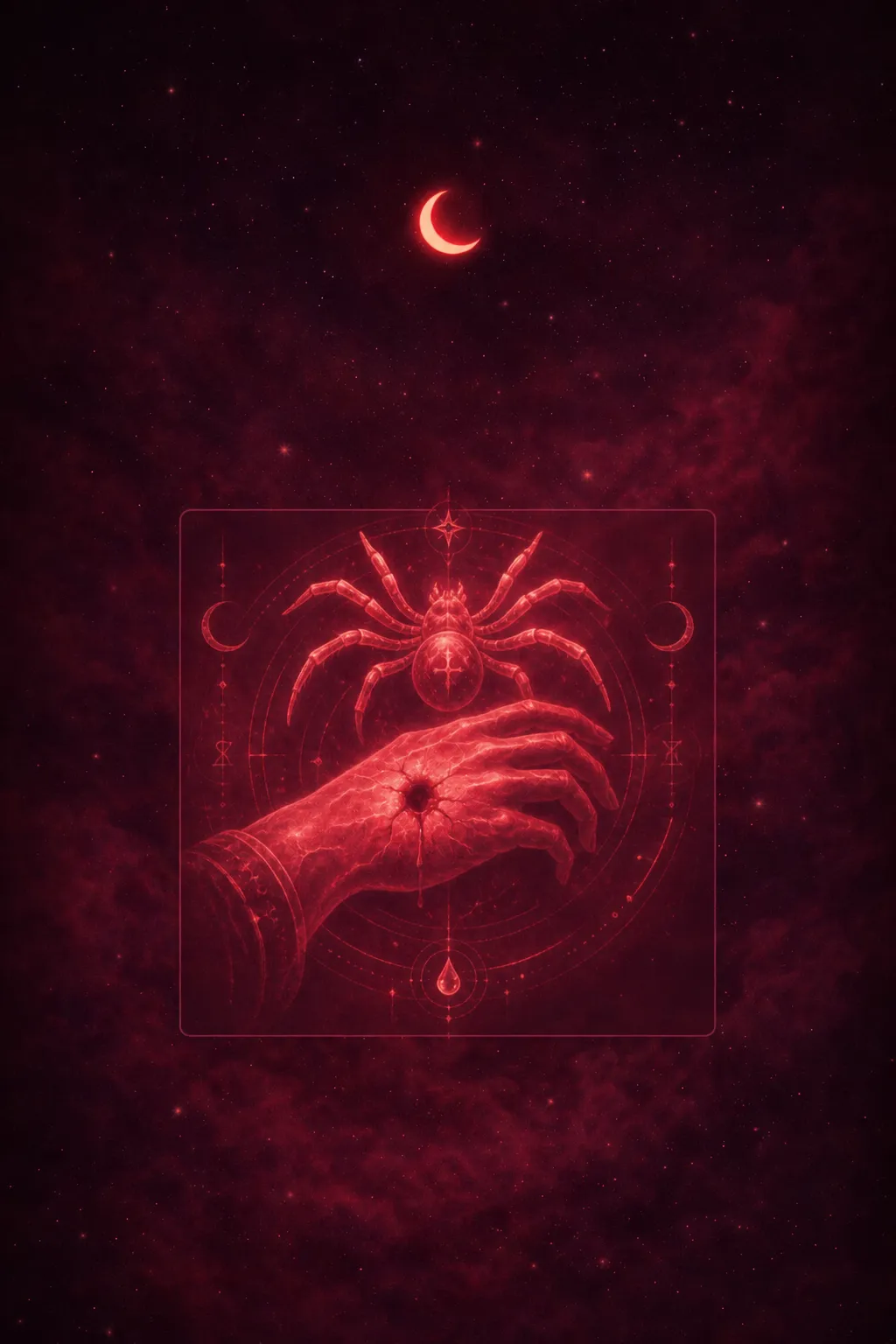

Dreaming about a spider bite typically means you feel wounded by someone's sharp words or manipulative behavior in waking life, signaling that a toxic relationship or hidden threat has finally broken through your defenses and is now demanding your emotional attention before the psychological venom spreads further.
In under a minute you could read what your exact dream means for you, and see a picture of it. Free.
Bad dream? See exactly what you dreamed — turned into a picture.
Just describe it and Dream Book paints your dream as a real image, plus a reading of what it means for you. Free, and it takes under a minute.


A dream still on your mind? Get your personal reading.
Describe your dream in a line or two. In seconds you get a reading of your exact dream, a picture drawn from your own words, and every symbol explained.
Free. No sign-up. Takes 10 seconds. Your dream stays private.
0%
Analyzing your dream…
Something went wrong. Please try again in a moment.
Your dreams deserve more than a dictionary
Common Spider Bite Dream Scenarios and Their Meanings
The setting and body location of a spider bite dream shift its meaning considerably. A sudden, unprovoked bite — where the spider appears from nowhere — is the most frequently reported variant, and it maps closely onto modern anxiety: something in waking life struck without warning, leaving the dreamer feeling exposed and stripped of control.
Dreaming of being bitten suddenly and without warning
A bite that comes from nowhere points to a stressor or hurtful event that struck before the dreamer could prepare. The central feeling here is lost control — a reminder that not every threat announces itself, and that the psyche is still processing the shock of that exposure.
A bad dream isn't a bad sign.
Dreaming of a spider bite on the hand or arm
A bite on the hand or arm narrows anxiety to a specific area of agency — a project at work, a task in progress, or something the dreamer has personally set in motion that now feels compromised or quietly "poisoned." The wound is close to action itself.
Dreaming of a bite that swells, festers, or keeps hurting
Lingering pain or spreading venom points to unresolved resentment or a worry that has been left to grow; the dream is pressing for attention before the damage spreads further.
Dreaming of being bitten on the face or neck
Touches identity and social standing — a fear of public embarrassment or a perceived threat to reputation. The vulnerability here is outward-facing, tied to how others see the dreamer.
Dreaming of being bitten then killing or removing the spider
A psychologically hopeful sign; even after being hurt, the dreamer moves toward confronting the source and reclaiming a sense of control. It suggests the capacity to respond rather than simply absorb the harm.
Dreaming of a spider bite but feeling no pain, or noticing only later
Suggests delayed emotional processing — a real hurt has registered on some level but has not yet broken through to conscious feeling, or is being quietly denied.
But what does your version mean?
Dreaming that someone else — a child or partner — is bitten
Reflects protective anxiety; the dreamer fears that someone vulnerable in their life is exposed to harm they cannot fully shield them from. Across all these variants, the connecting thread is the tension between being hurt and regaining self-possession.
What this dream could look like
Tap an image to open it full screen
Example images. Only you can see what you write in Dream Book.
Psychological Meaning of a Spider Bite Dream
From a psychological standpoint, dreaming of a spider bite does something precise that generalized anxiety dreams rarely do — it localizes the wound. Rather than a diffuse sense of dread, the mind is pinpointing a specific person, decision, or event as the source of distress. Pay attention to where on the body the bite lands: a bite to the hand often signals anxiety around agency and what you are — or feel unable to — do; one to the foot suggests uncertainty about direction or a major life choice; a bite to the face points toward identity, reputation, or how others perceive you. The subconscious is being unusually specific, and that precision is worth taking seriously.
The venom that spreads after the initial sting is psychologically rich. It mirrors rumination — the way a cutting remark, a betrayal, or a stressful event doesn't simply hurt once but keeps circulating, coloring mood and thought long after the moment has passed. This lingering quality frequently surfaces in dreams when a relationship has turned quietly toxic: someone trusted has gotten too close and caused harm, and the psyche registers it as poisoning rather than simple conflict. A mild Christian-influenced reading would frame this as a prompt to examine whether forgiveness or honest confrontation is being delayed, letting the "venom" do more damage through inaction.
The loss-of-control element is equally significant. The bite arrives fast and unbidden — a precise mirror for modern stressors that ambush rather than approach openly. Key psychological signals to reflect on include:
- Rumination loops — is an old hurt still spreading through your thinking?
- Entrapment feelings — do obligations or a relationship feel like a web closing in?
- Somatic awareness — the dream may be the body flagging real physical unease the waking mind is brushing aside.
- Agency anxiety — a sense that events or people are acting on you rather than with you.
Taken together, the spider bite dream is the subconscious calling for honest self-examination: identify the source, trace where the harm has spread, and reclaim a sense of conscious control over the response.
General meanings end here. Read your own dream.
Describe your dream in a line or two. In seconds you get a reading of your exact dream, a picture drawn from your own words, and every symbol explained.
Free. No sign-up. Takes 10 seconds. Your dream stays private.
0%
Analyzing your dream…
Something went wrong. Please try again in a moment.
Your dreams deserve more than a dictionary
Every dream you log starts to connect.
Dream Book keeps your dreams in one place and reveals the threads between them over time — your private dream journal. Free to start.
Cultural and Folk Readings of a Spider Bite Dream
In Anglo folk tradition the spider occupies genuinely ambivalent territory. The old rhyme "If you wish to live and thrive, let a spider run alive" reflects a longstanding belief that spiders are quietly protective household presences — patient, industrious, and best left undisturbed. A bite, then, is a meaningful violation of that uneasy truce. It tips the symbol away from craft and endurance toward intrusion and harm, suggesting that something once tolerated in the background has now crossed a boundary and made itself felt.
Was yours a sign? Find out.
Modern colloquial language reinforces this reading in a telling way. English speakers routinely describe damaging relationships, workplaces, or habits as "toxic" or "poisonous" — the venom metaphor is already woven into everyday speech. Dreaming of spider venom entering the body maps almost instinctively onto that vocabulary: a slow-acting negative influence, perhaps financial pressure, a draining colleague, or a nagging health worry, that has quietly escalated until the body registers the sting. The bite is small and easy to dismiss, which is precisely what makes it unsettling.
- Patience turned predatory: folk ambivalence about spiders means the bite signals a trusted or overlooked presence becoming a source of harm.
- Venom as creeping influence: the cultural "toxic people" framework gives this dream immediate modern resonance around control and self-protection.
- A call to inventory: traditional folk readings often treat such dreams as prompts to identify what — or who — has been allowed too close for too long.
Spiritual Meaning of a Spider Bite Dream
Within a broadly Christian frame, the spider bite carries a quiet but pointed warning. Venom entering the body through a hidden creature echoes the biblical motif of the deceiver — the subtle adversary who does not strike openly but works through small, unguarded moments. Just as the serpent in Genesis introduced harm through a seemingly minor exchange, a spider bite in a dream may signal that something spiritually corrosive has already slipped past the dreamer's defenses: a half-truth entertained too long, a relationship pulling subtly in the wrong direction, or a habit not yet serious enough to feel urgent.
Many believers interpret this dream as a wake-up prompt — a nudge from conscience or, in more devotional readings, from the Spirit — to examine small compromises before the "venom" spreads. The bite's characteristic delay fits this reading well: the wound is real before the pain is fully felt, mirroring how moral or spiritual drift tends to register only after it has taken hold.
- Guard the small gates. Spiritually, the dream asks whether a minor influence or temptation is being waved off as harmless.
- Inventory hidden stressors. The bite can represent an anxiety the dreamer has not yet brought into prayer, reflection, or honest conversation.
- Act before escalation. The bite's urgency is its smallness — a call to address a budding issue while it is still manageable, not catastrophic.
Related Dream Meanings

animals
Spider Web Dream Meaning: Trapped, Creative & Entwined
5 min read
animals
Snakes Dream Meaning: Fear, Change & Hidden Threats
5 min read

body health
Teeth Falling Out Dream: Anxiety, Loss & Vulnerability
5 min read

nightmares
Poltergeist Dream Meaning: Chaos, Repression & Fear
5 min read

nightmares
Speaking With Dead Dream Meaning: Grief & Guidance
6 min read

nightmares
Sinking Ship Meaning - Symbolism & Interpretation
5 min read

nightmares
Dead Grandfather Meaning - Symbolism & Interpretation
6 min read

nightmares
Dreaming of Dead Uncle Meaning - Dream Interpretation Guide
6 min read
What to Do After a Spider Bite Dream: Practical Takeaways
Because this dream points to something specific that has gotten under your skin — a pointed comment, a slow-building worry, a trust that feels quietly compromised — the most useful first step is simply naming it. Grab a notebook within a few minutes of waking and write down who or what surfaced in the dream. The mind rarely produces this kind of localized image without a real-life referent, and getting it on paper moves the anxiety from background noise into something you can actually examine and address.
- Trace the source. Ask yourself honestly: where in my daily life do I feel a small but persistent sting — a relationship, a workplace dynamic, a habit I keep avoiding? The dream is flagging something specific, not a general mood.
- Check what you are not saying. Spider bite dreams often surface when a boundary has been crossed and left unchallenged. Consider whether a direct, calm conversation is overdue.
- Distinguish manageable worry from rumination. If the dream recurs, it may signal that your nervous system is stuck in a loop. Practical stress-reduction routines — structured problem-solving, limiting news intake, or speaking with a counselor — can interrupt that cycle before it deepens.
- Take one concrete action. Control is best restored through small, deliberate steps. Choose one thing related to the source of tension that you can realistically act on this week.
A bad dream isn't a bad sign.
The dream is not a verdict — it is an alert. Treating it as useful feedback rather than a bad omen puts agency back in your hands, which is exactly where it belongs.
If it keeps coming back, the app helps you understand the pattern.
Log each recurring dream and the free app shows you what's underneath — calmly, over time. Free to start.
People Also Ask
Spiritually, a spider bite in a dream often signals a wake-up call — something hidden in your life is demanding attention. It may represent a toxic relationship, suppressed emotions, or a moment of transformation. The bite pierces the surface, urging you to confront what you have been avoiding before it spreads further.
Spiders spiritually symbolize creativity, fate, and feminine energy. They weave intricate webs representing life's interconnectedness. Seeing a spider in a dream may indicate you are crafting your destiny or feeling caught in someone else's. They can also signal wisdom, patience, and the need to examine the invisible threads shaping your current situation.
The Bible references spiders as symbols of fragility and false security — Job 8:14 compares misplaced trust to a spider's web. Dreaming of a spider bite through a biblical lens may suggest that something you rely on is weaker than it appears, urging you to ground your faith and decisions more firmly.
Being bitten in a dream typically points to feeling hurt, betrayed, or threatened by someone or something in waking life. It can reflect anxiety about a situation that feels dangerous or out of control. The bite is your subconscious signaling that a wound — emotional or psychological — needs acknowledgment and healing.
Curious what your dream would look like?