
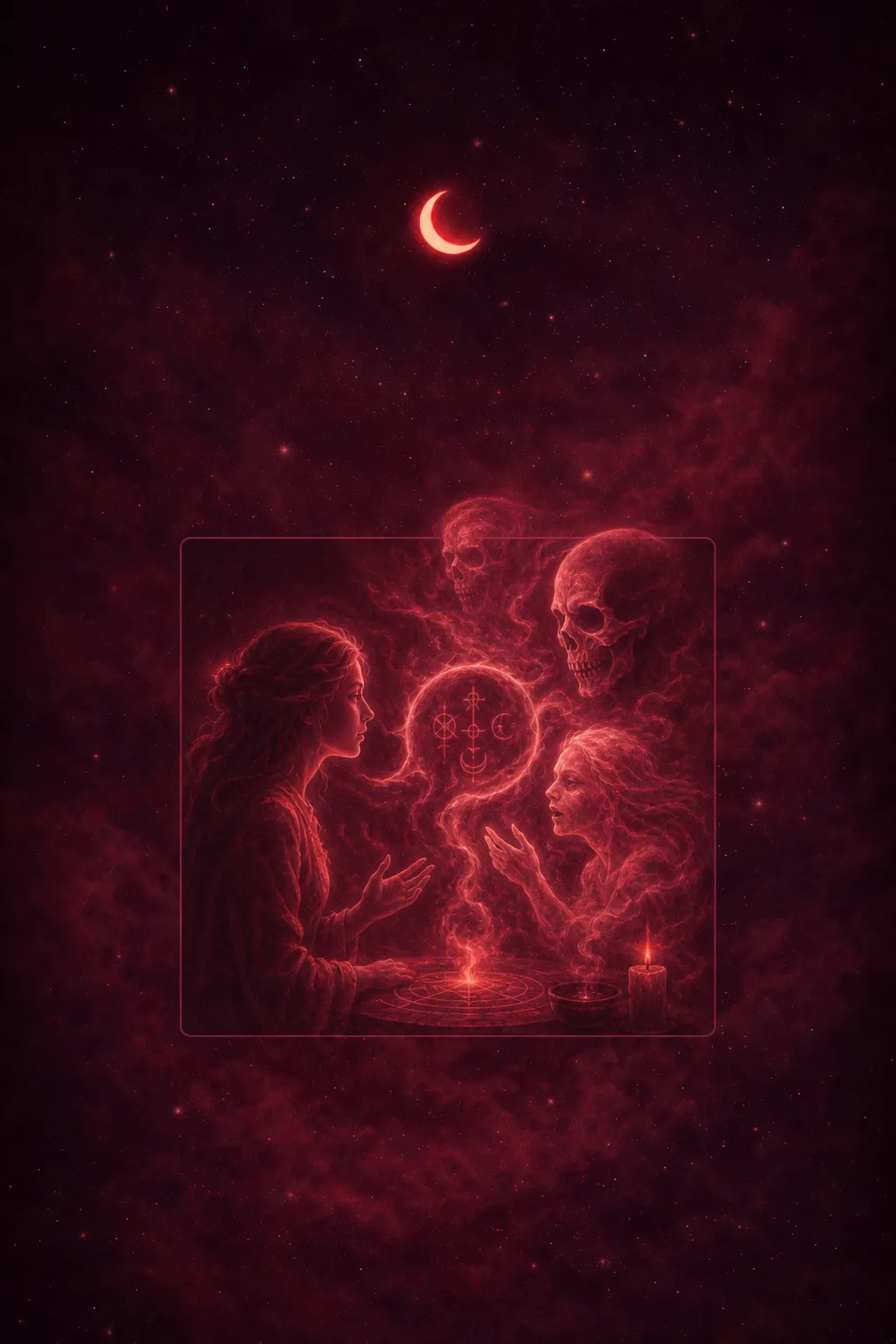

Dreaming of speaking with the dead often reflects unresolved grief, a longing for closure, or unfinished emotional business with someone you have lost. The deceased figure frequently represents a part of yourself, a value, or a relationship that still needs acknowledgment. These dreams can also carry a sense of comfort or guidance, suggesting your subconscious is processing loss and seeking healing.
In under a minute you could read what your exact dream means for you, and see a picture of it. Free.
A dream still on your mind? Get your personal reading.
Describe your dream in a line or two. In seconds you get a reading of your exact dream, a picture drawn from your own words, and every symbol explained.
Free. No sign-up. Takes 10 seconds. Your dream stays private.
0%
Analyzing your dream…
Something went wrong. Please try again in a moment.
Your dreams deserve more than a dictionary
Common Speaking With Dead Dream Scenarios
A Dead Loved One Gives You a Message
This is the scenario people remember most vividly — a parent, grandparent, or close friend appears and says something specific. The message might be comforting, cryptic, or surprisingly mundane. You wake up with the words still ringing in your ears.
These dreams often arrive during anniversaries, major life decisions, or periods of grief that have no clean ending. The dead person isn't necessarily "visiting" in a supernatural sense — but your mind has preserved their voice, their cadence, even their humor, and it knows exactly what they would have said. If the message felt like permission or peace, pay attention to what area of your life you've been seeking approval in. You can explore this further through the lens of visitation dreams, which carry their own distinct emotional fingerprint.
Was yours a sign? Find out.
Speaking With a Dead Parent
Dreaming of a dead father or dead mother and actually holding a conversation with them is one of the most emotionally charged dream experiences there is. These dreams often surface when you're facing a decision they would have had strong opinions about — a career pivot, a relationship ending, a move across the country.
Sometimes the parent in the dream isn't warm. They're critical, distant, or they say something that cuts. That's not your loved one haunting you — it's your own internalized version of them, the voice you've been carrying since childhood. The conversation you're having is really with yourself.
The Dead Person Seems Unaware They've Died
In this version, you're speaking with someone who acts completely normal — going about their life, talking about plans, unaware that anything has changed. There's a particular grief in this scenario, a strange tenderness. You know something they don't.
This dream often reflects your own difficulty accepting the loss. Part of you is still living in a world where they exist. It can also appear when you're suppressing grief — keeping busy, staying functional — and your sleeping mind is forcing you to sit with the reality of their absence. If you've also dreamed of hugging a dead person, the two dreams together suggest a deep, unprocessed longing for physical closeness.
An Argument or Confrontation With the Dead
Not all conversations with the dead are peaceful. Sometimes you're fighting, accusing, or being accused. Someone who wronged you in life shows up and the argument you never finished plays out in full. Or you find yourself apologizing for something you've carried for years.
These are the dreams that leave you shaken at 3am. They point directly to unresolved conflict — guilt you haven't processed, anger you decided was inappropriate to feel, or grief complicated by a relationship that was never simple. The deceased visiting you in this way is your psyche insisting the emotional ledger needs to be balanced, even if only in your own interior world.
What this dream could look like
Tap an image to open it full screen
Example images. Only you can see what you write in Dream Book.
Psychological Interpretation
Freud saw dreams about the dead as wish fulfillment wrapped in grief. In his framework, dreaming of speaking with someone who has died is the unconscious mind doing what waking life cannot — restoring what was taken. But Freud also pointed to something darker underneath: guilt. He believed that survivors often harbor unconscious hostility toward the dead (resentment, relief, old wounds), and the dream stages a conversation that lets some of that pressure escape. The dead speak so you don't have to carry their silence alone.
Jung pushed further into the symbolic territory. For him, a dead person in a dream isn't just a memory — they're an archetype, a figure from the collective unconscious representing wisdom, the past, or the Shadow Self. When you speak with the dead in a dream, Jung would say you're in dialogue with a part of yourself that has been buried or neglected. The dead relative who offers counsel is often your own deeper knowing, dressed in a familiar face. This connects to his concept of individuation — the lifelong process of integrating all parts of the self, including the ones that feel gone.
But what does your version mean?
Calvin Hall's content analysis of over 50,000 dream reports found that the dead appear in dreams far more often than waking logic would predict — and that these dreams are disproportionately emotional in tone. His research showed that dreamers rarely experience the dead as threatening; more often, the encounters are bittersweet or comforting. This supports the idea that the dreaming mind uses these figures to process relational emotion, not to frighten. Ernest Hartmann, whose work framed dreams as a kind of overnight emotional therapy, would agree: the brain uses sleep to contextualize painful feelings, and speaking with a lost person is one of the most direct ways it can do that. The conversation is the processing.
Hobson and McCarley's activation-synthesis model offers a more neurological angle. In their view, the brain during REM sleep fires signals semi-randomly, and the cortex constructs a narrative to make sense of them. The face of someone you loved — stored deep in memory — gets activated, and your storytelling mind builds a scene around it. That doesn't make the experience less meaningful. It just means the emotional weight you feel is entirely real, even if the mechanism is biological. Many people who've had these dreams also report experiences of sleep paralysis or an uncanny sense of presence — the nervous system fully committed to the encounter.
Every dream you log starts to connect.
Dream Book keeps your dreams in one place and reveals the threads between them over time — your private dream journal. Free to start.


Cultural & Spiritual Meaning
In Western spiritual traditions, dreams of speaking with the dead have long been treated as genuine contact — a thinning of the veil between worlds. Ancient Greek and Roman cultures built entire rituals around incubating such dreams, sleeping in sacred spaces to receive messages from deceased ancestors or gods. The Catholic tradition holds more ambivalence: such dreams might be divine comfort or, depending on the era, something to be cautious about. The emotional quality of the dream — peace versus dread — was often used as the diagnostic.
Ibn Sirin, the 8th-century Islamic scholar whose dream interpretations remain foundational across the Muslim world, had specific things to say about speaking with the dead. He interpreted a dream in which a dead person speaks cheerfully and with good news as a positive omen — a sign of blessings, answered prayers, or relief from hardship coming to the dreamer. But if the dead person appeared distressed or spoke of suffering, Ibn Sirin read this as a call to pray for the deceased and to examine one's own spiritual state. The message mattered as much as the messenger. You can explore related territory through ancestors visiting in dreams, which carries its own rich cross-cultural significance.
A bad dream isn't a bad sign.
In many Indigenous traditions across the Americas, Africa, and East Asia, the dead are understood to remain part of the community — present, watchful, occasionally communicative. Dreaming of speaking with an ancestor isn't a psychological event; it's a social one. The dream is a council meeting. In Chinese folk tradition, dreams of deceased relatives often prompt ritual offerings the next morning, a practical response to a spiritual conversation. The act of talking to the dead in a dream is less about what it means and more about what it asks of you.
Related Dream Meanings

nightmares
What Does It Mean When a Dead Person Visits You in a Dream
6 min read
nightmares
Dead Father Meaning - Symbolism & Interpretation
6 min read

nightmares
Dead Mother: Meaning and Interpretation
5 min read

nightmares
Hugging a Dead Person: Meaning & Interpretation
5 min read
nightmares
Deceased Visiting Dream: Closure, Guidance & Grief
5 min read
nightmares
Sleep Paralysis Dream Meaning: Helplessness & Anxiety
5 min read
nightmares
What Does It Mean When Ancestors Visit You in a Dream
6 min read
nightmares
Talking to Dead: Meaning and Interpretation
6 min read
What to Do After This Dream
First: write it down immediately. The specific words spoken in these dreams carry unusual weight, and they dissolve faster than almost any other dream content. Even fragments — a phrase, a tone of voice, the expression on their face — are worth capturing.
Then sit with the emotion rather than the narrative. The question isn't just "what did they say?" but "how did it feel to be in their presence again?" Relief, grief, guilt, warmth — the feeling is the message your psyche is actually sending. If the dream left you with unresolved guilt or anger, consider whether there's a living relationship carrying the same emotional charge. The dead often stand in for dynamics that are still very much alive.
If the dream keeps returning — the same person, the same unfinished conversation — that repetition is significant. Dream Book lets you describe the dream in detail and ask follow-up questions to understand what your subconscious is working through, especially when the meaning feels just out of reach.
And if the dream brought comfort? Let it. Not every dream of the dead is a problem to solve. Sometimes it's simply your mind giving you one more conversation, one more moment of presence, with someone you miss. Dreaming of a deceased loved one is one of the most human experiences there is — the sleeping mind's refusal to fully let go.
Was yours a sign? Find out.
Understanding your speaking-with-dead dream is the first step. The next is asking what it means for your life right now — that's where a personalized interpretation goes deeper than any dictionary.
Keep the ones that matter close.
The free app saves your most meaningful dreams and reads the signs across them — so a visit or a sign is never lost. Free to start.
People Also Ask
When a dead person speaks to you in a dream, it usually reflects unfinished emotional business — grief, guilt, longing, or something left unsaid. The message they deliver often mirrors what you most need to hear from yourself. Pay close attention to the emotional tone of the conversation, not just the words.
Many spiritual and cultural traditions — including Islamic dream interpretation as described by Ibn Sirin — treat these dreams as meaningful contact or omens, especially when the deceased appears peaceful and delivers good news. Whether you interpret it spiritually or psychologically, the experience is worth taking seriously rather than dismissing.
Recurring dreams of speaking with the dead typically signal unresolved grief or an emotional issue that hasn't been fully processed. Your sleeping mind returns to the conversation because something in it remains unfinished — an apology, a question, or simply the need to feel their presence one more time.
A warning from a deceased person in a dream usually reflects your own intuition or anxiety about a current situation, dressed in the voice of someone you trusted. It's worth asking what area of your life you've been feeling uneasy about — the dream is likely amplifying a concern your waking mind has been trying to ignore.
Curious what your dream would look like?