
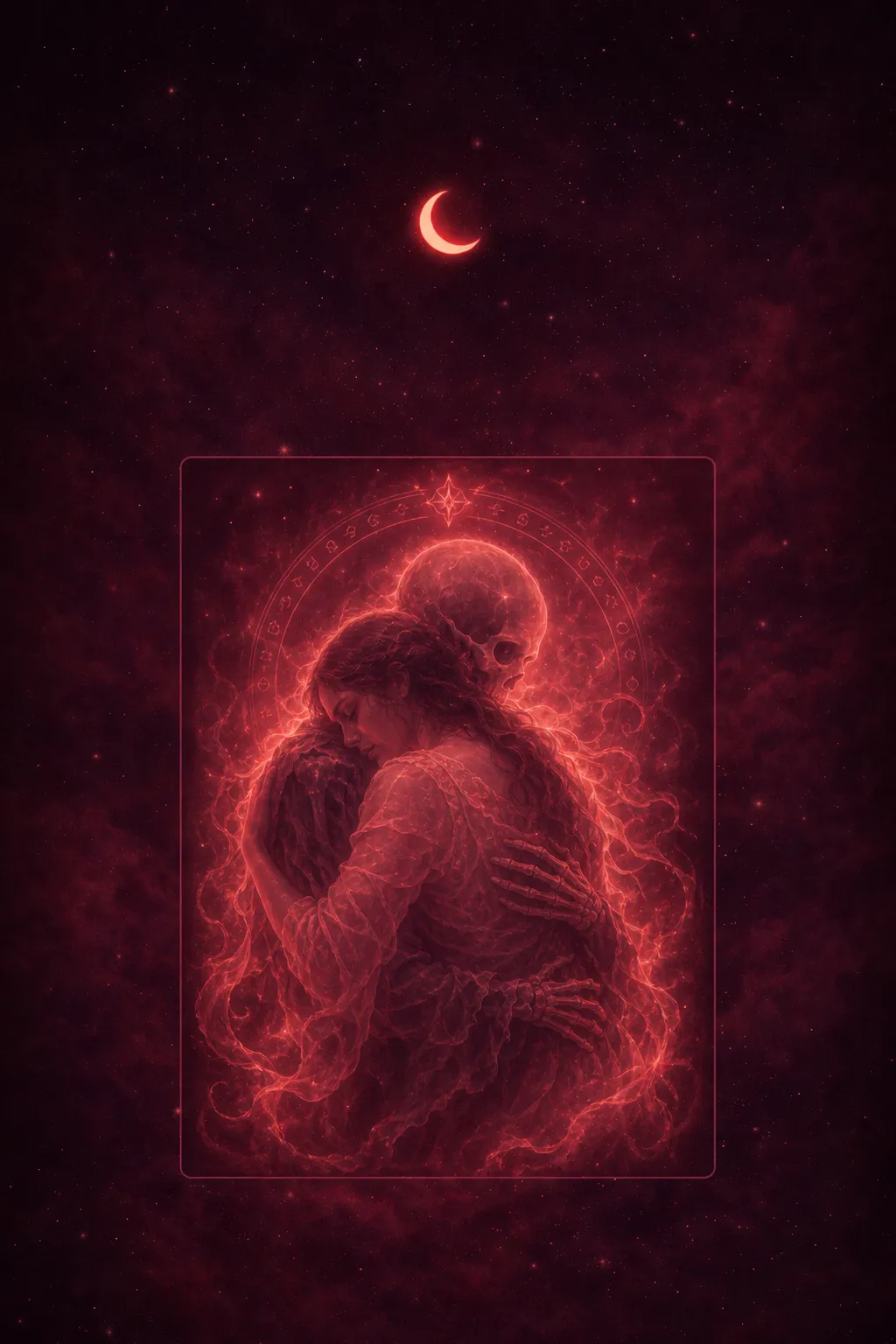

Dreaming about hugging a dead person most often reflects your mind's effort to process grief, maintain a continuing bond with someone you've lost, or work through unfinished emotional business — it's rarely alarming, and for most people the embrace brings a genuine sense of warmth, comfort, or the closure they never got to experience in waking life.
In under a minute you could read what your exact dream means for you, and see a picture of it. Free.
A dream still on your mind? Get your personal reading.
Describe your dream in a line or two. In seconds you get a reading of your exact dream, a picture drawn from your own words, and every symbol explained.
Free. No sign-up. Takes 10 seconds. Your dream stays private.
0%
Analyzing your dream…
Something went wrong. Please try again in a moment.
Your dreams deserve more than a dictionary
Common Scenarios and What They Mean
The details of the embrace matter enormously. Here are the most frequent versions of this dream and the distinct emotional territory each one maps.
Hugging someone who died recently
When the loss is fresh, this dream is your mind's most direct grief tool. The embrace recreates physical closeness at the exact moment your waking self is most aware it can't have it. There's nothing broken about this — psychologists call it a continuing-bonds response, a natural way of staying connected to an attachment figure while you slowly adjust to the world without them. Wake up feeling comforted rather than disturbed; that feeling is the point.
Was yours a sign? Find out.
Hugging someone who died years ago
When a long-deceased person appears and you pull them close, look for a current-life trigger: an anniversary, a milestone they would have witnessed, a decision you're wrestling with, or even a piece of music that belonged to them. The dream isn't random nostalgia — it's your psyche reaching for the wisdom, comfort, or simply the presence of that person in response to something happening right now. Explore what recently stirred that connection in your waking world.
A warm, peaceful embrace filled with love
This is arguably the most healing version of the dream. The physical warmth in the hug tracks directly to emotional progress in grief. Many people describe waking from this type of visitation dream feeling genuinely lighter — as if some quiet reconciliation occurred overnight. Psychologically, it signals acceptance and integration: you're holding this person's memory with tenderness rather than raw pain.
The dead person feels cold, stiff, or pulls away
This variation tends to surface unfinished business — guilt about something left unsaid, the feeling that you didn't say a proper goodbye, or ambivalence about moving forward. The emotional distance encoded in that cold, unresponsive body mirrors a felt distance within you. It's worth sitting with what conversation you never had, or what part of your grief you may still be avoiding rather than moving through.
The hug happens, then they leave or fade
Watch for this sequence carefully: connection, embrace, departure. It's the psyche rehearsing the hardest act — release. Your mind is gently walking you through the goodbye your waking self hasn't fully completed. These dreams often arrive exactly when you are, in fact, ready to take the next step in grieving, even if it doesn't feel that way during waking hours.
But what does your version mean?
You hug them not realizing they're dead
In this version, the knowledge of their death simply isn't present in the dream. That seamless reunion often reflects either wish-fulfillment — your sleeping mind granting you the one thing you most want — or a brief denial-stage comfort. It's not a sign of pathology; it's a sign of how deeply someone mattered. If these dreams recur frequently, they may be gently nudging you toward acknowledging the loss more fully in waking life.
Hugging a dead stranger
When the figure is unfamiliar, the dream typically points inward rather than outward. The dead person may symbolize a part of yourself that has ended — a role you no longer play, an identity you've outgrown, or a chapter of life that has definitively closed. The hug is your psyche making peace with that ending.
What a dream about hugging a dead person could look like
Tap an image to open it full screen
Example images. Only you can see what you write in Dream Book.
The Psychology Behind the Dream
Modern grief research has largely moved away from the idea that dreams of the deceased are a red flag. The continuing-bonds model, widely accepted in bereavement psychology, describes ongoing internal conversations with lost loved ones — including in dreams — as a healthy, adaptive part of mourning rather than a sign of being "stuck."
Dream Book and most contemporary therapists would frame a hugging dream as one or more of the following:
- Wish-fulfillment: The simplest and most human explanation — you miss this person, and your sleeping mind briefly gives you what waking life can't.
- Guilt and reconciliation: If the relationship had friction, or if the death was sudden and left words unspoken, the dream may be your psyche staging the conversation — or the forgiveness — you never got to have.
- Self-integration: The deceased can also represent a part of yourself — a more carefree version, a relationship role, or a belief system — that ended around the time of their death or that you associate strongly with them. Hugging them may be making peace with that lost self-aspect.
- Transitional marker: These dreams cluster around anniversaries, birthdays, major life decisions, and rites of passage. Your mind summons the figure at the very moments their absence feels most present.
A bad dream isn't a bad sign.
If you've been dreaming repeatedly of a specific person, consider what emotion lingers after you wake. That residue — comfort, guilt, sorrow, relief — is usually the clearest signal of what psychological work the dream is doing for you.
Every dream you log starts to connect.
Dream Book keeps your dreams in one place and reveals the threads between them over time — your private dream journal. Free to start.


Cultural Context
Within English-speaking culture, dreams of deceased loved ones are widely normalized and openly shared. People post about them on Reddit and Facebook not to seek warnings but to find community — to hear "I had the same dream after losing my mom" and feel less alone. The dominant vocabulary is therapeutic: closure, healing, processing, moving on. The omen-reading tradition that's central in some other cultures carries much less weight here.
The phrase "visit dream" has become a widely understood shorthand in grief communities — a dream so vivid and emotionally resonant that it feels less like ordinary dreaming and more like an actual visit. Whether or not one interprets that literally, these dreams serve a clear cultural function: they give the bereaved permission to still feel connected. For more on that framing, the deceased visiting in dreams page explores the phenomenon in depth.
Related dream themes — like talking to a dead person — follow the same cultural pattern: they're understood as the mind's way of completing unfinished conversations, not as literal messages from beyond.
Spiritual Perspectives
From a broadly Christian standpoint — the most prevalent spiritual lens in the Anglo-American context — a warm, peaceful hug dream is often read as reassurance: the soul is at rest, and the love between you remains intact. Many people in faith communities find these dreams deeply comforting precisely because they align with a belief in continuity beyond death. This reading is personal and devotional rather than doctrinal; no specific theology needs to be invoked for the dream to carry that weight.
More broadly, the spiritual interpretation of a hugging dream tends to be gentle and affirming across traditions: the embrace represents a bond that physical death couldn't fully sever. Whether you frame that as the soul's persistence, as the psyche's creative consolation, or simply as love refusing to be entirely erased, the emotional truth is the same — you are carrying someone with you, and the dream is one of the ways you do it.
Related Dream Meanings
nightmares
What Does It Mean When a Dead Person Visits You in a Dream
6 min read
nightmares
Dead Person Dream Meaning: Closure & Unresolved Loss
5 min read
nightmares
Deceased Visiting Dream: Closure, Guidance & Grief
5 min read
nightmares
Talking to Dead: Meaning and Interpretation
6 min read
nightmares
Prison Dream Meaning: Confinement, Freedom & Inner Struggle
5 min read

nightmares
Dead Fish Dream Meaning: Loss, Stagnation & Clarity
5 min read

nightmares
Dreaming of a Sword Meaning: What Your Dream Reveals
6 min read

nightmares
Dream of Being Attacked with a Knife: Meaning and Interpretation
6 min read
What to Do When You Wake Up
These dreams can leave you raw, tearful, or unexpectedly peaceful — sometimes all three at once. A few grounded practices help you receive the experience productively rather than letting it derail your day:
Was yours a sign? Find out.
- Write it down immediately. Before the details dissolve, note who it was, what the hug felt like, and the single strongest emotion you carried out of sleep. The specifics reveal the message.
- Identify the current-life trigger. Is there an anniversary approaching? A decision you'd have asked this person about? A milestone they would have shared? The dream rarely arrives without a waking-life anchor.
- Honor what was unsaid. If the dream carried guilt or incompleteness, try writing a letter to the deceased — not to send, but to finish the conversation your mind is asking you to have.
- Don't pathologize the grief. A recurring hug dream is not a sign you are failing to cope. It is, in most cases, evidence that your mind is doing exactly what it's supposed to do: keeping love alive while slowly, imperfectly, learning to live with the loss.
- Seek support if needed. If these dreams come with intense distress, intrusive thoughts, or are disrupting your daily life, speaking with a grief counselor can help you move through rather than around the feelings the dreams are surfacing.
Keep the ones that matter close.
The free app saves your most meaningful dreams and reads the signs across them — so a visit or a sign is never lost. Free to start.
People Also Ask
The Bible doesn't directly address bereavement dreams, but many Christians interpret a peaceful dream about a deceased loved one as God's comfort — a reassurance that the person is at rest and that love persists beyond death. Such dreams are seen as personal consolation rather than prophetic messages or doctrinal events.
Many people believe so, describing especially vivid, emotionally intense dreams as 'visit dreams' that feel distinctly different from ordinary dreaming. Psychology frames these as the mind's continuing-bonds mechanism — a healthy way of maintaining connection. Whether the experience is spiritual communication or deep psychological processing, the comfort it offers is real.
A hug in a dream generally symbolizes a desire for connection, comfort, reassurance, or reconciliation. When the person being hugged is deceased, the spiritual reading deepens: the embrace often represents an unbroken bond of love, a sense of peace about the person's passing, or the dreamer's own readiness to both honor and release the relationship.
Curious what your dream would look like?