


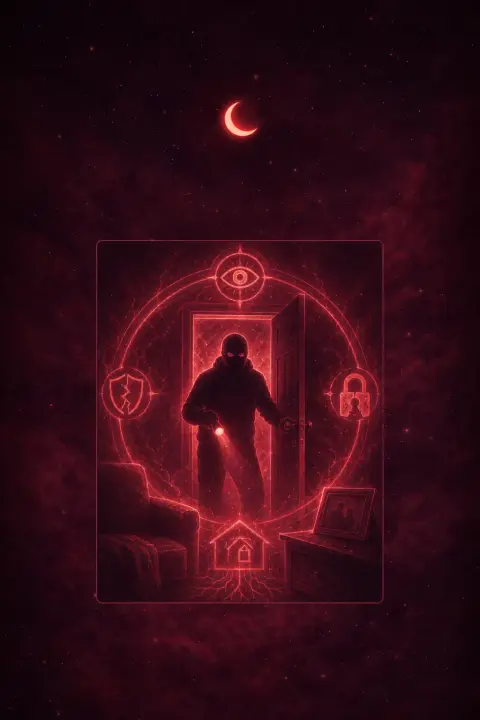
Dreaming about someone breaking into your house typically signals feelings of vulnerability, violated boundaries, or anxiety about losing control in your waking life, as the home in dreams represents the self, so an intruder forcing entry often reflects an unwanted situation, person, or suppressed emotion threatening your sense of safety and personal space.
In under a minute you could read what your exact dream means for you, and see a picture of it. Free.
Bad dream? See exactly what you dreamed — turned into a picture.
Just describe it and Dream Book paints your dream as a real image, plus a reading of what it means for you. Free, and it takes under a minute.


Common Break-In Dream Scenarios and What They Mean
The most frequent version — an unknown intruder forcing their way in — typically mirrors generalized anxiety: something in waking life feels invasive and out of your control, even if you cannot name it clearly. When the dream shifts and you hide or freeze rather than act, that freeze response often reflects real-life conflict avoidance; much like hiding in a dream, it signals a situation you feel too powerless to confront directly. On the opposite end, fighting or confronting the intruder is an encouraging sign — it suggests growing assertiveness and a readiness to reclaim agency over a boundary that has felt threatened. At Dream Book we explore this symbol in depth.
- A familiar person breaks in: Points to a specific relationship where trust or personal limits feel violated — the threat is close to home in every sense.
- Locks and doors fail: Your usual defenses feel inadequate; the pressures you are facing may have outgrown your current coping strategies.
- Shielding loved ones: Anxiety concentrated around your role as a protector or provider — fear that those in your care are also exposed to the threat you feel.
- Discovering signs of a break-in afterward: Often reflects delayed processing of a past violation or loss — a slow dawning awareness that something was taken or compromised without warning.
- A recurring break-in dream: A persistent, unresolved stressor at work; the repetition is the mind's signal that an ongoing threat still needs to be addressed rather than pushed aside.
What this dream could look like
Tap an image to open it full screen
Example images. Only you can see what you write in Dream Book.
What Your Subconscious Is Processing
In mainstream psychology, the home in a dream functions as a map of the self — its rooms and walls representing the boundaries of your identity, emotional life, and sense of security. When someone breaks in, the dream is rarely about literal crime; it is your subconscious staging a confrontation with something that already feels invasive in waking life. That "something" could be a demanding relationship, a creeping fear of failure, or the relentless pressure of modern overload — the kind of low-grade stress that never fully announces itself but quietly erodes your sense of control.
A bad dream isn't a bad sign.
From a psychological standpoint, the intruder frequently personifies a repressed emotion or an unacknowledged part of yourself demanding recognition. Jung would call this the shadow — the disowned material that eventually forces entry when ignored long enough. A Christian-influenced reading adds a complementary layer: the dream may surface when you feel spiritually or morally exposed, as though something is threatening the "house" you have built through your values and faith. Either way, the emotional signature is the same — vulnerability, helplessness, and a sharp awareness that your usual defenses are not holding.
- Loss of control: The break-in mirrors situations where external forces — a job change, a conflict, financial strain — feel beyond your management.
- Boundary anxiety: Recurring intruder dreams often signal that a real-life boundary is being crossed and needs your conscious attention.
- Repressed threat: The unfamiliar face of a stranger can represent an emotion or truth you have not yet allowed yourself to acknowledge.
- Hypervigilance: If the dream repeats, it may reflect an anxious nervous system scanning for danger even during sleep.
General meanings end here. Read your own dream.
0%
Analyzing your dream…
Something went wrong. Please try again in a moment.
Your dreams deserve more than a dictionary
Cultural and Traditional Readings of Break-In Dreams
Across Western folk tradition, dreaming of an intruder entering your home has long been treated as a warning signal — an omen urging the dreamer to take stock of who or what they have allowed into their life. In older Anglo-American household lore, such dreams were said to foreshadow unwanted news or a guest who brings trouble, reflecting a time when the home was understood as a sanctified, protected space whose violation carried moral weight. That instinct still surfaces in everyday language: when something feels "invasive," we say it hits close to home.
But what does your version mean?
Within US Christian culture, the image carries a recognizable scriptural echo — the idea of guarding one's house against an uninvited force, a theme woven through both Old and New Testament passages about watchfulness and spiritual vigilance. Rather than reading the dream as prophetic, most modern believers interpret it as a prompt toward self-examination: what boundaries in your life need reinforcing, and where have you grown careless? This framing sits comfortably alongside mainstream psychological readings without competing with them.
- Loss-of-control anxiety: Contemporary culture links break-in dreams to the stress of feeling that outside forces — financial pressure, workplace demands, social media — are encroaching on your personal space in ways you cannot fully manage.
- Boundary awareness: Folk wisdom in many English-speaking communities treats the dream as a nudge to examine relationships; a stranger forcing entry may represent a person in waking life whose influence feels unwelcome but unchallenged.
- Protective instinct: The urge to defend the home in such dreams is widely seen as a healthy signal — evidence that you recognize where your boundaries lie, even when waking life makes enforcing them difficult.
The Spiritual Meaning of Someone Breaking In
For dreamers with a Christian frame of reference, the intruder carries unmistakable biblical resonance. Jesus warns in Matthew 24:43 that a homeowner who stayed alert would not have let a thief break through, and in John 10:10 the thief comes only to steal, kill, and destroy. These images invite a spiritual self-check: where in your inner life have you grown careless or left a door unguarded? Rather than reading the dream as prophecy, most thoughtful Christian interpreters treat it as a prompt toward watchfulness — a nudge to examine whether stress, doubt, or a corrosive relationship has been quietly eroding your sense of spiritual groundedness.
Beyond formal theology, a quieter folk instinct runs through many households: a home-invasion dream is your deeper intuition sending up a flare. This is less about predicting a real burglary and more about recognizing that something already feels unsafe at a level you have not yet consciously named. From this angle the dream is almost a gift — an early-warning signal from the part of you that registers threat before your rational mind catches up.
Was yours a sign? Find out.
- Spiritual watchfulness: Ask what boundaries in your inner life need strengthening, not just your physical circumstances.
- Discernment over fear: The dream invites reflection, not panic — who or what are you allowing repeated access to your peace of mind?
- Intuition as guidance: The folk reading treats the dream as your own vigilance speaking, a prompt to stay alert to changes around you.
Related Dream Meanings

common dreams
Hiding Dream Meaning: Fear, Avoidance & Self-Protection
5 min read

people
Stranger Dream Meaning: Hidden Self & New Opportunities
5 min read
nightmares
Home Invasion Dream Meaning: Vulnerability & Lost Control
5 min read

nightmares
What Does It Mean When Demons Attack You in a Dream
6 min read

nightmares
Evil Eye Dream Meaning: What It Reveals About Your Subconscious
6 min read

nightmares
What Does It Mean When Ancestors Visit You in a Dream
6 min read

nightmares
What Does It Mean When a Dead Person Visits You in a Dream
6 min read

nightmares
Blood Moon Dream Meaning: What It Symbolizes in Your Dreams
5 min read
What You Can Actually Do After This Dream
Rather than letting the unease linger, treat the dream as a prompt for a quick self-audit. Ask yourself what in your waking life currently feels invasive or hard to control — an overbearing colleague, a draining relationship, a financial pressure creeping in at the edges. Naming the real-world stressor is usually enough to strip the dream of its grip, because the anxiety loses its disguise once you face it directly.
- Map your boundaries. Write down one or two areas of your life where you have been letting things slide that you normally would not — commitments you did not choose, access you did not consciously grant. Decide on one small, concrete limit you can reinstate this week.
- Check your stress load. Recurring home-invasion dreams often spike during periods of accumulated, low-level pressure. A honest look at sleep habits, workload, and screen time before bed can reduce the frequency significantly.
- Reclaim a sense of agency. The helplessness the dream stirs is a signal, not a verdict. Even one deliberate act of setting a boundary — saying no, locking something down, having a conversation you have been avoiding — can quiet the dream cycle over time.
A bad dream isn't a bad sign.
If the dreams persist and are leaving you genuinely shaken on waking, that is worth raising with a therapist, particularly one familiar with anxiety or trauma responses. Occasional intrusion dreams are normal; nightly dread that affects your daytime functioning is a different matter entirely.
If it keeps coming back, the app helps you understand the pattern.
Log each recurring dream and the free app shows you what's underneath — calmly, over time. Free to start.
People Also Ask
Spiritually, a warning dream often feels unusually vivid, leaves a lasting emotional impression, and carries a clear sense of urgency. If the dream recurs or prompts a strong gut feeling to reassess your relationships, security, or personal boundaries, many faith traditions interpret this as divine guidance worth taking seriously.
Dreaming of someone attempting to enter your home typically reflects anxiety about boundaries being violated in waking life. Your home symbolizes your inner self, so an intruder trying to get in may represent an unwanted influence, a manipulative person, or unresolved fears about losing control over your personal space or private life.
Spiritually, being robbed in a dream often signals feelings of loss, powerlessness, or that something precious — your energy, confidence, or opportunities — is being taken from you. It can serve as a prompt to identify draining relationships or situations and reclaim your personal power before the loss becomes more significant in waking life.
Strangers inside your home in a dream can represent unfamiliar aspects of yourself seeking acknowledgment, or outside energies entering your personal sphere. Spiritually, it may suggest you are allowing unknown influences into your life without proper discernment, urging you to evaluate who and what you are giving access to your time and energy.
Curious what your dream would look like?