
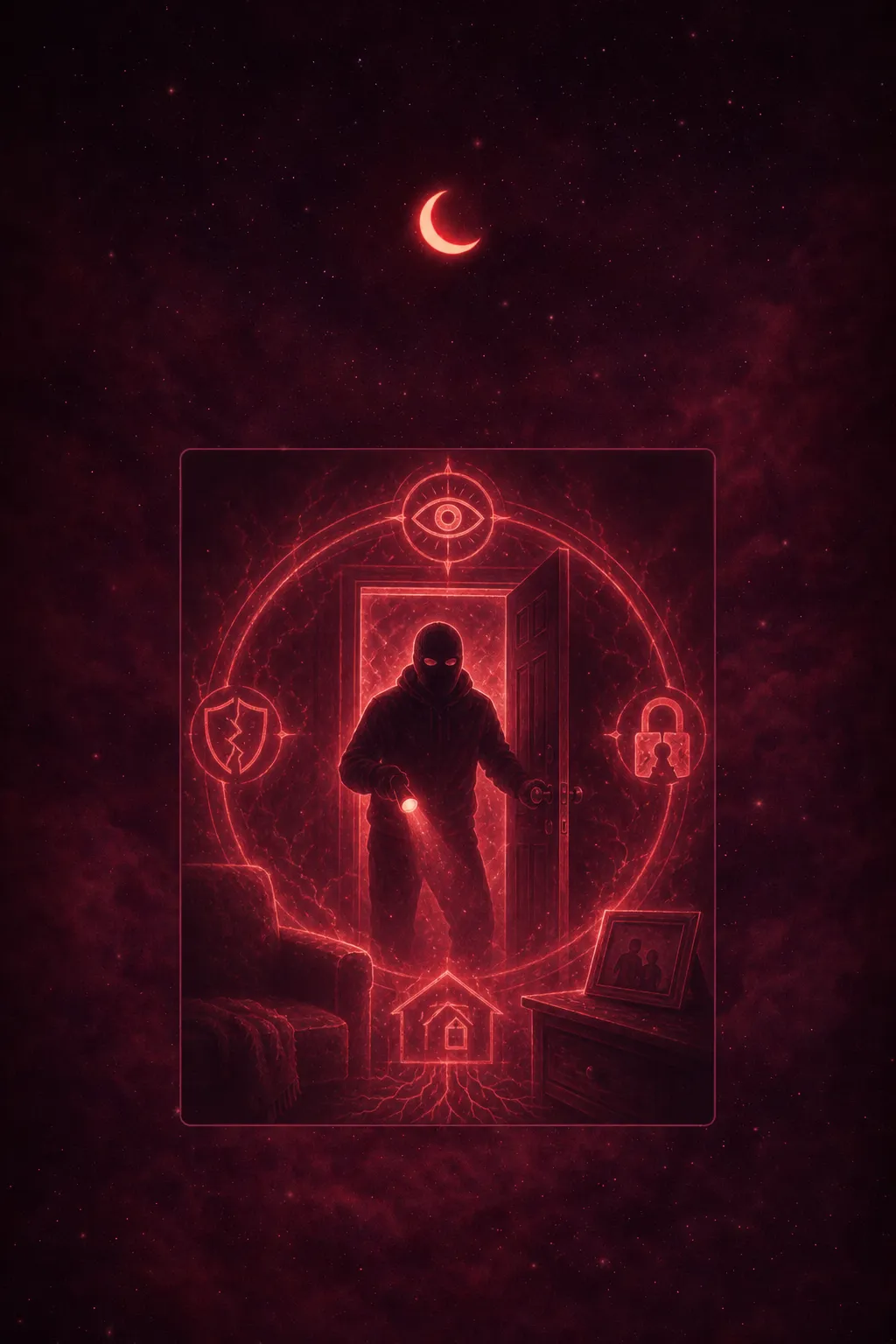

Dreaming about a home invasion typically means you feel your personal boundaries, privacy, or sense of security are being threatened in waking life, often reflecting anxiety about an intrusive relationship, unexpected change, or loss of control over your own space, emotions, or identity.
In under a minute you could read what your exact dream means for you, and see a picture of it. Free.
A dream still on your mind? Get your personal reading.
Describe your dream in a line or two. In seconds you get a reading of your exact dream, a picture drawn from your own words, and every symbol explained.
Free. No sign-up. Takes 10 seconds. Your dream stays private.
Add who was there and how you felt, and the reading will be about your dream.
0%
Analyzing your dream…
Something went wrong. Please try again in a moment.
Your dreams deserve more than a dictionary
Common Home Invasion Dream Scenarios
The most frequent version — an unknown intruder forcing their way in — typically mirrors generalized anxiety about something in waking life that feels unpredictable and beyond your control: a volatile work situation, financial pressure, or a health scare. Because the threat wears no face, the mind can't negotiate with it, which is exactly how chronic modern stress feels. When the intruder is someone you recognize, the dream shifts focus to a specific relationship; the imagery suggests that person has overstepped a boundary or that trust has quietly eroded.
- Hiding or unable to scream: A classic freeze response — the psyche rehearsing a situation it feels unequipped to confront head-on. Dreams of hiding from a threat often surface when you're suppressing a conflict rather than addressing it.
- Doors and windows that won't lock: Repeated failed attempts to secure the home point to boundaries that keep collapsing — often tied to a recurring stressor you've tried to contain but can't.
- Fighting back: Confronting the intruder is an encouraging sign of mobilizing agency — the mind rehearsing a shift from powerlessness toward self-defense and reclaimed control.
- Shielding family or children: Protective instincts are front and center here; caregiving strain or heightened responsibility for dependents is usually the waking-life driver.
- Returning to a ransacked home: The violation has already happened — this variant tends to accompany grief over something already lost, whether privacy, stability, or a sense of safety.
- Recurring invasions: When the dream repeats, the nervous system may be stuck in a threat-rehearsal loop, a signal that underlying stress or unresolved trauma deserves direct attention.
What a dream about a home invasion could look like
Tap an image to open it full screen
Open a frame to see the details
Example images. Only you can see what you write in Dream Book.
Psychological Meaning of a Home Invasion Dream
In psychological terms, the home in a dream is one of the most consistent stand-ins for the self — your private inner world, your sense of identity, your emotional boundaries. When an intruder forces their way in, the dreaming mind is staging a crisis of boundary violation: something in waking life is crossing a line it shouldn't. That "something" might be a controlling relationship, an overwhelming workload, or a creeping financial worry that refuses to stay outside your mental door. Modern anxiety research supports this reading — the brain actively rehearses perceived threats during sleep, and people carrying high stress loads or hypervigilance patterns (common in anxiety and PTSD) are especially prone to dreams that script danger as a physical breach of safe space.
A bad dream isn't a bad sign.
The intruder itself deserves close attention. From a Jungian perspective, a threatening figure in your own home can represent a disowned part of yourself — an impulse, a fear, or a trait you've refused to acknowledge — that is now forcing itself into conscious awareness. This is the shadow demanding recognition. The discomfort of the dream is the psyche's signal that something internal needs integrating, not just locking out. A Christian-influenced reading might frame this as a call to honest self-examination: what hidden vulnerability or unconfessed anxiety is quietly undermining your sense of security?
- Loss of control: The intruder embodies life events that feel invasive and beyond your management.
- Displaced anxiety: Real-world stressors — money, conflict, change — are symbolized as a physical breach.
- Vulnerability exposed: Fear of being truly seen in your most private, unguarded self.
- Safety-schema disruption: Because home is the deepest symbol of security, its violation signals that a core belief about your own safety is under strain.
Every dream you log starts to connect.
Dream Book keeps your dreams in one place and reveals the threads between them over time — your private dream journal. Free to start.


Cultural and Traditional Readings of a Home Invasion Dream
Few ideals run deeper in Anglo-American culture than the home-as-castle principle — the conviction that a person's dwelling is their sovereign space, a refuge where the outside world has no authority. That belief is baked into common law, popular sayings, and the emotional weight placed on homeownership as a marker of adult self-sufficiency. When a dream shatters that sanctuary, it lands with extra force precisely because the culture has taught us that a secure home is something we earn and are responsible for defending. The intruder, in that context, does not just threaten physical safety — it challenges a deeply held sense of competence and independence.
But what does your version mean?
Modern media amplifies this further. Round-the-clock crime coverage and social-media safety alerts keep a low hum of threat awareness running in the background of daily life, and researchers have noted that perceived — not just actual — crime risk shapes anxiety levels significantly. It is little surprise, then, that home invasion dreams appear to spike during periods of heightened public unease, functioning almost as a cultural stress thermometer. A dream featuring an unknown intruder may be less about real danger and more about how relentlessly the news cycle rehearses worst-case scenarios.
- Home-as-castle norm: cultural pressure to keep one's space safe means a breached home can feel like personal failure, not just misfortune.
- Self-sufficiency ideal: inability to repel the intruder in the dream often mirrors waking feelings of lost control over work, finances, or health.
- Media salience: high crime visibility in news and entertainment raises the symbolic stakes of this dream symbol well beyond statistical risk.
- Christian folk tradition: the home has long carried moral weight as a protected family covenant — its violation can carry a vague sense of spiritual exposure or unworthiness, though this reading sits alongside rather than above the psychological one.
Spiritual Meaning of a Home Invasion Dream
In Christian scripture, the house carries a consistent spiritual weight — it stands for the soul, the life a person has built before God. Jesus draws on this directly in Matthew 24:43, warning that a homeowner who knew when a thief was coming would have stayed alert. That image of the unexpected intruder has long served as a metaphor for spiritual unreadiness: something harmful slipping in precisely because watchfulness lapsed. Dreaming of a home invasion can resonate with that same sense of a boundary that should have held, didn't — a prompt to examine where you may have left yourself spiritually or emotionally exposed.
Within the US-Christian tradition, some dreamers instinctively frame an intruder figure as an unwanted influence — a destructive habit, a toxic relationship, or a source of fear that has been allowed too much access to the inner life. From this perspective, the dream becomes less a verdict and more a call to prayer and intentional protection over the household, both literal and figurative. This reading is most useful when it leads to concrete reflection rather than anxiety, asking what boundaries need reinforcing rather than simply feeding dread.
Was yours a sign? Find out.
- Watchfulness: the dream may surface a quiet awareness that something in your life deserves more careful attention before it takes hold.
- Sovereignty of the inner life: spiritually, the image echoes the conviction that what enters your mind and home matters — a nudge toward intentional choices about influence and environment.
- Invitation, not verdict: rather than a warning of literal danger, many faith traditions read such dreams as an opportunity for self-examination and renewed sense of purpose.
Related Dream Meanings

common dreams
Dreaming of Hiding From Someone: Avoidance or Rest
5 min read

people
Stranger Dream Meaning: Hidden Self & New Opportunities
5 min read

nightmares
Dreaming of a Spider Bite: Hurt, Hidden Threats, Lost Control
5 min read

nightmares
Dreaming of a Funeral: Endings, Loss and Change
5 min read

nightmares
Dreaming of a Snake Chasing You: What You Are Avoiding
6 min read

nightmares
Dream of Being Attacked: Vulnerability and Fear of Betrayal
5 min read

nightmares
Hell Dream Meaning: Fear, Guilt & Unresolved Issues
5 min read

nightmares
Graveyard in Dreams: Spiritual Meaning, Endings and Grief
5 min read
What to Do After a Home Invasion Dream
Because this dream almost always signals that something in waking life feels threatening or out of control, the most useful first step is a simple stress audit. Ask yourself honestly: where right now do you feel exposed — a relationship that keeps overstepping, a work demand that never lets up, a financial pressure that seems to arrive uninvited? Naming the real-world intruder tends to shrink its power considerably, because the anxious mind loops hardest on threats it cannot identify.
- Locate the boundary breach. Identify one area of life where your limits are being ignored — by someone else or by your own habit of overcommitting — and decide on one concrete step to reinforce it.
- Check your stress load. Recurring versions of this dream often track periods of sustained pressure. Sleep hygiene, workload, and unresolved conflict are practical levers worth adjusting.
- Notice who or what the intruder resembles. If the figure felt familiar, consider whether a recurring stranger in your dreams might represent a disowned quality you have been avoiding rather than an external threat.
- Rebuild a sense of agency. Choose one area — however small — where you can assert a clear decision today. Control over small things genuinely counters the powerless feeling this dream tends to leave behind.
A bad dream isn't a bad sign.
If the dream recurs frequently, consider keeping a brief journal entry after each occurrence, noting your stress level and any boundary issues from the previous day. Patterns usually surface within two or three weeks, giving you concrete, actionable information rather than free-floating unease.
If it keeps coming back, the app helps you understand the pattern.
Log each recurring dream and the free app shows you what's underneath — calmly, over time. Free to start.
People Also Ask
Dreaming of an intruder entering your home typically reflects feelings of vulnerability or a sense that your personal boundaries are being violated in waking life. The intruder often symbolizes an unwanted thought, fear, or person encroaching on your private emotional space. It may signal anxiety about losing control or security.
When a group invades your home in a dream, it often points to feeling overwhelmed by outside pressures, obligations, or other people's opinions. Your home represents your inner self, so multiple invaders can suggest that social demands or conflicts are threatening your sense of identity, peace, and personal boundaries in daily life.
This dream usually reflects a feeling of being disconnected from your true self, comfort, or safety. It can signal that stress, major life changes, or unresolved emotions are making it hard to find inner peace. It may also indicate a longing for stability or a sense of belonging that currently feels out of reach.
Many people believe divine warning dreams feel unusually vivid, emotionally intense, and carry a clear moral or urgent message. They tend to linger in memory long after waking. If a home invasion dream feels spiritually significant, consider praying, reflecting on your current circumstances, and seeking guidance from trusted spiritual leaders or scripture for discernment.
Curious what your dream would look like?