
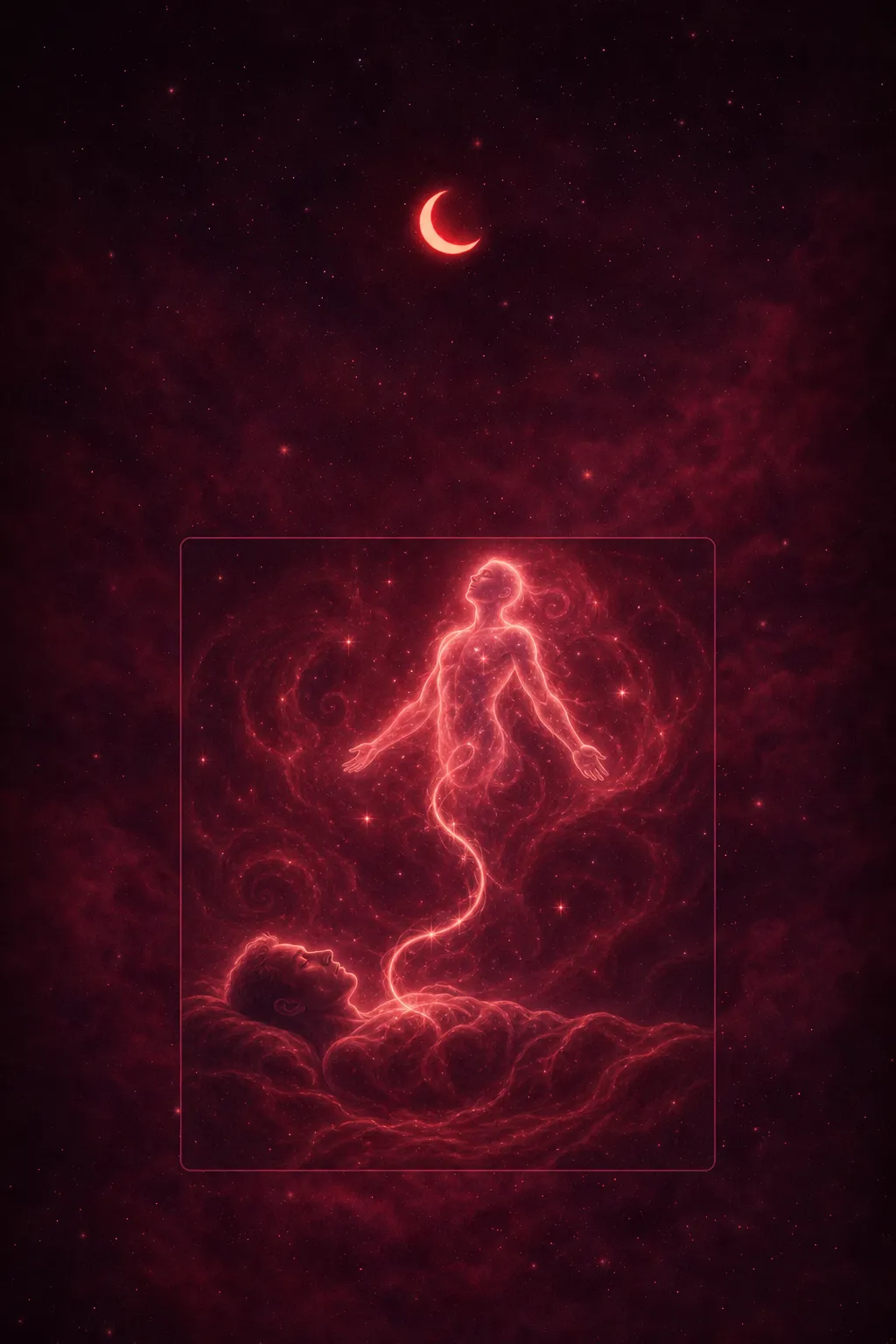

An out of body experience in a dream symbolizes a desire for freedom from physical or emotional limitations, often reflecting a need to gain perspective on your waking life, detach from stress or overwhelming situations, and explore deeper aspects of your subconscious self that feel difficult to access during ordinary, everyday consciousness.
In under a minute you could read what your exact dream means for you, and see a picture of it. Free.
A dream still on your mind? Get your personal reading.
Describe your dream in a line or two. In seconds you get a reading of your exact dream, a picture drawn from your own words, and every symbol explained.
Free. No sign-up. Takes 10 seconds. Your dream stays private.
0%
Analyzing your dream…
Something went wrong. Please try again in a moment.
Your dreams deserve more than a dictionary
Common Out-of-Body Dream Scenarios and What They Mean
The most frequently reported variant — floating above your own body and watching yourself from the ceiling — is a classic signal that stress or emotional overload has pushed you into observer mode. Rather than living through a demanding situation, your mind steps back to gain distance. This is rarely alarming on its own; it often surfaces during high-pressure periods at work or in relationships when your psyche is quietly asking you to reassess rather than just react.
- Unable to return to your body: This amplifies feelings of lost control. If you feel locked out of yourself, the dream may be reflecting a fear that you have drifted too far from your own needs, values, or daily life and cannot find your way back — not unlike the helpless descent in a falling dream.
- Calm, peaceful drifting: Not all out-of-body dreams carry dread. A weightless, serene float often signals a genuine need for relief — or even a healthy release of accumulated pressure. Many dreamers wake from this variant feeling rested rather than unsettled.
- Watching others while detached: Here the dreamer is a spectator to their own relationships or social world, pointing to feelings of emotional distance or of being an outsider even in familiar company.
- Tied to sleep paralysis: When the experience is coupled with an inability to move or a sense of waking in place, it is largely rooted in the sleep-wake transition. The fear response is real, but it does not necessarily signal a deeper psychological crisis.
- Leaving the body during illness or crisis imagery: This variant touches on vulnerability and mortality. For faith-oriented dreamers it may carry a spiritual dimension — the soul stepping briefly outside its vessel — while psychologically it often reflects unprocessed health anxiety or a confrontation with personal fragility, territory that overlaps with dreams about death and what it means to lose hold of existence itself.
What this dream could look like
Tap an image to open it full screen
Example images. Only you can see what you write in Dream Book.
The Psychological Reading: Dissociation, Control, and the Observing Self
From a psychological standpoint, an out-of-body dream is the sleeping mind staging its own defense mechanism. When waking life feels emotionally overwhelming — relentless deadlines, relationship strain, or a creeping sense that events are beyond your control — the psyche can shift into a detached observer position as a form of self-protection. This mirrors clinical dissociation, where the self-as-witness keeps emotional flooding at bay. The dream is not malfunctioning; it is coping, translating inner pressure into the vivid metaphor of hovering above your own life. That same anxiety-driven detachment can surface in other unsettling dream types, such as the helpless plunge of a falling dream, where loss of control is equally central.
A bad dream isn't a bad sign.
There is also a healthier dimension worth recognizing: watching yourself from above can represent a genuine need for perspective. The dreaming mind may be prompting you to "zoom out," review a decision with fresh eyes, or disengage from a situation you have been too close to. This is the clarity pole of the dream's emotional axis. Interestingly, neuroscience notes that OBE-type sensations naturally arise near sleep paralysis and sleep-wake transitions, suggesting the brain is wired to occasionally construct a vantage point outside the body — the dream simply borrows that architecture and loads it with personal meaning. A confrontation with one's mirrored self in dreams of death can carry a similarly transformative charge, pointing toward identity shifts rather than literal endings.
- Dissociation as protection: emotional distance shields against being overwhelmed by unprocessed feelings.
- Perspective-seeking: the observer angle may signal a healthy drive to reassess choices or step back from tunnel-vision thinking.
- Identity and embodiment: detachment from the physical self can point to body-image tension or a feeling of being unmoored from your role or sense of self.
- Agency and return: dreams in which you successfully descend back into your body often mirror a subconscious readiness to reassert control over waking circumstances.
Every dream you log starts to connect.
Dream Book keeps your dreams in one place and reveals the threads between them over time — your private dream journal. Free to start.


Cultural and Folk Traditions: The Soul That Wanders
Across many Western folk traditions, the idea that the soul could temporarily leave the body during sleep was taken as literal fact rather than metaphor. In early Christian thought, the boundary between dream-state and spiritual vision was blurry enough that mystics like Hildegard of Bingen described experiences that read remarkably like modern out-of-body accounts — consciousness lifted beyond the physical, granted a broader view. Popular American evangelical culture still carries echoes of this, treating such dreams as potential glimpses beyond the veil, though mainstream churchgoing tradition tends to counsel caution about reading too much into them.
But what does your version mean?
Folk belief in Anglo cultures also linked the wandering self to moments of personal crisis or transition. The old notion of a person "not being themselves" — acting detached, hollow-eyed, elsewhere — was sometimes explained as the soul having partially slipped free under extreme grief or shock, not unlike the unsettling suspension captured in dreams of falling or sudden death. This maps neatly onto the modern-anxiety reading: in an era of relentless connectivity and pressure to perform, the dream of floating above your own life can feel less like a supernatural event and more like an honest admission that you have lost your grip on who you are. It echoes the experience many people describe when burnout peaks — watching themselves go through the motions, much like the eerie calm of sleep paralysis, where the body and conscious self seem to occupy separate spaces.
- Christian mystical tradition: out-of-body experience as potential spiritual vision, handled with discernment.
- Anglo folk belief: partial soul-departure linked to grief, shock, or moral crisis.
- Modern cultural lens: detachment reframed as a signal of burnout, identity strain, or loss of control in high-pressure life.
The Spiritual Reading: Soul, Transcendence, and Grounded Faith
Within a Christian framework, an out-of-body dream can feel like a brush with the soul's separateness from flesh — a reminder that you are more than your circumstances. Scripture acknowledges this tension between spirit and body, and many believers instinctively read such dreams as a moment of transcendence, a brief loosening of the material world's grip. That reading carries genuine comfort, especially when modern anxiety has made you feel trapped or powerless: the dream whispers that your identity runs deeper than the pressures closing in around you. However, most mainstream Christian interpreters counsel caution here — treating the experience as a gift of perspective rather than a doorway to pursue. The soul's wandering is acknowledged; deliberately chasing it is another matter entirely.
Was yours a sign? Find out.
In broader metaphysical culture, out-of-body dreams are frequently linked to astral projection or spiritual awakening — the idea that consciousness genuinely travels beyond the physical self during sleep. This sits at the edges of folk belief rather than confirmed theology, and it is worth holding loosely. What the imagery does reliably signal, spiritually speaking, is a hunger for self-knowledge: the dreamer elevated above their own life, finally able to see it clearly. This resonates with the experience of flying in dreams, where height brings perspective rather than escape. Some dreamers also note an overlap with the frozen dread of sleep paralysis dreams, where the boundary between body and consciousness feels similarly unstable. If the dream left you feeling liberated rather than lost, its spiritual invitation may simply be to reclaim that clarity in waking life — to observe your situation honestly, much as one might when confronting the unsettling symbolism of death in dreams, and choose, from that grounded vantage point, how to re-enter it.
Related Dream Meanings

common dreams
Falling Dream Meaning: Insecurity, Fear & Loss of Control
5 min read

nightmares
Sleep Paralysis Dream Meaning: Helplessness & Anxiety
5 min read

nightmares
Death Dream Meaning: Transformation, Loss & Change
5 min read

common dreams
Flying Dream Meaning: Freedom, Ambition & Escape
5 min read

body health
Teeth Falling Out Dream: Anxiety, Loss & Vulnerability
5 min read

nightmares
Being Burned Dream Meaning: Pain, Change & Passion
5 min read

nightmares
Shark Attack Dream Meaning: Fear, Threat & Survival
5 min read

nightmares
Running But Can't Move: Meaning and Interpretation
5 min read
Practical Takeaways: Grounding Yourself After an Out-of-Body Dream
When this dream keeps returning, treat it as your mind's honest report card on your stress levels — not something to decode endlessly, but something to act on. The core signal is disconnection, so your practical goal is reconnection: back to your body, your choices, and the parts of daily life you can genuinely influence.
- Do a morning body scan. Before reaching for your phone, spend two minutes noticing physical sensations — breath, warmth, weight. This small ritual counters the drift the dream is flagging.
- Audit your overload. List the responsibilities currently competing for your attention. Identify one you can delegate, defer, or drop. Out-of-body dreams often spike when the to-do list has quietly become unmanageable.
- Name what feels out of your hands. Write it down, then draw a line between what you can influence and what you cannot. Clarity on that boundary is one of the most effective anxiety management tools available — no therapist required to start.
- Check sleep quality. Fragmented sleep and high cortisol are reliable triggers for dissociative dream imagery. If you also experience sleep paralysis alongside these dreams, prioritizing sleep hygiene becomes even more urgent. Recurring sensations of falling in the same sleep window can compound that disorientation and are worth tracking together.
- Watch for waking detachment. If the floaty, spectator feeling bleeds into your days — not just your dreams — that pattern is worth noting alongside any anxiety-linked dream symbols that cluster around the same period, and raising with a counselor or physician.
A bad dream isn't a bad sign.
Think of the dream less as a warning and more as a prompt: wherever you feel like a spectator in your own life right now, that is exactly where your attention belongs.
If it keeps coming back, the app helps you understand the pattern.
Log each recurring dream and the free app shows you what's underneath — calmly, over time. Free to start.
People Also Ask
The rarest form of dreaming is the fully conscious out-of-body experience combined with a lucid dream, where the sleeper feels physically separated from their body while remaining completely aware. Many researchers consider this a distinct state of consciousness, and only a small percentage of people report experiencing it spontaneously during sleep.
Spiritually, an out-of-body experience is seen as the soul briefly separating from the physical body, offering a glimpse of higher consciousness. Many traditions interpret it as evidence of a non-physical self, often triggering profound shifts in belief, a reduced fear of death, and a deeper sense of personal purpose and connection to the universe.
A false awakening out-of-body experience occurs when you dream that you have woken up and then feel yourself floating or drifting from your body, only to realize you are still asleep. It blends two vivid sleep phenomena, often feeling startlingly real and sometimes leading into a full lucid dream or a sleep paralysis episode.
They are related but not identical. A lucid dream means you are aware you are dreaming while remaining inside the dream world. An out-of-body experience involves the sensation of leaving your physical body entirely, which some connect to astral projection. The two can overlap, but many people report clear differences in how each experience feels and unfolds.
Curious what your dream would look like?