
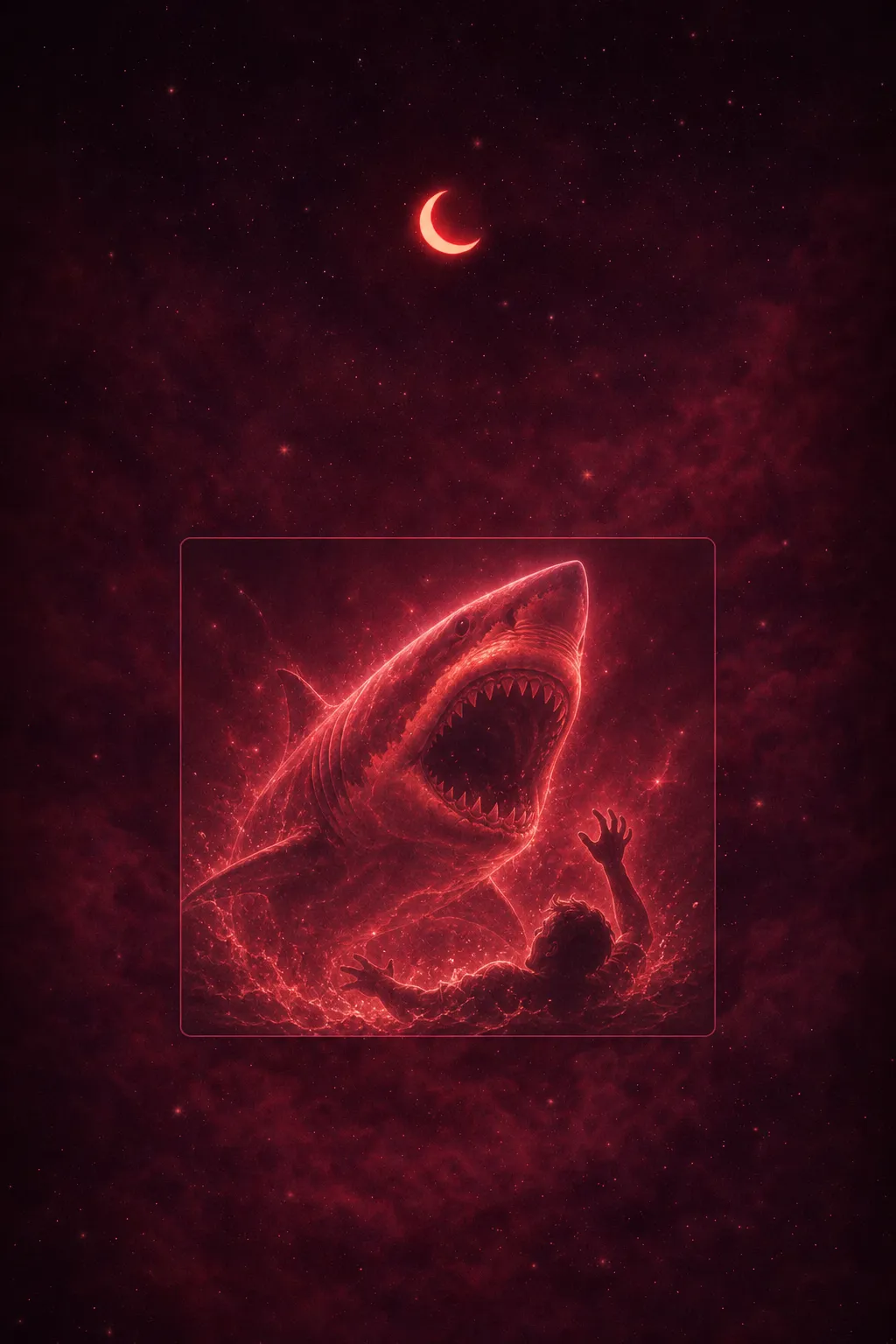

Dreaming of a shark attack often reflects a deep sense of threat, vulnerability, or being overwhelmed by a powerful force in your waking life. The shark can symbolize a predatory person, an uncontrollable situation, or your own repressed aggression surfacing. These dreams usually urge you to confront what feels dangerous before it catches you off guard.
In under a minute you could read what your exact dream means for you, and see a picture of it. Free.
Bad dream? See exactly what you dreamed — turned into a picture.
Just describe it and Dream Book paints your dream as a real image, plus a reading of what it means for you. Free, and it takes under a minute.


A dream still on your mind? Get your personal reading.
Describe your dream in a line or two. In seconds you get a reading of your exact dream, a picture drawn from your own words, and every symbol explained.
Free. No sign-up. Takes 10 seconds. Your dream stays private.
0%
Analyzing your dream…
Something went wrong. Please try again in a moment.
Your dreams deserve more than a dictionary
Common Shark Attack Dream Scenarios
Being Attacked by a Shark in the Ocean
Open water already signals emotional depth and the unknown — so when a shark strikes there, the dream is placing you in the most exposed position imaginable. You're out of your element, surrounded by something vast and uncontrolled, and the attack confirms what part of you already knows: something in your life has teeth, and you're in its territory.
This version of the dream often surfaces during periods of real vulnerability — a new job, a deteriorating relationship, a financial free-fall. If you also find yourself drowning in your dreams, the emotional stakes your subconscious is processing are likely even higher. The ocean isn't just a setting; it's the emotional climate you're swimming in right now.
A bad dream isn't a bad sign.
Shark Circling You Without Attacking
Sometimes the shark never bites — it just circles. This is arguably the more psychologically loaded version of the dream, because the threat is perpetual and unresolved. You wake up still waiting for the blow. That suspended dread maps directly onto waking-life situations where danger feels imminent but hasn't materialized: a difficult conversation you're avoiding, a relationship where you're always bracing for impact.
The circling shark is a portrait of anticipatory anxiety. Your nervous system is already in threat-response mode, even if nothing has happened yet. Pay attention to who — or what — you associate with that circling feeling when you wake up.
Shark Biting Your Leg or Hand
When the shark takes a specific body part, the symbolism sharpens. A bite to the leg often points to feeling cut off from forward movement — something is literally taking your ability to run, to progress, to escape. A bite to the hand or arm can signal a threat to your capability, your work, or your sense of control. Much like being stabbed in a dream, the wound's location carries meaning beyond the violence itself.
Notice whether you fight back in the dream or go limp. Fighting back suggests you have more inner resources than you're currently using. Going limp suggests you may feel overwhelmed to the point of surrender in some area of your waking life.
Watching Someone Else Get Attacked by a Shark
Witnessing the attack — rather than being its target — shifts the emotional register entirely. Here, you're the helpless observer. This dream often appears when someone you care about is in danger or self-destructing, and you feel powerless to intervene. It can also reflect a part of yourself you're watching suffer while another part stands frozen on the shore.
If the person being attacked is someone you recognize, consider what they represent to you — not just who they are. Sometimes the figure being consumed is a version of yourself you're afraid of losing. If the dream connects to grief or loss, it may be worth exploring what dreaming of someone dying means alongside it.
What this dream could look like
Tap an image to open it full screen
Example images. Only you can see what you write in Dream Book.
Psychological Interpretation
Freud would have looked at the shark and seen something primal — a symbol of devouring, aggressive energy, the kind that lives in the parts of the psyche we refuse to acknowledge. For Freud, the attack itself is the repressed wish or fear breaking through the surface: something you've been keeping underwater is now coming for you. The ocean, in his framework, frequently represented the unconscious, and the shark is what lives in its depths.
Jung took the predator image further and more personally. He'd likely read the shark as a manifestation of the Shadow — the disowned parts of yourself that accumulate power precisely because you refuse to look at them. The shark doesn't just threaten you; it is you, in some sense. The aggression, the hunger, the capacity for destruction you won't claim in waking life. Jung believed that when the Shadow attacks in dreams, it's an invitation to integrate, not just escape. If you find yourself also dreaming of snakes or other predatory animals, the Shadow is likely doing significant work in your dream life right now.
But what does your version mean?
Calvin Hall's content analysis of over 50,000 dream reports found that aggression and threat appear in roughly half of all dreams — and that the dreamer is far more often the victim than the aggressor. Shark attack dreams fit this pattern precisely. Hall argued these aren't random images; they reflect the dreamer's actual cognitive model of the world and their place in it. If you dream of being attacked, you likely hold a belief — conscious or not — that the world contains forces larger and more powerful than you, and that you are vulnerable to them.
Ernest Hartmann's emotional memory processing theory adds another layer: he saw nightmares not as failures of sleep but as the brain doing its most intense therapeutic work. The shark, in Hartmann's view, is the brain's chosen image for a feeling — probably something like helplessness, threat, or being overwhelmed — that hasn't been fully processed yet. The more vivid and violent the dream, the more emotionally charged the underlying material. Hobson and McCarley's activation-synthesis model would remind us that the brain is also partly constructing this narrative from random neural firing during REM sleep — but the specific image of a shark, rather than any other predator, still reflects your personal emotional associations. The brain reaches for the symbol that fits the feeling.
General meanings end here. Read your own dream.
Describe your dream in a line or two. In seconds you get a reading of your exact dream, a picture drawn from your own words, and every symbol explained.
Free. No sign-up. Takes 10 seconds. Your dream stays private.
0%
Analyzing your dream…
Something went wrong. Please try again in a moment.
Your dreams deserve more than a dictionary
Every dream you log starts to connect.
Dream Book keeps your dreams in one place and reveals the threads between them over time — your private dream journal. Free to start.
Cultural & Spiritual Meaning
In Western culture, the shark has been a symbol of ruthless predation since long before cinema made it iconic. Dreams of shark attacks in this tradition tend to be read as warnings about people in your life who operate without empathy — those who take without giving, who sense weakness and move toward it. The shark dream is often a message about a relationship or environment that is quietly consuming you.
Ibn Sirin, the 8th-century Islamic dream interpreter whose work remains one of the most consulted in the Islamic world, wrote about water creatures as symbols of power, authority, and the forces that govern human fate. A predatory creature attacking you in water was often read as a warning against a powerful enemy or a person of authority who wishes you harm — someone whose aggression is real, even if hidden. Ibn Sirin emphasized that the emotional state during the dream mattered enormously: if you escaped, the outcome was favorable; if you were consumed, caution was urgent.
Was yours a sign? Find out.
In many Indigenous Pacific and coastal cultures, the shark holds a dual nature — both destroyer and protector. Some traditions see the shark as an ancestral guardian, and dreaming of being attacked might signal that you've moved out of alignment with your own protection, rather than that an external enemy approaches. This reading inverts the Western interpretation: the threat isn't out there, it's a rupture within. Interestingly, tidal wave dreams carry a similar duality in many of these traditions — overwhelming force that is also, in some readings, a cleansing.
Related Dream Meanings
nightmares
Drowning Dream Meaning: Overwhelm, Fear & Hidden Stress
5 min read

nightmares
Being Stabbed Dream Meaning: Betrayal, Pain & Change
6 min read

nightmares
Someone Dying Dream Meaning: Change & Fear of Loss
5 min read
animals
Snakes Dream Meaning: Fear, Change & Hidden Threats
5 min read

nightmares
Tidal Wave Dream Meaning: What Your Subconscious Is Telling You
6 min read

common dreams
Dreaming of Dark Water Meaning: What Your Dream Reveals
6 min read

nightmares
Bomb Dream Meaning: Anxiety, Repression & Change
5 min read
nightmares
Dream of No Reflection in Mirror - Meaning and Interpretation
6 min read
What to Do After This Dream
First, don't dismiss it as just a nightmare. Shark attack dreams are your psyche's way of flagging something it considers urgent — a threat, a pattern, a feeling it needs you to pay attention to. Sit with the image when you wake up. Where in your life do you feel circled right now?
Write down every detail you can remember — the color of the water, whether you fought back, who else was present. Dark water versus clear water changes the interpretation significantly, as does whether you survived. These details are the emotional fingerprints of the dream.
Consider what — or who — the shark might represent. Often it's a specific relationship or situation rather than a general anxiety. If the dream keeps returning, that's your subconscious insisting you haven't addressed the source yet. Dream Book lets you describe your dream in detail and ask follow-up questions to understand what your subconscious is really working through — especially useful when the same threat keeps circling back.
And if the fear in the dream feels connected to real danger in your waking life — a person, a situation, a pattern you've been minimizing — take that seriously. Dreams don't manufacture threats from nothing. They amplify what you already know.
A bad dream isn't a bad sign.
Understanding your shark attack dream is the first step. The next is asking what it means for your life right now — that's where a personalized interpretation goes deeper than any dictionary.
If it keeps coming back, the app helps you understand the pattern.
Log each recurring dream and the free app shows you what's underneath — calmly, over time. Free to start.
People Also Ask
Dreaming of a shark attacking you typically signals that you feel threatened by a powerful, predatory force in your waking life — a toxic person, an overwhelming situation, or deep-seated anxiety that's finally breaking the surface. The attack represents something you've been aware of on some level but haven't fully confronted. Pay attention to where in your life you feel most vulnerable right now.
Not necessarily. While it's an intense nightmare, many dream interpreters — including those in the Islamic tradition following Ibn Sirin — see the outcome of the dream as the key indicator. If you escape or survive the attack, it often signals resilience and the ability to overcome a current threat. The dream is less a prophecy and more a psychological alarm bell.
Recurring shark attack dreams usually mean there's an unresolved threat or stressor in your waking life that your subconscious keeps returning to because you haven't addressed it yet. Ernest Hartmann's research on emotional memory processing suggests that recurring nightmares are the brain's way of insisting on attention to emotionally charged material. The dream will likely ease once the underlying situation is acknowledged and acted on.
A shark circling without striking is a dream about anticipatory dread — the feeling that something threatening is close, inevitable, and just out of reach. It often reflects a situation in waking life where you're bracing for a confrontation or outcome that hasn't happened yet. The sustained tension in the dream mirrors the sustained tension you're carrying while awake.
Curious what your dream would look like?