
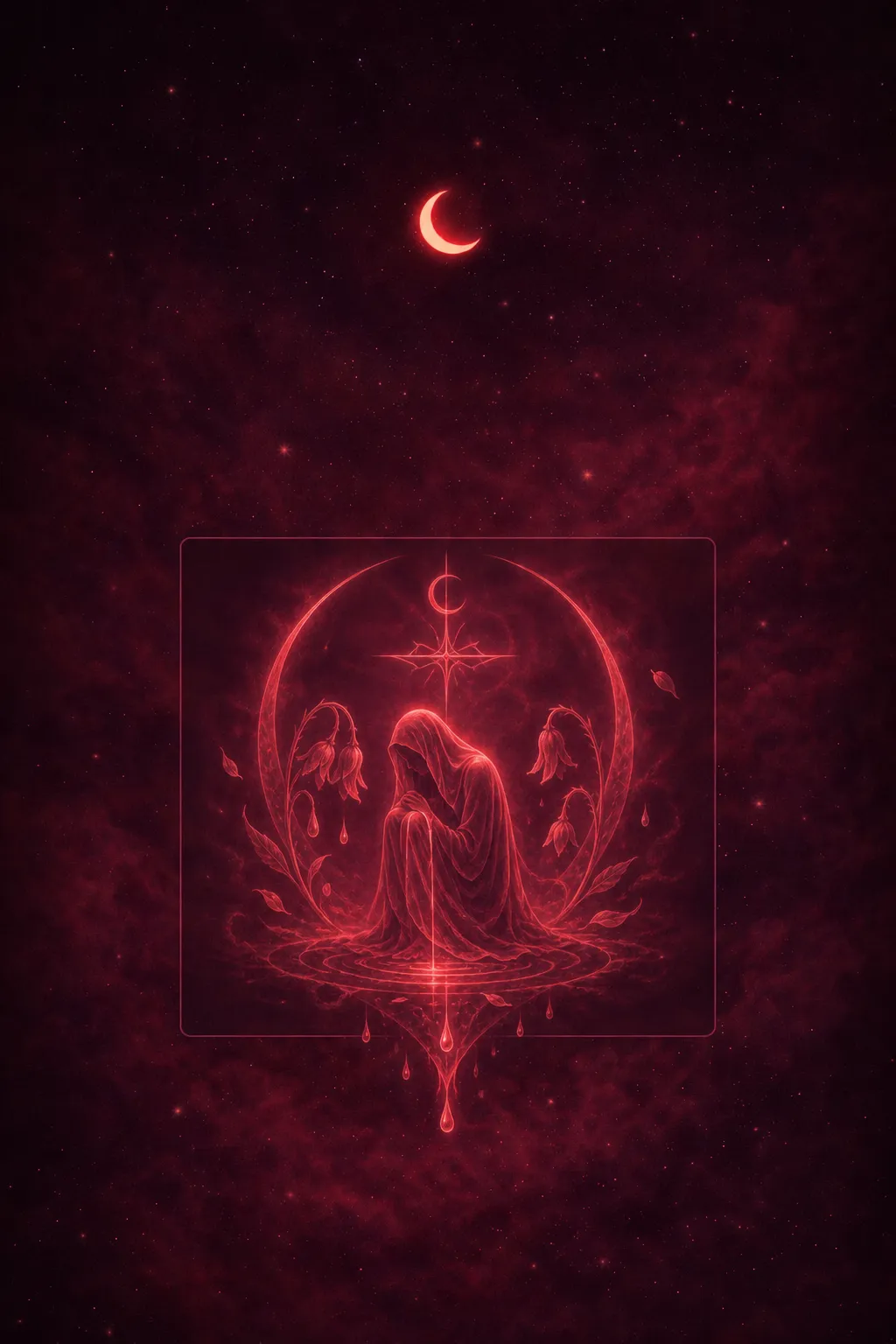

Dreaming of mourning often reflects emotional processing of loss, whether recent or long-buried. It can signal that part of your life — a relationship, identity, or chapter — is ending and needs acknowledgment. These dreams usually invite healing, not despair, guiding you toward acceptance and renewal.
In under a minute you could read what your exact dream means for you, and see a picture of it. Free.
Bad dream? See exactly what you dreamed — turned into a picture.
Just describe it and Dream Book paints your dream as a real image, plus a reading of what it means for you. Free, and it takes under a minute.


Common Mourning Dream Scenarios
Mourning Someone Who Is Still Alive
This one tends to leave you shaken when you wake up. You're weeping, dressed in black, standing at a grave — and the person you're mourning is someone who, as far as you know, is perfectly fine. The disorientation is the point. Your dreaming mind isn't predicting death; it's processing a shift in your relationship with that person.
You may be grieving a version of them — who they used to be, who you needed them to be. If you've been dreaming of a deceased loved one in the same period, the theme of loss is clearly running deep. The dream is asking you to acknowledge an ending you haven't yet named out loud.
A bad dream isn't a bad sign.
Mourning at a Funeral or Graveside
Standing at a funeral in your dream — or kneeling at a graveyard — places you inside a ritual of closure. Rituals matter to the dreaming mind. This scenario often appears when you're in the middle of a major transition and haven't given yourself permission to grieve what you're leaving behind.
The identity of the person being mourned matters enormously. Mourning a stranger suggests you're processing collective or inherited grief. Mourning yourself — watching your own funeral — is one of the more startling versions of this dream, but it almost always points to transformation, not death. You're witnessing the end of who you were.
Weeping and Unable to Stop
Some mourning dreams are less about imagery and more about sensation — you're crying in a way that feels bottomless, grief that has no floor. You wake up with wet eyes or a chest that feels hollow. Hartmann's research on emotional memory processing is particularly relevant here: the brain uses the dream state to metabolize emotions that were too intense to integrate while awake.
This kind of dream tends to arrive during periods of suppressed grief. You held it together through the funeral, through the breakup, through the diagnosis. Your sleeping mind is finishing the work your waking self couldn't start.
Mourning a Death That Already Happened
Reliving grief for someone already gone — replaying the moment of loss, standing again at the graveside — is one of the most emotionally exhausting dream experiences. It can feel like being robbed of the healing you've already done. But this dream often surfaces on anniversaries, at times of new stress, or when something in your present life rhymes with that original loss.
If you're dreaming of a dead relative or a dead friend, the dream may also be a visitation — the mind's way of maintaining connection with someone it still loves. These two experiences (grief processing and visitation) can coexist in the same dream.
What this dream could look like
Tap an image to open it full screen
Example images. Only you can see what you write in Dream Book.
Psychological Interpretation
Freud understood mourning as one of the psyche's most demanding tasks. In his 1917 essay "Mourning and Melancholia," he described grief as the ego's slow, painful work of withdrawing attachment from a lost object. When mourning appears in dreams, Freud would say the unconscious is still mid-process — still pulling back the threads of love and dependency, one by one. The dream is labor, not decoration.
Jung took a different angle. For him, mourning in dreams often signals individuation — the ongoing process of becoming more fully yourself. What you're mourning isn't always a person; it's frequently a persona, a belief system, or a shadow element you've finally begun to integrate. He'd pay close attention to who or what is being mourned, because the symbol carries the message. A death dream in the Jungian frame is almost never about literal death — it's about psychological transformation. Something is dying so something else can live.
But what does your version mean?
Calvin Hall's content analysis of over 50,000 dream reports found that themes of loss and death appear with striking regularity across cultures and age groups — and that they cluster around periods of real-life stress, transition, and interpersonal conflict. His data suggests mourning dreams aren't random noise; they track your emotional life with uncomfortable precision. Ernest Hartmann built on this, arguing that dreams function as a kind of overnight therapy — the sleeping brain creates narrative containers for overwhelming emotion, allowing the dreamer to feel grief in a context that won't destroy them. The dream is a controlled burn.
Hobson and McCarley's activation-synthesis hypothesis offers the neurological counterpoint: the brain stem fires randomly during REM sleep, and the cortex stitches those signals into a story. But even in this framework, the emotional tone of mourning dreams isn't random — the limbic system, which governs emotion and memory, has outsized influence during REM. Your grief doesn't just appear in these dreams by accident. It's the emotional weather your brain is currently living in.
General meanings end here. Read your own dream.
0%
Analyzing your dream…
Something went wrong. Please try again in a moment.
Your dreams deserve more than a dictionary
Cultural & Spiritual Meaning
In many Western traditions, mourning dreams are treated with a kind of reverence — the assumption being that grief doesn't stay neatly inside waking hours. Medieval European dream lore often interpreted weeping in dreams as a sign of coming joy, a reversal logic that still surfaces in folk wisdom today. The idea being that you cry in the night so you don't have to cry in the day — that the dream does the emotional work so the body doesn't have to carry it.
Ibn Sirin, the 8th-century Islamic scholar whose dream interpretations remain widely consulted, held a specific and striking view on mourning dreams: to see yourself weeping and wailing in a dream was often a sign of relief from distress to come — but to weep silently, without sound, was considered a more auspicious omen still, suggesting spiritual purification and divine mercy. He distinguished carefully between the quality and expression of grief in the dream, not just its presence. Context, as always, was everything.
Was yours a sign? Find out.
In many Indigenous and ancestral traditions across Africa, the Americas, and the Pacific, mourning in dreams is understood as literal communication — the dead reaching across to be acknowledged, to complete unfinished business, or simply to say goodbye properly. These traditions don't separate grief-processing from spiritual visitation the way Western psychology tends to. The dream is both. In East Asian traditions, particularly in Chinese and Japanese folk belief, dreaming of mourning rituals can signal that an ancestor requires attention — a prayer, a ritual, an acknowledgment that the living have not forgotten.
Related Dream Meanings
nightmares
Deceased Loved One Dream: Closure, Messages & Grief
5 min read

nightmares
Funeral Dream Meaning: End, Loss & New Beginnings
5 min read
nightmares
Graveyard Dream Meaning: Endings, Closure & New Starts
5 min read
nightmares
Crying Dream Meaning: Emotional Release & Hidden Stress
5 min read
nightmares
Dead Relative: Meaning and Interpretation
5 min read
nightmares
Dead Friend Dream Meaning: Closure & Unresolved Grief
5 min read

nightmares
Death Dream Meaning: Transformation, Loss & Change
5 min read

nightmares
UFO Dream Meaning: The Unknown, Change & Awe
6 min read
What to Do After This Dream
First: don't rush past it. Mourning dreams have weight, and they tend to repeat when you dismiss them. Give yourself a few minutes after waking — before the day colonizes your thoughts — to sit with what you felt. Not what you saw, but what you felt. That emotional residue is the message.
Write down who or what you were mourning. If it was a person, ask yourself honestly: is there a living grief here — something about this relationship, or a version of it, that you haven't let yourself grieve? If you were mourning something abstract, or yourself, consider what chapter of your life feels like it's ending right now. Transformation disguises itself as loss constantly.
If the dream keeps returning, it's worth going deeper than a general interpretation. Dream Book lets you describe your dream in detail and ask follow-up questions — so you can move from "this is a mourning dream" to "this is what it means for my life right now, specifically." That's where real understanding begins.
And if the grief in the dream feels connected to real, unprocessed loss — a death, a divorce, a rupture — consider whether you've actually given yourself space to mourn. Not performed mourning, but the real kind. Sometimes the dream is simply pointing at the door you've been walking past.
A bad dream isn't a bad sign.
Understanding your mourning dream is the first step. The next is asking what it means for your life right now — that's where a personalized interpretation goes deeper than any dictionary.
If it keeps coming back, the app helps you understand the pattern.
Log each recurring dream and the free app shows you what's underneath — calmly, over time. Free to start.
People Also Ask
Dreaming of mourning someone who is alive usually means you're grieving a change in that relationship, or a version of the person they used to be. It's not a premonition — it's your mind processing loss that's already happened emotionally, even if nothing has formally ended.
Recurring mourning dreams after a real loss are your brain's way of continuing the grief work — what Ernest Hartmann called emotional memory processing. The dreaming mind returns to overwhelming experiences repeatedly until the emotion is integrated. They typically ease as grief finds expression in waking life.
In most cultural and psychological traditions, no. Ibn Sirin interpreted weeping in dreams as a sign of coming relief, and Jungian psychology sees mourning dreams as markers of transformation rather than disaster. The dream is more likely processing something internal than predicting something external.
Mourning at a funeral in a dream often points to a need for closure around something you're leaving behind — a relationship, a role, or a phase of life. The ritual setting suggests your psyche is ready to formally acknowledge an ending, even if your waking self hasn't caught up yet.
Curious what your dream would look like?