
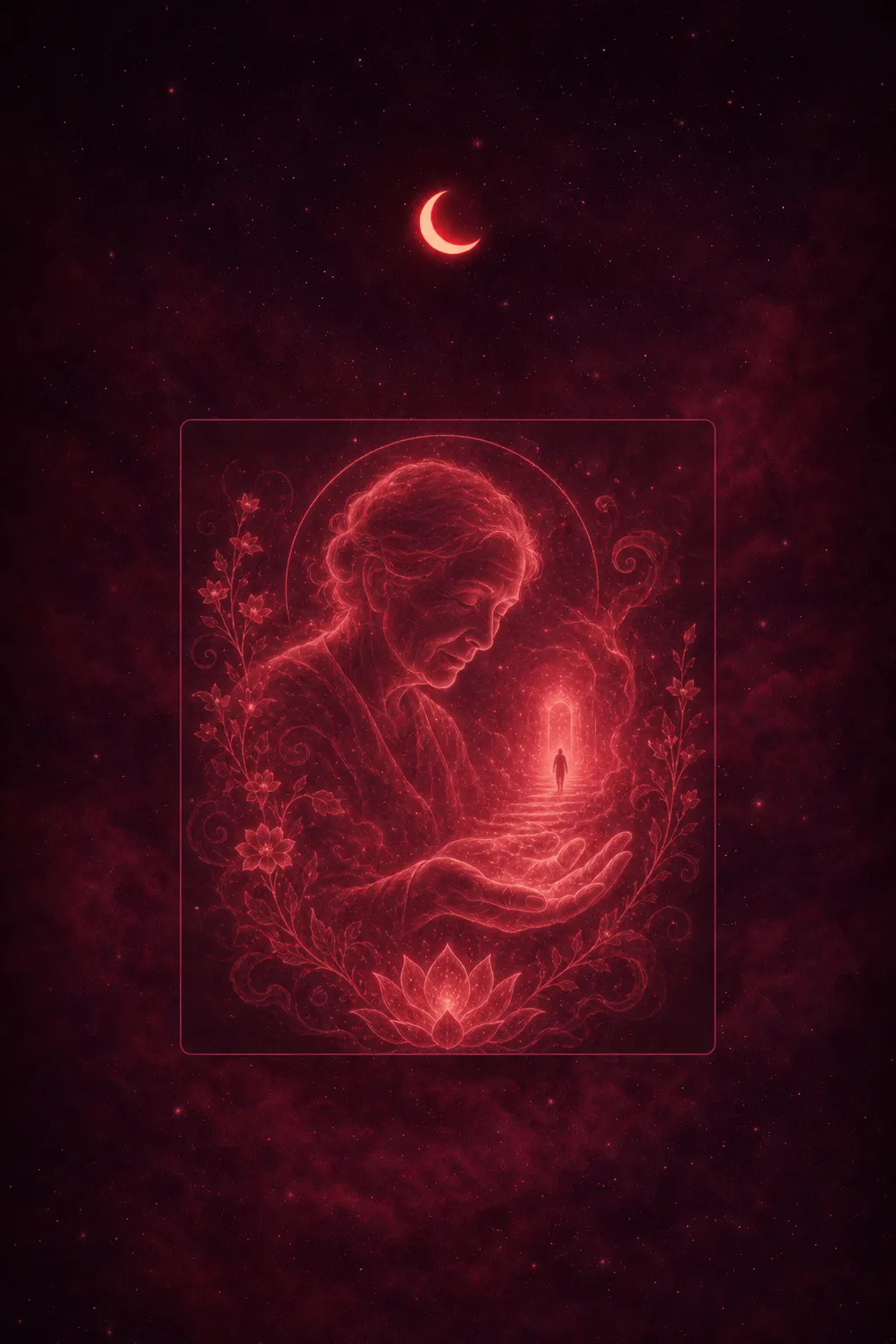

Dreaming about a dead relative typically reflects your mind processing grief, longing, or unresolved feelings toward that person, and many interpreters believe these vivid visits symbolize guidance, comfort, or a message from your subconscious urging you to honor their memory and apply lessons they taught you during their lifetime.
In under a minute you could read what your exact dream means for you, and see a picture of it. Free.
If they came to you in that dream, you already know it felt like more than a dream.
This page can't tell you what the visit meant for you. The free app gives you the warm, spiritual reading of your own dream — gently, in plain words.


A dream still on your mind? Get your personal reading.
Describe your dream in a line or two. In seconds you get a reading of your exact dream, a picture drawn from your own words, and every symbol explained.
Free. No sign-up. Takes 10 seconds. Your dream stays private.
0%
Analyzing your dream…
Something went wrong. Please try again in a moment.
Your dreams deserve more than a dictionary
Common Dream Scenarios and What They Mean
The shape a dead relative takes in your dream shifts the meaning considerably. A few recurring patterns stand out, each pointing to a different layer of grief, anxiety, or inner guidance-seeking.
Dreaming of a dead relative appearing alive and well
This is the most common scenario and usually reflects the continuing bond your mind has built around that person. You may be missing their perspective on something happening in your life right now, or simply rehearsing the relationship as it once was — a normal part of grief, not a sign of being "stuck."
Was yours a sign? Find out.
Dreaming of talking to a dead relative who gives advice
Here the dream is surfacing your own internalized version of that person — the counsel you absorbed from them over years. Those with a faith background sometimes experience this as meaningful reassurance, a sense that the person is still watchful.
Dreaming of hugging or saying goodbye to a deceased loved one
This grief-resolution motif often surfaces around anniversaries or after a long period of emotional stagnation, gently nudging you toward acceptance and closure.
Dreaming of a dead relative who is angry or in distress
This reflects your own unease — guilt, unresolved conflict, or things left unsaid — projected outward onto them. The discomfort belongs to you, not them.
Dreaming that a dead relative dies again
Re-experiencing the loss in a dream can mark a new stage of mourning, or it may mirror present-day anxiety about losing someone else currently in your life.
Dreaming of a dead relative warning or instructing you
Your own conscience is likely speaking through a trusted face. It can also signal displaced stress around a real responsibility you feel you're not on top of.
But what does your version mean?
Dreaming of a silent or distant presence of the deceased
Unspoken matters linger, or the sharpest edge of grief is softening — the bond persists, but feels just out of reach.
Dreaming of several deceased relatives gathered together
This often prompts reflection on family legacy, your place in the family line, and a broader reckoning with mortality and belonging.
Across all these variants, the emotional tone you wake with is your most reliable guide. Comfort and peace suggest the dream is doing healthy grief-work; guilt, fear, or dread are worth sitting with — they usually point toward something unresolved that your waking mind has been avoiding.
What this dream could look like
Tap an image to open it full screen
Example images. Only you can see what you write in Dream Book.
The Psychological Reading
From a psychological standpoint, dreaming of a dead relative is the sleeping mind doing active emotional housework. The continuing-bonds model — now widely accepted in grief psychology — holds that the psyche maintains a living internal representation of the deceased long after death. Far from being a sign of denial or dysfunction, this is healthy mourning-work: the brain rehearses the relationship during REM sleep, gradually integrating the loss into a revised sense of self and world. If the dream carries guilt, longing, or things-left-unsaid, that emotional residue is surfacing precisely because the subconscious judges it ready to be processed.
A second layer involves self-aspect projection. The relative in the dream often embodies values, habits, or a role you have internalized — a grandmother's patience, a father's drive — and seeing them may signal that you are either leaning on those qualities or struggling to live up to them. From a broadly Christian-influenced frame common in American culture, this maps naturally onto the idea of a moral inheritance: the dream becomes a quiet conscience check, not a supernatural visit, but a deeply personal one.
- Modern-anxiety framing: Recurring dreams of a dead relative frequently spike during life transitions — job changes, relationship shifts, health scares — when mortality salience is heightened and the need for emotional continuity feels urgent.
- Control and self-knowledge: The emotional tone matters most. Fear or chaos in the dream suggests unresolved anxiety about further loss; calm and closure suggest the mourning-work is progressing.
- Unfinished business: If dialogue feels blocked or the relative seems troubled, the subconscious is likely flagging unexpressed grief or regret still waiting for acknowledgment.
General meanings end here. Read your own dream.
Describe your dream in a line or two. In seconds you get a reading of your exact dream, a picture drawn from your own words, and every symbol explained.
Free. No sign-up. Takes 10 seconds. Your dream stays private.
0%
Analyzing your dream…
Something went wrong. Please try again in a moment.
Your dreams deserve more than a dictionary
Every dream you log starts to connect.
Dream Book keeps your dreams in one place and reveals the threads between them over time — your private dream journal. Free to start.
Cultural and Traditional Beliefs
Across many Western folk traditions, a visit from a dead relative in a dream has long been treated as something more than random neural noise. In older Anglo-American rural culture, such dreams were often called "visitation dreams" and were taken as genuine contact — the deceased dropping by to check on the living, offer a warning, or signal that they were at peace. This belief persists quietly today: surveys consistently show that a large share of bereaved Americans and Britons regard these dreams as meaningful beyond the purely psychological, regardless of formal religious affiliation.
A bad dream isn't a bad sign.
Within the US Christian tradition, the dream sits in nuanced territory. Scripture neither endorses nor flatly forbids the idea that God might communicate through dreams involving the departed, and many believers hold a middle ground — reading the dream not as literal contact with the dead but as a form of divine comfort or inner prompting toward forgiveness and reconciliation. The emotional residue of things left unsaid finds a culturally sanctioned frame here: the dream becomes an opportunity for closure that life did not provide.
- Comfort and reassurance: Folk tradition widely reads a calm, smiling relative as a sign that grief can be released.
- Warning or unfinished business: A troubled or urgent apparition is traditionally interpreted as a prompt to address something unresolved — a relationship, a responsibility, a change being avoided.
- Mortality anxiety: In modern-anxiety terms, the dream can surface during major life transitions, reflecting the dreamer's need for control and continuity when familiar structures feel threatened.
Spiritual Perspectives on Dreaming of a Dead Relative
Within a broadly Christian framework — still the dominant spiritual lens for many Americans — dreaming of a deceased loved one who appears calm and at peace is often received as quiet reassurance. Paul's words in 1 Thessalonians 4:13–14 anchor this reading: believers grieve, but not without hope, trusting that the dead rest in God's care. Through that lens, a serene visitation dream isn't necessarily supernatural contact so much as the heart finding comfort in what faith already promises. For people carrying modern anxiety about further loss or the uncertainty that follows a major life transition, that framing can be genuinely stabilizing — a reminder that love and meaning survive death even when daily control feels shaky.
At the same time, mainstream and conservative Christian voices draw a careful line. Deuteronomy 18:11 discourages actively seeking communication with the dead, so most pastoral guidance frames these dreams as God-permitted comfort through memory rather than literal two-way contact. The emphasis stays firmly on resurrection hope rather than ongoing spiritual dialogue — which, paradoxically, can ease anxiety precisely because it removes the pressure to decode every detail of the dream as a coded message.
- Comfort over contact: A peaceful dream image is often read as reassurance that the loved one is at rest, not a literal visitation requiring interpretation.
- Hope of resurrection: Christian spirituality anchors grief in a forward-looking promise rather than backward-looking longing.
- Caution about seeking: Scripture distinguishes between dreams that arise naturally and actively pursuing communication with the deceased.
Related Dream Meanings

nightmares
Dead Grandfather Meaning - Symbolism & Interpretation
6 min read

nightmares
Dreaming of Dead Uncle Meaning - Dream Interpretation Guide
6 min read

nightmares
What Does It Mean When You Dream About a Dead Aunt
5 min read

nightmares
What Does It Mean to Attend a Funeral in a Dream
5 min read

nightmares
What Does It Mean to Dream About Burial
5 min read

nightmares
Mourning Dream Meaning: Grief, Release & Transition
5 min read

nightmares
Being Chased by a Lion: Meaning and Interpretation
6 min read

nightmares
What Does It Mean to Dream About Being Chased by a Bear
6 min read
Practical Takeaways: What to Do After the Dream
When you wake from a dream about a dead relative — especially one that leaves a strong emotional residue — the most useful first move is to write it down immediately. Note not just the plot but the feeling: were you relieved, guilty, unsettled, comforted? That emotional fingerprint is the real data. If guilt or unfinished business surfaced, treat the dream as a low-pressure prompt to do the inner work you may have been postponing — writing a letter you never send, talking to a therapist, or simply sitting with the feeling rather than pushing it away.
- Journal the emotion, not just the story. A few sentences on how the dream felt can reveal what grief stage or anxiety you are currently navigating.
- Name the stress trigger. If you are going through a major life transition — a job change, a move, a health scare — recognize that your mind may be recruiting the deceased as a symbol for stability. Ask what value or strength that person represented to you, and look for ways to draw on it consciously.
- Limit catastrophizing. A dream about a dead relative does not predict another loss. Grounding techniques — slow breathing, a brief reality check — can help if the dream feeds overnight anxiety.
- Consider a grief check-in. If these dreams cluster around anniversaries or milestones, that is normal; if they are frequent and distressing over a long period, a counselor who works with bereavement can offer structured support.
Was yours a sign? Find out.
The simplest reframe: treat the dream as your mind's honest report on where you are in the ongoing process of loss and adaptation — not a crisis, but useful information worth a few quiet minutes of attention.
Keep the ones that matter close.
The free app saves your most meaningful dreams and reads the signs across them — so a visit or a sign is never lost. Free to start.
People Also Ask
The Bible warns against seeking communication with the dead, yet many believers view such dreams as God-given comfort. Scripture describes God speaking through dreams, so some interpret these experiences as divine reassurance rather than literal contact. Ultimately, biblical interpretation depends on your personal faith and the dream's emotional tone.
Across many spiritual traditions, seeing deceased people in dreams signals transformation, unfinished emotional business, or guidance from the other side. It may suggest your subconscious is processing grief, or that ancestral wisdom is surfacing. Many cultures consider these encounters sacred visits, offering peace, warnings, or messages meant to help the living move forward.
Many people genuinely believe deceased loved ones use dreams as a bridge between worlds. These vivid, emotionally intense experiences — often called visitation dreams — feel distinctly different from ordinary dreaming. Whether spiritual communication or the mind's way of honoring lost bonds, they frequently bring comfort, closure, and a lasting sense of continued connection.
Dreaming of someone who has passed often reflects unresolved grief, longing, or a need for their guidance. It can also signal that you're integrating their influence into your identity. If the person seemed happy or peaceful, it typically carries a reassuring meaning; distressing imagery usually points to unprocessed emotions needing attention.
Curious what your dream would look like?