


Dreaming of an intruder often reflects a sense of violated boundaries, unresolved anxiety, or an outside force threatening your sense of safety. The intruder can represent a real-life stressor, a suppressed emotion, or someone overstepping in your personal life. Understanding the context of the intrusion usually reveals what area of your life feels most vulnerable right now.
In under a minute you could read what your exact dream means for you, and see a picture of it. Free.
Bad dream? See exactly what you dreamed — turned into a picture.
Just describe it and Dream Book paints your dream as a real image, plus a reading of what it means for you. Free, and it takes under a minute.


Common Intruder Dream Scenarios
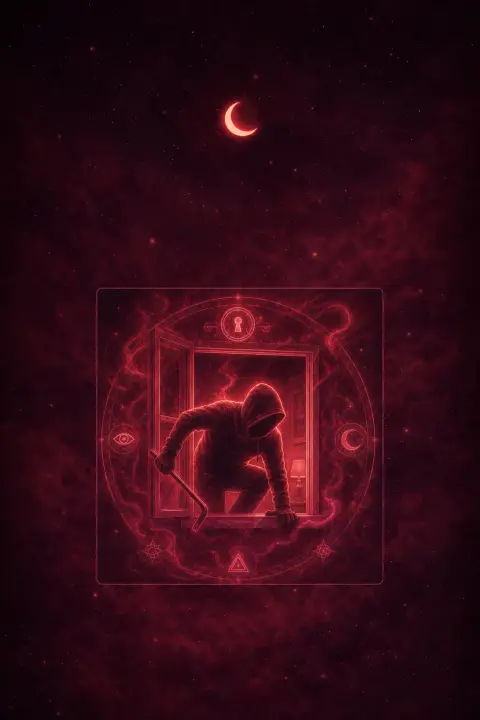
Someone Breaking Into Your Home
Your home in dreams is almost always a map of your psyche. When you dream of someone breaking in, the intrusion isn't just physical — it's a violation of the self. The rooms being entered, the doors that won't lock, the windows left open: all of it speaks to where you feel exposed.
This is the most reported version of the intruder dream, and it tends to spike during periods of major life change — a new relationship, a job shift, a move. Something external has gotten closer than you're comfortable with, and your sleeping mind is sounding the alarm.
A bad dream isn't a bad sign.
Being Chased by an Intruder
When the intruder stops lurking and starts pursuing you, the dream shifts into full-throttle panic. Being chased in a dream is one of the oldest and most universal nightmare patterns — and when the pursuer has broken into your space first, the emotional charge doubles. You're not just running from danger; you're running from something that already knows where you live.
Pay attention to whether you escape or get caught. Escaping suggests you have more psychological resources than you think. Getting caught — or waking up before you find out — often means the issue chasing you still needs to be faced head-on.
Hiding from the Intruder
Hiding is avoidance made literal. In this version, you're crouched behind a door, under a bed, holding your breath while the intruder moves through your house. This dream points directly to a situation in your waking life where you're choosing concealment over confrontation — and part of you knows it.
If you dream of being attacked after hiding, your subconscious may be telling you that avoidance has stopped working. The threat found you anyway. It's worth sitting with that.
Knowing the Intruder
Sometimes the face of the intruder is someone you recognize — an ex-partner, a family member, a coworker. This is where the dream gets genuinely interesting. When the intruder has a familiar face, the dream is rarely about that person literally breaking in. It's about the emotional territory they occupy in your life — the influence they still have, the way their presence (or memory) still enters your thoughts uninvited.
Ask yourself: what does this person represent to you? Their role in the dream is symbolic. The intrusion is theirs, but the house is still yours.
What this dream could look like
Tap an image to open it full screen
Example images. Only you can see what you write in Dream Book.
Psychological Interpretation
Freud would have had a field day with the intruder dream. For him, the home was a symbol of the self, and anything that broke in represented repressed material — desires, fears, or impulses that the conscious mind has locked away. The intruder isn't a stranger; it's the return of something you've worked hard not to think about. Freud saw dreams like this as wish fulfillment in disguise: the psyche staging what it cannot say out loud.
Jung took the intruder further into the territory of the Shadow — the collection of traits, impulses, and memories you've exiled from your conscious identity. For Jung, when a dark figure breaks into your dream home, it's the Shadow announcing itself. The more terrifying the intruder, the more charged the repressed material. This isn't necessarily bad news: Jung believed confronting the Shadow was essential to becoming a whole person. The intruder dream, in this reading, is an invitation — uncomfortable, yes, but meaningful. If you've also been dreaming of a shadow person or a presence in the room, you may be circling the same psychological territory.
But what does your version mean?
Calvin Hall's content analysis of over 50,000 dream reports found that threat dreams — including intruder scenarios — were far more common in people experiencing high-stress transitions. Hall's cognitive theory frames dreams as a kind of thinking: the mind rehearsing scenarios, testing responses, working through perceived dangers. The intruder dream, in his framework, is your brain running a threat simulation — not predicting the future, but processing current fear.
Ernest Hartmann, whose work on emotional memory processing reshaped how we understand nightmares, argued that recurring threat dreams like this one serve a therapeutic function. The dream is essentially asking: what is the emotional core of this fear? Hartmann believed the images in nightmares — the dark figure, the locked door that won't hold — are the mind's way of finding a container for emotions too raw to process consciously. Hobson and McCarley's activation-synthesis model adds a neurological layer: the brain stem fires random signals during REM sleep, and the cortex constructs a narrative around them. But even in that framework, the emotional coloring — why this particular narrative, why an intruder — still reflects your waking preoccupations.
General meanings end here. Read your own dream.
Describe your dream in a line or two. In seconds you get a reading of your exact dream, a picture drawn from your own words, and every symbol explained.
Free. No sign-up. Takes 10 seconds. Your dream stays private.
0%
Analyzing your dream…
Something went wrong. Please try again in a moment.
Your dreams deserve more than a dictionary
Cultural & Spiritual Meaning
In Western psychological tradition, the intruder dream has long been read as a confrontation with the unconscious — the dark figure at the door representing everything civilization asks us to suppress. But in older folk traditions across Europe, a stranger entering your home in a dream was sometimes read as an omen of change: not always malevolent, but always significant. The threshold of a house has always carried symbolic weight. To cross it uninvited is to violate something sacred.
Ibn Sirin, the 8th-century Islamic dream scholar whose interpretations remain influential across the Muslim world, wrote specifically about intruder figures in dreams. For Ibn Sirin, a thief or uninvited figure entering the home often signaled that the dreamer was vulnerable to deception — either by others or by their own nafs (lower self). He advised the dreamer to examine where they had been careless with their integrity or their boundaries. The intrusion, in his reading, was a spiritual warning to guard what matters most.
Was yours a sign? Find out.
In many Indigenous traditions, the home in dreams represents the community and the self simultaneously — and a figure who enters without welcome is often interpreted as a spirit that needs acknowledgment rather than a threat to be fled. Some traditions would counsel the dreamer to speak to the intruder, to ask what it wants. This mirrors, interestingly, what modern depth psychology recommends: turn toward the figure, not away from it.
Related Dream Meanings
nightmares
Someone Breaking Into Your House: Meaning and Interpretation
5 min read

nightmares
Being Chased Dream Meaning: Anxiety & Avoidance
5 min read

nightmares
Being Attacked Dream Meaning: Fear & Hidden Anxiety
5 min read

people
Ex Partner Dream Meaning: What Your Dreams About Former Lovers Reveal
6 min read

nightmares
Shadow Person in Dreams: What It Means When You See Them
5 min read

nightmares
Feeling Someone in Room Dream Meaning
5 min read

nightmares
What Does It Mean to See a Dead Bird in a Dream
5 min read

nightmares
Being Buried Alive: Meaning and Interpretation
5 min read
What to Do After This Dream
First, don't dismiss it as random noise. An intruder dream — especially a recurring one — is your psyche flagging something real. The question is what.
Start by asking: what in my waking life feels like an invasion right now? A relationship that's crossed a line? A habit that's taken over more space than you intended? An emotion — grief, anger, desire — that keeps showing up despite your best efforts to shut it out? The intruder is rarely random. It wears the shape of whatever you've been trying to keep outside.
Write the dream down immediately. Not just what happened, but how it felt. The feeling is the data. Notice whether you felt frozen, whether you tried to fight, whether you hid. Your response in the dream often mirrors your default response to threat in waking life — and that's worth knowing.
If this dream keeps returning, it's worth exploring with a personalized interpretation. Dream Book lets you describe your dream in detail and ask follow-up questions to understand what your subconscious is actually working through — because the same intruder dream can mean something different depending on your life, your history, and what's happening right now.
A bad dream isn't a bad sign.
Understanding your intruder dream is the first step. The next is asking what it means for your life right now — that's where a personalized interpretation goes deeper than any dictionary.
If it keeps coming back, the app helps you understand the pattern.
Log each recurring dream and the free app shows you what's underneath — calmly, over time. Free to start.
People Also Ask
Dreaming of an intruder in your house typically points to a boundary violation in your waking life — something or someone has gotten too close, or an emotion you've been suppressing is breaking through. The house represents your inner self, and the intruder represents whatever feels threatening or unwanted. It's rarely about literal danger and almost always about psychological pressure.
Recurring intruder nightmares usually signal ongoing anxiety, unresolved stress, or a situation in your life where you feel unsafe or out of control. Ernest Hartmann's research suggests that recurring nightmares are the mind's way of processing an emotion it hasn't fully worked through yet. The dream will often ease once the underlying issue is acknowledged and addressed.
In most cultural traditions, including Ibn Sirin's Islamic dream interpretation, an intruder dream is less a prediction and more a warning to examine where you feel vulnerable or where your boundaries need strengthening. It's a signal worth taking seriously, but not a prophecy of harm.
When the intruder has a familiar face, the dream is pointing to that person's emotional influence on you — not a literal threat. It often means their presence, memory, or the dynamic you share with them has been occupying your mental space in a way that feels intrusive or unresolved.
Curious what your dream would look like?