
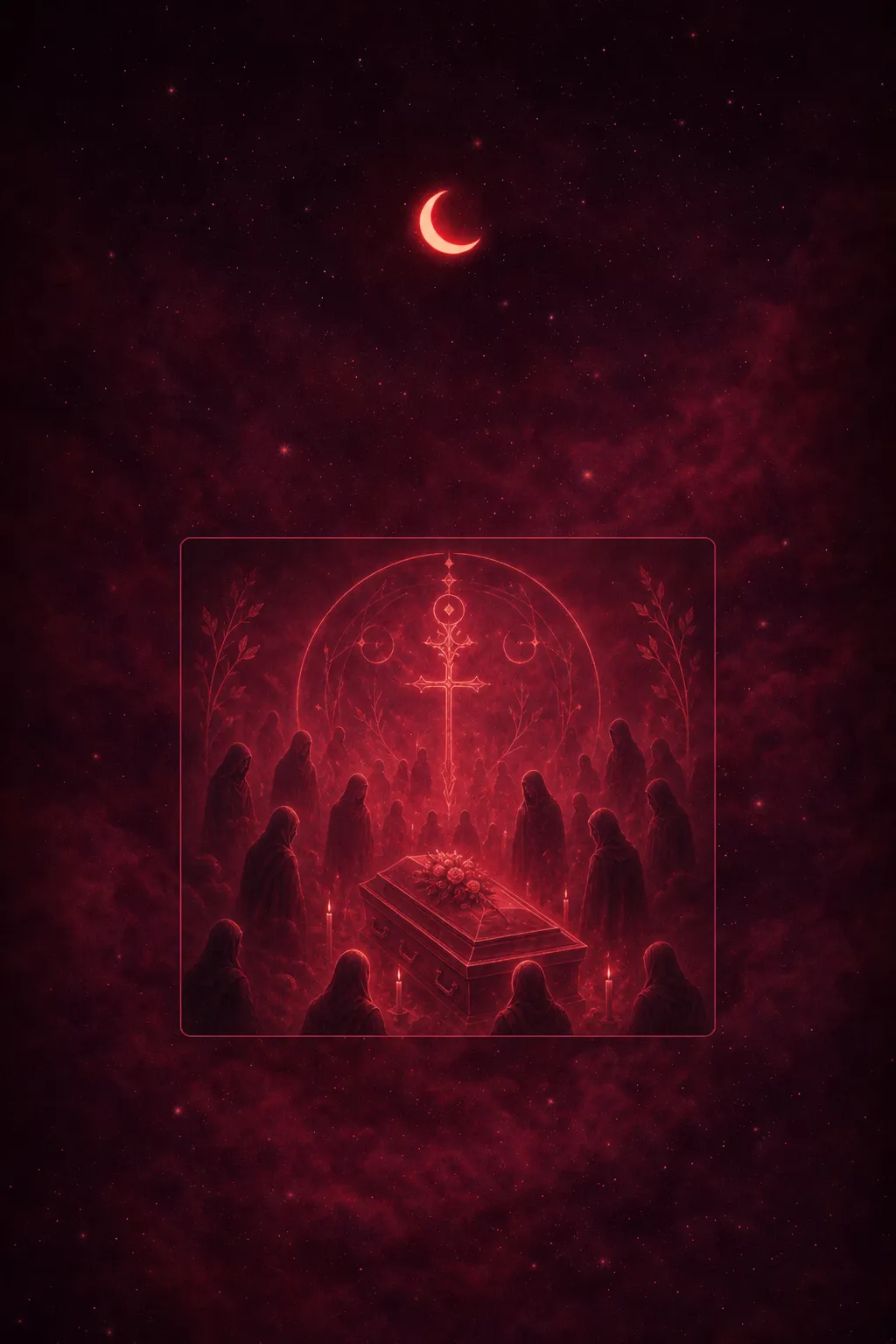

Attending a funeral in a dream typically signals a major life transition or the symbolic end of a relationship, habit, or chapter, as your subconscious uses the imagery of mourning to help you process loss, release the past, and prepare emotionally for the new beginnings that naturally follow endings.
In under a minute you could read what your exact dream means for you, and see a picture of it. Free.
If they came to you in that dream, you already know it felt like more than a dream.
This page can't tell you what the visit meant for you. The free app gives you the warm, spiritual reading of your own dream — gently, in plain words.


Common Funeral Dream Scenarios and What They Mean
The identity of the deceased and your emotional state inside the dream shift the meaning considerably. When you find yourself attending the funeral of a complete stranger, your mind is signaling a quiet, unnamed ending — something winding down beneath conscious awareness, whether a habit, a belief, or a chapter of life you haven't yet labeled. Dreaming of attending the funeral of someone who is very much alive carries a different weight: it rarely hints at anything literal, and far more often reflects a shift in that relationship — a phase closing, feelings changing, or a subconscious recognition that the person you once knew has grown into someone different. Similarly, attending a parent's or close family member's funeral while they are living often surfaces around real-life transitions in family roles, dependence, or a maturation step you're quietly negotiating. At Dream Book we explore this symbol in depth.
- Watching your own funeral: A strong signal of self-transformation — examining your life from the outside, fearing being forgotten, or standing on the edge of a significant personal reinvention.
- Arriving late or unable to find the service: A classic modern-anxiety scenario tied to guilt, avoidance, or a sense that you're not ready to close a chapter and move forward.
- Feeling calm or relieved: Healthy acceptance; the psyche acknowledging that grief has run its course and release is appropriate.
- A chaotic or surreal funeral: Conflicted feelings about an ending — things unresolved, messy, or resisting closure.
- Overwhelming dread throughout: Usually stress overflow, especially when the dreamer fears losing someone dear; projection of waking anxiety rather than any form of premonition.
Was yours a sign? Find out.
Across all these variants, the through-line is self-knowledge and control: the dream is pressing you to notice what is actually finishing in your life and whether you are meeting that ending honestly or sidestepping it.
What this dream could look like
Tap an image to open it full screen
Example images. Only you can see what you write in Dream Book.
Psychological Reading: Grief, Control, and Inner Transformation
From a psychological standpoint, dreaming of attending a funeral is rarely about death itself — it is the mind's way of staging a formal farewell to something that has already ended internally. Mainstream developmental psychology reads the funeral setting as the unconscious marking a transition: the close of a relationship, the shedding of an old identity, or the quiet retirement of a habit or belief system that no longer serves you. The ritual structure of a funeral gives the psyche a framework for what might otherwise feel like shapeless, unresolvable loss, allowing genuine grief to surface and move toward integration rather than remaining stuck below awareness.
Modern anxiety patterns add another layer. If your waking life is heavy with stress about aging, a career shift, or a change you feel powerless to prevent, the funeral dream can act as a rehearsal space — a controlled environment where the mind confronts an inevitable ending it cannot negotiate away. The act of attending, rather than being the one buried, is psychologically significant: it positions you as a conscious witness, suggesting some readiness to accept the ending even when the feeling is uncomfortable. That observer role reflects a degree of self-awareness, a part of you willing to show up and acknowledge what is over.
- Unprocessed mourning: Grief that was suppressed or rushed in waking life often resurfaces in sleep for delayed integration.
- Loss of control: The solemnity and inevitability of a funeral mirror anxiety about life changes the dreamer cannot stop or reverse.
- Social identity pressure: The gathered crowd can reflect concerns about duty, belonging, and how you are perceived by family or community during times of change.
General meanings end here. Read your own dream.
0%
Analyzing your dream…
Something went wrong. Please try again in a moment.
Your dreams deserve more than a dictionary
Cultural and Folk Traditions: What Attending a Funeral Has Long Meant
In Anglo-American culture, funerals are among the most codified social rituals — formal, restrained gatherings built around composure, duty, and the obligation to "pay one's respects." When this setting appears in a dream, it carries that cultural weight with it. The dreamer is not simply witnessing a death; they are being placed inside a structure of collective mourning that demands a particular kind of dignified behavior. Folk wisdom has long read such dreams not as dark omens but as signals of change: something in waking life is concluding, and the unconscious is staging a proper send-off for it, complete with ceremony and witnesses.
But what does your version mean?
A softer current of vernacular superstition actually inverts the imagery altogether — older household traditions in Britain and the American South held that dreaming of mourning could foretell a birth, a wedding, or unexpected good news. This inversion reflects a deep cultural instinct to neutralize death imagery, to insist that endings carry the seed of something new. While few people consciously hold this belief today, it points to a longstanding folk need to reframe loss as promise.
- Duty and composure: The formal norms of Anglo funeral culture mean the dream may also surface anxieties about social obligation — whether you are "holding it together" under pressure in waking life.
- Marking a transition: Traditional folk reading consistently treats the funeral dream as symbolic of closure, not literal death — a cultural shorthand for "something important is ending."
- Inversion folklore: The superstition that funeral dreams predict good news reflects a collective desire to assert control over frightening imagery by reversing its meaning.
Spiritual Meaning: Dying to the Old, Rising to the New
Within a US Christian frame, attending a funeral in a dream resonates strongly with the biblical image of dying to self — the passage in Romans 6:4 that speaks of being "buried with Christ" and raised to walk in newness of life. Viewed this way, the dream is less an omen than an invitation: something in you is being laid to rest so that something renewed can emerge. This mirrors the burial symbolism found throughout Scripture, where endings are never purely final but are understood as thresholds into transformation.
A bad dream isn't a bad sign.
From a broader spiritual standpoint, the funeral setting also functions as a sacred pause — a moment the dreaming mind carves out to honor and release what is genuinely passing. Modern life rarely offers structured rituals for the smaller losses: a fading relationship, a surrendered ambition, a version of yourself you've quietly outgrown. The dream may be supplying that missing ceremony, urging you to grieve with intention rather than push forward without acknowledgment.
- Dying to self: The dream may signal readiness to let go of an identity, habit, or chapter that no longer serves your growth.
- Hope beyond the ending: Christian symbolism frames this transition as purposeful — loss pointing toward resurrection, not simply loss.
- Spiritual surrender: Where anxiety about control runs high, the funeral image can be a gentle prompt to release what you cannot — and were never meant to — hold.
Related Dream Meanings
nightmares
Grief Dream Meaning: Loss, Healing & Unresolved Emotions
5 min read

nightmares
Mourning Dream Meaning: Grief, Release & Transition
5 min read

nightmares
What Does It Mean to Dream About Burial
5 min read
nightmares
Miscarriage Dream Meaning: Loss, Fear & Anxiety
5 min read

nightmares
Paralysis Dream Meaning: Helplessness & Loss of Control
5 min read
nightmares
Anger Dream Meaning: Stress, Conflict & Need for Change
5 min read

nightmares
Fear in Dreams: Meaning, Anxiety & Hidden Struggles
5 min read

nightmares
Volcano Dream Meaning: Repressed Emotions & Change
5 min read
Practical Takeaways: Acting on What Your Funeral Dream Is Telling You
Because this dream almost always points to an ending you are already living through, the most useful first step is simple honesty: name what is actually over. A relationship, a job chapter, a version of yourself you have outgrown — write it down in plain language. That act of naming converts a vague nighttime unease into something you can actually work with, and it directly addresses the control anxiety that often drives the dream in the first place.
- Run a brief life audit. Ask yourself what you have been reluctant to formally close off — a project, a friendship, an old identity. Funerals are ceremonies of acknowledgment; your waking self may need a small equivalent ritual, even just a journal entry or a frank conversation.
- Notice the emotional tone you woke with. Relief suggests you are ready to move forward. Dread or guilt may point to unprocessed grief that deserves more attention, whether through reflection, trusted conversation, or a few sessions with a counselor.
- Resist the urge to over-control what comes next. Transition dreams like this frequently spike during periods of high stress precisely because the mind craves certainty. Channel that energy into one concrete, manageable next step rather than trying to map the entire road ahead.
Was yours a sign? Find out.
Think of the dream as your mind's own closure ceremony. Honoring it consciously — rather than shaking it off — is usually the fastest route back to a steadier sense of direction.
Keep the ones that matter close.
The free app saves your most meaningful dreams and reads the signs across them — so a visit or a sign is never lost. Free to start.
People Also Ask
Dreaming of attending a funeral often reflects a need to process endings, grief, or significant life changes. It may signal that you are letting go of an old habit, relationship, or chapter of your life. Your subconscious uses the funeral setting to help you acknowledge and accept transformation rather than resist it.
Biblically, funeral dreams are often linked to themes of resurrection, renewal, and spiritual transition. Just as death precedes new life in scripture, such a dream may signal God calling you toward spiritual growth or a season of change. It can represent shedding your old self and stepping into a renewed, purpose-driven path.
Dreaming about your own funeral rarely signals literal death. Instead, it typically reflects deep self-reflection, a desire for reinvention, or concern about how others perceive you. It may indicate you feel overlooked in waking life or that a significant personal transformation is underway, urging you to consider what truly matters to you.
Dreaming of a living person's funeral usually symbolizes a shift in your relationship with them or a change in how you see them. It may reflect unresolved conflict, emotional distance, or a fear of losing them. It rarely predicts harm and more often points to evolving feelings or a relationship entering a new phase.
Curious what your dream would look like?