
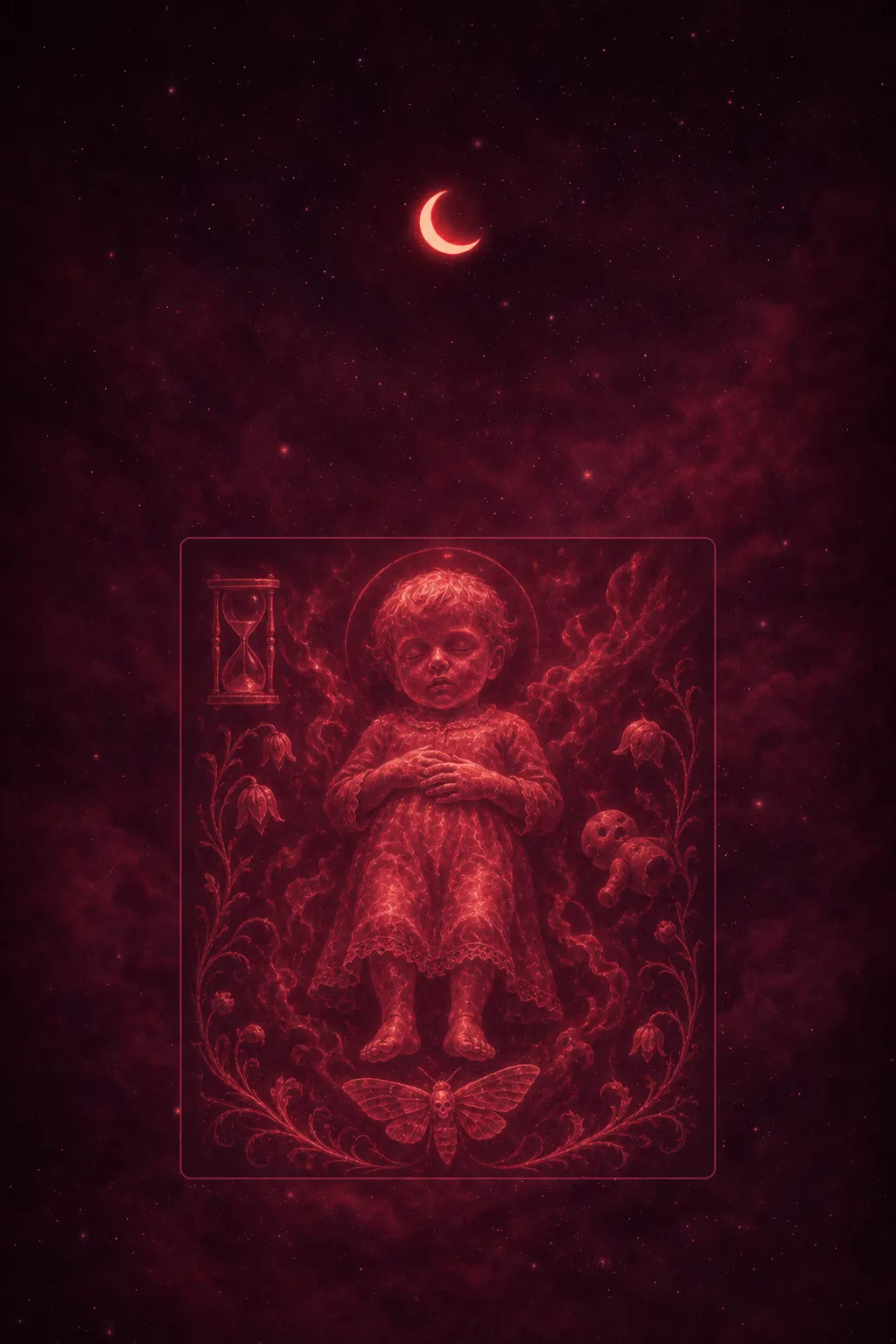

Dreaming about a dead child typically symbolizes the loss of innocence, the end of a life phase, or suppressed grief, reflecting deep emotional pain, fear of failure as a caregiver, or anxiety about a child's wellbeing rather than a literal prediction of harm.
In under a minute you could read what your exact dream means for you, and see a picture of it. Free.
If they came to you in that dream, you already know it felt like more than a dream.
This page can't tell you what the visit meant for you. The free app gives you the warm, spiritual reading of your own dream — gently, in plain words.


Common Dream Scenarios and What They Mean
The specific details surrounding a dead child in a dream shift the meaning considerably. Context — who the child is, what you are doing, and how the scene resolves — tells you far more than the image alone. At Dream Book we explore this symbol in depth.
- Your own living child appears dead. This is the scenario that jolts most parents awake in a cold sweat. Almost always, it reflects anxiety amplification rather than prophecy — your mind stress-testing a worst-case outcome as a way of feeling prepared. It often surfaces during periods of separation, a child's growing independence, or a stretch of life when you feel you have little control over keeping the people you love safe.
- An unknown or anonymous dead child. When the child is a stranger, look to what feels neglected or doomed in your waking life — a creative project, a new venture, an ambition that never quite got off the ground. The anonymous child represents vulnerable potential that has not yet been protected or nurtured.
- Holding or carrying the dead child. This posture points to unresolved grief or guilt you are still actively carrying. Something has ended, but you have not yet set it down.
- The child dies, then revives. A hopeful turn. The dream is framing a current difficulty as a transition rather than a final ending — something you feared was lost may still be recoverable.
- Miscarriage or stillbirth imagery. This can reflect literal reproductive grief or anxiety, but just as often it symbolizes a plan or relationship that never had the chance to fully begin.
- Failing to save the child or arriving too late. A classic control-and-guilt cluster. You feel responsible for an outcome that was, in reality, outside your power to change.
- Recognizing the child as a younger version of yourself. Here the dream turns inward. The loss is one of innocence, spontaneity, or an authentic self that has been quietly suppressed under the weight of adult responsibilities.
Was yours a sign? Find out.
Across all these variants, the recurring thread is a tension between vulnerability and control — the mind's attempt to process what it fears it cannot protect or recover.
What a dream about your dead child could look like
Tap an image to open it full screen
Example images. Only you can see what you write in Dream Book.
Psychological Meaning of Dreaming About a Dead Child
From a psychological standpoint, a dead child in a dream almost never signals a literal premonition. Instead, the "child" functions as a symbol for something young, vulnerable, and full of potential within the dreamer's inner world — a new project, a budding relationship, a fragile hope, or an emerging identity. When that figure appears dead or dying, the subconscious is registering a perceived ending: something once alive with possibility now feels stalled, abandoned, or beyond saving. Carl Jung's inner-child framework is especially relevant here — the image may point to a wounded or neglected aspect of the self that has been quietly "killed off" by adult pressure, relentless responsibility, or years of self-suppression.
Modern anxiety culture adds another layer. In an era of hypervigilance and performance pressure, this dream frequently surfaces as an anxiety projection — a vivid, emotionally charged way the mind rehearses the fear of inadequacy or losing control over outcomes that matter deeply. The overwhelming helplessness many people feel in such dreams mirrors waking experiences of being unable to prevent a career collapse, a relationship breakdown, or a miscarriage of carefully laid plans. For some dreamers with a faith background, the image can also prompt reflection on surrender — acknowledging that not every outcome is within human hands.
- Inner-child wound: suppressed or neglected parts of the self crying out for attention
- Symbolic transition: the "death" of one life stage — a career, a role, a marriage — mourned in emotional terms
- Grief rehearsal: the mind processing real loss, anticipated loss, or unresolved bereavement
- Control and helplessness: anxiety about being unable to protect what matters most, despite genuine effort
General meanings end here. Read your own dream.
Describe your dream in a line or two. In seconds you get a reading of your exact dream, a picture drawn from your own words, and every symbol explained.
Free. No sign-up. Takes 10 seconds. Your dream stays private.
0%
Analyzing your dream…
Something went wrong. Please try again in a moment.
Your dreams deserve more than a dictionary
Cultural and Traditional Readings of a Dead Child in Dreams
Across many Western folk traditions, dreaming of death has long been interpreted as an "opposite" omen — a sign of new beginnings, birth, or unexpected good fortune rather than literal loss. This belief persists quietly in everyday conversation, and while Dream interpreters do not endorse it as a predictive fact, it carries real comfort value. Recognizing that the cultural instinct is to flip the image toward hope reflects how deeply unsettling this dream is — communities have always needed a way to neutralize its emotional charge.
Within broadly Christian households in the United States, a dead child in a dream can stir feelings tied to innocence, divine protection, and the fear of failing as a caretaker. The cultural weight of childhood innocence in this tradition makes the image especially jarring, which is precisely why reassurance matters: the dream is almost never a warning about a real child's safety, but rather a signal that something fragile in the dreamer's own life feels threatened or unprotected.
But what does your version mean?
Modern parenting culture adds another layer. The rise of intensive parenting — constant monitoring, hypervigilance, and pressure to control every outcome — has created fertile ground for anxiety to surface at night in its most visceral form. Key cultural pressures that feed this dream include:
- Social media comparisons that amplify parental guilt and self-doubt
- Cultural messaging that frames any lapse in protection as personal failure
- Widespread stress around uncertainty and the limits of control
Rather than a dark omen, the dream often mirrors the dreamer's waking struggle to safeguard what feels most vulnerable — whether that is a child, a relationship, or an unfinished goal.
Spiritual Meaning of Dreaming About a Dead Child
Within a Christian framework, a dream like this can function as an invitation to grieve honestly and then release. David's response to the death of his infant son in 2 Samuel 12:22–23 is striking precisely because it moves through raw sorrow and arrives at a kind of surrender — a model many believers find unexpectedly relevant when a distressing dream won't let them go. Jesus's words in Matthew 19:14, placing children close to the heart of God's kingdom, suggest that the image of a child carries spiritual weight; when that image appears broken or lost in a dream, it may signal that something genuinely precious — a calling, a season of faith, an aspect of trust — has quietly ended and deserves to be mourned before it can be released.
Beyond specifically Christian readings, many spiritual traditions treat the death imagery in dreams not as a signal of literal mortality but as a marker of passage — the shedding of an older version of the self to make room for what comes next. In this light, the dead child is less a tragedy than a threshold. For dreamers already stretched thin by modern pressures around performance and control, that reframe can be quietly liberating: the dream may be pointing toward something you can finally stop trying to save.
A bad dream isn't a bad sign.
- Surrender over control: The image may invite loosening your grip on an outcome you cannot force.
- Legitimate grief: Spiritually, naming the loss — even a symbolic one — is often the first step toward healing.
- Hope in transition: Resurrection framing in Christian thought softens finality; an ending is rarely the whole story.
Related Dream Meanings

nightmares
Death Dream Meaning: Transformation, Loss & Change
5 min read

nightmares
Funeral Dream Meaning: End, Loss & New Beginnings
5 min read
body health
Pregnancy Dream Meaning: Creativity & New Beginnings
5 min read

nightmares
Knife Dream Meaning: Conflict, Fear & Cutting Ties
5 min read
nightmares
Plane Crash Dream Meaning: What Your Subconscious Is Telling You
5 min read
nightmares
Mirror Dream Meaning: Self-Reflection & Hidden Truths
5 min read
nightmares
Faceless Person Dream: Anxiety, Identity & Uncertainty
5 min read
nightmares
Feeling Someone in Room Dream Meaning
5 min read
Practical Takeaways: What to Do After This Dream
Before anything else, resist the urge to treat this dream as a warning about a real child's safety. That instinct is understandable — the image is jarring — but acting on panic rarely helps. Instead, treat the dream as useful data about your own inner state. Ask yourself honestly: what feels unfinished, abandoned, or quietly grieved in your waking life right now? A shelved creative project, a relationship drifting in the wrong direction, a version of yourself you've outgrown — any of these can surface as this striking image.
Once you've identified a candidate, you have something concrete to work with:
- Journal within 24 hours. Write down the emotional tone of the dream, not just the plot. Sadness, guilt, and relief each point toward a different underlying concern.
- Name the thing you're afraid to lose — or have already lost. Anxiety spikes when we avoid naming a fear directly. Putting words to it reduces its grip.
- Separate grief from guilt. If the dream left you feeling responsible, ask whether that sense of failure is proportionate — or whether modern pressure to control every outcome is distorting your self-assessment.
- Consider a brief check-in with a counselor if the dream recurs or if it's connected to actual loss, such as miscarriage or estrangement.
The dream is uncomfortable by design — discomfort is how the mind flags something that deserves your attention. Meeting it with curiosity rather than dread is almost always the more productive response.
Was yours a sign? Find out.
Keep the ones that matter close.
The free app saves your most meaningful dreams and reads the signs across them — so a visit or a sign is never lost. Free to start.
People Also Ask
Seeing a dead child in a dream rarely predicts literal harm. It typically symbolizes the end of innocence, a lost opportunity, or an aspect of yourself that has been neglected. It may also reflect grief, anxiety about a child's wellbeing, or a major life transition that feels emotionally heavy and irreversible.
The Bible acknowledges that God can communicate through dreams, as seen in Genesis and Joel. However, it also cautions against seeking the dead for guidance. Most biblical scholars interpret dreams of deceased individuals as reflections of grief or unresolved emotions rather than literal spiritual visitations requiring specific action.
Many believers say a God-sent warning dream feels unusually vivid, peaceful, and clear rather than chaotic or frightening. It often carries a consistent, simple message that stays with you for days. Praying for discernment, consulting scripture, and speaking with a trusted spiritual mentor can help you interpret its true significance.
Dreaming of a child dying often represents the close of a chapter — the end of a carefree phase, a project, or a relationship. For parents, it frequently mirrors deep protective fears. Psychologically, it can signal that you are letting go of childlike habits or beliefs as you grow and mature.
Curious what your dream would look like?