
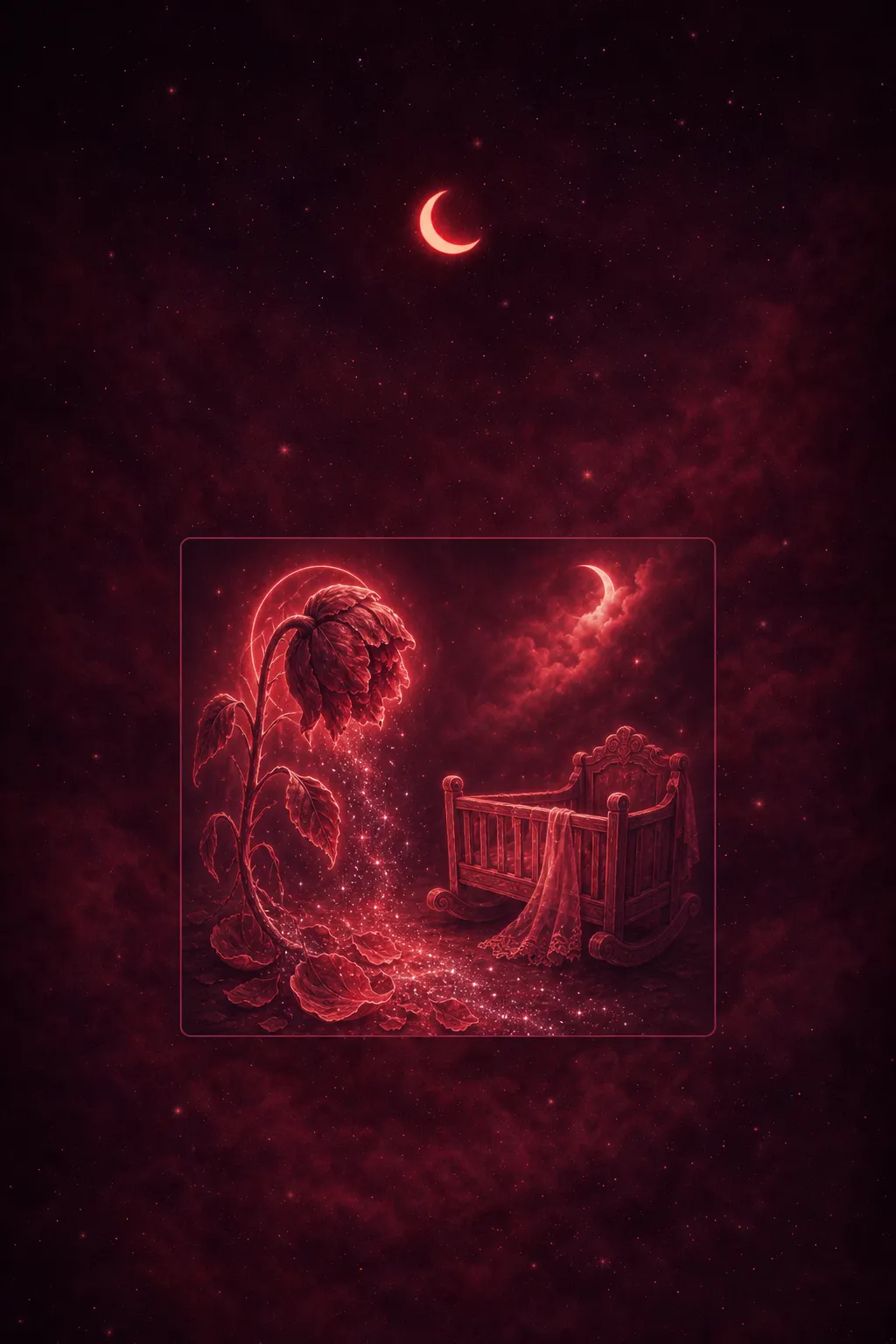

Dreaming of a dead baby often symbolizes the loss of a new idea, project, or aspect of yourself that never fully developed. It can reflect grief, fear of failure, or anxiety about a major life transition. Rather than a literal omen, this dream usually invites you to examine what hopes or beginnings you feel you have lost or abandoned.
In under a minute you could read what your exact dream means for you, and see a picture of it. Free.
If they came to you in that dream, you already know it felt like more than a dream.
This page can't tell you what the visit meant for you. The free app gives you the warm, spiritual reading of your own dream — gently, in plain words.


A dream still on your mind? Get your personal reading.
Describe your dream in a line or two. In seconds you get a reading of your exact dream, a picture drawn from your own words, and every symbol explained.
Free. No sign-up. Takes 10 seconds. Your dream stays private.
0%
Analyzing your dream…
Something went wrong. Please try again in a moment.
Your dreams deserve more than a dictionary
Common Dead Baby Dream Scenarios
Finding a Dead Baby
You stumble across a small, still body — in a crib, in a drawer, somewhere you'd forgotten to look. This version of the dream tends to surface when you've neglected something important. A creative project left unfinished, a relationship you stopped tending, a version of yourself you quietly gave up on.
The discovery element matters. Finding implies you weren't watching. This dream is often your subconscious flagging the moment you looked away — and asking whether it's too late to look back. If you've been dreaming about death in other forms recently, this fits into a wider pattern of endings your mind is trying to process.
Was yours a sign? Find out.
Holding a Dead Baby
There's something uniquely devastating about this scenario — you're already holding the child when you realize it's gone. This dream points to grief you're carrying close. You haven't let it go, and you may not be ready to. The act of holding suggests intimacy with the loss, not distance from it.
This often appears during or after a miscarriage, a failed IVF cycle, or the loss of a relationship that felt like it had a future. The dream isn't morbid — it's your emotional mind doing the work your waking mind keeps postponing. If the baby in your arms feels familiar, pay attention to what it represents in your waking life.
Your Own Baby Dying in the Dream
For parents, this is the nightmare that wakes you gasping. The fear is visceral and immediate. But dreams rarely work literally — what your sleeping mind is processing is almost always the terror of loss, not its prediction. This dream tends to spike during periods of high parental anxiety, life transitions, or when you feel like you're failing at something that matters deeply to you.
It connects closely to dreams about babies in general — where the infant represents vulnerability, new beginnings, or something precious and fragile. The death in the dream amplifies the stakes of whatever that symbol means for you personally.
A Stranger's Dead Baby
When the baby isn't yours, the emotional distance in the dream is itself a clue. You're witnessing loss rather than experiencing it — which can mean you're observing something dying in someone else's life, or that the "new beginning" being mourned feels less personal, more abstract. A dream about a funeral for someone else's child carries a similar emotional register.
This version often appears when you're aware of loss happening around you — a friend's divorce, a colleague's failed business, a family member's fading health — and your empathic mind is working through it at night.
What a dream about a dead baby could look like
Tap an image to open it full screen
Example images. Only you can see what you write in Dream Book.
Psychological Interpretation
Freud would have looked at this dream and asked immediately: what are you afraid to want? For him, babies in dreams were often tied to wish fulfillment — and a dead baby, the inversion of that wish. He saw death imagery in dreams as the mind's way of processing forbidden or painful desires, turning them over in the dark where the ego's defenses are lowered. The dead baby, in Freudian terms, is often the dream of someone who wanted something deeply and believes, consciously or not, that they don't deserve it.
Jung took a different angle. For him, the baby is one of the most powerful archetypes in the collective unconscious — the Divine Child, representing wholeness, potential, and the future self. A dead baby in a dream signals that this archetype has been wounded. Something in your individuation process — the lifelong work of becoming who you truly are — has stalled or been cut off. Jung would ask: which part of your authentic self did you bury? If you've been having dreams about talking to the dead, that same theme of unfinished psychological business is likely running underneath.
But what does your version mean?
Calvin Hall's content analysis of over 50,000 dream reports found that death dreams are far more common than people admit, and that they cluster around periods of major life transition. His cognitive theory frames the dead baby not as a symbol of literal fear but as a cognitive script — your brain rehearsing worst-case scenarios to prepare you emotionally for change. The dream isn't a prophecy. It's a stress test. Ernest Hartmann, whose work focused on dreams as emotional memory processing, would agree: the dead baby dream is your sleeping brain stitching together threads of anxiety, grief, and unresolved feeling into a single overwhelming image. The more emotionally charged the image, the more emotional work is being done.
Hobson and McCarley's activation-synthesis model adds another layer. Their neuroscientific research showed that the sleeping brain takes random neural signals and constructs narrative from them — and that emotionally loaded imagery like death or infants gets amplified because those neural pathways are deeply worn. The dead baby dream may be, in part, your brain's most dramatic available metaphor for "something is wrong and needs attention." The drowning sensation some people report alongside this dream — that airless, helpless feeling — fits the same pattern of the brain reaching for its most visceral emotional vocabulary.
General meanings end here. Read your own dream.
Describe your dream in a line or two. In seconds you get a reading of your exact dream, a picture drawn from your own words, and every symbol explained.
Free. No sign-up. Takes 10 seconds. Your dream stays private.
0%
Analyzing your dream…
Something went wrong. Please try again in a moment.
Your dreams deserve more than a dictionary
Every dream you log starts to connect.
Dream Book keeps your dreams in one place and reveals the threads between them over time — your private dream journal. Free to start.
Cultural & Spiritual Meaning
In many Western folk traditions, dreaming of a dead child was historically seen as an omen of transformation rather than literal loss — the death of one phase making room for another. The Romantic era, saturated with grief and rebirth symbolism, treated such dreams as messages from the unconscious long before Freud gave that concept a name. Today, therapists working in a Western clinical context tend to frame these dreams as grief work — particularly relevant for anyone who has experienced pregnancy loss or infertility.
Ibn Sirin, the 8th-century Islamic dream interpreter whose work remains foundational across much of the Muslim world, offered a specific reading: a dead baby in a dream can signify the dreamer's worries about a new endeavor coming to nothing, or anxiety about a dependent who is vulnerable. He also noted that such dreams can reflect the dreamer's own sense of spiritual stagnation — a new beginning in faith or practice that has not been nurtured. His interpretations consistently emphasized context: who the baby was, how it died, and what the dreamer felt upon waking all shape the meaning significantly. Dreams about being stabbed or sudden violence appearing in the same dream cycle were read by Ibn Sirin as signs of external threats to something precious.
A bad dream isn't a bad sign.
In some Indigenous traditions across the Americas and Africa, the spirit of an unborn or young child is considered particularly close to the spirit world — and dreaming of such a child, even in death, is sometimes understood as a visitation rather than a nightmare. The child is not lost; it is present in a different form. This stands in striking contrast to the dread most Western dreamers feel upon waking, and offers a gentler frame: the dream as connection, not warning.
Related Dream Meanings
nightmares
Death Dream Meaning: Transformation, Loss & Change
5 min read
nightmares
Miscarriage Dream Meaning: Loss, Fear & Anxiety
5 min read
people
Babies Dream Meaning: New Beginnings & Growth
5 min read
nightmares
Funeral Dream Meaning: End, Loss & New Beginnings
5 min read
nightmares
Talking to Dead: Meaning and Interpretation
6 min read
nightmares
Drowning Dream Meaning: Overwhelm, Fear & Hidden Stress
5 min read
nightmares
Being Stabbed Dream Meaning: Betrayal, Pain & Change
6 min read
nightmares
Dreaming of Dead Sister Meaning: Symbolism and Interpretation
6 min read
What to Do After This Dream
First, give yourself a moment before you try to analyze it. This dream hits hard, and your nervous system needs to settle before your mind can do useful work. Write down everything you remember — the setting, the feeling, whether you knew the baby, what you did with your hands.
Then ask the real question: what new thing in your life feels fragile or already lost? It might be a relationship, a career move, a creative project, a version of yourself you were just beginning to inhabit. The dead baby is rarely about a baby. It's about something that needed care and didn't get it — or something you're terrified of losing.
If this dream keeps returning, it's worth exploring with a personalized interpretation. Dream Book lets you describe your dream in detail and ask follow-up questions, so you can move past the surface image and understand what your subconscious is actually working through.
Be gentle with yourself in the days after this dream. Grief — even symbolic grief — deserves acknowledgment. If the dream connects to real loss, whether a miscarriage, a failed relationship, or a hope you've quietly given up, consider whether that grief has had anywhere to go in your waking life. Dreams fill the space that waking life leaves empty.
Was yours a sign? Find out.
Understanding your dead baby dream is the first step. The next is asking what it means for your life right now — that's where a personalized interpretation goes deeper than any dictionary.
Keep the ones that matter close.
The free app saves your most meaningful dreams and reads the signs across them — so a visit or a sign is never lost. Free to start.
People Also Ask
Dreaming about a dead baby most often represents the loss of potential — an abandoned project, a fading hope, or a new beginning that didn't survive. It can also reflect deep anxiety about failure or grief that hasn't been fully processed in waking life. The dream is rarely a literal fear and almost always a symbolic one.
In most psychological and spiritual traditions, a dead baby dream is not a literal prediction but a symbolic message about something in your inner or outer life that needs attention. Ibn Sirin, the classical Islamic dream interpreter, framed such dreams as reflections of the dreamer's anxieties about new endeavors, not prophecies of real loss.
Recurring dreams signal unresolved emotional material — something your subconscious keeps returning to because it hasn't been fully processed. If this dream repeats, it's worth examining what new beginning, creative effort, or vulnerable part of yourself feels neglected or at risk in your current life.
For anyone who has experienced pregnancy loss, this dream often reflects grief that is still active and looking for expression. It's not a sign that something is wrong with you — it's a sign that your emotional mind is still doing the work of mourning. Many people find that these dreams gradually shift as grief is acknowledged and processed.
Curious what your dream would look like?