
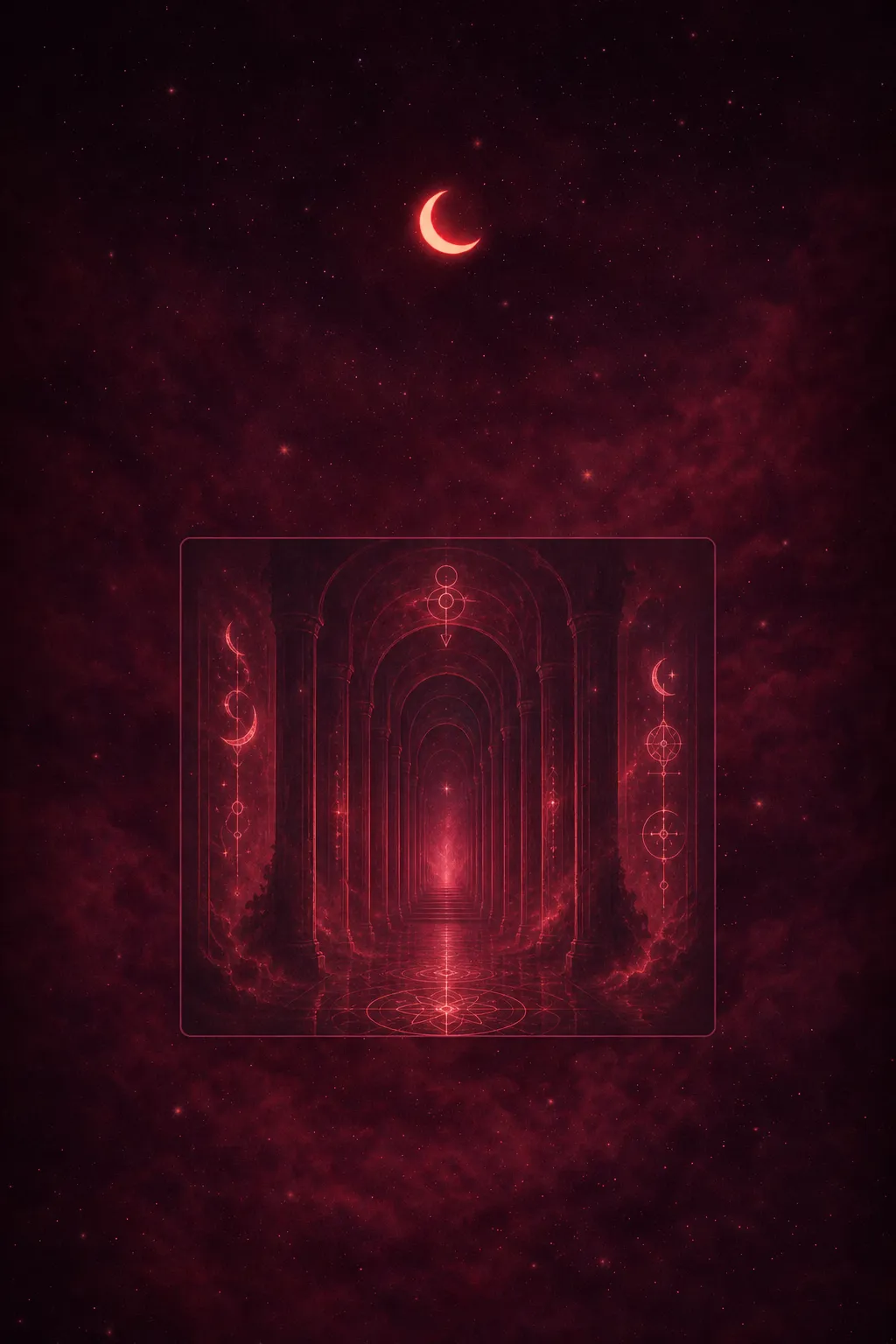

Dreaming about walking through a dark hallway typically represents a period of uncertainty or transition in waking life — your path forward is unclear; this symbol reflects hidden fears, unresolved emotions, or the courage required to confront the unknown as you move through a challenging but navigable phase of personal growth.
In under a minute you could read what your exact dream means for you, and see a picture of it. Free.
Bad dream? See exactly what you dreamed — turned into a picture.
Just describe it and Dream Book paints your dream as a real image, plus a reading of what it means for you. Free, and it takes under a minute.


A dream still on your mind? Get your personal reading.
Describe your dream in a line or two. In seconds you get a reading of your exact dream, a picture drawn from your own words, and every symbol explained.
Free. No sign-up. Takes 10 seconds. Your dream stays private.
0%
Analyzing your dream…
Something went wrong. Please try again in a moment.
Your dreams deserve more than a dictionary
Common Dark Corridor Dream Scenarios
The details of how the corridor appears — and what you do inside it — sharpen the dream's message considerably. The most frequently reported version involves walking forward without knowing where you're headed: a reliable signal that you are actively moving through a life transition even though clarity hasn't arrived yet. Waking anxiety about a career shift, a relationship change, or any high-stakes decision often generates exactly this image — forward motion demanded, destination withheld. A related and equally common variant features a corridor lined with closed doors. Here the pressure isn't about moving forward so much as choosing which door to open, reflecting the modern dread of committing to one path while the others swing shut behind you.
- Corridor that never ends: A sign of feeling trapped in a prolonged stressful stretch — burnout, a situation that seems to have no resolution. The dream is prompting you to reassess rather than keep grinding forward on autopilot.
- Being chased down the corridor: Classic avoidance imagery — something urgent is gaining on you rather than being faced. Much like a dream of a maze, the corridor here channels anxiety about a problem you're outrunning instead of confronting.
- A faint light or open door at the far end: An encouraging sign that the current uncertain phase is nearing its close; from a Christian perspective many readers recognize this as a symbol of providence guiding the passage.
- Sensing a presence in the dark: Points to an unresolved relationship or an aspect of yourself demanding acknowledgment — something you've pushed to the margins of your awareness. The feeling often carries the same raw vulnerability as dreams of pure darkness, where control slips entirely out of reach.
- Frozen, unable to move: Decision paralysis made literal; the dream is flagging that overwhelm, not circumstance, is what's actually blocking your next step.
What this dream could look like
Tap an image to open it full screen
Example images. Only you can see what you write in Dream Book.
Psychological Meaning of a Dark Corridor Dream
From a psychological standpoint, a dark corridor is a near-perfect image of the liminal mind — the inner space you occupy when one chapter of life has closed but the next hasn't fully opened. Mainstream psychology reads this setting as the subconscious externalizing a loss of control: the narrowing walls represent shrinking options, while the absence of light reflects an inability to foresee outcomes. For many dreamers today, that combination lands squarely in the territory of modern anxiety — the low-grade, persistent dread of not knowing whether a career shift, a relationship change, or a health situation will resolve in your favor.
A bad dream isn't a bad sign.
Jungian thought adds a deeper layer: darkness in dreams frequently signals shadow content — repressed emotions, unacknowledged fears, or aspects of the self you've been reluctant to face. Walking a dark corridor, then, isn't just about external uncertainty; it's the psyche issuing an invitation (or a push) to move toward that material rather than away from it. This links naturally to dreams of feeling lost in a confusing space, where disorientation similarly points to unresolved inner conflict. From a broadly Christian psychological perspective, the corridor can also echo the biblical motif of walking through darkness toward renewal — a passage that demands trust before clarity arrives.
- Anticipation dread: forward movement is required even though the outcome is still pending.
- Control anxiety: feeling funneled by circumstances rather than choosing your own direction.
- Shadow confrontation: the darkness may hold repressed material ready to surface.
- Transformative pressure: liminality is uncomfortable by design — it signals genuine change in progress.
General meanings end here. Read your own dream.
Describe your dream in a line or two. In seconds you get a reading of your exact dream, a picture drawn from your own words, and every symbol explained.
Free. No sign-up. Takes 10 seconds. Your dream stays private.
0%
Analyzing your dream…
Something went wrong. Please try again in a moment.
Your dreams deserve more than a dictionary
Every dream you log starts to connect.
Dream Book keeps your dreams in one place and reveals the threads between them over time — your private dream journal. Free to start.
Cultural and Traditional Readings of a Dark Corridor Dream
Across Western folk tradition, dark passageways have long carried the weight of threshold symbolism — the idea that moving through a confined, lightless space signals a rite of passage rather than a dead end. Medieval allegory regularly used the dark tunnel or hallway as a metaphor for spiritual trial, the soul pressed through difficulty before emerging into clarity. That imagery filtered into everyday belief, and many Americans still intuitively read a shadowy corridor as a warning to "watch where you're going" in waking life — a cultural shorthand for approaching a crossroads without enough information. This sense of being funneled without control shares surprising ground with dreams of losing your way in a maze, where the architecture itself becomes the source of dread.
But what does your version mean?
Within US Christian folk interpretation, the dark corridor echoes biblical passages about walking through the valley of shadow, framing the dream not as doom but as a test of faith and forward courage. The darkness is temporary; movement through it is the point. This reading sits comfortably alongside modern-anxiety thinking, which reframes the same symbol in secular terms: a corridor with no visible exit reflects the contemporary pressure of high-stakes decisions — career pivots, relationship changes, financial uncertainty — where you feel funneled forward by circumstances rather than guided by choice. Dreaming of a formless darkness that confines rather than simply surrounds tends to amplify exactly that sense of lost agency.
- Threshold folklore: corridors mark the in-between — neither the room you left nor the one you'll enter.
- Folk caution: traditionally, a dark passage advises slowing down before committing to a path.
- Modern-anxiety layer: the corridor as a symbol of narrowing options and pressure to decide without full visibility.
- Christian folk reading: darkness as temporary trial, with the corridor itself as proof that passage — and emergence — is possible.
Spiritual Meaning of a Dark Corridor Dream
Within a US Christian framework, the dark corridor maps naturally onto one of scripture's most recognized images of trial: the "valley of the shadow of death" in Psalm 23:4. The passage doesn't promise the darkness will be skipped — it promises companionship through it. Dreaming of a dim, unending hallway can therefore be read as a spiritual prompt: you are being asked to trust forward movement even when the destination is hidden from view. Jesus's declaration in John 8:12 — "I am the light of the world; whoever follows me will not walk in darkness" — reinforces a darkness-to-light motif that many believers instinctively apply to exactly this kind of dream, understanding the corridor not as a trap but as a passage that ends in guidance.
Was yours a sign? Find out.
For those with a more broadly spiritual outlook, the dark corridor echoes universal threshold mythology: the idea that genuine transformation requires moving through an uncomfortable in-between space before clarity arrives. Modern anxiety amplifies this — when life demands a decision under pressure, the psyche can generate this image to externalize how constrained and exposed the moment feels. Spiritually, the corridor invites a reframe: the narrowness that feels limiting may actually be what keeps you oriented, preventing you from scattering in too many directions at once. The darkness, in this reading, is not absence of meaning but an invitation to develop inner steadiness and trust when external landmarks disappear.
Related Dream Meanings
nightmares
Room With No Exit Dream: Trapped, Stuck & Powerless
6 min read
common dreams
What Does Dreaming About a Maze Mean? Dream Interpretation Guide
6 min read
nightmares
Darkness Dream Meaning: Fear, Uncertainty & Hidden Self
5 min read
nightmares
Hell Dream Meaning: Fear, Guilt & Unresolved Issues
5 min read
nightmares
Graveyard Dream Meaning: Endings, Closure & New Starts
5 min read
nightmares
Intruder in House: Meaning and Interpretation
5 min read

nightmares
Dead Snake Dream Meaning: Transformation & Endings
5 min read
nightmares
Talking to Dead: Meaning and Interpretation
6 min read
What to Do After Dreaming of a Dark Corridor
Because this dream almost always surfaces during periods of real-world uncertainty, the most useful first step is a brief, honest audit of where your life actually feels narrow right now. Ask yourself which decision you have been postponing, which transition you have entered without a clear exit point, or which relationship or career path feels like it is funneling you forward whether you feel ready or not. Writing that down — even a few lines — moves the anxiety from the unconscious into a space where you can work with it directly.
- Name the corridor in waking life. Identify the specific situation generating the sense of limited visibility or lost control.
- Focus on the next single step, not the far end. The corridor dream rarely shows a destination — it shows movement. Match that logic: commit to one small, concrete action rather than demanding full clarity before you proceed.
- Check your stress load. Modern anxiety can make manageable transitions feel suffocating. Sleep quality, workload, and decision fatigue all amplify how threatening a darkness dream feels — addressing those factors often softens the dream's emotional charge.
- Notice whether you feel trapped or merely in motion. If the corridor felt like a maze with no exit, that distinction matters: entrapment points to a situation needing an active boundary or decision, while simple forward motion suggests patience is the more appropriate response.
- Sit with the discomfort briefly rather than rushing the outcome. Liminal periods have their own necessary pace; forcing resolution prematurely can create more anxiety than the uncertainty itself.
A bad dream isn't a bad sign.
If the dream recurs, treat it as useful feedback rather than a warning: your mind is signaling that the underlying transition still needs conscious attention, not avoidance.
If it keeps coming back, the app helps you understand the pattern.
Log each recurring dream and the free app shows you what's underneath — calmly, over time. Free to start.
People Also Ask
A dark hallway often symbolizes uncertainty, transition, or fear of the unknown. It suggests you are moving through a challenging phase in life without a clear sense of what lies ahead. The darkness reflects anxiety, while the hallway itself points to a journey between two states — leaving something behind and moving toward change.
Walking in the dark in a dream typically represents navigating life without clear guidance or confidence. It may reflect self-doubt, confusion about a decision, or feeling emotionally lost. It can evoke fear, yet often carries a positive undertone — you are still moving forward, even without perfect clarity or certainty.
A hallway in dreams represents transition, passage, and the space between major life changes. It is neither a destination nor an origin — it connects different parts of your life. Dreaming of a hallway may signal that you are in a period of waiting, decision-making, or preparing to step into a new chapter or opportunity.
Lucid dreams — where the dreamer is fully aware they are dreaming and can control events — are considered among the rarest. Recurring prophetic dreams and dreams involving fire or vivid elemental imagery are also uncommon. Most people experience fragments rather than complete, narrative-driven dreams, making highly structured symbolic dreams relatively rare and meaningful.
Curious what your dream would look like?