
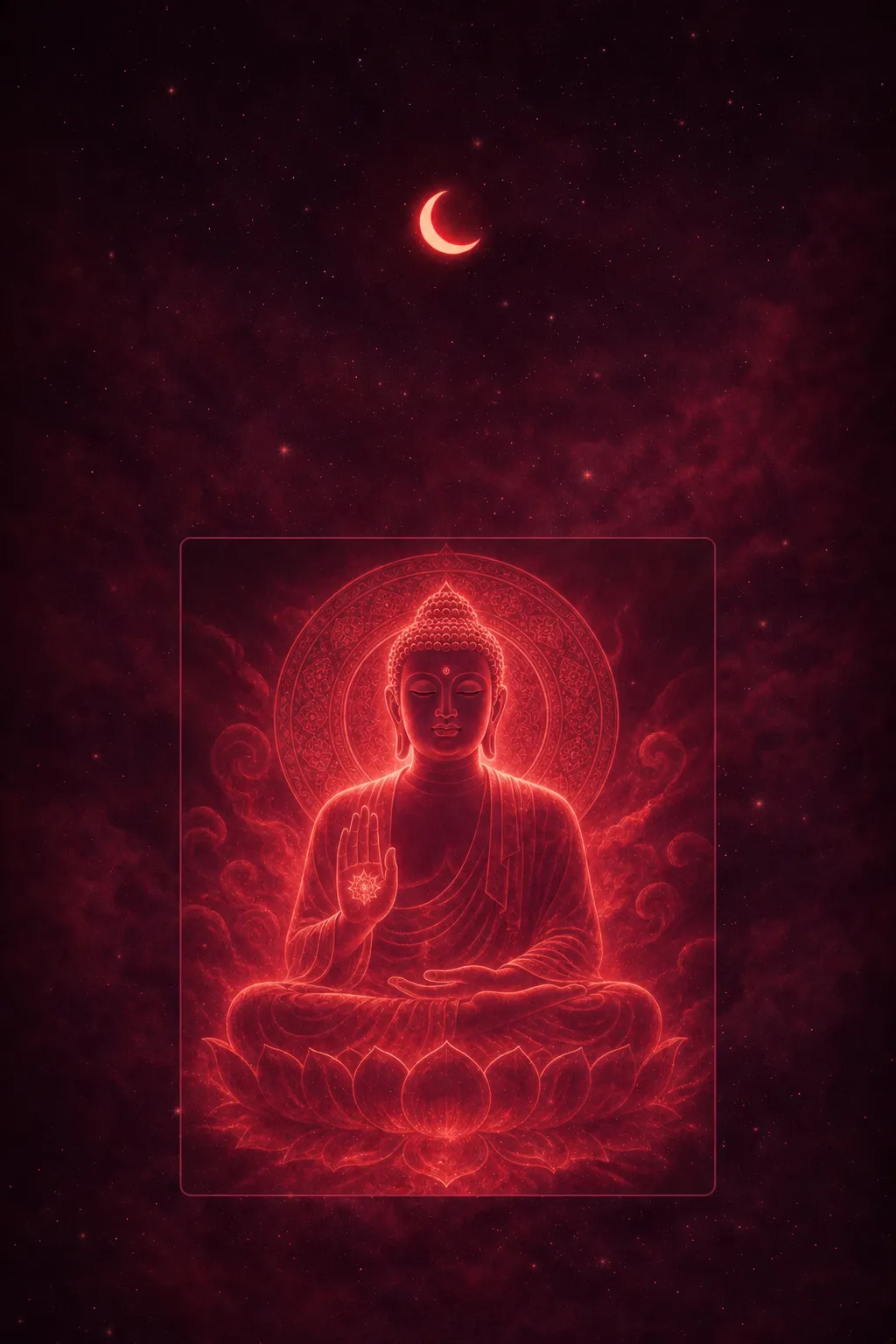

Dreaming of Buddha often symbolizes inner peace, wisdom, and spiritual growth. It can reflect a desire for calm and clarity during a turbulent time, or signal that you are on a meaningful path of self-discovery. Some interpretations also suggest Buddha in dreams represents compassion — toward others or yourself.
In under a minute you could read what your exact dream means for you, and see a picture of it. Free.
A dream still on your mind? Get your personal reading.
Describe your dream in a line or two. In seconds you get a reading of your exact dream, a picture drawn from your own words, and every symbol explained.
Free. No sign-up. Takes 10 seconds. Your dream stays private.
0%
Analyzing your dream…
Something went wrong. Please try again in a moment.
Your dreams deserve more than a dictionary
Common Buddha Dream Scenarios
Seeing a Glowing or Radiant Buddha
When Buddha appears in your dream bathed in golden light or radiating a visible warmth, this is one of the most universally positive dream experiences you can have. The image speaks directly to illumination — not just spiritual light, but the kind of clarity that cuts through confusion. You may be on the verge of a breakthrough, or finally seeing a situation in your life for exactly what it is.
This vision often arrives when you've been carrying a heavy mental load. The radiance isn't external — it's a mirror. Your dreaming mind is showing you a quality of peace that already exists somewhere inside you, even if waking life makes it hard to access. If you've been meditating or praying more than usual, this dream is often the subconscious confirming that the practice is working.
But what does your version mean?
Buddha Speaking to You
A Buddha who speaks in your dream deserves serious attention. Whatever words come through — even if they dissolve the moment you wake — the emotional residue is the message. Dreams of divine or enlightened figures speaking directly to you share a lineage with dreams of seeing Jesus or God speaking: they feel categorically different from ordinary dreams, and most people who have them never forget them.
The content matters, but so does the tone. A gentle, calm Buddha voice points toward reassurance — you're being told that the path you're on is right, even when it's hard. A more urgent or serious tone suggests there's something you've been avoiding that genuinely needs your attention. Your subconscious chose the most authoritative, compassionate figure it could summon to make sure you listened.
A Broken or Damaged Buddha Statue
Dreaming of a cracked, broken, or defaced Buddha statue carries a different weight entirely. This image often surfaces when your sense of inner peace has been shattered — by grief, betrayal, or simply the relentless grind of a life that feels out of alignment. The statue is a stand-in for your own spiritual center, and seeing it damaged is your mind's way of acknowledging that something sacred has been lost or neglected.
It's not a bad omen so much as an honest diagnosis. Just as a broken mirror in dreams signals fractured self-perception, a broken Buddha points to a fracture in your sense of peace or purpose. The dream isn't punishing you — it's asking you to look at what broke, and why.
Sitting Beside or Touching Buddha
Physical closeness to Buddha in a dream — sitting at his feet, placing your hand on a statue, or simply sharing space with him in comfortable silence — is often a dream of profound comfort. You're not receiving a lesson; you're being held. This scenario tends to appear during periods of grief, burnout, or when you feel spiritually adrift, like being lost with no map.
The intimacy of the image matters. Your subconscious isn't keeping the divine at a reverent distance — it's pulling it close. That's significant. It suggests you're ready to receive peace, not just admire it from afar.
What this dream could look like
Tap an image to open it full screen
Example images. Only you can see what you write in Dream Book.
Psychological Interpretation
Jung would have recognized the Buddha immediately as an archetype — specifically, what he called the Wise Old Man, one of the most ancient figures in the collective unconscious. This archetype appears when the psyche needs guidance that the ego can't provide on its own. The Buddha in your dream isn't a religious figure so much as a symbol of the Self — Jung's term for the totality of the psyche, the part of you that already knows what you need to do. Dreaming of Buddha is often a signal that individuation, the lifelong process of becoming your truest self, is actively underway.
Was yours a sign? Find out.
Freud would have approached this differently. For him, elevated, idealized figures in dreams often represent the superego — the internalized voice of moral authority and ideal behavior. Dreaming of Buddha might reflect a desire to transcend your own impulses, a wish for a version of yourself that is calmer, less reactive, more in control. Freud also understood religious imagery in dreams as wish fulfillment: the peace Buddha represents is something you deeply want but haven't yet found in waking life.
Ernest Hartmann's research on dreams as emotional memory processing adds another layer. Hartmann found that powerful, emotionally resonant images — like a glowing divine figure — function as the dreaming mind's way of processing intense feeling states. If you've been through something difficult recently, Buddha appearing in your dream may be your brain weaving that experience into a larger, more meaningful narrative. The image provides a kind of emotional container, the way water dreams often do when the psyche needs to process something fluid and overwhelming.
Calvin Hall's content analysis of over 50,000 dream reports found that figures of authority and wisdom appear far more frequently during periods of personal uncertainty and life transition. His data showed that dreamers consistently populate their dreams with figures who embody qualities they feel they lack. If Buddha is visiting your sleep, Hall's framework suggests you're searching for equanimity, wisdom, or acceptance — and your dreaming mind is doing its best to give you a direct experience of it. Hobson and McCarley's activation-synthesis model would note that the brain selects Buddha as the most coherent narrative frame for whatever emotional signals are firing — but the meaning your waking mind assigns to that image is where the real work begins.
Every dream you log starts to connect.
Dream Book keeps your dreams in one place and reveals the threads between them over time — your private dream journal. Free to start.


Cultural & Spiritual Meaning
In Buddhist traditions across Southeast Asia, East Asia, and Tibet, dreaming of Buddha is considered deeply auspicious — a sign of spiritual protection, merit accumulated from past actions, or an invitation to deepen one's practice. In Tibetan dream yoga, such visions are not treated as ordinary dreams at all but as transmissions. The appearance of an enlightened being in the dream state is understood as a direct pointing toward the nature of mind itself. This isn't metaphor — for practitioners, it's as real as any waking encounter.
In the Islamic tradition, Ibn Sirin — the 8th-century scholar whose dream interpretations remain influential today — held that seeing a figure of divine wisdom or a prophet in a dream was among the most blessed of visions. While Ibn Sirin wrote specifically about prophetic figures within the Islamic tradition, his broader principle applies: when a figure of profound spiritual authority appears in your dream, it signals divine guidance, protection, or a call to reflection. The dreamer, in his view, should treat such a vision with reverence and examine what in their waking life requires spiritual attention.
A bad dream isn't a bad sign.
In Western psychological and spiritual traditions, Buddha has increasingly become a cross-cultural symbol of mindfulness and non-attachment — values that resonate far beyond any single religion. Dreaming of him in a Western context often reflects a deep hunger for stillness in an overstimulated life. It's worth noting that this dream appears with particular frequency alongside dreams of seeing God or angel encounters — the psyche reaching for whatever form of the sacred feels most accessible and true.
Related Dream Meanings
common dreams
Meditation Dream Meaning: Peace, Clarity & Inner Growth
5 min read
people
Seeing Jesus Dream Meaning: Hope, Guidance & Faith
5 min read
people
God Speaking Dream Meaning: Guidance, Purpose & Truth
5 min read
nightmares
Broken Mirror Dream Meaning: Identity & Change
6 min read
common dreams
Being Lost Dream Meaning: Confusion & Direction
5 min read
common dreams
Water Dream Meaning: Emotions, Intuition & Growth
5 min read
people
Seeing God Dream Meaning: Guidance & Inner Peace
5 min read
people
Angel Dream Meaning: Guidance, Protection & Insight
5 min read
What to Do After This Dream
Start by sitting with the feeling the dream left behind. Not the imagery — the feeling. Was it peace? Longing? Awe? That emotional residue is the actual message, and it will fade faster than you think if you don't capture it. Write it down within the first few minutes of waking.
Ask yourself honestly: where in your life are you most lacking what Buddha represents? If the dream carried a sense of calm, you probably already know which area of your waking life feels most chaotic. If it carried a sense of distance — watching Buddha from afar rather than being close — that gap is worth examining. What's keeping you from the peace you're clearly searching for?
Consider whether this dream is connected to other recurring themes. Buddha dreams often appear alongside dreams about dying, heaven, or sacred figures — all pointing toward the same deeper inquiry about meaning, mortality, and what you actually believe. If this dream keeps returning, it's worth exploring with a personalized interpretation — Dream Book lets you describe your dream and ask follow-up questions to understand what your subconscious is really saying.
But what does your version mean?
Understanding your Buddha dream is the first step. The next is asking what it means for your life right now — that's where a personalized interpretation goes deeper than any dictionary.
One dream is never the whole picture.
The free app remembers your dreams, draws them, and connects the threads over time — so the next one means even more. Free to start.
People Also Ask
A smiling Buddha in a dream is widely interpreted as a sign of approval, blessing, or reassurance. Your subconscious is likely affirming a choice you've made or a direction you're moving in. It often appears when you've been doubting yourself and need confirmation that you're on the right path.
In nearly every cultural and psychological framework, yes — dreaming of Buddha is considered a positive and meaningful sign. It typically signals a search for inner peace, spiritual growth, or wisdom during a challenging period. Even a broken Buddha statue, while more complex, is ultimately an invitation toward healing rather than a warning.
A speaking Buddha is one of the most vivid and memorable dream experiences, often described as feeling more real than ordinary dreams. The specific words matter less than the emotional tone — reassurance, warning, or gentle instruction. Most dream traditions treat this kind of vision as a direct message from the deeper self or a higher source of guidance.
Buddha functions as a universal archetype of wisdom, peace, and enlightenment that transcends any single religion. Jung's concept of the collective unconscious explains this well — the Wise Old Man figure appears regardless of your personal beliefs when your psyche needs guidance. Your dreaming mind is drawing on the most powerful symbol of calm and clarity it has access to.
Curious what your dream would look like?