
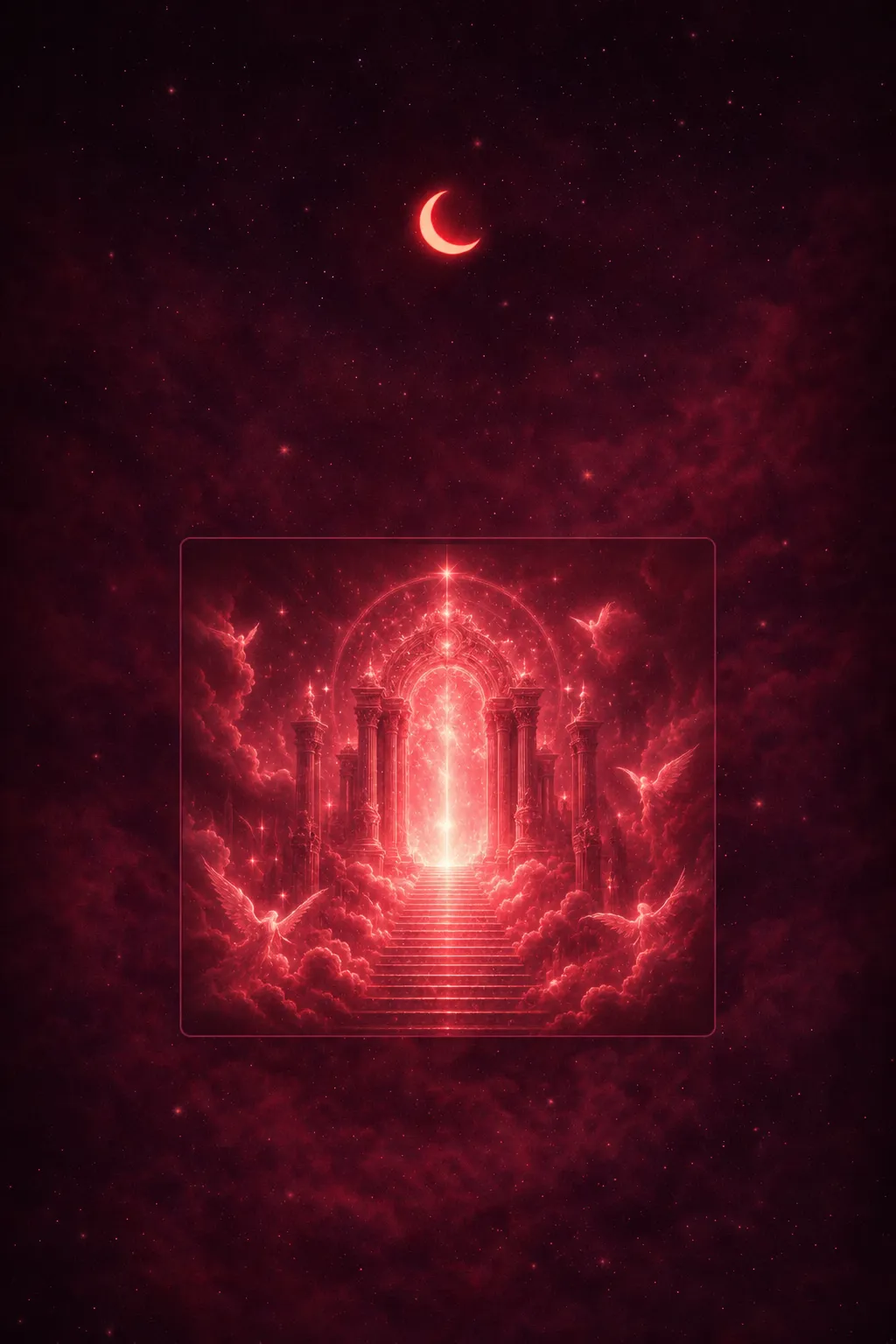

Dreaming about heaven typically means your subconscious is processing feelings of peace, hope, or spiritual longing, and may reflect a deep desire for comfort after loss, a yearning for perfection, or a sense that you are moving toward a higher purpose or a more fulfilling chapter in your waking life.
In under a minute you could read what your exact dream means for you, and see a picture of it. Free.
If they came to you in that dream, you already know it felt like more than a dream.
This page can't tell you what the visit meant for you. The free app gives you the warm, spiritual reading of your own dream — gently, in plain words.


A dream still on your mind? Get your personal reading.
Describe your dream in a line or two. In seconds you get a reading of your exact dream, a picture drawn from your own words, and every symbol explained.
Free. No sign-up. Takes 10 seconds. Your dream stays private.
0%
Analyzing your dream…
Something went wrong. Please try again in a moment.
Your dreams deserve more than a dictionary
Common Heaven Dream Scenarios and What They Mean
The shape a heaven dream takes often says as much as the symbol itself. Rising or floating upward toward heaven is one of the most reported variants, and it typically reflects a deep desire to escape mounting pressure — whether that's a crushing workload, a relationship in crisis, or a situation that feels completely out of your hands. The ascent is the psyche's way of rehearsing relief. By contrast, standing before heaven's gates or a blinding white light tends to surface at genuine life thresholds — a career change, a health scare, a major commitment — where part of you is quietly asking whether you're ready to move forward.
- Seeing a deceased loved one at peace in heaven: Almost always a grief-processing dream. Your mind is working through loss and offering itself comfort; the image suggests an internalized reassurance that the person is safe and that the bond still holds in some form.
- A serene, beautiful heavenly landscape: A direct response to modern overwhelm — your sleeping mind is constructing the rest and safety your waking life is denying you. Think of it as the psyche's own pressure-relief valve.
- Being turned away or barred from entry: This scenario typically signals a conscience conflict — guilt over a decision, fear of not measuring up morally or professionally. It's worth asking honestly what standard you feel you've fallen short of.
- Falling from heaven: Closely related to other falling dreams, this variant points to sudden disillusionment, a loss of hard-won security, or a fear that a period of happiness is about to end.
- Encountering God or angels in heaven: Usually a search for external guidance when your own sense of direction feels unreliable — a prompt to examine your core values rather than wait for circumstances to decide for you.
What this dream could look like
Tap an image to open it full screen
Example images. Only you can see what you write in Dream Book.
What Heaven Reveals About Your Inner Life
From a psychological standpoint, dreaming of heaven is a classic act of wish-fulfillment — the sleeping mind constructing the relief it cannot find while awake. When daily life feels relentless or out of control, the psyche reaches for an idealized space where peace is guaranteed and nothing more can go wrong. This is especially visible in modern stress patterns: people navigating burnout, grief, or major life transitions frequently report heaven dreams precisely because the waking mind has exhausted its coping reserves and the unconscious steps in to offer emotional regulation through imagery.
Was yours a sign? Find out.
Heaven dreams also carry significant moral weight. The question of whether you are welcomed or kept at a distance in the dream often reflects the inner critic at work — a subconscious audit of your choices, relationships, and integrity. For many dreamers shaped by a Christian framework, this worthiness theme runs deep, but even in a secular context the same dynamic appears: the mind rehearsing whether it has lived up to its own values. Alongside that self-appraisal sits grief processing; seeing a deceased loved one in a heavenly setting is the psyche's way of maintaining what researchers call a continuing bond — finding reassurance that love and connection persist beyond loss. In that sense, a death-related dream and a heaven dream often share the same emotional root: the need to make meaning out of endings.
- Overwhelm and control-loss: Heaven signals the mind's urgent search for a safe, stable space when waking life feels unmanageable.
- Grief and reassurance: Reunion imagery helps the psyche process loss and sustain emotional connection to those no longer present.
- Moral self-appraisal: Access or rejection in the dream reflects the conscience weighing personal integrity.
- Meaning-making: Confronting mortality or uncertainty drives the mind toward transcendent imagery as a way of restoring a sense of purpose.
General meanings end here. Read your own dream.
Describe your dream in a line or two. In seconds you get a reading of your exact dream, a picture drawn from your own words, and every symbol explained.
Free. No sign-up. Takes 10 seconds. Your dream stays private.
0%
Analyzing your dream…
Something went wrong. Please try again in a moment.
Your dreams deserve more than a dictionary
Every dream you log starts to connect.
Dream Book keeps your dreams in one place and reveals the threads between them over time — your private dream journal. Free to start.
Heaven in Culture and Folk Belief
Whether or not a dreamer holds religious convictions, the imagery of heaven — pearly gates, golden light, vast cloudscapes — functions as a shared cultural shorthand deeply embedded in the Anglo-American imagination. Centuries of Christian tradition have shaped these visual cues so thoroughly that even secular dreamers reach for them instinctively, the way a person might hum a hymn without remembering the words. In that sense, dreaming of heaven draws on a collective inheritance rather than personal theology alone, evoking feelings of moral aspiration and the sense that a better, more ordered existence is possible.
But what does your version mean?
Folk tradition has long treated a heaven dream as a hopeful omen — a sign of inner peace on the horizon or reassurance after bereavement. Dreaming of a deceased loved one in a heavenly setting is widely interpreted, across many Protestant and Catholic households alike, as a comforting message that the person has found rest. This folk reading sits comfortably alongside the broader secular use of "heaven" as everyday shorthand for perfect happiness, entirely detached from any afterlife belief — think of the phrase "this is absolute heaven" said over a quiet morning coffee.
Through a modern lens, however, the cultural dream of heaven carries a new layer of meaning: escape. At a time when burnout, relentless connectivity, and loss of personal control have become defining anxieties, the mind reaches for the ultimate pressure-free zone. Heaven, in this reading, is less a theological destination and more a fantasy of finally being off the clock — a longing closely related to dreams of falling, which also signal an overwhelmed psyche searching for release. The cultural weight of the symbol gives that longing a shape that feels both ancient and immediately familiar.
The Spiritual Meaning of Dreaming About Heaven
Within a Christian framework, dreaming of heaven carries a quiet but steady current of hope rather than literal prophecy. The New Testament image of a dwelling prepared for each person — "many rooms," as Jesus describes in John 14:2 — offers the subconscious a powerful template for reassurance when waking life feels uncertain or fragile. Encountering heaven in a dream may therefore function as a spiritual prompt: an invitation to examine what you genuinely believe about peace, purpose, and what lies beyond your control. It is less a forecast of death and more a mirror held up to your deepest values.
For dreamers who carry faith as part of their identity, the dream can arrive during seasons of grief, burnout, or moral questioning — moments when the gap between the life you have and the life you long for feels widest. In that context, a dream of heaven may act as inner consolation, a reminder that relief and wholeness are not merely fantasies. It can also surface alongside a dream featuring an angelic presence, reinforcing a sense of guidance or protection that the anxious waking mind struggles to access on its own.
A bad dream isn't a bad sign.
Spiritually, the takeaway is rarely dramatic. Most interpreters across faith traditions would read this dream as a gentle call to self-reflection — asking where your sense of meaning is anchored, and whether your daily choices align with what you truly hold sacred. Heaven in a dream is less a destination than a question about direction.
Related Dream Meanings

common dreams
Falling Dream Meaning: Insecurity, Fear & Loss of Control
5 min read

nightmares
Death Dream Meaning: Transformation, Loss & Change
5 min read

people
Angel Dream Meaning: Guidance, Protection & Insight
5 min read

common dreams
Hurricane Dream Meaning: What Your Subconscious Is Telling You
6 min read

common dreams
Christmas: Meaning and Interpretation
5 min read

common dreams
Speaking in Tongues: Meaning and Interpretation
5 min read

common dreams
Dreaming About Playing Baseball - Meaning and Interpretation
6 min read

common dreams
Football: Meaning and Interpretation
5 min read
Turning Your Heaven Dream Into Grounded Action
Rather than simply filing a heaven dream away as pleasant or unsettling, treat it as useful data about your current stress load and unmet needs. The core signal is almost always the same: some part of your waking life feels unresolvable, and your mind is compensating by imagining a state of complete relief. That gap — between where you are and where you wish you could be — is worth examining honestly.
- Name the pressure point. When you wake from a heaven dream, write down the first real-life situation that comes to mind. That instinctive association usually identifies the exact source of overwhelm your psyche was processing overnight.
- Separate the controllable from the uncontrollable. Heaven imagery often spikes during periods of helplessness. List what you can actually influence this week — even small steps count — and consciously release what you cannot. This is a practical anxiety-management move, not just a spiritual one.
- Check for avoidance. If heaven felt unreachable in the dream, consider whether you are postponing a difficult conversation or decision. Dreams of distant or blocked paradise often mirror real-life situations where you know the resolution but keep deferring it.
- Build micro-moments of calm. Because the dream signals a longing for peace, deliberately schedule brief daily pauses — a walk, quiet reading, or prayer if that fits your practice — rather than waiting for circumstances to magically improve.
Was yours a sign? Find out.
If recurring heaven dreams coincide with falling dreams or other loss-of-control imagery, that pattern is worth discussing with a counselor, as it can point to sustained anxiety that deserves more than self-reflection alone.
Keep the ones that matter close.
The free app saves your most meaningful dreams and reads the signs across them — so a visit or a sign is never lost. Free to start.
People Also Ask
A warning dream from God often feels urgent, deeply emotional, and stays vivid long after waking. It may repeat or carry a clear moral message. Many people describe a strong sense of conviction or peace alongside the warning, urging them toward a specific change in behavior or direction in life.
Many people across cultures and faiths report vivid dreams of heavenly places filled with light, peace, and loved ones. Whether literal or symbolic, these experiences feel profoundly real. Spiritually, some believe the soul briefly touches a higher realm during deep sleep, while psychologists view it as the mind processing hope and transcendence.
The Bible records several visions of heaven during sleep or trance-like states, including those of Jacob, Ezekiel, and John in Revelation. Scripture suggests God can communicate through dreams, making heavenly visions spiritually significant. Such dreams are generally seen as divine reassurance, revelation, or a call to deepen one's faith and trust in God.
Dreams featuring deceased loved ones are extremely common and often feel strikingly real. Many people report receiving comfort, closure, or even guidance from these encounters. Whether you view them as genuine spiritual visits or the mind's way of processing grief, they typically leave a lasting sense of peace, love, and continued connection beyond physical death.
Curious what your dream would look like?