
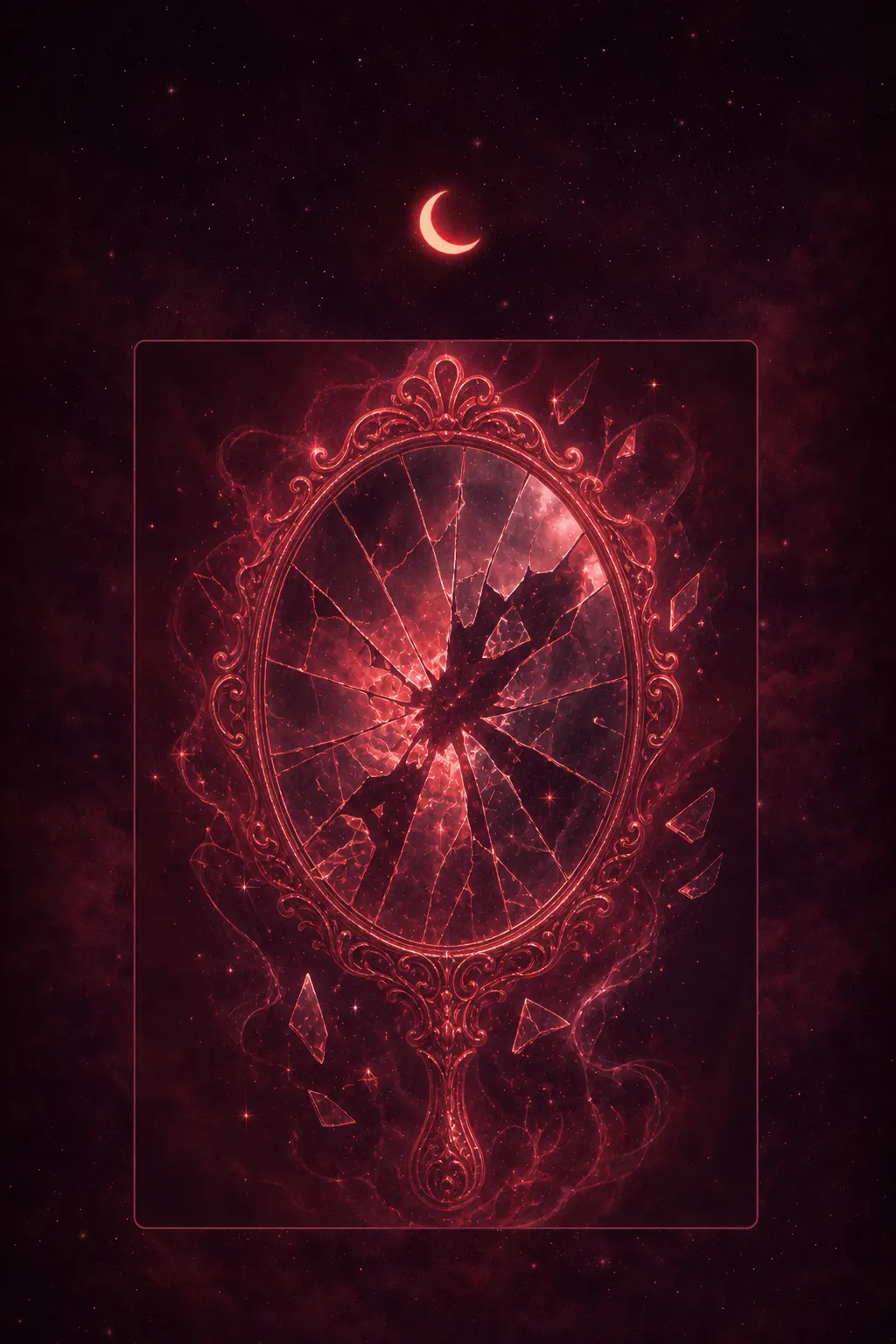

Dreaming of a broken mirror often reflects a distorted or uncertain sense of self, anxiety about how others perceive you, or a significant life transition. It can also symbolize releasing an old identity to make room for growth. Rather than bad luck, the broken mirror in your dream usually points to inner change already underway.
In under a minute you could read what your exact dream means for you, and see a picture of it. Free.
Bad dream? See exactly what you dreamed — turned into a picture.
Just describe it and Dream Book paints your dream as a real image, plus a reading of what it means for you. Free, and it takes under a minute.


A dream still on your mind? Get your personal reading.
Describe your dream in a line or two. In seconds you get a reading of your exact dream, a picture drawn from your own words, and every symbol explained.
Free. No sign-up. Takes 10 seconds. Your dream stays private.
0%
Analyzing your dream…
Something went wrong. Please try again in a moment.
Your dreams deserve more than a dictionary
Common Broken Mirror Dream Scenarios
You Break the Mirror Yourself
When your own hand sends the mirror crashing, the dream is pointing the finger directly at you — and not necessarily in blame. This is often about a conscious or unconscious desire to destroy an image of yourself you no longer believe in. The reflection you've been presenting to the world, the version that smiles at the right moments and says the right things, is the thing shattering.
There's something almost liberating in this version of the dream, even when it feels terrifying. Breaking your own mirror can mean you're ready to stop performing and start being. Pay attention to how you feel in the moment of breaking — guilt suggests fear of consequences, while relief suggests you already know what needs to change.
A bad dream isn't a bad sign.
You See a Distorted or Fragmented Reflection
Looking into a broken mirror and seeing your face split across the shards is one of the more unsettling dream images a person can encounter. The fragments reflect different versions of you — younger, older, distorted, unrecognizable. This dream often surfaces during identity crises: a divorce, a career collapse, a period of deep grief where you've stopped recognizing yourself.
If you've been dreaming of teeth falling out alongside this image, the two are closely related — both speak to anxiety about appearance, control, and the fear of being seen as less than whole. The broken reflection is your psyche asking: which version of yourself is the real one?
Someone Else Breaks the Mirror
When another person — a stranger, a friend, a partner — is the one who breaks the mirror, the dream shifts toward betrayal and external threat. Someone in your life is disrupting your sense of self, or you fear they will. This version sometimes appears after experiencing being cheated on or after a rupture in a close relationship that left you questioning your own judgment.
The identity of the person matters. A stranger breaking the mirror suggests a more diffuse anxiety — the world feels unpredictable, dangerous in an unnamed way. Someone you know points more directly to that specific relationship and the wound it's opened.
Broken Mirror with Blood
Blood and broken glass together in a dream intensify everything. This isn't just about a cracked self-image — it's about real pain, the kind that leaves a mark. If you see yourself bleeding from the broken mirror, or cutting your hands on the shards, the dream is telling you that the fracture in your life is costing you something tangible.
This scenario often appears during periods of grief or after a loss that felt violent in its suddenness. The blood isn't always dark — sometimes it signals that something is alive in you, that the wound is fresh and still processing. It's worth sitting with what, exactly, you were trying to pick up from the broken pieces.
What this dream could look like
Tap an image to open it full screen
Example images. Only you can see what you write in Dream Book.
Psychological Interpretation
Freud would have been fascinated by the broken mirror — and he'd have gone straight to narcissism. In his framework, the mirror represents the ego's relationship with its own image, the careful construction of self we present to the world. A shattered mirror in a dream signals a rupture in that ego structure, often tied to repressed shame or a desire for self-destruction that can't be consciously acknowledged. For Freud, what we break in dreams is almost always something we secretly want to break.
Jung took the mirror deeper. For him, the reflection isn't just the ego — it's the persona, the mask we wear in social life. When the mirror breaks, the persona cracks, and what bleeds through is the Shadow: the parts of yourself you've denied, suppressed, or refused to integrate. Jung saw this kind of dream as an invitation, not a punishment. The broken mirror is the psyche demanding individuation — the long, uncomfortable work of becoming whole. If you've also been being chased in your dreams, that's often the Shadow in pursuit, and the broken mirror is where it finally catches your eye.
But what does your version mean?
Calvin Hall's content analysis of tens of thousands of dream reports found that mirrors and reflective surfaces appear most frequently in dreams during periods of social anxiety and self-evaluation. His cognitive theory frames the broken mirror as the dreamer's own conceptual script about identity — when life challenges your self-concept, the dream dramatizes the challenge literally. Ernest Hartmann's emotional processing theory adds another layer: the broken mirror is the brain's way of metabolizing a wounding emotional event, using the visceral image of shattered glass to give form to something that otherwise has no shape. The nightmare quality isn't accidental — the emotional intensity is what makes the processing stick.
Hobson and McCarley's activation-synthesis model reminds us that the brain is also doing something purely mechanical — firing signals during REM sleep and stitching them into narrative. But even within that framework, the emotional weight of the broken mirror image isn't random. The brain reaches for symbols that carry the highest emotional charge, and few images carry more cultural freight than a shattered reflection. The neuroscience and the symbolism, for once, point in the same direction. Dreams about death and broken mirrors often cluster together for the same reason — both are the mind's shorthand for irreversible change.
General meanings end here. Read your own dream.
Describe your dream in a line or two. In seconds you get a reading of your exact dream, a picture drawn from your own words, and every symbol explained.
Free. No sign-up. Takes 10 seconds. Your dream stays private.
0%
Analyzing your dream…
Something went wrong. Please try again in a moment.
Your dreams deserve more than a dictionary
Every dream you log starts to connect.
Dream Book keeps your dreams in one place and reveals the threads between them over time — your private dream journal. Free to start.
Cultural & Spiritual Meaning
In Western tradition, the broken mirror carries the oldest of superstitions: seven years of bad luck. That number isn't arbitrary — it traces back to Roman belief that the soul renewed itself every seven years, meaning a broken mirror fractured the soul itself and required a full cycle to heal. The dream taps directly into this inherited dread, the cultural memory that certain things, once broken, exact a price. Even people who consciously dismiss the superstition often feel its shadow in the dream.
Ibn Sirin, the 8th-century Islamic scholar whose dream interpretations remain influential across the Muslim world, interpreted mirror dreams as revelations about one's public standing and reputation. A broken mirror, in his reading, signified the loss of a trusted advisor or protector — often a spouse or a father figure — whose presence had been the dreamer's clearest reflection of themselves in the world. The break wasn't purely negative; it could also signal liberation from a relationship that had become distorting rather than clarifying. His interpretation carries a social dimension that purely psychological readings sometimes miss.
Was yours a sign? Find out.
In East Asian traditions, particularly in Chinese and Japanese folk belief, mirrors are objects of spiritual protection — they ward off evil and reveal the true nature of things. A broken mirror in a dream suggests that protection has failed, or that something hidden is now exposed. There's a famous Chinese phrase, 破镜重圆 (pò jìng chóng yuán) — "a broken mirror made round again" — which refers to the reunion of separated lovers. In this context, the broken mirror dream can carry a bittersweet hope: the fracture is real, but reunion remains possible. If you've been dreaming of an ex-partner alongside this image, that cultural resonance may be doing some of the emotional work.
Related Dream Meanings

body health
Teeth Falling Out Dream: Anxiety, Loss & Vulnerability
5 min read

people
Being Cheated On Dream Meaning: Insecurity & Trust
5 min read
nightmares
Grief Dream Meaning: Loss, Healing & Unresolved Emotions
5 min read

body health
Blood Dream Meaning: Loss, Vitality & Transformation
5 min read

nightmares
Being Chased Dream Meaning: Anxiety & Avoidance
5 min read

nightmares
Death Dream Meaning: Transformation, Loss & Change
5 min read

people
Ex Partner Dream Meaning: What Your Dreams About Former Lovers Reveal
6 min read
nightmares
Drowning Dream Meaning: Overwhelm, Fear & Hidden Stress
5 min read
What to Do After This Dream
The first thing to do is resist the urge to dismiss it as superstition or noise. A broken mirror dream that wakes you up, or that lingers into your morning, is carrying something worth examining. Start by writing down exactly what broke, who was there, and how you felt — not what you think you should feel, but what was actually present in your body when you woke.
Ask yourself what in your waking life feels fractured right now. Not just relationships — your sense of purpose, your self-image, your plans for the future. The broken mirror is rarely about one single thing. It tends to appear when multiple cracks have been accumulating and the dream finally gives them one unified image.
If the dream keeps returning, or if it's part of a pattern of unsettling dreams — drowning, being stabbed, images of tidal waves — that's your subconscious working overtime on something unresolved. Dream Book lets you describe your dream in your own words and ask follow-up questions to understand what your subconscious is actually trying to surface — it's the difference between a dictionary definition and a real conversation.
Be patient with yourself. The mirror broke in the dream because something needed to break. That's not a curse — it's information.
A bad dream isn't a bad sign.
Understanding your broken mirror dream is the first step. The next is asking what it means for your life right now — that's where a personalized interpretation goes deeper than any dictionary.
If it keeps coming back, the app helps you understand the pattern.
Log each recurring dream and the free app shows you what's underneath — calmly, over time. Free to start.
People Also Ask
Breaking a mirror in a dream usually points to a disruption in your self-image or identity — something about how you see yourself, or how you believe others see you, is changing or needs to change. It can also reflect anxiety about consequences or a fear of irreversible decisions. The emotional tone of the dream (guilt, relief, fear) gives you the clearest clue about what's really being processed.
The seven-years-bad-luck superstition is a cultural belief, not a prophetic one — dreams don't predict misfortune. Psychologically, the broken mirror is more often a signal about internal fracture than an omen about external events. Think of it as your mind flagging something that needs attention, not as a warning about what's coming.
Recurring broken mirror dreams usually mean there's an unresolved question about identity, self-worth, or a significant relationship that you haven't fully processed. The dream keeps returning because the underlying emotional material hasn't been addressed. Journaling, therapy, or a personalized dream interpretation can help you identify the specific fracture the dream is pointing to.
Seeing your own face fragmented across broken glass is one of the most direct images the dreaming mind produces for an identity crisis. It often appears when you're in a period of major transition — a breakup, a loss, a change in how you understand yourself. Jung would say the shattered reflection is an invitation to examine which parts of yourself you've been ignoring or suppressing.
Curious what your dream would look like?