
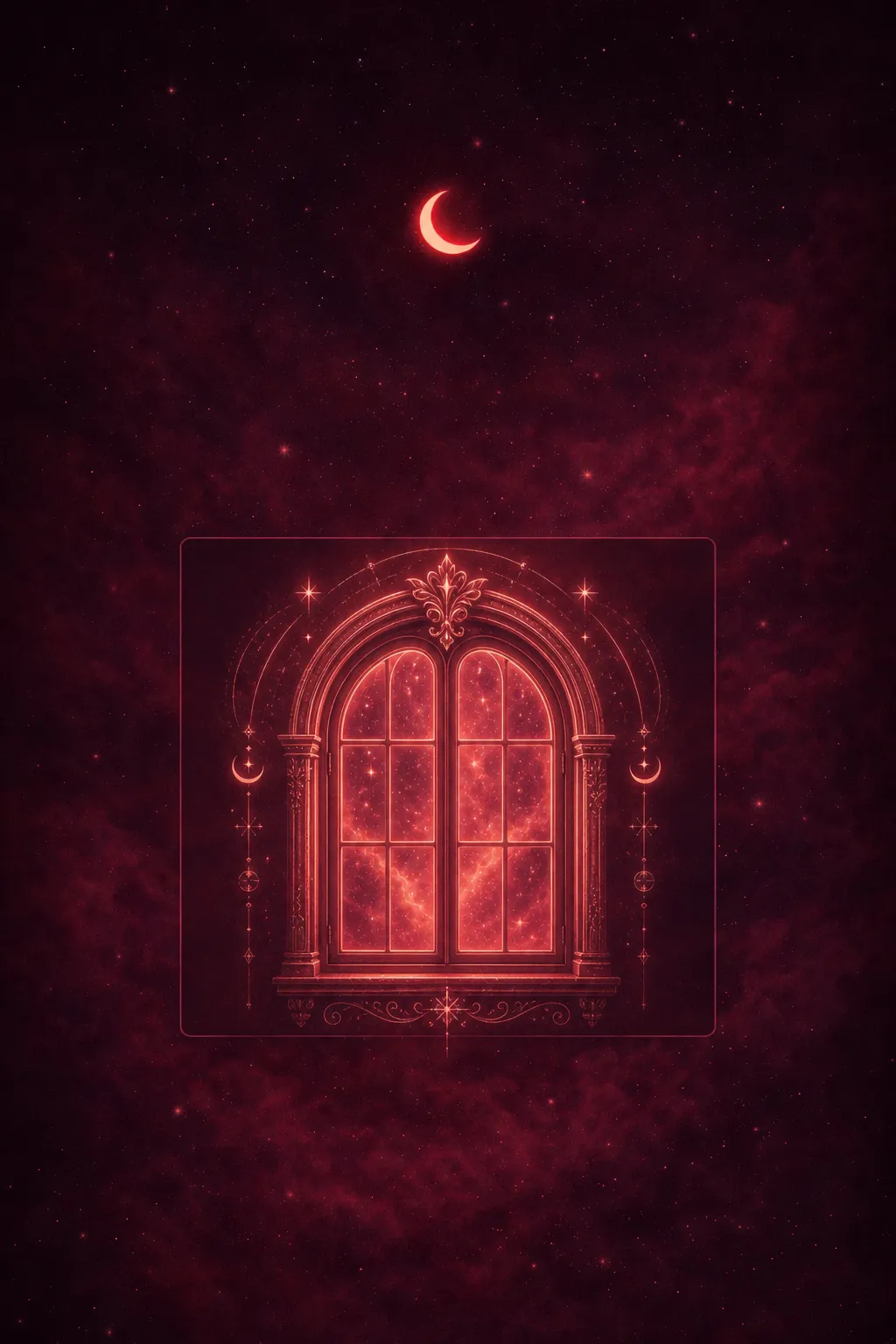

Dreaming of a window often symbolizes how you see the world and your openness to new opportunities or change. A clear window can reflect clarity and optimism, while a broken or closed window may suggest missed chances or feeling trapped. Your window dream usually points to a desire for greater freedom, insight, or a fresh perspective on a situation in your waking life.
In under a minute you could read what your exact dream means for you, and see a picture of it. Free.
A dream still on your mind? Get your personal reading.
Describe your dream in a line or two. In seconds you get a reading of your exact dream, a picture drawn from your own words, and every symbol explained.
Free. No sign-up. Takes 10 seconds. Your dream stays private.
0%
Analyzing your dream…
Something went wrong. Please try again in a moment.
Your dreams deserve more than a dictionary
Common Window Dream Scenarios
Looking Out a Window
You're standing at the glass, watching the world move without you. This is the most frequent window dream, and it tends to surface when you feel like a spectator in your own life — observing possibilities you haven't yet reached for. There's longing in it, but also safety. The window keeps you from the cold.
If the view outside is beautiful — open fields, sunlight, a vast ocean — your subconscious is pointing toward something you genuinely want. The distance between you and that view is the emotional work still to be done. If the view is threatening, like a approaching storm or a dark figure in the yard, the window becomes a boundary between your conscious self and something you're not yet ready to face.
But what does your version mean?
Broken or Shattered Window
A broken window is one of the more unsettling variations. The protective barrier is gone — whatever you were keeping out, or keeping in, is now exposed. Dreams of broken glass often accompany periods of real-life rupture: a relationship fracturing, a plan falling apart, a boundary violated.
The direction of the break matters. Glass shattered inward suggests something external has forced its way into your world. Glass blown outward hints that the pressure came from inside you — emotion, truth, or desire that couldn't be contained any longer. Either way, the dream is asking you to look at what's been breached.
Climbing Through a Window
This one carries a charge of transgression. You're not using the door — the sanctioned entry point — which means you're either sneaking in somewhere you feel you don't belong, or finding an unconventional path because the official route is closed to you. Both readings matter.
Climbing out through a window in a dream often signals a desire to escape a situation that feels too structured or suffocating. Climbing in suggests you're pursuing something you believe you don't have legitimate access to — a role, a relationship, a version of yourself. The window becomes the gap between who you are and who you're trying to become. If the dream also involves a secret room on the other side, the symbolism deepens considerably.
Someone — or Something — at the Window
A face at the window. A hand on the glass. Few dream images create that particular cold-water feeling quite like this one. When a stranger, shadow, or unknown presence appears outside your window, the dream is usually dramatizing something you've been avoiding — an emotion, a memory, a truth that keeps showing up at the edge of your awareness.
If you recognize the figure — an ex-partner, a deceased relative, someone from your past — the meaning shifts toward unresolved connection. They're not inside your life anymore, but they're not entirely gone either. They're at the window: present but separate, asking to be acknowledged.
What this dream could look like
Tap an image to open it full screen
Example images. Only you can see what you write in Dream Book.
Psychological Interpretation
Freud would have read the window as a boundary between the conscious and the unconscious — the pane of glass standing in for repression itself. Just thin enough to see through, but solid enough to prevent direct contact. For Freud, the act of looking out a window in a dream often expressed wish fulfillment: the dreamer desires something in the external world that waking life has placed just out of reach. The window is the shape of that longing.
Was yours a sign? Find out.
Jung took a wider view. For him, the window belonged to the architecture of the psyche — and Jung was deeply interested in what houses in dreams represent as maps of the self. The window, in Jungian terms, is a point of individuation: the place where the ego looks outward toward the collective world, and inward toward the unconscious. A locked or painted-over window might represent a refusal to integrate shadow material — the parts of yourself you've sealed away. A locked door carries similar energy, but the window is more specifically about seeing, not entering.
Calvin Hall's analysis of tens of thousands of dream reports found that settings — rooms, buildings, thresholds — consistently reflected the dreamer's current emotional state rather than symbolic archetypes. A window in Hall's framework is less a mythic portal and more a cognitive snapshot: your brain mapping the gap between where you are and where you want to be. Ernest Hartmann, whose work on emotional memory processing changed how we think about nightmares, would add that recurring window dreams — especially anxious ones — are the brain's way of working through unresolved emotional tension. The dream keeps returning to the window because the feeling behind it hasn't been fully processed yet.
Hobson and McCarley's activation-synthesis model offers a grounding counterpoint: the brain during REM sleep is firing semi-randomly, and the mind constructs narrative around that neural noise. A window, in this framework, might emerge simply because the visual cortex is active and the mind reaches for a familiar boundary-image. But even Hobson acknowledged that the emotional coloring the mind assigns to these images — the dread at the figure outside, the ache of the beautiful view — is where meaning lives. The neuroscience and the symbolism aren't enemies here.
Every dream you log starts to connect.
Dream Book keeps your dreams in one place and reveals the threads between them over time — your private dream journal. Free to start.


Cultural & Spiritual Meaning
In Western folk tradition, windows have long been treated as liminal spaces — neither fully inside nor outside, they were considered points where spirits could enter or exit. In some European traditions, a window left open after a death was deliberate: it allowed the soul to depart. Dreaming of an open window near themes of death or loss may tap into this deep cultural memory, even if you've never consciously encountered it.
Ibn Sirin, the 8th-century Islamic scholar whose dream interpretations remain widely consulted, wrote specifically about windows as symbols of a person's public reputation and the way they present themselves to the world. A bright, clear window in his interpretation signals honor and transparency — others can see your true character and it reflects well. A darkened or broken window, by contrast, points to concealment, shame, or a reputation at risk. Ibn Sirin's lens is notably social: the window is always about the relationship between your private self and the world watching from outside.
A bad dream isn't a bad sign.
In Chinese and East Asian dream traditions, windows carry associations with opportunity and timing — an open window represents a favorable moment that must be seized, while a closed one suggests the right time has not yet arrived. Some Indigenous frameworks across North America treat the threshold between interior and exterior space as spiritually charged, a place where communication between worlds becomes possible. A mirror and a window share this quality in many traditions: both are surfaces that show you something, but only one lets you pass through.
Related Dream Meanings

common dreams
Ocean Dream Meaning: Emotions, Change & the Subconscious
5 min read

common dreams
Storm Dream Meaning: Turmoil, Anxiety & Change
5 min read

nightmares
What Does Broken Glass Mean in a Dream? Interpretation and Symbolism
5 min read
common dreams
Door Dream Meaning: Opportunities, Transitions & Choices
5 min read
common dreams
Dream of Secret Room Meaning: What Your Subconscious Reveals
5 min read

people
Ex Partner Dream Meaning: What Your Dreams About Former Lovers Reveal
6 min read
common dreams
What Does It Mean to Dream About Houses
6 min read

common dreams
Locked Door Dream Meaning: Blocked Desires & Hidden Fears
5 min read
What to Do After This Dream
Start by sitting with the emotional texture of the dream before you analyze it. Were you afraid, wistful, curious, relieved? The feeling is the first data point — more reliable than any symbol. A broken window that left you feeling free is a different dream than a broken window that left you terrified, even if the image looks identical on paper.
Ask yourself what you're currently watching from a distance in your waking life. A job you haven't applied for. A conversation you've been avoiding. A version of yourself you can see clearly but haven't stepped into yet. The window dream almost always has a real-life correlate — and it's usually not subtle once you look for it.
If this dream keeps returning, or if the emotional charge of it is hard to shake, it's worth exploring with a personalized interpretation. Dream Book lets you describe your dream in your own words and ask follow-up questions to understand what your subconscious is actually working through — not just what windows "mean" in general, but what this window means for you, right now.
But what does your version mean?
Understanding your window dream is the first step. The next is asking what it means for your life right now — that's where a personalized interpretation goes deeper than any dictionary.
One dream is never the whole picture.
The free app remembers your dreams, draws them, and connects the threads over time — so the next one means even more. Free to start.
People Also Ask
A broken window in a dream usually points to a boundary that's been violated or a protective barrier that's collapsed — emotionally, relationally, or in terms of your sense of safety. The direction of the break matters: glass shattered inward suggests something external has intruded, while glass blown outward hints at internal pressure that could no longer be contained.
Dreaming of looking out a window typically reflects a feeling of being a spectator in your own life — watching opportunities or experiences from a safe distance rather than engaging with them directly. It often surfaces during periods of transition or indecision, when you can see what you want but haven't yet moved toward it.
A figure at the window — especially an unknown or shadowy one — usually represents something you've been avoiding: an unresolved emotion, a suppressed truth, or an aspect of yourself you haven't integrated. If you recognize the person, the dream is likely processing unfinished emotional business with them.
Yes — climbing through a window in a dream signals that you're seeking an unconventional path, either because the official route feels closed to you or because you believe you don't have legitimate access to something you want. It can reflect ambition, transgression, or a desire to escape a situation that feels too restrictive.
Curious what your dream would look like?