
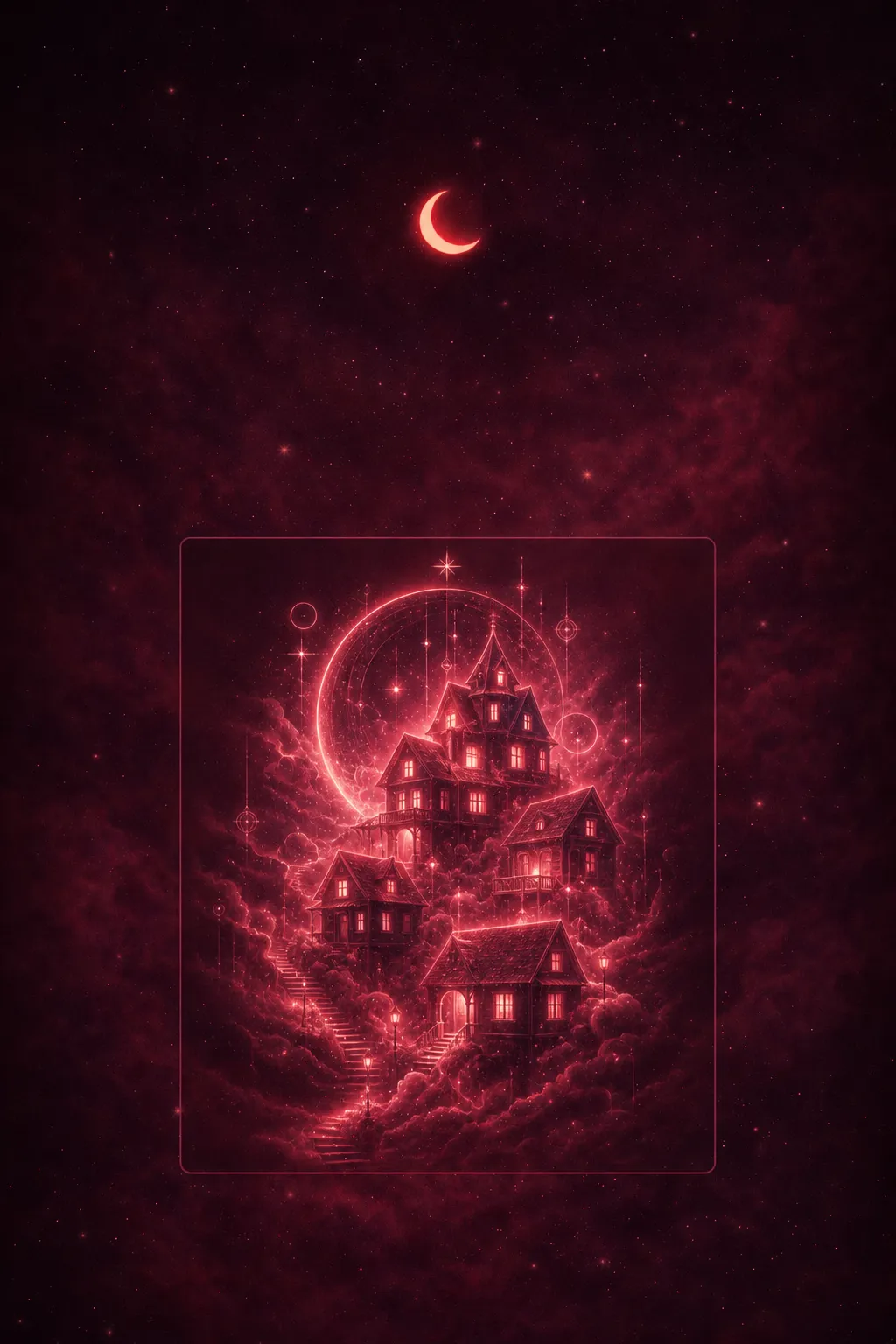

Dreaming about houses typically represents the self or mind, with each room reflecting a different aspect of your personality, emotions, or life circumstances, so exploring unfamiliar rooms may signal hidden potential, while a crumbling structure can point to inner turmoil or unresolved issues demanding your attention.
In under a minute you could read what your exact dream means for you, and see a picture of it. Free.
You read what it can mean. But what did yours mean?
General meanings stop here. In the free app, tell Dream Book your exact dream and get a reading that actually makes sense for you.


A dream still on your mind? Get your personal reading.
Describe your dream in a line or two. In seconds you get a reading of your exact dream, a picture drawn from your own words, and every symbol explained.
Free. No sign-up. Takes 10 seconds. Your dream stays private.
0%
Analyzing your dream…
Something went wrong. Please try again in a moment.
Your dreams deserve more than a dictionary
Common House Dream Scenarios and What They Mean
The specific shape a house dream takes usually points directly to which corner of your inner life needs attention. Here are the most frequently reported scenarios and what they tend to mean.
- Returning to a childhood home: This often signals unfinished emotional business rooted in family history — nostalgia tangled with a pull toward earlier, simpler versions of yourself. It rarely means you want to go back; more often it means something from that chapter still needs resolving.
- Discovering hidden or new rooms: A consistently hopeful sign — untapped abilities or overlooked parts of your personality are coming into awareness. Think of it as your mind expanding its own floor plan.
- A house that is damaged, leaking, or crumbling: One of the clearest stress-signals in dream life. The specific room matters — a flooded basement may point to buried emotions surfacing under pressure, while a cracking roof can reflect anxiety about external responsibilities closing in.
- An intruder or break-in: Reflects a felt loss of control over personal boundaries — common during periods when work, relationships, or social media demand more access to your private self than feels comfortable.
- An empty or abandoned house: Often maps to emotional vacancy — a life phase that feels hollow or a disconnection from your own sense of identity.
- Moving in or out: A straightforward marker of transition — either excitement about reinventing yourself or anxiety about leaving familiar ground behind.
- A haunted house: Repressed memories or unresolved guilt surfacing; the past is quite literally rattling the walls of your present self.
- Buying, building, or touring a mansion: Points to ambition and identity construction — actively investing in who you are becoming, or feeling overwhelmed by how many roles you are expected to fill at once.
But what does your version mean?
Across all these variants, pay attention to how much control you feel inside the dream. Being locked out, chased through rooms, or unable to repair damage all amplify a waking sense that life circumstances are outpacing your ability to manage them. Dreams of falling through floors or collapsing staircases within a house carry a similar charge — a very modern and recognizable form of anxiety your dreaming mind is working through in architectural form.
What this dream could look like
Tap an image to open it full screen
Example images. Only you can see what you write in Dream Book.
The Psychological Reading: Your Mind in Blueprint Form
From a psychological standpoint, dreaming of a house is essentially dreaming about yourself. Carl Jung understood the house as a symbol of the Self — a structured map of the psyche in which each level carries distinct meaning. Upper floors tend to reflect conscious thought and intellect, while the basement holds repressed material, fears, and instincts you have not yet brought into the light. The attic often represents memory or higher aspiration. When you dream of wandering into an unfamiliar room, your subconscious may be nudging you toward a part of your personality you have not yet fully acknowledged or integrated.
The emotional condition of the house matters just as much as its layout. A crumbling wall, a leaking roof, or a door that will not lock typically mirrors felt vulnerability — a sense that your inner stability is under strain, not unlike the vertiginous loss of footing captured in falling dreams. Conversely, dreaming of renovation or of discovering spacious new rooms often reflects genuine psychological growth or a life transition already underway. Modern life adds another layer to this: with housing costs, mortgages, and the pressures of keeping a household running, the dream house can also surface very concrete anxieties about whether your life is truly "holding together" — financially, relationally, or emotionally. That same dread of something silently eroding beneath the surface connects house dreams to recurring anxiety symbols like teeth falling out, where the body itself becomes the measure of felt control.
- Locked or hidden rooms: unacknowledged emotions or aspects of identity seeking recognition
- A house in disrepair: perceived loss of control over your circumstances or sense of self
- Expanding or newly built rooms: readiness for growth, identity shift, or new responsibility
- An intruder inside the house: an external pressure — or an internal conflict — threatening your sense of security
General meanings end here. Read your own dream.
Describe your dream in a line or two. In seconds you get a reading of your exact dream, a picture drawn from your own words, and every symbol explained.
Free. No sign-up. Takes 10 seconds. Your dream stays private.
0%
Analyzing your dream…
Something went wrong. Please try again in a moment.
Your dreams deserve more than a dictionary
Every dream you log starts to connect.
Dream Book keeps your dreams in one place and reveals the threads between them over time — your private dream journal. Free to start.
Houses in Culture and Tradition: The Home as a Mirror of Who You Are
In Anglo-American culture, the home carries enormous symbolic weight well beyond its four walls. Owning a house is a deeply ingrained marker of adulthood, stability, and personal success — which is precisely why property anxiety bleeds so readily into the dream world. When you dream of a house that is crumbling, unaffordable, or impossible to maintain, that imagery often echoes a very modern fear: the sense that the life you have built — your career, your relationships, your sense of control — could be pulled out from under you at any moment. Folk wisdom has long held that dreaming of a tidy, well-kept home signals that things are genuinely in order, while a neglected or chaotic one is a quiet warning to take stock before small cracks become serious fractures.
Was yours a sign? Find out.
Beyond religious readings, Anglo-American folk tradition treats the house as a portrait of the dreamer's inner life, and everyday language preserves the link: we speak of “getting your house in order,” of someone “falling apart,” and of feeling “at home” in oneself. Older American dream dictionaries leaned heavily on this, reading each part of the house as a part of the person — the attic as the intellect, the basement as buried memory, the kitchen as family life and nourishment. In this popular tradition a tidy, well-lit house was taken as a sign of a settled mind, while a house under repair or filled with strangers was read as a life in transition or a boundary under strain.
- Solid, well-maintained house: cultural signal of security, self-mastery, and a life on steady ground.
- Dilapidated or collapsing house: folk warning of neglected responsibilities or eroding foundations — personal or spiritual.
- A house with a hidden basement: traditionally linked to secrets kept below the surface of everyday life.
- Moving into a new house: widely read as a sign of transition, fresh identity, or a new chapter beginning.
The Spiritual Reading: Your Inner House and the Soul Within
In the Christian tradition, the house carries profound scriptural weight. Jesus describes building one's life on rock versus sand (Matthew 7:24–27), a parable that maps almost perfectly onto the dream symbol: the condition of your house reflects the foundation of your faith, values, and inner integrity. A crumbling or unstable house in a dream can serve as a quiet spiritual prompt — an invitation to examine what you are truly building your life upon, especially during seasons of change, loss, or overwhelming pressure.
Beyond scripture, many people in spiritually-oriented communities interpret the house dream as a message about the soul's current state. Just as the basement of a dream house can surface buried fears and forgotten memories, spiritual traditions often read hidden or locked rooms as parts of the self that have been closed off from prayer, community, or honest self-reflection. The modern anxiety of feeling out of control — stretched thin by work, relationships, and uncertainty — can manifest as a spiritually disordered house, one that calls you back toward intentional inner work.
A bad dream isn't a bad sign.
Some of the most frequently noted spiritual patterns in house dreams point to specific areas of inner life worth attending to:
- A house under threat may signal a need to reinforce your core values or spiritual commitments.
- Discovering new rooms can point to untapped spiritual gifts or callings not yet explored.
- A house in disrepair might prompt honest self-examination: where have you neglected your inner life?
- A warm, welcoming home often reflects peace of mind and alignment between your outer life and inner convictions.
Related Dream Meanings
common dreams
Dreaming of Basement Meaning: What Your Subconscious Reveals
5 min read

nightmares
Being Chased Dream Meaning: Anxiety & Avoidance
5 min read

common dreams
Falling Dream Meaning: Insecurity, Fear & Loss of Control
5 min read

body health
Teeth Falling Out Dream: Anxiety, Loss & Vulnerability
5 min read

common dreams
Driving Dream Meaning: Control, Direction & Life Path
5 min read

common dreams
Swimming Dream Meaning: Emotions, Freedom & Growth
5 min read

common dreams
Tornado Dream Meaning: Chaos, Turmoil & Warnings
5 min read

common dreams
Flood Dream Meaning: Emotions, Loss & Need for Change
5 min read
What to Do When Your House Dream Feels Like a Warning
Because the house represents your inner world, a troubling house dream is essentially your mind flagging a real-life pressure worth examining. Rather than brushing it off, treat it as useful feedback. The morning after, jot down the condition of the house — was it crumbling, locked up, unexpectedly spacious? That detail alone can point to where you feel most out of control right now, whether that's finances, a relationship, or a workload that's quietly eroding your sense of stability. House dreams often cluster with other threat-themed dreams — if you've also been dreaming about falling or being chased, that pattern is worth taking seriously as a signal of sustained stress rather than a one-off bad night.
- Name the room, name the issue. A dream focused on a specific space — a cluttered basement, a locked bedroom — often maps to a particular compartment of your life. Ask honestly whether that area is getting the attention it needs.
- Check your real-world security levers. Modern anxiety loves to rehearse worst-case scenarios in dream form. If the house felt threatened or unstable, review one concrete thing you can shore up: a financial buffer, a difficult conversation you've been avoiding, or a boundary you haven't set.
- Use the dream as a self-audit prompt. Ask yourself whether your public presentation and your private inner life are reasonably aligned. A house with a polished exterior but crumbling rooms inside is a recognizable image — and a recognizable pattern in daily life too.
But what does your version mean?
You don't need to over-analyze every architectural detail. The practical goal is simply to let the dream redirect your attention toward whichever area of your life genuinely needs care, then take one small, concrete step in that direction.
One dream is never the whole picture.
The free app remembers your dreams, draws them, and connects the threads over time — so the next one means even more. Free to start.
People Also Ask
Houses in dreams typically represent the self — your mind, identity, and inner world. Each room can reflect a different aspect of your personality or life. The condition of the house, whether run-down or pristine, often mirrors your current emotional state or how you feel about your life overall. Recurring visits to an <a href="/dream-dictionary/old-house/">old house</a> may point to unresolved memories.
Spiritually, a house symbolizes the soul and its journey. It represents shelter, protection, and the sacred space within you. Many spiritual traditions view the dream house as a reflection of your higher self, suggesting that exploring its rooms means you are seeking deeper self-awareness and spiritual growth. A <a href="/dream-dictionary/haunted-house/">haunted house</a> dream can signal unresolved spiritual burdens.
In a biblical context, a house often symbolizes the dwelling place of the spirit or the foundation of one's faith. Scriptures reference the house as a symbol of wisdom and stability. A dream of a sturdy house may suggest divine blessing, while a crumbling one could signal a need for spiritual renewal.
Dreaming of a house with many rooms suggests unexplored aspects of your personality or untapped potential. Discovering a <a href="/dream-dictionary/secret-room/">secret room</a> often signals new opportunities or suppressed emotions coming to light. Each room may represent a different life area — relationships, creativity, or ambition — inviting you to explore yourself more fully.
Curious what your dream would look like?