
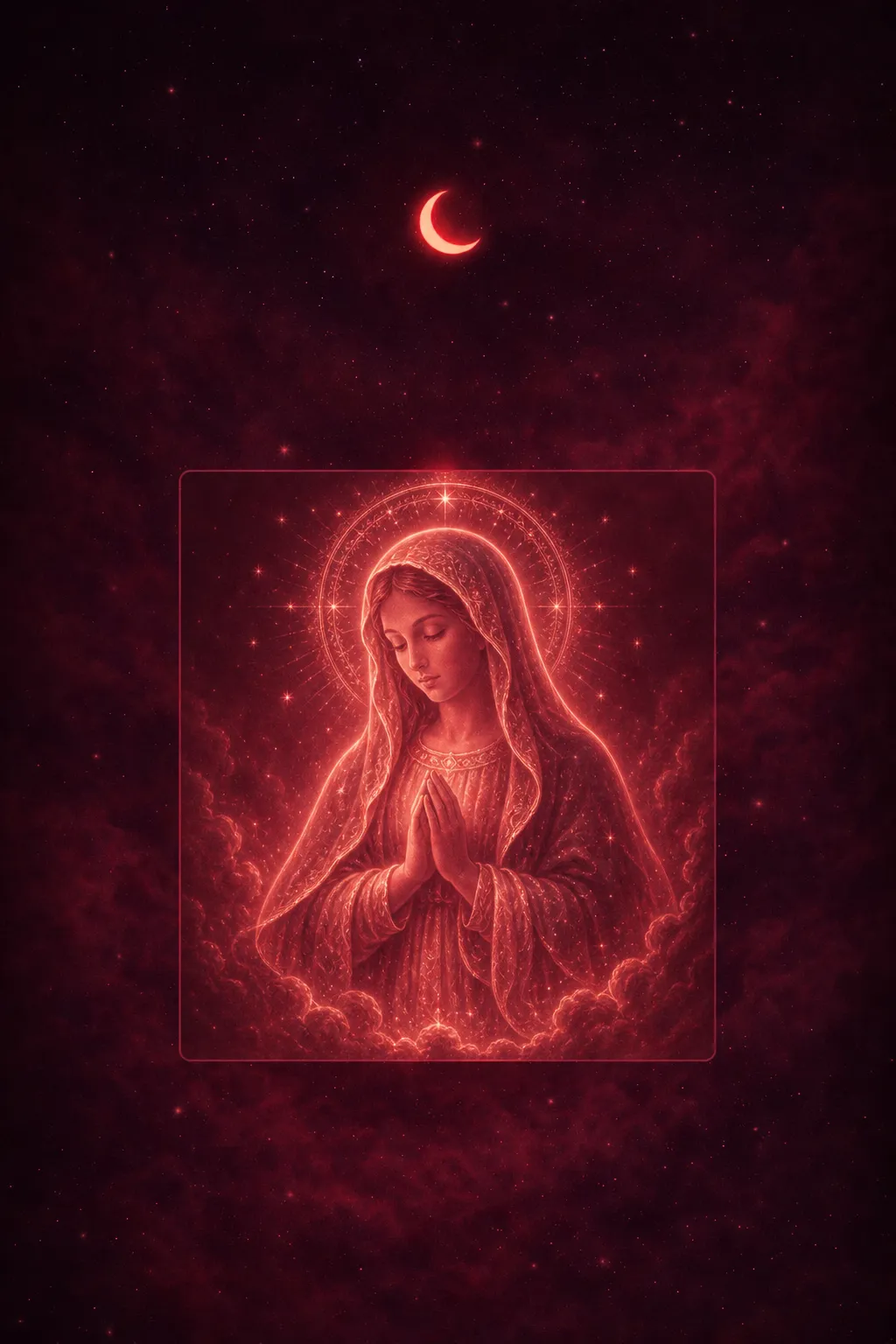

Dreaming of the Virgin Mary meaning centers on divine protection, purity, and compassion, as this sacred figure typically appears in dreams to offer comfort during difficult times, signal a need for spiritual guidance, or reflect the dreamer's longing for unconditional love, inner peace, and a deeper connection with faith, hope, and maternal nurturing energy.
In under a minute you could read what your exact dream means for you, and see a picture of it. Free.
A dream still on your mind? Get your personal reading.
Describe your dream in a line or two. In seconds you get a reading of your exact dream, a picture drawn from your own words, and every symbol explained.
Free. No sign-up. Takes 10 seconds. Your dream stays private.
0%
Analyzing your dream…
Something went wrong. Please try again in a moment.
Your dreams deserve more than a dictionary
Common Virgin Mary Dream Scenarios and What They Mean
The form Mary takes in a dream shapes its message considerably — each variant carries a distinct emotional register worth examining on its own terms.
Dreaming of a statue or painting of the Virgin Mary
Seeing her image at a distance — perhaps inside a quiet church setting — often signals that you are reaching toward an idealized standard, measuring yourself against a moral benchmark or simply craving reassurance during a stressful stretch of waking life. The image comforts but also sets a quiet challenge: are you living in line with what you value?
But what does your version mean?
Dreaming that Mary speaks to or guides you
Your psyche is doing something more urgent here — clothing your own deep intuition in the voice of a trusted authority so you will actually listen to it. Pay close attention to the specific words; they tend to reflect decisions or conflicts you have been avoiding.
Dreaming of Mary weeping or in distress
This variant points to projected grief or a nagging sense that something you hold dear — a relationship, a value, your own integrity — is being neglected or threatened. The sorrow you witness is often your own, given a face you trust.
Dreaming of praying to or reaching for Mary
A candid signal that anxiety has hit a peak and the waking mind is craving permission to release control. Like prayer in waking life, the gesture acknowledges that you cannot carry a burden alone and that surrender, not weakness, may be what the moment asks.
Dreaming of Mary holding the Christ child
This image connects to the maternal archetype — protecting something new and vulnerable, whether a project, a relationship, or a caregiving responsibility you feel the weight of. It can also reflect hope tied to a new beginning you are quietly nurturing.
Dreaming of a radiant apparition of Mary in glowing light
This carries overwhelming awe and often follows a period of crisis, signaling a deep inner longing for peace, resolution, and the reassurance that things can still be made right. Across all these variants, a serene Mary points toward comfort, while a sorrowful or distant one mirrors unresolved tension within yourself.
What a dream about the Virgin Mary could look like
Tap an image to open it full screen
Example images. Only you can see what you write in Dream Book.
Psychological Meaning of Dreaming About the Virgin Mary
From a depth-psychology perspective, the Virgin Mary activates what Carl Jung called the Great Mother archetype — the psyche's internalized image of unconditional nurturing, containment, and acceptance. When this figure surfaces in a dream, it rarely arrives by accident. More often, the unconscious is compensating for something absent in waking life: a secure emotional base, a sense of being held, or the reassurance that imperfection is forgivable. Dreamers who feel isolated, overwhelmed by responsibility, or starved of maternal warmth may find that their sleeping mind conjures the most idealized nurturing presence it knows.
Was yours a sign? Find out.
The figure also carries a strong moral dimension. She can function as a gentle but firm conscience — the internalized standard against which the dreamer quietly measures their choices, desires, and self-worth. Feelings of guilt, shame, or the longing to "do better" often lie just beneath the surface of such dreams. When she appears alongside a protective or heavenly presence, the psychological signal intensifies: the psyche is reaching toward purity, moral clarity, or absolution. Crucially, the psychological message is rarely condemnation; instead, the appearance of this archetype tends to signal a desire for self-forgiveness and integration — reconciling who you actually are with the compassionate, patient self you aspire to become.
Modern-anxiety research adds another layer: when stress strips away a person's sense of control, the mind reaches for figures that embody calm and certainty. Dreaming of the Virgin Mary during periods of burnout, grief, or major life transitions may simply mean the psyche is searching for stillness — much as it might set a dream inside a quiet sacred space to create the same effect. Common psychological themes tied to this dream include:
- Craving emotional safety when waking-life support feels thin or unreliable
- Processing guilt and seeking an inner sense of absolution
- Integrating compassion and patience into a harsh internal self-narrative
- Coping with loss of control by symbolically surrendering to a trustworthy, protective presence
Every dream you log starts to connect.
Dream Book keeps your dreams in one place and reveals the threads between them over time — your private dream journal. Free to start.


Cultural and Traditional Beliefs About Dreaming of the Virgin Mary
Across Western culture, the Virgin Mary occupies a unique position that reaches well beyond formally religious boundaries. Even among dreamers who do not identify as practicing Catholics or Christians, she functions as a widely shared cultural emblem of motherhood, mercy, and moral purity — a figure absorbed through art, literature, and collective memory rather than personal devotion alone. In a broadly Protestant-majority Anglo context, she tends to carry less devotional weight than she does in strongly Catholic traditions, which means her appearance in a dream often registers more as a psychological or symbolic event than a strictly spiritual one. The subconscious draws on her as a ready-made image of safety and goodness precisely because the culture has kept that image so visible — much as dreaming of a church can evoke sanctuary and moral grounding regardless of one's personal faith.
Folk belief across generations has long treated a dream of Mary as a favorable omen — a sign of coming comfort, answered prayer, or protection during difficult times. In that same tradition, seeing her weeping or turning away was read as a warning to examine one's conscience before a situation slipped out of control. These older interpretations map surprisingly well onto modern-anxiety readings: when waking life feels uncertain or morally tangled, the dreaming mind reaches for the most culturally legible figure of reassurance it knows. Her appearance can feel as instinctively comforting as an angelic presence, and just as arresting when the image turns sorrowful.
A bad dream isn't a bad sign.
- Icon of universal motherhood: recognized across secular and religious lines as a symbol of unconditional care, echoing the deep emotional pull explored in dreams of a mother figure.
- Moral mirror: folk traditions link her dream appearance to self-examination and the desire to realign with personal values.
- Omen of protection: historically interpreted as a sign that guidance or relief is available, even in periods of high stress.
Spiritual Meaning of Dreaming About the Virgin Mary
Within a Christian framework, Mary's appearance in a dream carries the weight of grace and intercession. The Annunciation account in Luke 1:26–38 presents her as someone who received an overwhelming, life-altering calling and responded not with resistance but with surrender: "Let it be to me according to your word." When she surfaces in your dream during a season of anxiety or uncertainty, that biblical posture is part of the message — an invitation to release the need to control outcomes and trust a larger unfolding. For dreamers navigating high-stakes decisions or moral crossroads, this figure can feel less like a visitation and more like a mirror, reflecting a latent desire for faith and steadiness. Her arrival sometimes echoes the role of a heavenly messenger, signaling that your deeper self is reaching for divine reassurance rather than earthly solutions.
From a broader spiritual angle, Mary functions as an emblem of protective intercession — the sense that someone beyond the immediate situation is holding space for you. Dreaming of her during periods of guilt or self-doubt may signal a need for self-forgiveness rather than continued self-judgment. If your dream unfolded inside a sacred or church-like setting, that context amplifies the call toward spiritual grounding. If it involved an act of prayer directed toward her, consider what specific relief or guidance you were seeking; the content of that inner petition often points directly to the waking-life pressure your spirit is trying to process.
- Guidance in moral uncertainty: Her presence may prompt honest self-examination about a choice you have been avoiding.
- Surrender over control: The dream may be nudging you toward faith and acceptance rather than anxious striving.
- Intercession and protection: A felt sense that comfort and grace are available, even when circumstances feel beyond your control.
Related Dream Meanings

people
Church Dream Meaning: Spirituality, Guidance & Belief
5 min read
people
Prayer Dream Meaning: Hope, Surrender & Inner Peace
5 min read
common dreams
Mother Dream Meaning: Love, Guilt & Inner Nurturing
6 min read
people
Angel Dream Meaning: Guidance, Protection & Insight
5 min read
people
Twins Dream Meaning: Duality, Balance & New Beginnings
5 min read

people
Dreaming About Family Members Meaning - Dream Interpretation Guide
5 min read

people
Grandparents Dream Meaning: Wisdom, Guidance & Family
5 min read

people
What Does It Mean to Dream About Love
6 min read
Practical Takeaways: What to Do After This Dream
When the Virgin Mary appears in a dream, treat it as a prompt for honest self-reflection rather than a passive comfort. Start by noting what was happening in your waking life the night before — high stress, a difficult decision, unresolved guilt, or a strained relationship with a maternal figure are all common triggers. Writing a few sentences in a journal while the imagery is still fresh helps you identify which pressure point the dream is responding to, giving you something concrete to work with rather than vague unease.
From there, consider these grounded action steps:
- Name the underlying need. Are you seeking reassurance, moral clarity, or self-forgiveness? Labeling the need precisely makes it easier to address in waking life — through a conversation, a decision, or a deliberate act of self-compassion.
- Check your standards. If anxiety about meeting an impossibly high moral or personal ideal drove the dream, ask whether that standard is genuinely yours or one you absorbed from others. Adjust accordingly.
- Take one small, calming action. Whether that means a few minutes of prayer, quiet reflection inside a church or familiar sacred space, or simply calling someone you trust, the dream is nudging you toward comfort — act on that nudge rather than waiting for the feeling to pass on its own.
- Revisit the dream in a week. If the figure returns repeatedly, it signals a persistent unmet need worth exploring more deeply, possibly with a counselor or trusted mentor.
But what does your version mean?
The core message is practical: something in your life needs tending. The dream hands you the awareness — what you do with it is entirely within your control.
One dream is never the whole picture.
The free app remembers your dreams, draws them, and connects the threads over time — so the next one means even more. Free to start.
People Also Ask
Divine warning dreams often feel unusually vivid and leave a lasting emotional impression upon waking. Symbols like the Virgin Mary appearing with a sorrowful expression, urgent gestures, or a sense of heaviness can signal that your subconscious — or a higher power — is urging you toward <a href="/dream-dictionary/praying-to-god/">prayer</a> and reflection on a current life decision or danger.
<a href="/dream-dictionary/jesus/">Dreaming of Jesus</a> often symbolizes a deep need for guidance, forgiveness, or spiritual reassurance. It may reflect your longing for unconditional love and moral direction. Many dreamers report feeling profound peace after such dreams, suggesting an inner call to reconnect with your core values, faith, or a sense of divine purpose in your waking life.
Scripture does not record specific dreams of Mary, though she received divine messages through the <a href="/dream-dictionary/angel/">angel</a> Gabriel. In dream interpretation tradition, Mary is seen as a vessel of spiritual revelation. Dreaming about her story may reflect themes of acceptance, faithful surrender to a greater calling, and the courage to embrace life's unexpected, transformative challenges.
The Virgin Mary symbolizes compassion, purity, unconditional motherly love, and spiritual protection. Seeing her in a dream often signals comfort during hardship, a need for emotional nurturing, or an invitation toward inner peace. She can also represent grace under pressure — a reminder to approach your struggles with patience, humility, and quiet inner strength.
Curious what your dream would look like?