
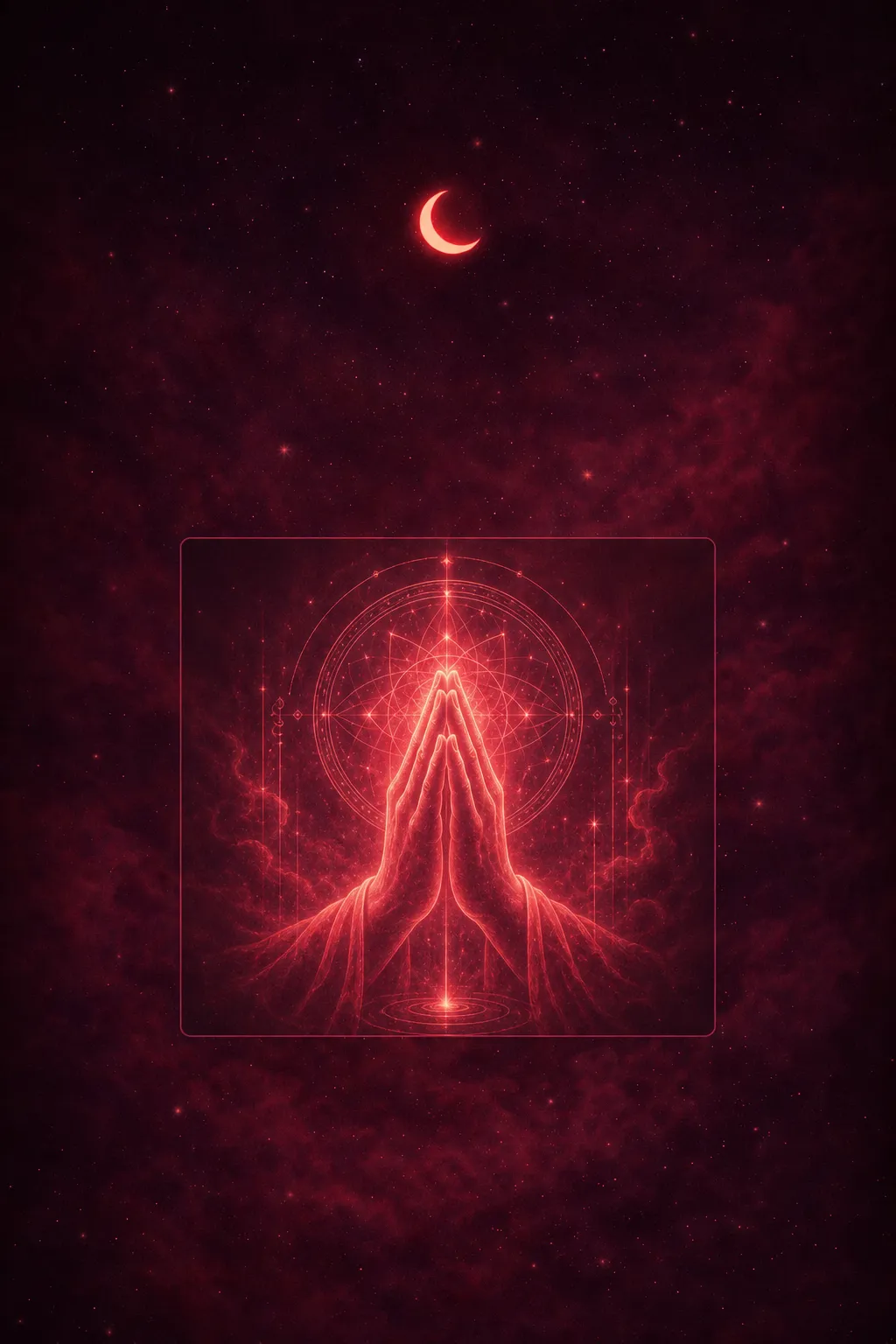

Dreaming of prayer often reflects a deep longing for guidance, comfort, or connection to something greater than yourself. It can signal emotional surrender, a desire for healing, or an unspoken need to release worry and trust the process. This dream usually appears during times of stress, transition, or spiritual searching.
In under a minute you could read what your exact dream means for you, and see a picture of it. Free.
A dream still on your mind? Get your personal reading.
Describe your dream in a line or two. In seconds you get a reading of your exact dream, a picture drawn from your own words, and every symbol explained.
Free. No sign-up. Takes 10 seconds. Your dream stays private.
0%
Analyzing your dream…
Something went wrong. Please try again in a moment.
Your dreams deserve more than a dictionary
Common Prayer Dream Scenarios
Praying Alone in Silence
You're kneeling — or maybe just still — and the words come out of you like something that's been held too long. Praying alone in a dream almost always points to a private struggle you haven't voiced to anyone. Something is weighing on you that you don't feel you can share.
This dream often surfaces during periods of grief, major decisions, or when you feel fundamentally unseen. It's not necessarily about religion. Even for people with no spiritual practice, the act of prayer in a dream represents a reaching outward — an acknowledgment that you can't carry something alone anymore.
But what does your version mean?
Praying in a Church or Sacred Space
When the setting is a church or temple, the dream adds a layer of communal meaning. You're not just seeking help — you're seeking it within a structure, a tradition, a shared framework of belief. This can reflect a need for belonging, or a tension between your personal values and the expectations of a community around you.
Sometimes this dream appears when you're questioning something you were raised to believe. The sacred space becomes a kind of mirror — are you praying from conviction, or from habit? Your emotional state inside the dream is the key. Peace suggests integration. Discomfort suggests something unresolved between who you are and who you were taught to be.
Praying to God or Hearing a Response
Dreams where you're praying to God and actually receiving an answer — a voice, a feeling, a sudden knowing — carry unusual weight. These are the dreams people remember for years. They tend to arrive at crossroads moments: before a major loss, after one, or in the middle of a life that's stopped making sense.
If you dreamed of God speaking back to you, pay attention to what was said — or what was felt, even if no words came. The message your sleeping mind constructed is worth sitting with. This isn't necessarily a supernatural event, but it is your deepest self communicating something it couldn't get through during waking hours.
Praying with Others or Witnessing Someone Pray
Watching someone else pray — a parent, a stranger, a figure you can't quite identify — often points to admiration or longing. You may be recognizing a quality in that person (faith, surrender, peace) that you want for yourself. If you're praying alongside others, the dream speaks to community, shared purpose, and the comfort of not being alone in your beliefs or your fears.
If the person praying is someone who has passed away, the dream takes on a different texture entirely — one of visitation, memory, and unfinished emotional business. These dreams are rarely frightening. They're usually tender, and they tend to leave a feeling that lingers long after waking.
What this dream could look like
Tap an image to open it full screen
Example images. Only you can see what you write in Dream Book.
Psychological Interpretation
Freud would have looked at a prayer dream with particular interest. For him, prayer represents a wish — specifically, the wish for an all-powerful figure to intervene and resolve what we cannot. He saw religious imagery in dreams as a sophisticated form of wish fulfillment, often tied to the earliest relationship we have: the parent who could fix everything. When you dream of praying, Freud might ask: what do you want rescued from? And who, in your waking life, do you wish would step in?
Was yours a sign? Find out.
Jung took the same imagery somewhere richer. Prayer, for Jung, touches the archetypal layer of the unconscious — the part of the psyche that isn't personal but collective, shared across every human culture that has ever existed. He saw the act of prayer as a symbolic gesture of the ego reaching toward the Self — the deeper, larger center of the whole psyche. When you dream of praying, Jung would say you're engaged in individuation: the slow, lifelong work of becoming who you actually are. It's worth noting that if your prayer dreams come alongside shadow figures or dark presences, Jung would read that as the psyche dramatizing the tension between the ego and the parts of yourself you haven't yet integrated.
Calvin Hall's content analysis of over 50,000 dream reports found that religious imagery — including prayer — appeared most frequently during periods of reported stress, loss, and life transition. His cognitive theory frames dreams as a kind of thinking: you're not receiving messages so much as working through your own conceptual understanding of your life. A prayer dream, in Hall's framework, reflects how you conceptualize your relationship to control — specifically, what you believe lies beyond it.
Ernest Hartmann's emotional processing theory adds another dimension. Hartmann argued that dreams are the brain's way of weaving new, difficult emotional experiences into existing memory — a kind of overnight therapy. Prayer is one of the most emotionally loaded acts a human being can perform. When it shows up in dreams, Hartmann would say the brain is using that image as a container for something overwhelming — grief, fear, hope — that needs to be processed and integrated before you can move forward.
Every dream you log starts to connect.
Dream Book keeps your dreams in one place and reveals the threads between them over time — your private dream journal. Free to start.


Cultural & Spiritual Meaning
Across Western spiritual traditions, dreaming of prayer has long been interpreted as a sign of divine communication or imminent blessing. Medieval Christian dream interpreters saw it as evidence of a soul in dialogue with God — a positive omen suggesting protection or answered wishes. In many Indigenous traditions, prayer in dreams is understood as a direct form of ceremony: the dream-self performing sacred work that has real consequences in waking life. The boundary between the dream and the spiritual act is considered thin, or nonexistent.
Ibn Sirin, the 8th-century Islamic scholar whose dream interpretations remain foundational in Islamic tradition, wrote specifically about prayer dreams. He interpreted dreaming of performing prayer correctly and in the proper direction as a sign of righteousness, guidance, and that the dreamer's affairs would be set right. To dream of praying in the wrong direction, however, was a warning — a signal that the dreamer may be following a path that deviates from what is true or just. Ibn Sirin's framework is striking for how specific it is: the details of the prayer matter as much as the act itself.
A bad dream isn't a bad sign.
In Eastern traditions, particularly within Buddhist and Hindu frameworks, the act of prayer in dreams is often understood as the mind touching something beyond ordinary consciousness — a moment of genuine spiritual contact rather than mere symbolic processing. Dreaming of sacred figures during prayer, or of angelic presences, is considered auspicious across many of these traditions, a sign that the dreamer is under some form of spiritual protection or guidance.
Related Dream Meanings

people
Church Dream Meaning: Spirituality, Guidance & Belief
5 min read
people
What Does It Mean to Pray in a Dream
5 min read

people
God Speaking Dream Meaning: Guidance, Purpose & Truth
5 min read

nightmares
Deceased Loved One Dream: Closure, Messages & Grief
5 min read
nightmares
Shadow Person in Dreams: What It Means When You See Them
5 min read
nightmares
Demons Dream Meaning: Fears, Conflicts & Hidden Struggles
5 min read

people
Seeing Jesus Dream Meaning: Hope, Guidance & Faith
5 min read
people
Angel Dream Meaning: Guidance, Protection & Insight
5 min read
What to Do After This Dream
Start by sitting with the emotional residue before you try to analyze it. Prayer dreams carry a specific feeling — sometimes peace, sometimes urgency, sometimes a grief that has no name yet. That feeling is data. Write it down before it fades.
Ask yourself what you were praying for, if you can remember. Even a vague sense of the request points toward something real in your waking life: a relationship, a fear, a decision you've been avoiding. The dream isn't telling you what to do — it's showing you what you already know matters.
If the dream keeps returning, or if it arrived alongside something significant — a loss, a transition, a moment of crisis — it's worth exploring more deeply. Dream Book lets you describe your dream in detail and ask follow-up questions to understand what your subconscious is actually working through, beyond what any general dictionary can offer.
But what does your version mean?
Understanding your prayer dream is the first step. The next is asking what it means for your life right now — that's where a personalized interpretation goes deeper than any dictionary.
One dream is never the whole picture.
The free app remembers your dreams, draws them, and connects the threads over time — so the next one means even more. Free to start.
People Also Ask
Dreaming about praying usually reflects a deep need for guidance, relief from anxiety, or a desire for forgiveness and peace. It often surfaces during stressful life transitions or when you feel a lack of control over something important. The emotional tone of the dream — whether you felt heard, desperate, or at peace — gives you the clearest clue about its meaning.
In most cultural and spiritual traditions, dreaming of prayer is considered a positive omen — a sign of protection, divine attention, or that your situation will improve. Ibn Sirin, the classical Islamic dream interpreter, specifically associated correct prayer in dreams with righteousness and the resolution of one's affairs. Psychologically, it suggests your mind is actively processing something difficult and seeking resolution.
Praying and crying in a dream points to emotional release — something you've been holding in waking life that your sleeping mind finally allowed to surface. It often appears during grief, guilt, or periods of profound longing. Rather than a warning, it's usually a sign that healing is underway.
Watching someone else pray in a dream often reflects admiration for a quality that person represents — faith, surrender, inner peace — that you feel you're lacking. If the person praying is someone who has died, the dream may be a form of visitation, your mind's way of maintaining connection and processing grief.
Curious what your dream would look like?