
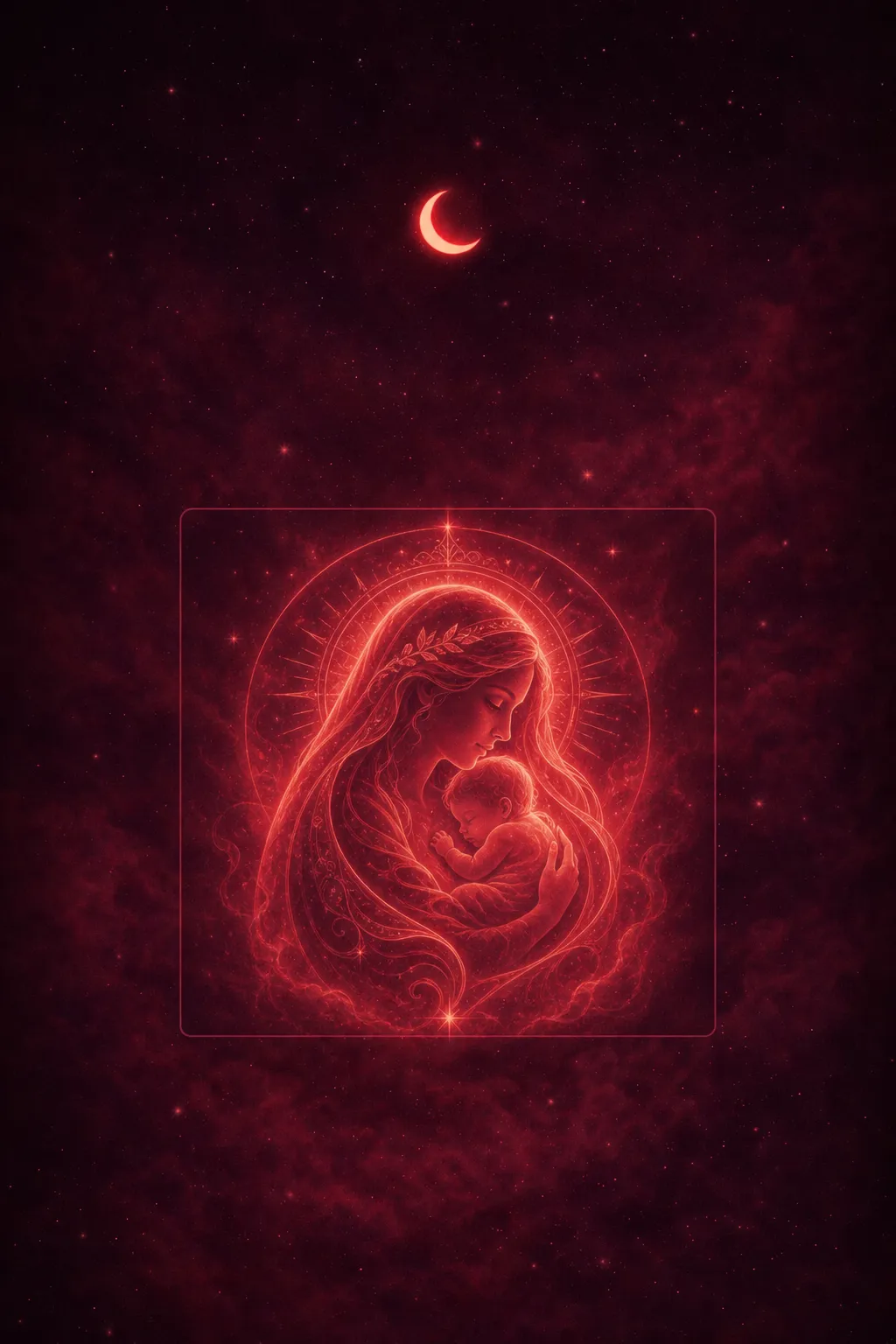

Dreaming of your mother usually reflects a deep need for comfort, security, or emotional support. It can also surface unresolved feelings about your relationship with her, or signal that your inner voice is urging you to care for yourself or others. The tone of the dream — warm, tense, or distant — often points to which theme is most active in your waking life.
In under a minute you could read what your exact dream means for you, and see a picture of it. Free.
You read what it can mean. But what did yours mean?
General meanings stop here. In the free app, tell Dream Book your exact dream and get a reading that actually makes sense for you.


A dream still on your mind? Get your personal reading.
Describe your dream in a line or two. In seconds you get a reading of your exact dream, a picture drawn from your own words, and every symbol explained.
Free. No sign-up. Takes 10 seconds. Your dream stays private.
0%
Analyzing your dream…
Something went wrong. Please try again in a moment.
Your dreams deserve more than a dictionary
Common Mother Dream Scenarios
Dreaming of a Dead Mother
Dreams featuring a deceased mother are among the most emotionally charged and frequently reported. When the dreamer's mother has died in waking life, such dreams often represent grief processing and the psyche's attempt to maintain an internal bond with the lost figure. The appearance of a [dead mother](https://dreaminterpreter.com/dead-mother) in a dream does not necessarily predict misfortune; rather, it tends to signal that the dreamer is integrating loss or seeking guidance from an internalized maternal image. When the mother is alive in waking life but appears dead in the dream, the symbolism shifts toward transformation. This scenario frequently accompanies major life transitions — leaving home, beginning a new relationship, or assuming an independent adult identity. The "death" of the mother in the dream may represent the psychological separation necessary for individuation, the process of becoming a fully autonomous self.But what does your version mean?
Arguing or Fighting with Mother
Conflict scenarios with the mother figure are extremely common and typically reflect internal tension rather than a literal prediction of relational discord. The dreaming mind often uses the mother as a stand-in for the dreamer's own internalized critical voice — the part of the psyche that sets standards, enforces rules, and generates guilt. Dreams of [fighting](https://dreaminterpreter.com/fighting) with a mother figure may therefore indicate that the dreamer is struggling against their own self-imposed limitations or inherited belief systems. These dreams can also surface during periods of genuine relational strain. If the dreamer is navigating real-world boundary issues, resentment, or unspoken grievances with their mother, the dream may be providing a safe arena in which suppressed emotions can be expressed and examined without consequence.Was yours a sign? Find out.
Mother Being in Danger or Sick
Dreaming of a mother who is ill, injured, or threatened often activates the dreamer's deepest anxieties about vulnerability and loss of foundational support. Psychologically, this scenario is linked to what researchers call "attachment anxiety" — a heightened vigilance about the availability of primary caregivers. Such dreams frequently occur when the dreamer is under significant stress, feeling unsupported, or facing circumstances that echo early experiences of abandonment or instability. These dreams may also appear when the dreamer's own nurturing capacities feel depleted. Because the mother often symbolizes the self's caretaking function, seeing her endangered can be a signal that the dreamer is neglecting their own emotional or physical wellbeing. Themes of [drowning](https://dreaminterpreter.com/drowning) or being overwhelmed frequently accompany this scenario, reinforcing the sense that sustaining resources are under threat.A bad dream isn't a bad sign.
A Comforting or Idealized Mother Figure
Dreams in which the mother appears warm, reassuring, or unusually perfect often reflect the dreamer's longing for unconditional support. This scenario is particularly common during periods of grief, illness, or existential uncertainty. The idealized mother figure in such dreams frequently corresponds to what Jung called the "Great Mother" archetype — a universal symbol of nourishment, protection, and belonging that transcends any individual relationship. These dreams can also emerge after [giving birth](https://dreaminterpreter.com/giving-birth) or during [pregnancy](https://dreaminterpreter.com/pregnancy), when the dreamer is psychologically rehearsing and reconstructing their own model of maternal care. The comforting mother dream may serve as an emotional resource, temporarily restoring a sense of safety that waking life has disrupted.What a dream about your mother could look like
Tap an image to open it full screen
Example images. Only you can see what you write in Dream Book.
Psychological Interpretation
Sigmund Freud positioned the mother as the foundational object of the libidinal economy. In his framework, the mother is the infant's first love object, and unresolved Oedipal dynamics — the tension between desire, identification, and prohibition — leave psychic residue that resurfaces in adult dream life. For Freud, dreams featuring the mother often carry displaced wish fulfillment, particularly when the dream content involves reunion, conflict, or loss. He viewed the mother's appearance in dreams as a window into the earliest layers of the unconscious, where preverbal emotional experience is stored. Carl Jung substantially expanded this framework by situating the mother within the collective unconscious as one of humanity's most universal archetypes. Jung identified the "Mother archetype" as a bipolar symbol encompassing both the nurturing, life-giving aspect and its shadow — the devouring, engulfing, or smothering dimension. He argued that the personal mother activates this deeper archetypal layer, meaning that dreams of one's own mother are rarely just about that individual; they tap into a far older symbolic inheritance. Dreams of [houses](https://dreaminterpreter.com/houses) and enclosed spaces often accompany mother dreams in Jungian analysis, as both symbols share connotations of containment, the body, and the womb. Calvin Hall's large-scale content analysis of dream reports, conducted across thousands of participants, found that mothers appear in dreams with notable frequency and are disproportionately associated with themes of anxiety, ambivalence, and emotional intensity — even when the waking relationship is described as positive. Hall's empirical data suggested that the dreaming mind does not simply replay waking attitudes; it amplifies emotional complexity and unresolved tension. Ernest Hartmann's emotional processing theory offers a complementary lens: Hartmann proposed that dreaming functions as a form of emotional contextualization, weaving new stressful experiences into existing emotional networks. Within this model, a mother dream following a period of loss or transition is the brain's attempt to contextualize the new experience within the most fundamental emotional template the dreamer possesses. J. Allan Hobson's activation-synthesis model, while skeptical of symbolic interpretation, acknowledges that the brain's random activation during REM sleep is shaped by the dreamer's dominant emotional concerns and memory networks. Because the mother relationship is encoded across multiple memory systems — procedural, episodic, and emotional — she is statistically likely to be recruited by the dreaming brain when processing experiences related to safety, dependency, or care. This neurological perspective does not negate symbolic meaning; it explains why such dreams feel so viscerally significant. Dreams involving [water](https://dreaminterpreter.com/water) and [babies](https://dreaminterpreter.com/babies) frequently co-occur with mother dreams in clinical settings, consistent with the overlapping emotional networks these symbols share.General meanings end here. Read your own dream.
Describe your dream in a line or two. In seconds you get a reading of your exact dream, a picture drawn from your own words, and every symbol explained.
Free. No sign-up. Takes 10 seconds. Your dream stays private.
0%
Analyzing your dream…
Something went wrong. Please try again in a moment.
Your dreams deserve more than a dictionary
Every dream you log starts to connect.
Dream Book keeps your dreams in one place and reveals the threads between them over time — your private dream journal. Free to start.
Cultural & Spiritual Meaning
Across Western traditions, the mother figure in dreams has long been associated with the earth, fertility, and cyclical renewal. In classical antiquity, dreaming of a divine or idealized mother was interpreted as a sign of divine favor and forthcoming abundance. Medieval European dream manuals typically framed a nurturing mother dream as an omen of comfort and restoration, while a threatening or absent mother signaled misfortune or spiritual depletion. In contemporary Western psychotherapy, these older symbolic associations have been largely reframed in developmental terms, but the emotional weight of the symbol remains culturally consistent. In Islamic dream interpretation, the tenth-century scholar Ibn Sirin held that dreaming of one's mother in a pleasant state signifies that the dreamer will experience relief from hardship and the fulfillment of a long-held wish. Ibn Sirin also specified that if the mother appears ill in the dream, it may indicate that the dreamer's own spiritual or physical condition requires attention — the mother's state serving as a mirror for the dreamer's inner life. This interpretive tradition emphasizes the mother as a symbol of divine mercy and earthly provision, closely linked to the concept of baraka, or sacred blessing. Eastern traditions offer equally rich symbolic frameworks. In Hindu dream lore, the mother figure is associated with Shakti — the primordial feminine energy that sustains and animates all existence. Dreaming of the mother in a radiant or elevated form is considered highly auspicious, signaling spiritual protection and karmic favor. In Chinese interpretive traditions, the mother in dreams is connected to the yin principle — receptivity, depth, and the unconscious itself — and her appearance is often read as a call to attend to the inner, reflective dimensions of one's life. Indigenous traditions across multiple cultures similarly honor the mother dream as a communication from ancestral or earth-based wisdom, particularly when the dream carries a quality of unusual vividness or emotional resonance.Related Dream Meanings
nightmares
Grief Dream Meaning: Loss, Healing & Unresolved Emotions
5 min read

people
Being Abandoned Dream Meaning: Insecurity & Fear
5 min read
nightmares
What Does It Mean to Dream About Being Trapped
6 min read
body health
What Does It Mean to Dream About Being Sick
5 min read
nightmares
Dead Mother: Meaning and Interpretation
5 min read
common dreams
Reading: Meanings and Interpretations
5 min read
common dreams
Fruit: Meanings and Interpretations
5 min read

common dreams
Riding a Bicycle: Meaning and Interpretation
5 min read
What to Do After This Dream
The most productive first step after a mother dream is to record it in as much detail as possible — the emotional tone, the specific actions, the setting, and any other figures present. Dream journaling consistently reveals patterns that single-dream analysis misses. Pay particular attention to how you felt in the dream, not just what happened: the emotional signature is frequently more diagnostically meaningful than the narrative content. Consider what is currently happening in your waking life that might activate maternal themes. Are you in a caregiving role? Navigating a significant transition? Experiencing loss, illness, or a crisis of self-sufficiency? Contextualizing the dream within your present circumstances is essential to accurate interpretation. If the dream was distressing or recurrent, speaking with a psychotherapist — particularly one familiar with attachment theory or Jungian analysis — can provide substantial insight. For structured symbolic analysis, *The Dream Book: Symbols for Self Understanding* by Betty Bethards offers an accessible framework for exploring the layered meanings of figures like the mother, situating personal associations within broader symbolic traditions. It can serve as a useful companion to professional guidance. Understanding your mother dream is the first step. The next is asking what it means for your life right now — that's where a personalized interpretation goes deeper than any dictionary.One dream is never the whole picture.
The free app remembers your dreams, draws them, and connects the threads over time — so the next one means even more. Free to start.
People Also Ask
Dreaming of your mother dying typically symbolizes psychological separation, major life transition, or the transformation of your relationship with nurturing and dependency — not a literal prediction. If your mother has already passed, such dreams often reflect ongoing grief processing and the mind's effort to maintain an internal bond with the lost figure.
A deceased mother appearing in a dream is often described as a 'visitation dream' and tends to carry a strong sense of presence and emotional comfort. Psychologically, it represents the dreamer's internalized maternal figure offering guidance or reassurance during a period of stress or transition.
Recurring dreams about your mother usually indicate that an unresolved emotional theme connected to nurturing, security, or early attachment is persistently active in your unconscious. These dreams tend to intensify during periods of stress, grief, or significant life change, as the psyche returns repeatedly to its most foundational emotional template.
An angry mother in a dream often represents the dreamer's own internalized critical voice — the self-judging part of the psyche — rather than a reflection of the actual relationship. It may signal guilt, unmet personal standards, or suppressed resentment that has not yet been consciously acknowledged.
Curious what your dream would look like?