
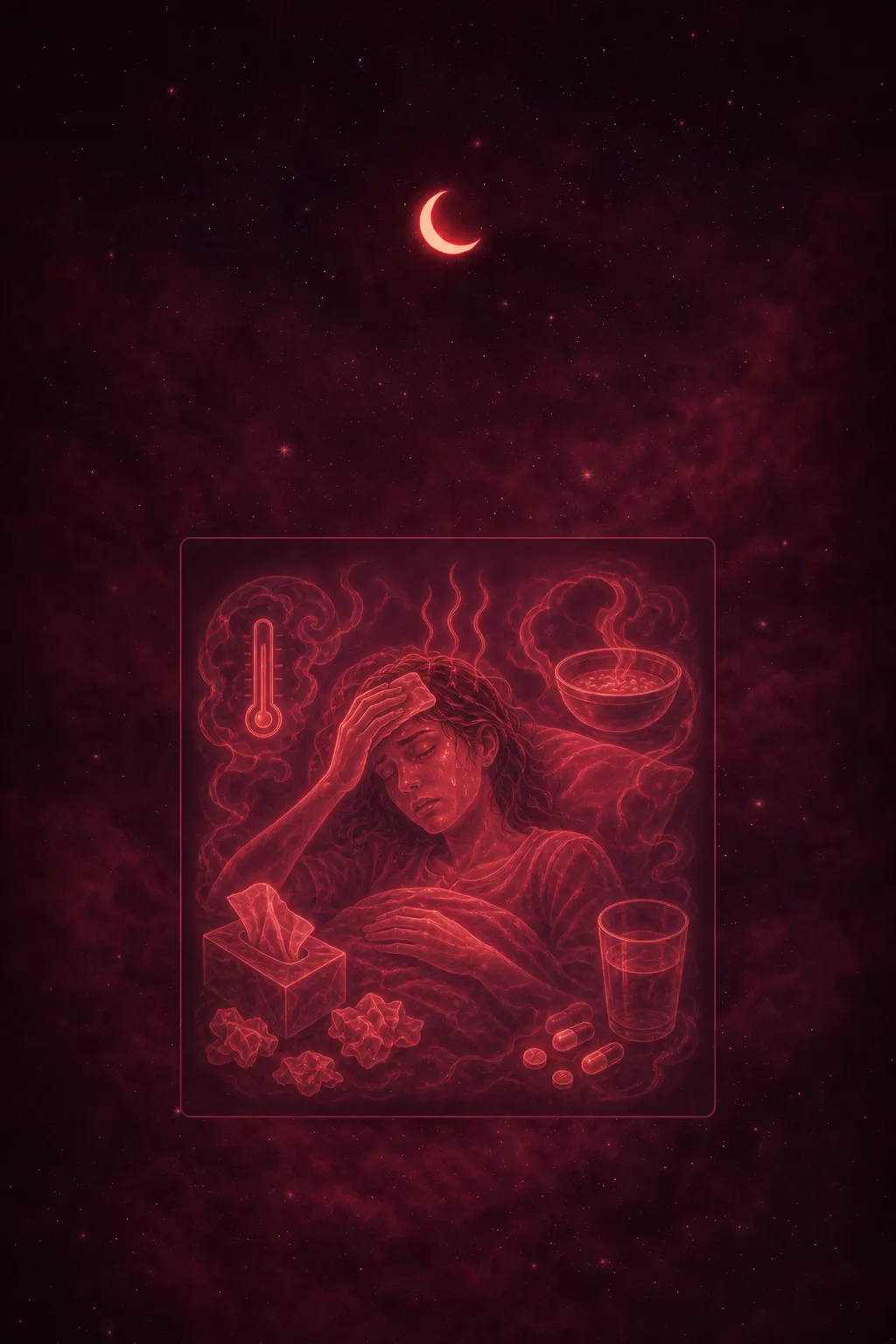

Dreaming about being sick often symbolizes emotional exhaustion, suppressed stress, or a sense that something in your waking life feels deeply wrong, as your subconscious uses illness as a vivid metaphor for vulnerability, unresolved inner conflict, or a need to slow down and address neglected aspects of your mental or physical well-being.
In under a minute you could read what your exact dream means for you, and see a picture of it. Free.
You read what it can mean. But what did yours mean?
General meanings stop here. In the free app, tell Dream Book your exact dream and get a reading that actually makes sense for you.


Common Dream Scenarios Involving Being Sick
The specific form your illness takes in a dream carries its own weight. Vomiting or throwing up is one of the most common variants, and despite the unpleasant imagery it often arrives with a sense of release — your psyche is expelling something it can no longer tolerate, whether a draining relationship, a suppressed emotion, or a situation that has quietly turned toxic. A dream of vomiting is rarely just about the stomach; it is your inner life forcing a purge you have been putting off. Feeling generally unwell without a clear cause points in a different direction: diffuse exhaustion and stress overload. The body in the dream has no dramatic diagnosis — it is simply running on empty, which is exactly how modern burnout feels before it has a name. At Dream Book we explore this symbol in depth.
- Receiving a serious diagnosis: Reflects fear that something is quietly growing worse — an unaddressed problem, a stalled decision, or low-grade health anxiety amplified by waking life stress. Dreams set in a hospital often intensify this theme, placing the dread of hidden illness in a clinical, helpless setting.
- Fever or delirium: Signals emotional overheating; a conflict or intensity you cannot think through calmly is consuming your mental bandwidth.
- Sick but unable to reach help: Points to isolation and unmet support needs — a feeling that care is unavailable precisely when you need it most.
- Fear of catching an illness: A boundary concern; you may worry about absorbing a difficult person's negativity or losing your sense of self under outside pressure.
- Chronic or recurring sickness: Suggests a persistent, unresolved stressor that keeps surfacing because it has never been fully addressed.
- Recovering and getting better: An encouraging sign — a hard chapter is closing and your energy is beginning to return.
What this dream could look like
Tap an image to open it full screen
Example images. Only you can see what you write in Dream Book.
The Psychological Reading: Depletion, Control, and What You've Been Holding In
From a psychological standpoint, dreaming of being sick is the unconscious mind's somatic shorthand for states the waking self may be reluctant to admit. Mainstream stress research consistently links illness imagery to burnout: when waking demands exceed your genuine coping capacity, the psyche reaches for a visceral, impossible-to-ignore metaphor — a body that has simply stopped cooperating. This is especially common in high-achievers who push past their limits and only register exhaustion in the dream state, where defenses are lowered. The dream is not predicting physical illness so much as flagging that your internal resources are running dangerously low.
But what does your version mean?
A second layer involves suppressed emotional content. Feelings that have been swallowed rather than processed — resentment, grief, anxiety, shame — accumulate until the unconscious stages them as physical malaise. Illness in a dream can also dramatize a loss of agency: being sick removes your ability to perform, choose, and control outcomes, mirroring real situations where you feel helpless or trapped by obligations you never fully consented to. There is sometimes a covert wish embedded here too — a longing to be excused from pressure without the guilt of simply saying no. A light biblical thread runs alongside this: suffering as refining, or the body as a vessel called to rest and renewal rather than endless output.
- Stress overload: The dream signals your coping threshold has been breached.
- Unprocessed emotion: Illness stands in for feelings you haven't allowed yourself to name or express.
- Loss of control: Sickness strips agency, echoing powerlessness in waking life — much like the helplessness captured in dreams of falling, where the body itself refuses to be commanded.
- Health anxiety: For anxious dreamers, visiting a doctor in dreams or feeling ill may replay real diagnosis fears rather than carry symbolic meaning.
- Self-neglect prompt: The unconscious surfaces unmet physical or emotional needs as a quiet call to prioritize self-care.
General meanings end here. Read your own dream.
Describe your dream in a line or two. In seconds you get a reading of your exact dream, a picture drawn from your own words, and every symbol explained.
Free. No sign-up. Takes 10 seconds. Your dream stays private.
0%
Analyzing your dream…
Something went wrong. Please try again in a moment.
Your dreams deserve more than a dictionary
Cultural and Traditional Readings of Sickness in Dreams
In mainstream American culture, dreaming of illness carries a distinctly modern flavor. Where older folk traditions might have read a sick dream as an omen or a warning from the spirit world, contemporary interpretation leans heavily on the cultural weight placed on productivity and self-sufficiency. Being sick — even in a dream — registers as a failure to cope, a forced pause in a culture that quietly equates busyness with worth. That framing alone gives the image its emotional sting: it is not just about physical fragility but about losing your grip on the pace and performance of daily life.
Was yours a sign? Find out.
A lighter biblical thread runs through this reading without dominating it. In scripture, illness is sometimes a site of testing, purification, or divine attention — a stripping away of pretense before healing can begin. Dreamers with a Christian background may intuitively sense that dimension, reading the sickness not as punishment but as an invitation to slow down and examine what has been neglected. This sits comfortably alongside the modern mental-health literacy that reframes the same imagery around burnout and violated boundaries rather than supernatural warning signs. Much like dreams of teeth falling out, sickness imagery often spikes during periods of real-world pressure, suggesting the sleeping mind is processing anxieties the waking self has not yet named.
- Productivity culture: illness as a symbol of being overwhelmed or "not keeping up."
- Health anxiety: heightened by real-world concerns about access to care, especially vivid in dreams featuring a visit to a doctor or a clinical setting.
- Self-care framing: the sick dream as the mind's signal that boundaries have been crossed and rest is overdue.
- Mild biblical resonance: purification or testing — illness as a threshold before renewal, not a verdict.
The Spiritual Reading: Trial, Renewal, and the Call to Release
Within a broadly Christian frame, sickness in a dream can echo the biblical motif of seasons of trial — think of Job's affliction not as punishment but as a threshold experience, a stripping away that ultimately opens the door to restoration. Dreaming of being ill may signal that some area of your inner life has grown depleted and is quietly asking for renewal rather than just better management. This is a gentler read than fire-and-brimstone warning: the emphasis falls on hope and healing waiting on the other side of vulnerability.
A bad dream isn't a bad sign.
From a wider spiritual standpoint, illness imagery is often understood as the soul's way of flagging stagnant energy — patterns, relationships, or obligations that have been held too long and have begun to feel toxic. Where the psychological reading focuses on stress and suppressed emotion, the spiritual layer asks a slightly different question: not just what are you carrying, but what are you being invited to release so that genuine restoration can begin? Dreaming of expelling something from the body fits neatly here — the image of purging carries real spiritual resonance across traditions, much as dreams of losing teeth are widely read as signals that something once stable is crumbling and needs to be let go.
In practice, the spiritual takeaway tends to be less about diagnosis and more about orientation. A dream of sickness may be nudging you toward honest self-examination — a quiet prompt to acknowledge where control has become a substitute for trust, and where rest, surrender, or even prayer might do what sheer willpower cannot.
Related Dream Meanings
body health
Vomiting Dream Meaning: Release, Purging & Toxic Emotions
5 min read
common dreams
Dreaming of Hospital Meaning: What Your Dream Reveals
5 min read

common dreams
Falling Dream Meaning: Insecurity, Fear & Loss of Control
5 min read
people
Doctor Dream Meaning: Healing, Guidance & Self-Care
5 min read

body health
Teeth Falling Out Dream: Anxiety, Loss & Vulnerability
5 min read
body health
Broken Teeth Dream Meaning: Anxiety, Power & Appearance
5 min read

body health
Giving Birth Dream Meaning: New Beginnings & Growth
5 min read

body health
Teeth Crumbling Dream Meaning: Anxiety & Loss of Control
5 min read
Practical Takeaways: What to Do After a Sickness Dream
Rather than dismissing the dream or spiraling into health anxiety, treat it as useful data. Start by asking one honest question when you wake: What in my waking life is currently draining me? Stress, overcommitment, and suppressed frustration are the most common culprits, and naming them out loud — even in a private journal — begins to loosen their grip. If the dream recurs, that repetition is worth taking seriously as a signal that something unresolved is building pressure.
But what does your version mean?
- Do a quick load audit. List your current obligations and identify any that feel genuinely unsustainable. One small boundary — saying no to one request, delegating one task — can shift the internal sense of helplessness the dream reflects.
- Check what you've been holding back. Sickness imagery often tracks with swallowed emotions. If a dream about vomiting appeared, ask what you've been unable to express and find a low-stakes outlet: a letter you don't send, a conversation you've been avoiding.
- Tend to your actual body. Sleep quality, hydration, and skipped medical appointments can seed illness imagery. Use the dream as a nudge to schedule that check-up you've been putting off — or finally book that visit to a doctor you've been delaying.
- Notice whether the dream ended in relief or dread. Relief suggests your psyche is ready to release something; dread suggests you may need more support — from a trusted person or a professional — to process what's underneath.
One dream is never the whole picture.
The free app remembers your dreams, draws them, and connects the threads over time — so the next one means even more. Free to start.
People Also Ask
Some researchers believe dreams can reflect subtle bodily signals before conscious awareness kicks in. Your sleeping mind may notice physical discomfort, fatigue, or inflammation and translate these into sickness imagery. While dreams are not medical diagnoses, recurring illness dreams are worth taking seriously and discussing with a healthcare professional.
Illness in a dream typically symbolizes emotional exhaustion, unresolved stress, or feelings of vulnerability. It can represent a situation draining your energy or a relationship that feels toxic. Sometimes it reflects guilt, self-neglect, or fear of losing control — similar themes appear in dreams about teeth falling out. The specific body part affected often points to the area of life most impacted.
Spiritually, dreaming of sickness often signals a need for inner cleansing or healing. Many traditions interpret it as the soul shedding old patterns, beliefs, or burdens. It may also indicate a call to slow down, reconnect with yourself, and prioritize your well-being on a deeper, more meaningful level beyond the physical.
Fully lucid, controlled dreams are considered among the rarest experiences. Dreams of being sick are actually quite common, often triggered by stress or real physical sensations during sleep. If you experience a lucid dream in which you are ill, it may carry especially vivid emotional weight and feel unusually significant upon waking.
Curious what your dream would look like?