
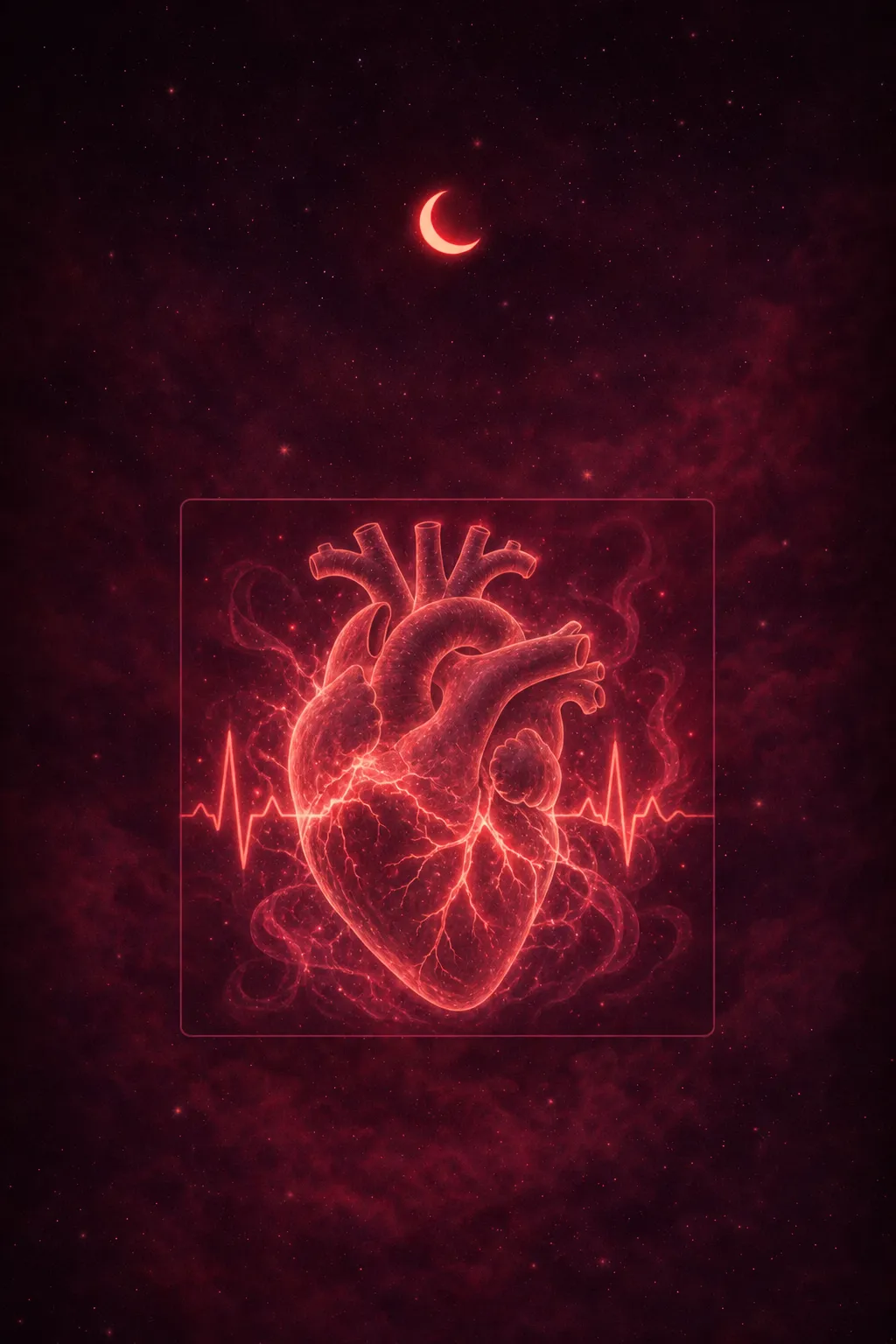

A dream about having a heart attack most often signals emotional overload, burnout, or fear of losing control — not a literal medical prediction. Your psyche is dramatizing accumulated stress, relationship anxiety, or a situation that has pushed your emotional limits past what feels sustainable, using the body's most dramatic alarm system as its messenger.
In under a minute you could read what your exact dream means for you, and see a picture of it. Free.
You read what it can mean. But what did yours mean?
General meanings stop here. In the free app, tell Dream Book your exact dream and get a reading that actually makes sense for you.


Common Heart Attack Dream Scenarios and What They Mean
You experience your own heart attack
This is the most frequently reported version, and its message is almost always some variation of this pace is unsustainable. When you're the one clutching your chest in the dream, your subconscious is modeling what genuine overload feels like — it is giving physical form to the burnout, perfectionism, or relentless pressure you're carrying while awake. Think of it as an internal alarm going off before the real crisis arrives. Ask yourself honestly: where in your waking life are you running on empty?
But what does your version mean?
A family member or partner has a heart attack
Watching someone you love collapse is one of the most distressing dream experiences there is, yet its meaning is rarely about that person's literal health. More often it reflects attachment anxiety — a fear of losing them, grief about the relationship's current state, or caregiver worry you haven't fully acknowledged. If your relationship with that person has felt strained or fragile lately, the dream is less a warning about their heart and more a mirror of your own fear of loss. Dreams about dying loved ones often carry a similar emotional signature.
You witness a stranger collapse
When the victim is someone you don't recognize, the dream is almost certainly projecting your own vulnerability outward. You're watching yourself, at a safe distance — aware on some level that you, too, have limits. The helplessness you feel standing there, unable to stop what's happening, maps directly onto waking situations where circumstances feel outside your control.
You have a heart attack and survive
Survival dreams carry a fundamentally different energy: relief, resilience, and the sense of a second chance. This scenario often functions as a wake-up call the psyche delivers gently, showing you that you can come back from the edge — but also that you came dangerously close. It's an invitation to change something before the metaphor becomes reality.
You die from the heart attack
Distressing as this sounds, death in a dream is rarely about literal death. Here it typically signals the end of something — a draining chapter, an identity you've outgrown, or a role you've been playing that no longer fits. It's symbolic closure rather than omen. For more on this theme, Dream Book's guide to dreams about dying explores how the subconscious uses endings as invitations to transform.
Was yours a sign? Find out.
You perform CPR or rescue the victim
If you're the one rushing in to help, the dream is highlighting your sense of responsibility. You may be trying — perhaps too hard — to revive or repair a relationship or emotional situation that has gone flat. It speaks to agency under pressure and a deep-seated desire to fix what feels broken.
Recurring heart attack dreams
A dream that returns night after night is the psyche turning up the volume because it wasn't heard the first time. Recurring heart attack imagery almost always points to a chronic, unaddressed source of stress or anxiety — something that deserves serious attention in waking life, whether that's a toxic work environment, a relationship in crisis, or a health concern you've been avoiding.
What this dream could look like
Tap an image to open it full screen
Example images. Only you can see what you write in Dream Book.
The Psychology Behind Heart Attack Dreams
Psychologically, the heart attack dream belongs to a family of somatic-symbolic stress dreams — vivid, physically felt experiences in which the body becomes the stage for emotional drama the waking mind hasn't processed. The involuntary, sudden nature of a cardiac event maps perfectly onto the fear of losing control: you can't negotiate with a heart attack, you can't will it away, and you can't outwork it. That's precisely why the anxious, high-achieving, or chronically overstretched mind reaches for this image.
There's also a distinction worth making between dreaming about your own heart attack and dreaming about someone else's. The former is primarily an internal stress signal; the latter more often reflects fear of abandonment or loss — the kind of dread that lives in the chest even when everything looks fine on the surface. Both are worth taking seriously as data about your emotional state.
If you find yourself dreaming about being sick in various forms — not just heart attacks but illness, collapse, or bodily failure — the pattern almost always points to the same root: a self that is overextended and begging for rest.
A bad dream isn't a bad sign.
One additional layer: health anxiety. For people who already worry about their physical wellbeing, a heart attack dream can amplify that fear considerably. It's worth separating the symbolic from the medical. A dream, however vivid, is not a diagnosis. That said, if you're experiencing actual waking symptoms — chest discomfort, shortness of breath, palpitations — please consult a medical professional. The dream may be a coincidence, but your body deserves to be checked regardless.
General meanings end here. Read your own dream.
Describe your dream in a line or two. In seconds you get a reading of your exact dream, a picture drawn from your own words, and every symbol explained.
Free. No sign-up. Takes 10 seconds. Your dream stays private.
0%
Analyzing your dream…
Something went wrong. Please try again in a moment.
Your dreams deserve more than a dictionary
Cultural Context: The Heart as an Emotional Symbol
Across the Anglo cultural tradition, the heart has always carried double weight: it's both the literal organ that keeps you alive and the metaphorical seat of love, courage, and identity. To lose heart is to lose hope. To have a change of heart is to fundamentally shift who you are. To give someone your heart is to make yourself completely vulnerable.
It's no accident, then, that the dream of a heart attack lands with such force. It doesn't just threaten the body — it threatens the self. This is why heart attack dreams often accompany major life transitions, relationship ruptures, or moments of deep emotional reckoning. The imagery of being in a hospital after a dream heart attack further reinforces the vulnerability and loss-of-control themes, placing the dreamer in an environment of helplessness and dependence.
Spiritual Readings of Heart Attack Dreams
Within the US Christian tradition, the heart is explicitly the seat of will, moral character, and spiritual life — the biblical instruction to "guard your heart" (Proverbs 4:23) recognizes it as the wellspring from which all of life flows. A heart attack dream in this frame can read as a prompt to examine what you're allowing into that inner space: anxiety, resentment, or striving that crowds out trust and peace.
More broadly, many spiritual frameworks interpret heart attack dreams as urgent invitations toward emotional release and realignment. The message is less about fear and more about what you've been holding too tightly — control, perfectionism, the need to sustain an unsustainable pace. From this angle, the dream isn't a punishment; it's a nudge back toward what genuinely matters.
Related Dream Meanings

nightmares
Dying Dream Meaning: Transformation, Fear & Change
5 min read
body health
What Does It Mean to Dream About Being Sick
5 min read
common dreams
Dreaming of Hospital Meaning: What Your Dream Reveals
5 min read

body health
Surgery Dream Meaning: Change, Healing & Control
5 min read
body health
What Does a Broken Leg Dream Mean? Interpretation and Symbolism
6 min read
body health
What Does It Mean to Dream About a Broken Arm? Dream Interpretation
5 min read

body health
What Does It Mean to Dream About Gaining Weight
5 min read
body health
Being Blind Dream Meaning: Denial, Fear & Clarity
5 min read
What To Do After a Heart Attack Dream
Dreams don't come with instruction manuals, but they do come with questions worth asking. After a dream like this, try sitting with a few honest ones:
- Where am I overextended? Identify the specific area of life — work, relationships, finances, caregiving — that is demanding more than you can sustainably give.
- What am I afraid of losing? If the dream involved someone else, name the fear. Fear of loss is much easier to work with once it's named.
- What would I do differently if I had a genuine wake-up call? The answer to that question is usually the change the dream is asking for.
- Am I dismissing real physical signals? If you've been ignoring waking symptoms or skipping check-ups, let the dream be the nudge to schedule that appointment.
- Is this dream recurring? Patterns demand attention. Journaling the frequency and emotional texture of the dream can help you track what's triggering it in waking life.
But what does your version mean?
Heart attack dreams are uncomfortable precisely because they're effective. They pierce the numbness we build up around stress and force us to feel — fully — how much pressure we've been carrying. Treat them not as enemies but as an honest friend delivering a message you needed to hear.
One dream is never the whole picture.
The free app remembers your dreams, draws them, and connects the threads over time — so the next one means even more. Free to start.
People Also Ask
Spiritually, a heart attack dream is often read as an urgent invitation to examine what you're carrying in your inner life — resentment, anxiety, or relentless striving that crowds out peace. In Christian tradition, the heart is the seat of will and spirit, so the dream can signal a need to release burdens and reconnect with what truly matters.
While rare cardiac events during sleep do occur, most heart attack dreams are purely psychological — your mind processing stress and fear. If you wake from such a dream with genuine chest pain, shortness of breath, or physical symptoms, seek medical attention promptly. The dream itself is not a predictor of a real heart attack.
Dreaming of having a heart attack in your sleep most commonly reflects emotional overload, burnout, or fear of losing control. It's your subconscious dramatizing pressure that has reached a tipping point — signaling that the current pace, stress level, or unresolved emotional weight needs to be addressed before it becomes a real-world crisis.
Dreams can act as psychological warnings by surfacing unprocessed stress, anxiety, or emotional conflict before it fully manifests in waking life. They're not supernatural predictions, but they can reflect patterns your conscious mind has been too busy to notice. A recurring distressing dream in particular is worth taking seriously as an internal signal worth acting on.
Curious what your dream would look like?