
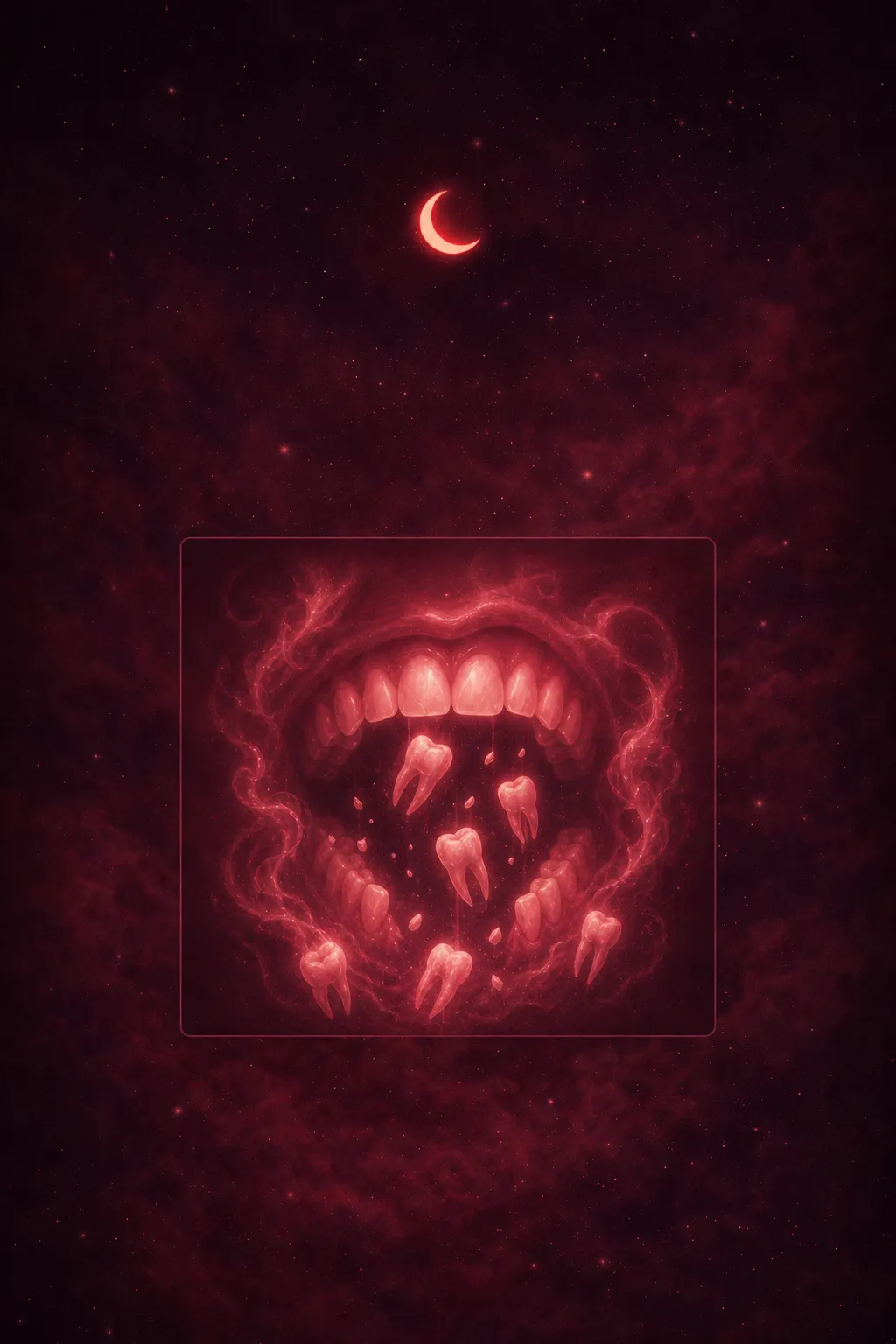

Dreaming about losing teeth typically signals feelings of anxiety, powerlessness, or fear of loss in your waking life, and may reflect concerns about your appearance, communication, or confidence, as teeth symbolize strength and self-expression, so this common dream often surfaces during times of major change, stress, or uncertainty about how others perceive you.
In under a minute you could read what your exact dream means for you, and see a picture of it. Free.
You read what it can mean. But what did yours mean?
General meanings stop here. In the free app, tell Dream Book your exact dream and get a reading that actually makes sense for you.


A dream still on your mind? Get your personal reading.
Describe your dream in a line or two. In seconds you get a reading of your exact dream, a picture drawn from your own words, and every symbol explained.
Free. No sign-up. Takes 10 seconds. Your dream stays private.
0%
Analyzing your dream…
Something went wrong. Please try again in a moment.
Your dreams deserve more than a dictionary
Common Scenarios and What They Mean
The specific way teeth are lost in a dream shifts its meaning considerably. The most distressing variant — teeth crumbling into fragments — tends to surface during periods of acute overwhelm, reflecting a sense that a situation is falling apart faster than you can manage it. Closely related, teeth falling out one by one points to something more gradual: cumulative stress, a slow erosion of confidence, or a life transition that is quietly draining your sense of control. Both variants are among the most widely reported anxiety dreams adults experience, sharing the same core helplessness found in classic falling dreams.
- Pulling a tooth out yourself: An active choice under pressure — often signals a painful but self-driven decision to release something: a relationship, a job, an old identity.
- Complete toothlessness: A deeper sense of diminished power or agency, sometimes tied to fears about aging, mortality, or being seen as incapable — themes that overlap with death-related dreams in their confrontation with vulnerability.
- Blood accompanying the loss: Raises the emotional stakes — pointing to a decision or change that carries real personal cost, or concern about family wellbeing.
- Catching fallen teeth in your hand: An anxious attempt to salvage what is slipping away, reflecting the desire to reassert control even as things change.
- A single loose, wobbling tooth: Anticipatory anxiety — instability is building but the loss has not yet happened, mirroring the dread before a difficult conversation or looming decision.
But what does your version mean?
Across all these variants, the common thread is the tension between control and helplessness. Whether teeth shatter suddenly or drift loose over time, the dream is often the mind's honest signal that something in waking life feels precarious and deserves your attention.
What this dream could look like
Tap an image to open it full screen
Example images. Only you can see what you write in Dream Book.
The Psychological Reading: Control, Anxiety, and the Inner Self
From a mainstream psychological standpoint, dreaming of losing teeth is widely understood as an expression of performance anxiety and a felt loss of control. The mouth governs communication, appearance, and the capacity to defend yourself — so when teeth dissolve or drop away in a dream, the subconscious is often processing a waking situation where you feel exposed, judged, or powerless. This lines up closely with modern-anxiety patterns: deadline pressure, identity uncertainty, fear of failing publicly. Much like the classic sensation of falling in a dream, the teeth-loss dream doesn't predict disaster so much as it mirrors the inner tension you may be carrying without fully acknowledging it.
Psychodynamically, teeth also represent agency — the ability to "bite into" life, make decisions, and project competence. Their loss in a dream can signal that a part of you doubts whether you're measuring up, whether at work, in relationships, or in your own self-image. It's worth noting that dreams of being chased and teeth dreams share a similar emotional grammar — both surface when the waking mind feels outpaced by circumstances it cannot fully control. For those with a Christian frame, this kind of vulnerability dream can prompt honest self-examination — a nudge toward humility and trust rather than self-reliance. Either way, the emotional residue (shame, embarrassment, helplessness) is the real diagnostic clue worth sitting with after you wake. Many people also find that death-themed dreams appear in the same life seasons as teeth dreams, both pointing toward deep psychological transitions rather than literal endings.
- Control anxiety: A core signal that you feel a situation slipping beyond your management.
- Self-image pressure: Fear of how others perceive your competence or attractiveness.
- Transition marker: Sometimes signals a healthy, if uncomfortable, psychological shift — letting go of an old identity.
- Communication stress: Unspoken words, suppressed conflict, or fear of saying the wrong thing.
General meanings end here. Read your own dream.
Describe your dream in a line or two. In seconds you get a reading of your exact dream, a picture drawn from your own words, and every symbol explained.
Free. No sign-up. Takes 10 seconds. Your dream stays private.
0%
Analyzing your dream…
Something went wrong. Please try again in a moment.
Your dreams deserve more than a dictionary
Every dream you log starts to connect.
Dream Book keeps your dreams in one place and reveals the threads between them over time — your private dream journal. Free to start.
Cultural and Folk Traditions Around Teeth Loss Dreams
Across many Western folk traditions, dreaming of losing teeth has long been treated as an omen of change or loss — sometimes foretelling the death of a relative, sometimes signaling a major life transition on the horizon. These older superstitions reflect a time when teeth were visible markers of health, status, and survival, making their loss in waking life genuinely catastrophic. That symbolic weight carried naturally into dream lore, where a tooth-loss dream became shorthand for something precious slipping beyond your reach — not unlike the vertiginous helplessness many people report in falling dreams.
Was yours a sign? Find out.
Within American Christian folk belief, such dreams are occasionally read through a biblical lens of trials and endurance — a reminder that seasons of vulnerability are part of a larger, purposeful arc. Rather than pure dread, this reading encourages the dreamer to examine what attachments or illusions may need to be released. More broadly, mainstream US culture frames the dream through a modern-anxiety lens: the pressure to appear competent, youthful, and in control feeds directly into nighttime imagery of decay and collapse — an anxiety that surfaces in other unsettling dream symbols too, including the primal threat encoded in dreams of being chased.
- Omen of transition: Many folk traditions link tooth loss in dreams to significant life change — a job shift, a relationship ending, or a new stage of maturity.
- Loss of social standing: Older European folklore sometimes read the dream as a warning about reputation or public embarrassment.
- Call for self-examination: Contemporary folk wisdom, blending psychology with tradition, treats the dream as a nudge toward honest self-assessment about where you feel powerless or exposed.
A Spiritual Perspective: Trial, Trust, and Letting Go
Within a broadly Christian frame, dreams of losing teeth are sometimes read as an invitation to examine where your sense of security truly rests. Since teeth represent capacity and strength, their loss in a dream can echo biblical themes of stripping away self-reliance — moments in scripture where figures are brought low precisely so they can be rebuilt on a firmer foundation. No canonical text addresses tooth-loss dreams directly, but the emotional texture maps onto well-known passages about trials that test character and produce endurance. For many people of faith, the dream becomes less a warning than a prompt: what am I gripping too tightly, and what would it mean to release it?
A bad dream isn't a bad sign.
Older Anglo folk belief adds a murkier layer, linking tooth-loss dreams to illness or death in the family — a residual superstition that still surfaces and can spike anxiety in an already unsettling dream. Most contemporary spiritual readers treat this as symbolic rather than prophetic: the "death" being signaled is more likely the end of an old identity, a role, or a phase of life than a literal loss. In that sense, the dream sits alongside other anxiety-laden symbols — much like dreams of falling — where the spiritual takeaway is an invitation to surrender control rather than a forecast of harm.
- Trial and renewal: loss of control as a spiritual threshold, not a final verdict
- Misplaced security: a call to notice how much self-worth is tied to appearance or performance
- Folk omen, reframed: "death" imagery as transition rather than literal foreboding
Related Dream Meanings
body health
Teeth Falling Out Dream: Anxiety, Loss & Vulnerability
5 min read
common dreams
Falling Dream Meaning: Insecurity, Fear & Loss of Control
5 min read

nightmares
Death Dream Meaning: Transformation, Loss & Change
5 min read

nightmares
Being Chased Dream Meaning: Anxiety & Avoidance
5 min read

body health
Breastfeeding Dream Meaning: Nurture, Care & Growth
5 min read

body health
What Does It Mean to Dream About Nails? Interpretation and Symbolism
5 min read

body health
Surgery Dream Meaning: Change, Healing & Control
5 min read
body health
What Does a Broken Leg Dream Mean? Interpretation and Symbolism
6 min read
Practical Takeaways: Turning the Dream Into Self-Knowledge
Because this dream clusters so tightly around anxiety, control, and self-image, the most useful first step is simple: identify the waking-life pressure it most likely mirrors. Ask yourself what feels genuinely out of your hands right now — a deadline, a relationship shift, a health concern — and whether you have been avoiding naming it directly. Often the dream loses its grip once the underlying stressor is acknowledged rather than suppressed. Notably, teeth-loss dreams frequently appear alongside other anxiety archetypes such as dreams of falling or being chased, which suggests your mind may be working through a broader episode of stress rather than one isolated worry.
- Journal the emotion, not just the plot. Note what you felt in the dream — embarrassment, panic, grief — then trace that feeling back to a current situation. The emotion is the clue; the teeth are just the messenger.
- Audit your sense of control. Separate what you can influence from what you genuinely cannot. Taking one small, concrete action in an area where you feel helpless — even a single email or conversation — can interrupt the cycle of recurring teeth-loss dreams tied to ongoing stress.
- Check physical contributors. Teeth-grinding during sleep (bruxism) can seed these dreams. If the dream recurs, a dentist check-up is a reasonable, grounded step.
- Reframe loss as signal, not verdict. If your faith tradition resonates, treat the dream as a prompt to reassess where you are placing your confidence — not as punishment or prophecy.
But what does your version mean?
Ultimately, this dream is your mind's honest report on stress levels and unmet needs for security. Treat it as useful data rather than a source of further anxiety, and you shift from being unsettled by the symbol to genuinely learning from it.
One dream is never the whole picture.
The free app remembers your dreams, draws them, and connects the threads over time — so the next one means even more. Free to start.
People Also Ask
Losing teeth in a dream commonly signifies anxiety, loss of control, or fear of change. It often surfaces during times of stress, major life transitions, or low self-confidence. Some interpretations also link it to concerns about appearance or how others perceive you, similar to dreams about falling, which also reflect inner tension rather than any literal physical warning.
In biblical contexts, teeth falling out can symbolize weakness, loss of power, or divine warning. Some scripture passages use teeth as metaphors for strength and vitality, so losing them may represent spiritual vulnerability or a call to examine your faith and priorities during a challenging season of life.
When teeth fall out mid-dream, it typically points to feelings of helplessness or fear of embarrassment in waking life. You may be facing a situation where you feel unheard or exposed. Much like being chased in dreams, this is one of the most common dream experiences worldwide and usually reflects emotional stress rather than anything physically meaningful.
No, teeth dreams are extremely common and rarely cause for concern. They are your mind processing stress, insecurity, or life changes. If the dreams recur frequently and cause distress, it may be worth reflecting on what pressures exist in your waking life, or speaking with a therapist about underlying anxiety.
Curious what your dream would look like?