
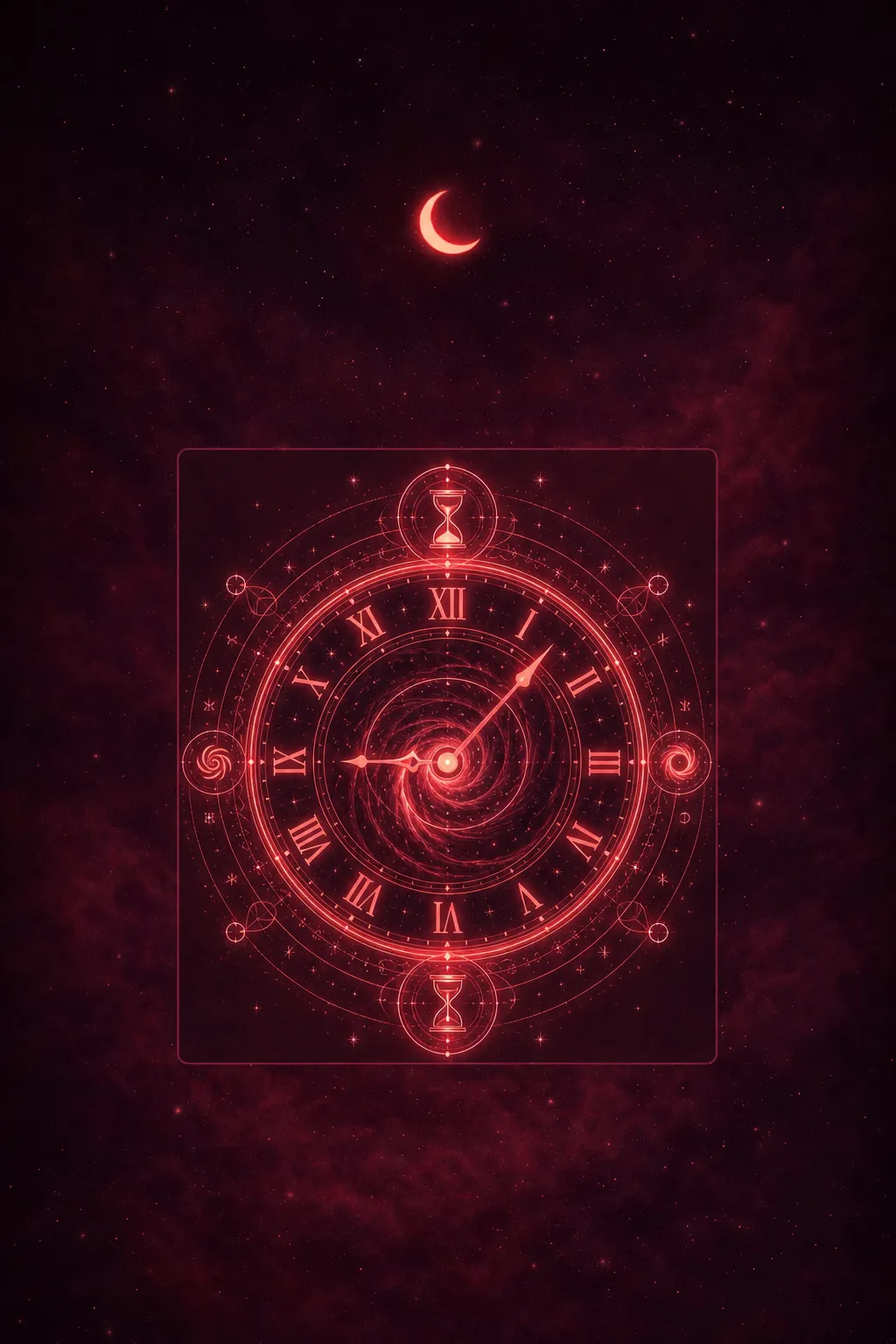

Dreaming about time travel typically means your subconscious is processing regret, nostalgia, or anxiety about the future, as your mind revisits past choices you wish you could change or rehearses upcoming events, reflecting a deep desire for control over circumstances that feel uncertain or irreversible in waking life.
In under a minute you could read what your exact dream means for you, and see a picture of it. Free.
A dream still on your mind? Get your personal reading.
Describe your dream in a line or two. In seconds you get a reading of your exact dream, a picture drawn from your own words, and every symbol explained.
Free. No sign-up. Takes 10 seconds. Your dream stays private.
0%
Analyzing your dream…
Something went wrong. Please try again in a moment.
Your dreams deserve more than a dictionary
Common Time Travel Dream Scenarios
The most frequent version — traveling back to the past — centers on regret, nostalgia, or unfinished business. Your mind is replaying a fork in the road, weighing what might have been different. When the dream goes further and you actually alter a past event, the emotional tone matters: changing things with relief points toward readiness to make amends or seek closure in waking life, while changing things with dread may signal guilt still needing to be addressed. A closely related and equally common scenario is finding yourself stuck in the past, unable to return to the present — one of the clearest dream images for feeling trapped in a former stage of life, unable to let go of a relationship, role, or version of yourself that no longer fits.
- Jumping into the future: Anticipatory rehearsal — your mind is stress-testing outcomes. Hope and dread often appear together, reflecting genuine uncertainty about where current choices lead.
- Repeating time loop: Much like the feeling of being chased, a loop signals a pattern your psyche won't release until something shifts — a lesson absorbed, a habit broken, or a decision finally made.
- Meeting a younger or older self: An invitation toward self-compassion or honest self-appraisal; the encounter often carries a warning or an unspoken reconciliation between who you were and who you are now.
- Time speeding up or freezing: A direct readout of pace-of-life stress — either events feel dangerously out of control or you feel paralyzed while the world moves on without you.
- Using a machine or portal: Often pop-culture scaffolding with limited symbolic depth, though the desire for a reliable mechanism to manage change still speaks to a strong need for control.
But what does your version mean?
Across all these variants, the core question the dream is asking is the same: how much agency do you believe you have over your own timeline? A light but persistent theme — especially for dreamers with a faith background — is whether certain events feel destined or fixed, and whether acceptance of that is freeing or frustrating.
What this dream could look like
Tap an image to open it full screen
Example images. Only you can see what you write in Dream Book.
What Your Mind Is Really Doing When You Time Travel in a Dream
At its core, a time travel dream is the psyche's way of staging a conversation with itself about agency and the passage of time. Mainstream psychology frames it as temporal orientation — the mind swinging between an unresolved past and an uncertain future because the present feels unmanageable. When life accelerates and decisions feel irreversible, the unconscious reaches for a fantasy of the ultimate control: the ability to rewind, preview, or simply exit the current moment. This is why time travel imagery spikes during periods of burnout, major life transitions, or the creeping sense that time is slipping away faster than you can keep up with it.
A quieter thread running through these dreams involves identity continuity — the ongoing inner work of reconciling who you once were with who you are now. Encountering your younger self, or watching yourself from a distance in another era, is the subconscious holding up a mirror: it asks whether you recognize that person, and whether you accept the choices that connect them to you. For many dreamers with a faith background, this reconciliation carries a note of providence — a felt sense that certain events were fixed, and that wrestling with them in the dream is part of accepting a larger pattern rather than controlling every outcome.
- Regret and counterfactual thinking: replaying a fork-in-the-road decision to process lingering guilt or grief.
- Anticipatory anxiety: traveling forward to "rehearse" a coming change before it arrives.
- Control-seeking: the time machine itself symbolizes the desire to impose order on what feels unstoppable.
- Escapism: fleeing present-day pressure into an idealized past or a hoped-for future.
Every dream you log starts to connect.
Dream Book keeps your dreams in one place and reveals the threads between them over time — your private dream journal. Free to start.


What Culture and Tradition Say About Time Travel Dreams
Unlike ancient symbols rooted in centuries of folk interpretation, time travel as a dream image is almost entirely a product of modern storytelling. The imagery your sleeping mind reaches for — machines, portals, paradoxes, loops — is borrowed directly from films, novels, and television, which means pop culture now functions as the folk tradition for this symbol. That scaffolding is significant: it shapes not just the scenery of the dream but its emotional grammar. Stories about time travel almost universally center on a second-chance narrative, the deeply American and broadly Western belief that a fresh start is always possible if you can only get the timing right. When that fantasy surfaces in a dream, it reflects a cultural assumption as much as a personal wish — the idea that mistakes are correctable and that individual agency can override circumstance.
Was yours a sign? Find out.
Modern life intensifies this. In an era defined by rapid, often irreversible change — career pivots, technological disruption, fractured routines — dreaming of rewriting the timeline can be the mind's direct response to feeling like time itself is out of your control. The cultural pressure to stay current while also honoring the past creates a genuine tension, and the time travel dream stages that tension vividly. Folk wisdom has long warned against living in the past, yet nostalgia is simultaneously sold back to us as comfort. The dream may be reflecting exactly that contradiction.
From a Christian-inflected perspective, present in a significant slice of Anglo-American culture, time travel dreams can carry a quieter note about divine providence — a sense that one's timeline is not entirely one's own to rewrite. Key themes this lens highlights include:
- Fixed versus free: wondering which events in life were ordained and which genuinely remained open choices
- Stewardship of time: a mild conviction that squandered or misused time carries moral weight
- Trust over control: the dream as a prompt to release the compulsion to engineer outcomes and accept a larger order
The Spiritual Meaning of Time Travel Dreams
From a spiritual standpoint, a time travel dream can feel less like a random fantasy and more like a prompt to examine where you stand in relation to a larger plan. Within a broadly Christian frame, time itself is understood as belonging to God — "a time for every purpose under heaven" — which means the dreamer's desperate wish to rewind or fast-forward carries a subtle theological weight: it surfaces the tension between trusting divine timing and the very human urge to seize control of a timeline that feels like it's slipping away. Much like a dream featuring a clock, this image invites reflection on who, ultimately, governs the hours of a life.
A bad dream isn't a bad sign.
That tension between providence and free will sits at the heart of this dream's spiritual message. Are the choices you regret truly irreversible, or is there grace available in the present moment that makes the past less catastrophic than it feels? Spiritually, the dream may be nudging you away from the anxiety of "if only" and toward an acceptance that your path — including its wrong turns — is not beyond redemption or meaning.
- Divine timing: A sense that certain doors open and close according to a purpose larger than your own planning.
- Fixed vs. free: The dream raises the question of what is genuinely fated versus what remains within your power to change right now.
- Present-moment call: Many faith traditions read this kind of restless time-wish as a spiritual invitation to return to the present rather than live in an imagined past or future.
Related Dream Meanings

nightmares
Being Chased Dream Meaning: Anxiety & Avoidance
5 min read

nightmares
Mirror Dream Meaning: Self-Reflection & Hidden Truths
5 min read
common dreams
Clock Dream Meaning: Time, Deadlines & Urgency
5 min read

common dreams
Rain Dream Meaning: Emotional Release & Renewal
5 min read

common dreams
Snow Dream Meaning: Purity, Peace & Fresh Starts
5 min read

common dreams
Storm Dream Meaning: Turmoil, Anxiety & Change
5 min read

common dreams
Exam Dream Meaning: Anxiety, Self-Doubt & Pressure
5 min read
common dreams
Elevator: Meaning and Interpretation
6 min read
What to Do After a Time Travel Dream
The most useful first step is identifying which direction your dream traveled — and why. If you went backward, ask yourself honestly what unresolved decision or regret is still pulling at your attention. If you went forward, notice what upcoming change is triggering anticipatory dread. Naming the real-life trigger — a career shift, a relationship crossroads, a deadline — shrinks its power considerably, because anxiety thrives on vagueness.
- Journal the emotional tone, not just the plot. Did the time shift feel exciting, desperate, or relieved? That emotional fingerprint tells you more than the destination does.
- Identify one thing you can actually change. If the dream is fueled by regret, redirect that energy toward a concrete action today rather than a mental replay of the past.
- Notice any clock or time pressure imagery — recurring time stress in dreams often signals that your waking schedule or pace needs a realistic adjustment.
- Practice grounding in the present. Time travel dreams spike when modern life feels out of control. A brief daily routine — even five minutes of planned stillness — can reduce the urgency your mind brings to sleep.
But what does your version mean?
If the dream recurs, treat it as a reliable signal that something unresolved is still live in your thinking. Rather than brushing it off as sci-fi noise, use it as a low-stakes prompt for honest self-review — the kind of check-in that busy, high-pressure routines tend to crowd out.
One dream is never the whole picture.
The free app remembers your dreams, draws them, and connects the threads over time — so the next one means even more. Free to start.
People Also Ask
Truly rare dreams include fully lucid time-travel experiences where the dreamer consciously controls movement between eras. Most people dream of the past or future passively, but deliberately navigating timelines while aware you are dreaming is extraordinarily uncommon and often feels profoundly vivid and emotionally significant upon waking.
Warning dreams from a spiritual source tend to repeat, carry an unusually calm yet urgent tone, and leave a lasting impression days later. Symbolic figures, clear messages, or a strong gut feeling that the dream meant something beyond ordinary sleep are common signs worth taking seriously and reflecting on carefully.
Never dismiss recurring dreams, nightmares featuring personal danger, or vivid dreams involving deceased loved ones delivering messages. Time-travel dreams showing future regret or past wounds also deserve attention, as they often signal unresolved emotions, a need for course correction, or deep subconscious processing of life choices and personal growth.
Physically, no, but mentally dreams create a genuine sense of moving through time. Your sleeping mind freely revisits memories or constructs imagined futures, making the experience feel real. Many psychologists believe these journeys help the brain process grief, anticipate challenges, and explore identity, giving dream time travel meaningful psychological and emotional value.
Curious what your dream would look like?