
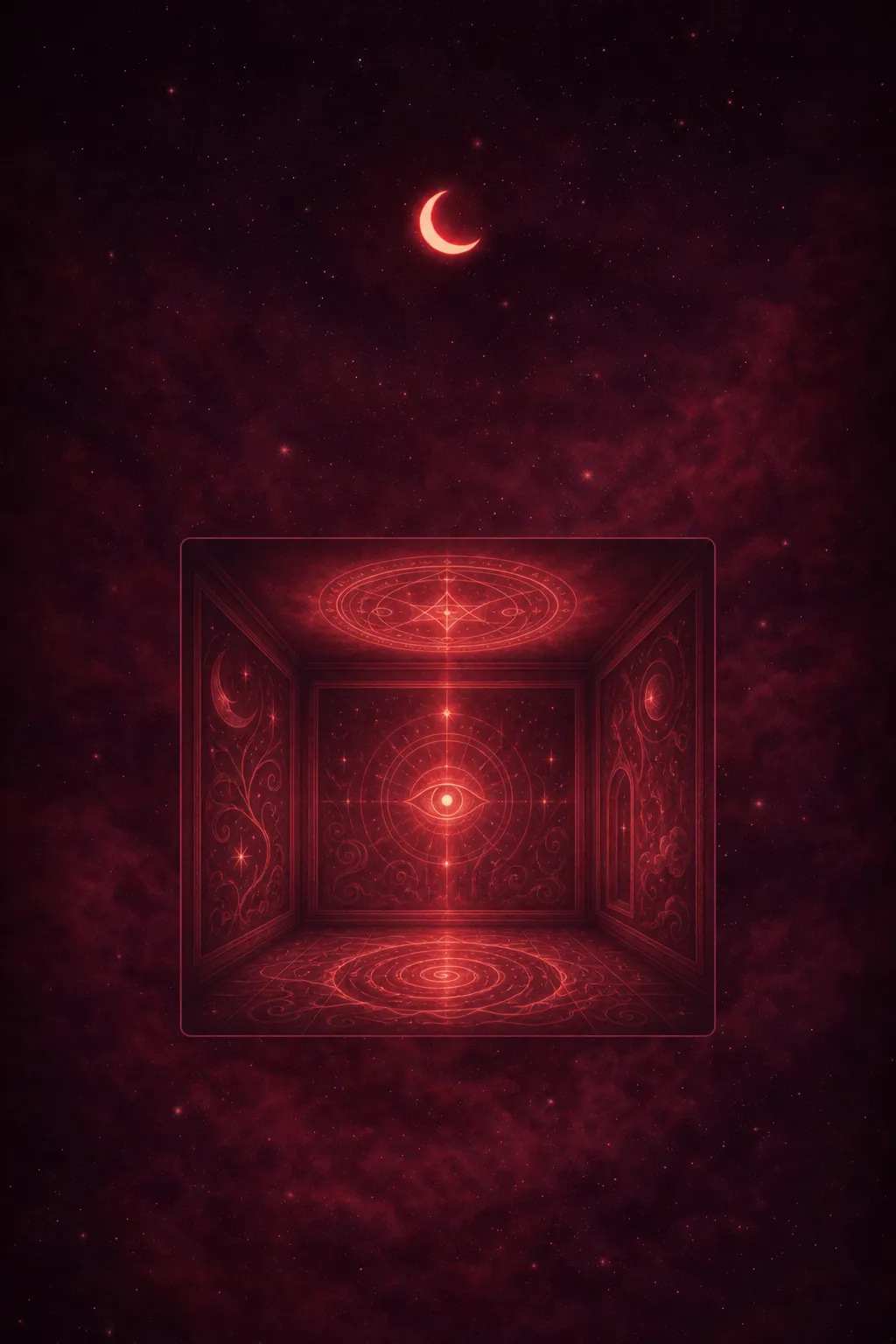

Dreaming of a room with no exit often reflects feelings of being trapped, stuck, or powerless in a waking-life situation. It can speak to emotional pressure, a relationship, or a decision that feels impossible to escape. Your subconscious may be urging you to look for a way forward you haven't considered yet.
In under a minute you could read what your exact dream means for you, and see a picture of it. Free.
Bad dream? See exactly what you dreamed — turned into a picture.
Just describe it and Dream Book paints your dream as a real image, plus a reading of what it means for you. Free, and it takes under a minute.


A dream still on your mind? Get your personal reading.
Describe your dream in a line or two. In seconds you get a reading of your exact dream, a picture drawn from your own words, and every symbol explained.
Free. No sign-up. Takes 10 seconds. Your dream stays private.
0%
Analyzing your dream…
Something went wrong. Please try again in a moment.
Your dreams deserve more than a dictionary
Common Room With No Exit Dream Scenarios
The Room That Keeps Shrinking
You're standing in a room — maybe familiar, maybe not — and the walls are moving. Slowly at first. Then faster. The ceiling drops. The floor rises. There's no door, or there was one and now it's just smooth plaster where the handle used to be. This variation of the room-with-no-exit dream tends to show up when you feel a situation in your waking life closing in from every side.
The shrinking room is claustrophobia made symbolic. It often surfaces during periods of mounting pressure — a job that's become a trap, a relationship where you've stopped breathing freely, a financial situation with no obvious out. If you've also been dreaming of being trapped in other settings, the message is consistent: something in your life has run out of room.
A bad dream isn't a bad sign.
The Maze of Endless Corridors
Sometimes the dream isn't one room but a labyrinth — you move through doorway after doorway, each opening into another passage, another dead end. You might be running. You might be walking in exhausted silence. Either way, you never arrive anywhere. This is one of the most disorienting variations, because the exits keep promising themselves and then disappearing.
Dreams of endless corridors often accompany a specific kind of waking confusion: you can see options, but none of them actually lead anywhere. Decisions that circle back to the same problem. If you've been being lost in your dreams more broadly — in cities, forests, unfamiliar buildings — the labyrinth is the architectural version of that same feeling. You know you should be able to find the way. You just can't.
The Room You've Been In Before
This version is quieter and somehow worse. The room is recognizable — your childhood bedroom, a basement from an old house, a school classroom after hours. You know this place. And you know, with the certainty that only dreams can produce, that there is no way out. No window. No door. Just four walls and the feeling that you've been here before and you'll be here again.
Returning to a secret room or a familiar enclosed space often signals unresolved history. Something from your past — a relationship, a wound, a version of yourself you thought you'd left behind — hasn't actually been processed. It's waiting in that room. The old house in dreams is rarely just architecture; it's memory with walls.
The Room With a Locked Door
You can see the door. You can touch the handle. It just won't open. You try every key you have, and none of them fit. Sometimes someone is on the other side. Sometimes there's just silence. This variation is distinct from the doorless room because it introduces the cruelest element: hope, and then its removal.
Dreams of a locked door point to something specific — a path you want but can't access, a conversation you need to have but can't start, a part of your life that feels sealed off. The room-with-no-exit becomes unbearable precisely because of that door. You can see the possibility. You just can't reach it. That gap between wanting and having is where the nightmare lives.
What this dream could look like
Tap an image to open it full screen
Example images. Only you can see what you write in Dream Book.
Psychological Interpretation
Freud would have looked at the room-with-no-exit and seen something about containment and desire. For him, enclosed spaces in dreams often represented the womb — a place of both safety and imprisonment — and the inability to leave pointed to ambivalence: part of you wants to escape something, part of you is terrified to. He believed dreams like this expressed wishes we can't consciously acknowledge, including the wish to stay small, stay hidden, stay unaccountable for the life waiting outside the door.
But what does your version mean?
Jung took the enclosed room in a different direction. For him, rooms in dreams are chambers of the psyche itself. A room with no exit isn't a trap — it's an invitation from the unconscious to stop running and look at what's in here with you. He called this process individuation: confronting the parts of yourself you've walled off. The dark corridor that leads nowhere might be the Shadow — everything you've refused to integrate — demanding your attention. Jung would say the exit appears when you stop looking for it and start looking inward.
Calvin Hall spent decades analyzing over 50,000 dream reports and found that confinement dreams — rooms, cages, locked spaces — appeared consistently across cultures and demographics when dreamers were experiencing conflict between what they wanted and what they felt permitted to do. His content analysis showed these dreams weren't random; they mapped directly onto waking-life situations of constraint, whether self-imposed or external. The room, in Hall's framework, is a cognitive representation of a real problem your mind is actively trying to solve.
Ernest Hartmann's emotional memory processing theory adds another layer. He argued that dreams, especially nightmares, function like therapy — taking the raw emotional charge of a difficult experience and weaving it into narrative to make it manageable. The room-with-no-exit, in this reading, is your brain doing exactly what it's supposed to do: taking the feeling of being stuck and giving it a shape you can examine. Hobson and McCarley's activation-synthesis model offers the neurological counterpoint — the brain firing signals during REM sleep, and the mind constructing the most coherent story it can from that activity. But even in their model, why the mind reaches for confinement imagery specifically still points back to the emotional material it's working with. If you've also been experiencing running but can't move in dreams, you're seeing the same underlying anxiety expressed through different dream mechanics.
General meanings end here. Read your own dream.
Describe your dream in a line or two. In seconds you get a reading of your exact dream, a picture drawn from your own words, and every symbol explained.
Free. No sign-up. Takes 10 seconds. Your dream stays private.
0%
Analyzing your dream…
Something went wrong. Please try again in a moment.
Your dreams deserve more than a dictionary
Every dream you log starts to connect.
Dream Book keeps your dreams in one place and reveals the threads between them over time — your private dream journal. Free to start.
Cultural & Spiritual Meaning
Ibn Sirin, the 8th-century Islamic scholar whose dream interpretations remain influential across the Muslim world, wrote specifically about dreams of imprisonment and confinement. For him, dreaming of being locked in a room without exit was often a sign of spiritual stagnation — the soul recognizing that it has become confined by sin, distraction, or neglect of one's duties. But he also offered a more hopeful reading: such a dream could signal that a period of trial was coming to an end, that the dreamer was being shown the walls precisely so they could begin to look for the door God had already placed there. The confinement, in Ibn Sirin's interpretation, was never permanent — it was instructive.
In Western psychological and literary tradition, the room with no exit carries existential weight. Sartre's "No Exit" gave the image its most famous articulation — hell as a drawing room with no escape from other people, or from yourself. This cultural resonance runs deep. When you dream of such a room, you're drawing on a collective understanding that confinement is one of the most fundamental human fears: the loss of agency, of future, of the ability to change. It's no coincidence that prison dreams carry similar emotional signatures.
Was yours a sign? Find out.
Indigenous traditions across various cultures tend to interpret enclosed dream spaces differently — not as punishment but as initiation. Being held in a confined space in a dream can signal a threshold moment, a period of transformation that requires stillness before movement. The Lakota concept of the vision quest, for instance, involves voluntary confinement as a path to revelation. In this framework, the room with no exit isn't a trap — it's a cocoon. What emerges depends on whether you fight the walls or let them teach you something. If you've been dreaming of being chased alongside these confinement dreams, you might be in the running-from phase rather than the sitting-with-it phase. The nightmare is asking you to stop.
Related Dream Meanings
nightmares
What Does It Mean to Dream About Being Trapped
6 min read
common dreams
Being Lost Dream Meaning: Confusion & Direction
5 min read
common dreams
Dream of Secret Room Meaning: What Your Subconscious Reveals
5 min read
common dreams
Old House Dream Meaning: Past, Nostalgia & Unresolved Issues
5 min read
common dreams
Locked Door Dream Meaning: Blocked Desires & Hidden Fears
5 min read
nightmares
Walking Through Dark Hallway: Meaning and Interpretation
5 min read

nightmares
Running But Can't Move: Meaning and Interpretation
5 min read
nightmares
Prison Dream Meaning: Confinement, Freedom & Inner Struggle
5 min read
What to Do After This Dream
The first thing to do is resist the urge to shake it off. A room-with-no-exit dream is uncomfortable by design — your unconscious is using discomfort to get your attention. Before the feeling fully fades in the morning, sit with it for a moment. What did the room feel like? Familiar or foreign? Was there anyone else there? The emotional texture of the dream often tells you more than the imagery alone.
Ask yourself the honest question: where in your waking life do you feel like there's no way out? It might be obvious — a job, a relationship, a financial situation. It might be subtler — a belief about yourself, a pattern of behavior you can't seem to break. The room is a symbol, but it's pointing at something real. Write it down. Name it. That act of naming is often the first crack in the wall.
If the dream keeps returning, journaling helps — but so does talking to someone. Recurring confinement dreams are your psyche's way of flagging something unresolved, and sometimes you need more than a single night's reflection to understand it. Dream Book lets you describe your dream in detail and ask follow-up questions to get a personalized interpretation — useful when the imagery is layered or the emotional charge is hard to place on your own.
A bad dream isn't a bad sign.
Finally, look at what you can actually change. Not everything that feels like a trap is one. Sometimes the room-with-no-exit dream is revealing a story you're telling yourself — "I have no options" — rather than a literal truth. The exit might not be where you've been looking. It might be a conversation you've been avoiding, a decision you've been postponing, or a version of yourself you haven't yet allowed to exist. Understanding your room-with-no-exit dream is the first step. The next is asking what it means for your life right now — that's where a personalized interpretation goes deeper than any dictionary.
If it keeps coming back, the app helps you understand the pattern.
Log each recurring dream and the free app shows you what's underneath — calmly, over time. Free to start.
People Also Ask
Dreaming of a room with no doors typically reflects a waking situation where you feel you have no options or no way forward. Psychologically, it points to feelings of constraint — whether from an external circumstance or an internal belief that's keeping you stuck. The dream is your mind's way of making that feeling visible so you can examine it.
Yes, it falls into the nightmare category because of the anxiety and helplessness it generates. Ernest Hartmann's research suggests these dreams serve a purpose — processing difficult emotions by giving them a narrative shape. The discomfort is intentional; it's your psyche flagging something that needs attention.
Recurring confinement dreams usually signal an unresolved situation in your waking life — something your subconscious keeps returning to because it hasn't been processed or addressed. The repetition is the dream amplifying its message. Identifying what in your life feels inescapable is usually the key to understanding why the dream keeps coming back.
Jung interpreted rooms as chambers of the psyche — different spaces representing different parts of the self. A room with no exit, in Jungian terms, often represents the Shadow: the parts of yourself you've walled off and refused to integrate. The dream is an invitation to stop avoiding that interior space and start exploring what's in it.
Curious what your dream would look like?