
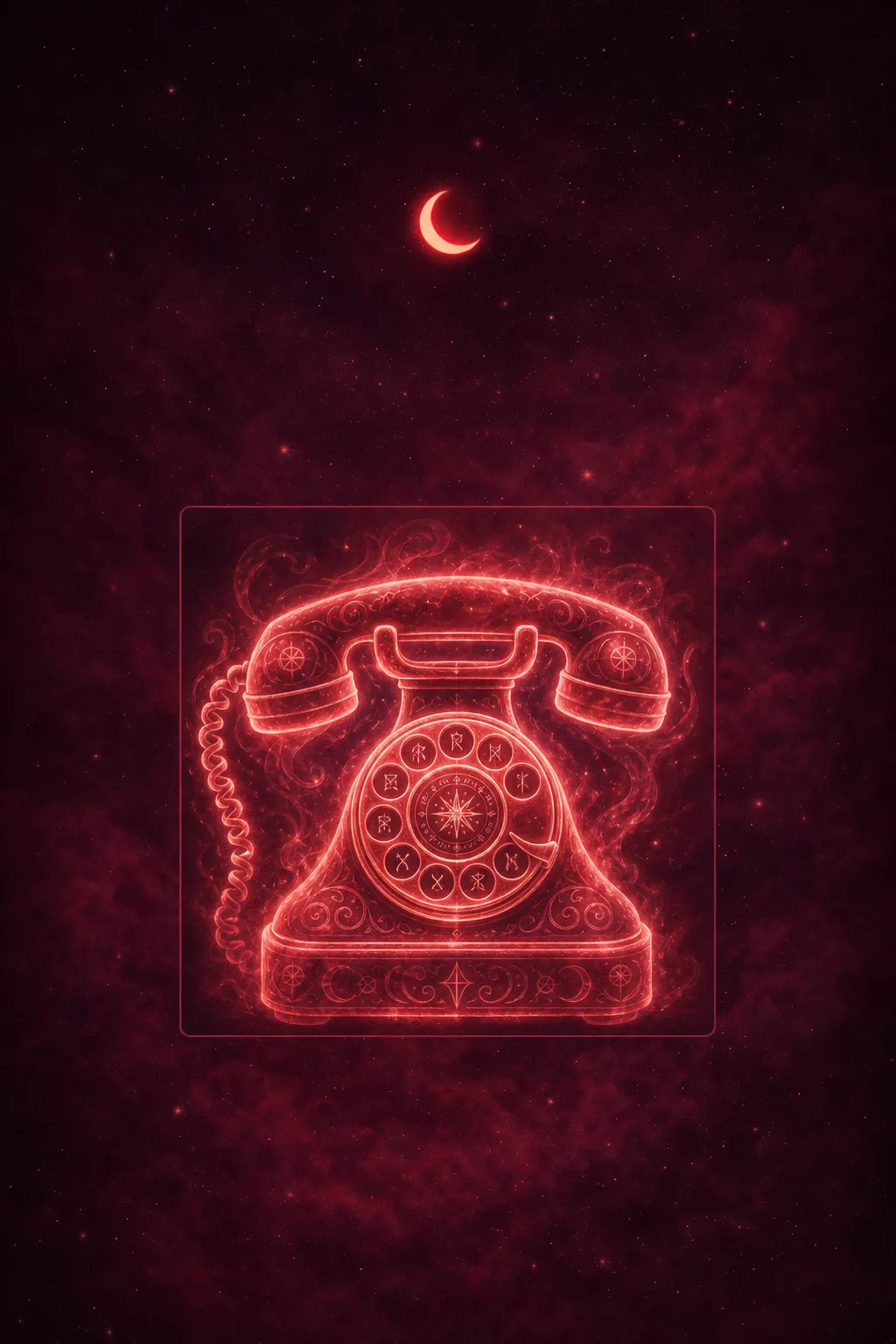

Dreaming about a phone meaning reflects your subconscious desire for connection, communication, or urgent self-expression, often signaling that an important message, relationship, or unresolved conversation in your waking life is demanding your attention and needs to be addressed before it slips away.
In under a minute you could read what your exact dream means for you, and see a picture of it. Free.
A dream still on your mind? Get your personal reading.
Describe your dream in a line or two. In seconds you get a reading of your exact dream, a picture drawn from your own words, and every symbol explained.
Free. No sign-up. Takes 10 seconds. Your dream stays private.
0%
Analyzing your dream…
Something went wrong. Please try again in a moment.
Your dreams deserve more than a dictionary
Common Phone Dream Scenarios and What They Mean
The most frequently reported phone dream — the phone that won't dial, or whose numbers keep shifting every time you press them — maps directly onto waking feelings of powerlessness. You know what you need to say, but every attempt collapses. This is a classic stress-dream motif: urgent intent with zero agency, and a reliable signal that you feel unheard or blocked in some real conversation. Closely related is the dream of calling someone who never picks up. Here the phone becomes a stand-in for emotional distance; the person who won't answer mirrors a relationship where connection feels one-sided, or where grief has been left unresolved.
- Phone rings and you receive a call: Pay attention to who is calling and whether you answer. Picking up signals openness to a new demand or change; letting it ring suggests reluctance or self-protection.
- Dead battery, no signal, or dropped call: A vivid modern-anxiety image for burnout and disconnection — your internal resources feel depleted, your support network out of reach.
- Lost or broken phone: Because the phone functions as an extension of identity and control, losing it in a dream points to threatened autonomy — a fear of being unreachable, forgotten, or stripped of your usual tools.
- Unknown number, silent caller, or threatening voice: Something unnamed is pressing for acknowledgment. This scenario often surfaces suppressed worry or a boundary that feels violated.
- A call from someone who has died: Rather than ominous, most dreamers wake from this scenario feeling comforted. It reflects the mind's natural grief work — a continuing bond, a longing for guidance, or the need for closure.
- Wrong number or overhearing a call not meant for you: Points to misdirected communication or the sense of being on the outside of something important — though occasionally it signals that useful insight is arriving from an unexpected direction, much like a message slipped under the wrong door.
But what does your version mean?
Across all these variants, the central question is the same: who controls the line? Dreams where you cannot connect or are cut off tend to reflect anxiety about competence and belonging, while dreams where the call comes to you shift the focus toward readiness — your willingness to respond to what life, or your own inner life, is asking of you.
What this dream could look like
Tap an image to open it full screen
Example images. Only you can see what you write in Dream Book.
The Psychological Reading: Connection, Anxiety, and the Inner Voice
From a psychological standpoint, a phone in a dream functions as the mind's shorthand for relational need — the raw, sometimes desperate urge to connect, be heard, or resolve something left unspoken. Mainstream psychology frames it as a communication drive: the subconscious surfaces an unfinished conversation, a relationship under strain, or an emotion you haven't yet put into words. The person on the other end of the line is rarely arbitrary; they typically represent a real dynamic in your waking life, and how that call goes — warmly answered, coldly ignored, or eerily silent — mirrors how safe or threatened you feel within that relationship.
Modern life adds a sharper edge. In an always-on culture saturated with notifications and social pressure, the phone has become a symbol of availability itself. Dreaming of a dead battery, a missed call you can't return, or a screen that won't respond can reflect the particular dread of losing control — of slipping out of reach at the worst possible moment. This control-and-availability anxiety is a recognizable stress signature: the feeling that you must remain reachable, responsive, and "on" at all times, even while asleep.
Perhaps most telling is the unanswered call that comes from an unknown number — or from yourself. Psychologically, this points inward: a neglected part of your inner life is trying to get your attention. From a broadly Christian-influenced perspective, this might feel like a nudge toward honest self-examination, a quiet prompt to listen before speaking. Either way, the dream invites the same response — picking up, paying attention, and acknowledging what your own subconscious is dialing in.
Every dream you log starts to connect.
Dream Book keeps your dreams in one place and reveals the threads between them over time — your private dream journal. Free to start.


Cultural and Traditional Readings of the Phone Dream
The telephone entered everyday life just over a century ago, yet it has already accumulated a rich layer of folk meaning. In mainstream Western culture, a ringing phone that goes unanswered carries the same uneasy weight as a letter left unopened — a sense that something important is being delayed or deliberately avoided. This intuition is old even if the device is new: oral tradition has long treated a messenger who cannot deliver the message as an omen of stalled fortune or unresolved obligation, and the dream phone simply updates that archetype for the modern world.
Was yours a sign? Find out.
Within American Christian folk belief, the phone dream sometimes reads as a nudge from conscience — the feeling that a higher call (literally and figuratively) is going unheeded. Where a biblical framework is present, missing a call can evoke the idea of a summons that demands a response, a spiritual "are you there?" that the dreamer is not quite ready to answer. This reading sits comfortably alongside the broader cultural anxiety that defines contemporary life: the always-on smartphone era has made unreachability feel like a moral failing, and dreams absorb that pressure faithfully.
Popular dream tradition also emphasizes the control dimension. Folk interpreters across English-speaking cultures have consistently linked phone imagery to questions of who holds power in a relationship — who initiates contact, who waits, who hangs up first. A dead battery or a dropped call is widely read as a sign of lost influence or a relationship drifting beyond one's reach, much like the unsettling helplessness of a falling dream. Taken together, these cultural threads frame the phone as a mirror of our need to remain connected without surrendering our sense of control.
The Spiritual Reading: A Call Waiting to Be Answered
Within a Christian-influenced frame, dreaming of a phone carries a quiet but pointed metaphor: the line is open, but are you listening? The prophet Elijah encountered God not in wind or fire but in a still small voice (1 Kings 19:12) — a whisper that required stillness to hear. A phone dream can function the same way, nudging the dreamer to ask whether they have been too distracted, too anxious, or too tightly wound in modern life's noise to receive what is already being communicated to them. An unanswered call in this reading is less a failure than an invitation — something spiritually significant is waiting on the other end of the line.
A bad dream isn't a bad sign.
This framing sits comfortably alongside modern-anxiety concerns about control: the dream may signal that the urge to manage every outcome is itself blocking a deeper kind of receptivity. Many faith traditions frame prayer precisely as a two-way channel — not a broadcast but a conversation. If the dreamed phone goes dead, the battery runs out, or the signal drops entirely, it may reflect a spiritual restlessness, a sense of being cut off from something larger than the self. A closed or locked door carries a similar weight in both dream symbolism and religious imagery — threshold moments where the question is whether you are willing to open up.
Spiritually, then, the phone dream is less about who is calling and more about the quality of attention you bring to the call. It asks: what inner voice have you been sending to voicemail?
Related Dream Meanings

common dreams
Door Dream Meaning: Opportunities, Transitions & Choices
5 min read

body health
Teeth Falling Out Dream: Anxiety, Loss & Vulnerability
5 min read

common dreams
Falling Dream Meaning: Insecurity, Fear & Loss of Control
5 min read

common dreams
Photograph Dream Meaning: Memories & the Past
5 min read
common dreams
What Does an Open Door Mean in a Dream
5 min read

common dreams
What Does It Mean When Someone Knocks on Your Door in a Dream
5 min read

common dreams
Door Not Opening Dream: Blocked Progress & Missed Chances
5 min read

common dreams
Dreaming of Salt Meaning: Symbolism and Interpretation
6 min read
Practical Takeaways: What to Do After a Phone Dream
Before the dream fades, ask yourself one direct question: who was I trying to reach — or avoid? That answer almost always points to a real conversation you have been putting off. Phone dreams thrive on unfinished business, so the most useful thing you can do is name the relationship or situation causing the tension and decide, in daylight, what a single honest step forward looks like — a text, a call, or simply writing out what you actually want to say.
If the anxiety in the dream felt less about a specific person and more about being constantly on-call and overwhelmed, treat it as a signal worth taking seriously. Modern connectivity pressures are real, and your sleeping mind is flagging a boundary problem your waking mind keeps dismissing. Consider auditing your phone habits: notification settings, response-time expectations you have set for yourself, and moments in the day where you are genuinely unreachable and at ease with that.
But what does your version mean?
- Identify the unspoken: Journal the name or situation the dream brought up — even a few lines cuts through avoidance.
- Check your availability habits: Are you reachable to everyone at all times? Deliberate limits reduce the anxiety that feeds these dreams.
- Listen inward: An unanswered call can mirror an ignored inner need — much like a closed door in a dream signals a threshold you have not yet chosen to cross.
- Act small but concretely: One real-world communication step — sent or scheduled — tends to dissolve the dream's urgency faster than any amount of analysis.
One dream is never the whole picture.
The free app remembers your dreams, draws them, and connects the threads over time — so the next one means even more. Free to start.
People Also Ask
Spiritually, a phone in a dream represents communication between your conscious and subconscious mind, or even a higher power trying to send you a message. It may signal that you need to listen more carefully to your inner voice or pay attention to guidance being offered from a spiritual source.
Absolutely. Phones are central to modern daily life, so dreaming about them is very common. Your brain processes familiar objects during sleep. Seeing your phone in a dream often reflects real concerns about connection, communication, or even anxiety about missing something important in your waking life.
The Bible does not mention phones directly, but biblically the symbol aligns with themes of divine communication and hearing God's call. Just as prophets received messages from God, a phone in a dream may represent a calling, a warning, or an invitation to listen closely to spiritual truth speaking into your life.
Dreaming of a broken or lost phone often signals feelings of disconnection, miscommunication, or fear of being unreachable. It may reflect anxiety about losing touch with someone important or a sense that your voice is not being heard. It encourages you to address communication barriers in your relationships.
Curious what your dream would look like?