
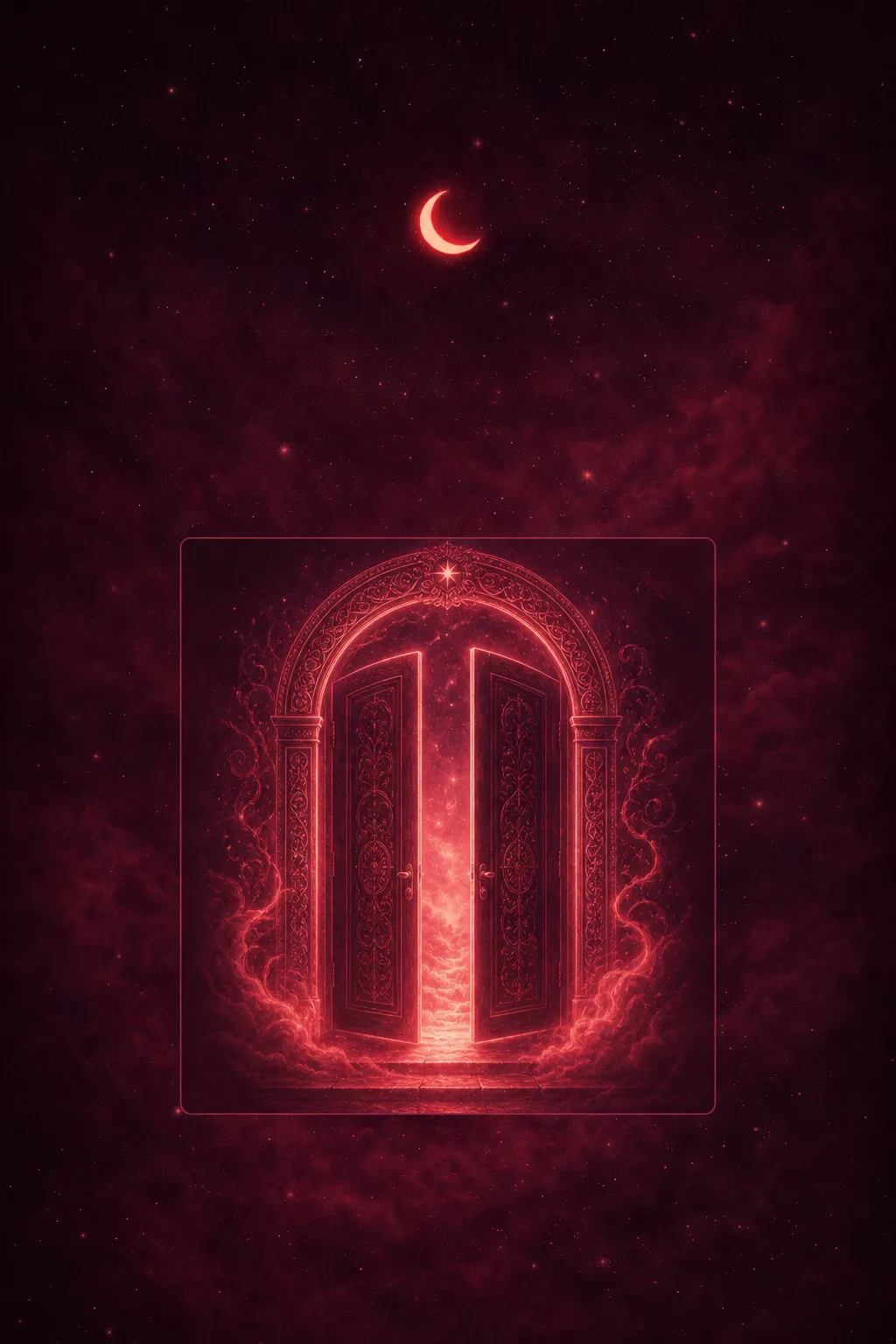

An open door in a dream typically means new opportunities, transitions, or invitations are appearing in your waking life, symbolizing that you are ready to embrace change, step into an unknown chapter, or accept a path that was previously closed, reflecting your subconscious desire for freedom, growth, or fresh beginnings ahead.
In under a minute you could read what your exact dream means for you, and see a picture of it. Free.
You read what it can mean. But what did yours mean?
General meanings stop here. In the free app, tell Dream Book your exact dream and get a reading that actually makes sense for you.


A dream still on your mind? Get your personal reading.
Describe your dream in a line or two. In seconds you get a reading of your exact dream, a picture drawn from your own words, and every symbol explained.
Free. No sign-up. Takes 10 seconds. Your dream stays private.
0%
Analyzing your dream…
Something went wrong. Please try again in a moment.
Your dreams deserve more than a dictionary
Common Open Door Dream Scenarios
The specific action surrounding the open door shapes its meaning considerably. Walking confidently through an open door signals active acceptance — you are ready to commit to a new chapter and trust the path ahead. By contrast, standing frozen at the threshold reflects decision paralysis; the opportunity is right in front of you, yet something — fear, self-doubt, or competing obligations — holds you back. This hesitation scenario is among the most common and often mirrors real-life anxiety about a career move, relationship shift, or major life choice.
- Door opens on its own: Change is arriving whether you planned for it or not; the uncanny feeling this produces often points to a situation outside your control — a layoff, a sudden opportunity, or an unexpected invitation.
- Darkness beyond the door: Anxiety is doing the framing here. The open door is real, but fear of uncertain outcomes clouds what lies ahead — much like the unsettled feeling behind dreams of falling, where loss of control is the core concern.
- Light or brightness beyond the door: Hope and clarity are near; spiritually, many people in faith traditions read this as reassurance that the next step is blessed or aligned.
- Unable to close the door: A boundary has been breached or a decision made that cannot be undone — this variant speaks to feelings of exposure and lost control over your private space or personal limits.
- A hallway of many open doors: Abundance tips into overwhelm; the dream is flagging decision fatigue and a need to prioritize rather than keep every option open indefinitely.
- Someone standing in the doorway: The emotional tone tells you everything — a welcomed figure signals a positive new influence entering your life, while an unwanted presence suggests an intrusion on your boundaries.
What this dream could look like
Tap an image to open it full screen
Example images. Only you can see what you write in Dream Book.
The Psychological Meaning of an Open Door in Dreams
From a psychological standpoint, an open door represents a liminal moment — a threshold the unconscious mind constructs to mirror unresolved readiness in waking life. Whether you are weighing a new relationship, a career shift, or a deeper turn toward self-understanding, the psyche projects that inner tension outward as a doorway standing ajar. The sense of agency is central here: the door being open — rather than locked or blocked — signals that the dreamer perceives real options are available, even if acting on them still feels daunting.
But what does your version mean?
The boundary dimension carries equal weight. An open door cuts both ways: it is an invitation and an exposure. When the feeling in the dream is unease rather than hope, the image may reflect anxiety about vulnerability — a sense that your personal space, privacy, or sense of control is permeable. In a broadly Christian cultural context, this can also surface as a tension between trusting an open path as providential and fearing what lies beyond human sight. Either way, the emotional charge points back to a real-life boundary the dreamer has not yet settled.
Modern life adds a sharper edge to the symbol. Decision fatigue and the pressure to seize every opportunity can transform what should feel like freedom into overwhelm. Key psychological themes the open door commonly surfaces include:
- Ambivalence about change — desire and hesitation pulling in equal measure
- Fear of choosing the wrong path — especially during major life transitions
- Curiosity as a growth signal — the psyche's drive to integrate new awareness, much like the unsettling pull explored in dreams about falling
- Loss of control over personal boundaries — the open door as unwanted exposure
General meanings end here. Read your own dream.
Describe your dream in a line or two. In seconds you get a reading of your exact dream, a picture drawn from your own words, and every symbol explained.
Free. No sign-up. Takes 10 seconds. Your dream stays private.
0%
Analyzing your dream…
Something went wrong. Please try again in a moment.
Your dreams deserve more than a dictionary
Every dream you log starts to connect.
Dream Book keeps your dreams in one place and reveals the threads between them over time — your private dream journal. Free to start.
Cultural and Traditional Meanings of an Open Door Dream
English-speaking culture has long treated the open door as one of its most intuitive symbols of possibility. The common idiom "when one door closes, another opens" does more than offer comfort — it frames change itself as a self-correcting process, suggesting that loss and opportunity are always paired. Everyday phrases like "door of opportunity" and "foot in the door" reinforce a cultural reflex to read an open door as an invitation to act, making it unsurprising that the image resurfaces in dreams precisely when real-life decisions feel urgent. In a modern landscape defined by career pivots, shifting relationships, and relentless pressure to "seize the moment," the open door dream can carry distinct anxiety alongside its optimism — it reminds the dreamer that windows of opportunity do not stay open forever.
Was yours a sign? Find out.
There is also a warm hospitality tradition woven into the symbol. Historically, a literally open door signaled welcome, safety, and non-judgment — think of the cultural ideal of the "open-door policy," whether in a family home or a manager's office. This layer gives the dream a social dimension: the open door may reflect how open or guarded you feel toward other people, or how much control you believe you hold over who and what you allow into your life. Within US Christian tradition, the image quietly echoes scriptural themes of divine invitation and grace — a door opened by a higher hand — though that reading sits alongside, rather than above, these broader cultural layers.
- Optimism about change: "When one door closes, another opens" encodes cultural faith that transitions lead somewhere worthwhile.
- Agency and timing: "Foot in the door" suggests that acting quickly matters — a modern-anxiety reminder that hesitation has a cost.
- Hospitality and openness: An open door traditionally signals welcome, reflecting how safe or exposed you feel in your relationships.
- Spiritual undertones: In broadly Christian cultural memory, an open door can suggest grace or a path provided beyond personal effort.
Spiritual Meaning of an Open Door Dream
Within a Christian framework, an open door carries unmistakable biblical weight. The promise in Revelation 3:8 — that God sets before his people "an open door no one can shut" — resonates strongly with dreamers who sense that a threshold appearing in sleep may signal a providential moment rather than a purely personal one. From this perspective, the dream is less about whether you are ready and more about whether you are paying attention to a path being cleared for you.
A bad dream isn't a bad sign.
That distinction matters practically. Many believers in this tradition treat such a dream as a prompt for prayerful discernment — pausing before acting, inviting divine guidance rather than rushing through on willpower alone. In an age shaped by pressure to decide quickly and optimize every choice, this spiritual posture offers a counterweight: not every open door demands an immediate answer, and waiting on clarity can itself be an act of faith rather than hesitation.
- A calling or new faith season: The threshold may signal that a spiritual chapter — a ministry, a community, a deeper commitment — is genuinely opening up.
- Discernment over impulse: Dreaming of pausing at the doorway can reflect a healthy spiritual instinct to seek guidance before stepping forward.
- Surrender of control: When anxiety colors the dream, the spiritual invitation is often to release the need to manage every outcome — a theme that pairs naturally with dreams about falling, where loss of control becomes its own form of spiritual reckoning.
Related Dream Meanings
common dreams
Falling Dream Meaning: Insecurity, Fear & Loss of Control
5 min read

nightmares
Being Chased Dream Meaning: Anxiety & Avoidance
5 min read
common dreams
Bridge Dream Meaning: Transition, Change & New Starts
5 min read
common dreams
Dreaming About Phone Meaning: What Your Phone Dreams Reveal
5 min read
common dreams
Door Dream Meaning: Opportunities, Transitions & Choices
5 min read
common dreams
Keys Dream Meaning: Access, Opportunity & Control
5 min read
common dreams
What Does the Color Red Mean in Dreams
5 min read

common dreams
Failing Exam Dream Meaning: Anxiety, Fear & Insecurity
5 min read
What to Do After an Open Door Dream
Rather than simply logging the image and moving on, treat the dream as a prompt for a brief waking audit. Ask yourself what decision or transition you have been circling without committing to — a job offer, a conversation you keep postponing, a boundary you have not yet set. Writing it down in plain language, even one sentence, shifts it from background anxiety into something concrete you can actually evaluate.
- Name the real-life door. Identify the specific opportunity or change the dream likely mirrors. Vague unease is harder to act on than a named situation.
- Check whether hesitation is fear or wisdom. Freezing at a threshold is not always avoidance — sometimes it is your mind asking for more information before you commit. Give yourself a short, firm deadline to gather that information rather than leaving the decision open-ended indefinitely.
- Reduce the stakes mentally. Modern anxiety tends to catastrophize transitions. Remind yourself that most open doors allow you to step back through if the new phase does not fit — very few choices are truly irreversible.
- Create one small forward action. If the dream carries a hopeful tone, match it with a single concrete step this week — a phone call, a drafted email, a scheduled conversation — so momentum builds rather than stalls.
But what does your version mean?
If recurring open door dreams leave you feeling exposed rather than hopeful — closer in feeling to a dream of being pursued than one of calm possibility — that emotional shift is worth noting separately, as it may point less to opportunity and more to a sense that boundaries in your waking life need attention.
One dream is never the whole picture.
The free app remembers your dreams, draws them, and connects the threads over time — so the next one means even more. Free to start.
People Also Ask
Spiritually, an open door represents divine invitation, new beginnings, and unlimited possibility. It signals that a path forward has been cleared, often suggesting that a higher power is guiding you toward growth, opportunity, or transformation. Many traditions view it as a blessing, indicating that the right moment to move forward has arrived.
In Christianity, doors in dreams often reflect God's provision and timing. Revelation 3:8 speaks of an open door no one can shut, symbolizing divine opportunity. Dreaming of a door may indicate that God is presenting a new calling, season of favor, or answered prayer, encouraging you to step forward in faith without hesitation.
A door symbolizes transition, choice, and access to the sacred. It stands between the known and unknown, representing the threshold between your current life and something greater. Spiritually, it can signify protection, boundaries, or readiness for inner growth, depending on whether it appears welcoming, blocked, or somewhere in between.
A self-opening door in a dream often signals unseen forces working on your behalf. Spiritually, it suggests that opportunities are being created without your direct effort, pointing to divine intervention, fate, or your subconscious clearing away internal barriers. It encourages trust that the right path is unfolding naturally, even if you cannot yet see how.
Curious what your dream would look like?