
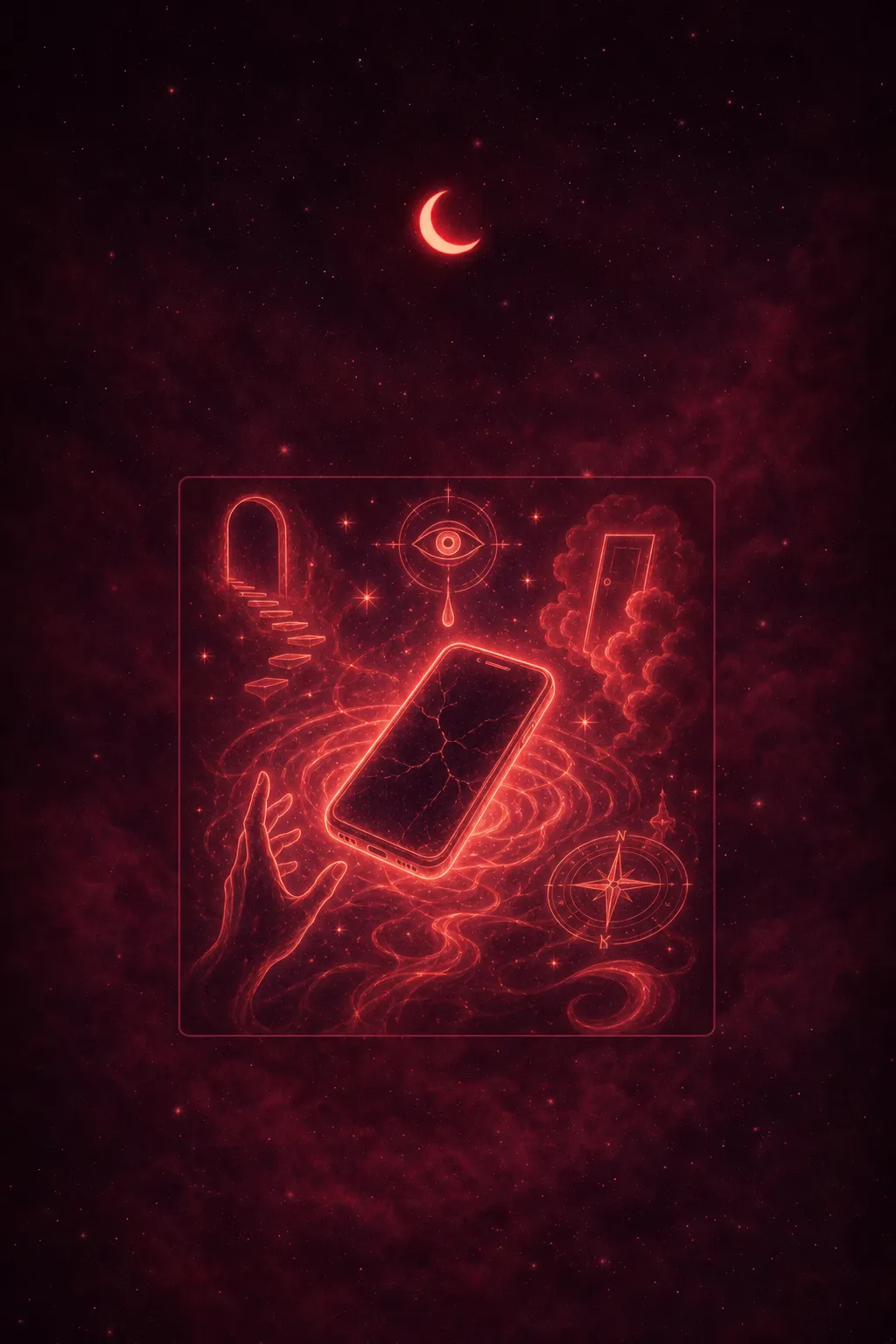

Dreaming about losing your phone typically signals anxiety over disconnection, fear of losing control, or stress about managing too many obligations at once — your subconscious is processing the pressure of staying reachable and in control in a hyper-connected world.
In under a minute you could read what your exact dream means for you, and see a picture of it. Free.
You read what it can mean. But what did yours mean?
General meanings stop here. In the free app, tell Dream Book your exact dream and get a reading that actually makes sense for you.


A dream still on your mind? Get your personal reading.
Describe your dream in a line or two. In seconds you get a reading of your exact dream, a picture drawn from your own words, and every symbol explained.
Free. No sign-up. Takes 10 seconds. Your dream stays private.
0%
Analyzing your dream…
Something went wrong. Please try again in a moment.
Your dreams deserve more than a dictionary
What Different "Losing Phone" Dreams Actually Mean
The specific scenario inside the dream matters enormously. Each variation carries its own emotional fingerprint, so it's worth asking yourself exactly what happened.
Frantically searching and can't find it
This is the most common version, and it directly mirrors waking-life overwhelm. When you're scrambling through pockets, bags, and couch cushions in a dream, your mind is rehearsing the feeling of scattered priorities and too many things demanding your attention. The search itself is the message: you're reaching for control or reassurance and coming up empty. If this dream keeps recurring, it's worth asking which area of your life feels most chaotic right now.
But what does your version mean?
Your phone is stolen or taken
A stolen phone in a dream almost always points to a perceived violation of boundaries. Someone or something in your life — a demanding boss, a relationship dynamic, an obligation that crept past healthy limits — may be taking access to your time, your privacy, or your sense of agency. This dream variant shares psychological ground with dreams about being robbed: both signal a felt loss of personal power.
Dead battery or no signal
Losing your phone through a dead battery or a blank "no signal" screen reflects emotional depletion. You want to reach someone — or you fear they can't reach you — but the line is simply gone. This version often surfaces during periods of emotional exhaustion or when a relationship is quietly drifting. It echoes the themes in dreams where your phone won't work, and both are worth sitting with if you've been feeling unheard or isolated.
You drop and break it, then lose it
The two-stage loss — breaking the phone first, then losing the pieces — amplifies anxiety about damaging something fragile. That fragile thing is usually a relationship or your social standing. There's a sense that the bridge between you and others is not just temporarily gone, but actively broken. Pay attention to who you were trying to call before it shattered.
Lost in a crowd or public place
Losing your phone in a crowd targets social anxiety specifically. You're at your most exposed — surrounded by people, seen by everyone — and at that exact moment your lifeline disappears. This dream often shows up before big presentations, social events, or moments when you feel your image is under scrutiny.
Was yours a sign? Find out.
Feeling relief after losing it
This rarer scenario carries a genuinely positive message. If the loss brings a quiet exhale rather than panic, your subconscious is telling you something honest: part of you longs to step off the treadmill of constant availability. It's a wish for freedom from digital obligation, not a fear at all.
What this dream could look like
Tap an image to open it full screen
Example images. Only you can see what you write in Dream Book.
The Psychology Behind Phone Loss Dreams
Mainstream psychology frames the phone as an extension of the self. It holds your relationships, your calendar, your photos, your identity. Losing it in a dream, then, isn't just losing an object — it's a symbolic loss of the self you've built in the eyes of others.
Stress-anxiety dreams tend to cluster around the things we rely on most. Decades ago, that symbol was often a car or a wallet. Today, for a huge proportion of the population, it's the phone. The dream is your nervous system offloading accumulated pressure — the fear of being unreachable, unproductive, or unseen.
This connects closely to themes in dreams about losing control: both reflect a mind that's working overtime to manage responsibilities it fears slipping through the fingers. If you're waking from these dreams with your heart racing, it's a reliable signal to examine where in waking life you feel most out of your depth.
There's also an identity angle worth exploring. Because we curate so much of who we are through our phones — the photos we take, the messages we send, the accounts we manage — losing the device in a dream can feel like losing access to your own story. That psychological charge is real, and it's worth taking seriously.
General meanings end here. Read your own dream.
Describe your dream in a line or two. In seconds you get a reading of your exact dream, a picture drawn from your own words, and every symbol explained.
Free. No sign-up. Takes 10 seconds. Your dream stays private.
0%
Analyzing your dream…
Something went wrong. Please try again in a moment.
Your dreams deserve more than a dictionary
Every dream you log starts to connect.
Dream Book keeps your dreams in one place and reveals the threads between them over time — your private dream journal. Free to start.
Cultural Context: A Uniquely Modern Dream
Earlier generations dreamed about losing their wallet or finding themselves completely lost in unfamiliar territory. Those symbols carried the same core anxiety — disconnection, loss of resources, loss of bearings — that the phone now carries for contemporary dreamers.
What's distinctive about the phone is how thoroughly it fuses the practical and the personal. A lost wallet means financial vulnerability; a lost phone means social, relational, and psychological vulnerability all at once. Dream dictionaries and cultural interpreters across the English-speaking world have begun placing this symbol alongside the classic loss dreams precisely because its emotional weight has become equivalent.
A bad dream isn't a bad sign.
The Dream Book team has found that these dreams peak during life transitions — starting a new job, moving cities, ending a relationship — moments when the need to stay connected with the old world collides with the demands of the new one.
A Spiritual Perspective
For those who approach dreams through a faith lens, losing your phone can carry a meaningful invitation rather than just a warning. In a broadly Christian reading, the dream may be prompting a question: What are you placing your trust in? The phone represents your web of human connections and your sense of control over how others perceive you. Losing it in a dream can be read as a gentle nudge toward relinquishing control — toward recognizing that not everything can or should be managed, and that peace doesn't depend on being reachable at all times.
Some Christian interpreters would frame it as a call to examine whether anxiety over connection has displaced a deeper, quieter source of reassurance. The question isn't whether God is sending a literal message through the dream, but whether the dream is surfacing a spiritual restlessness worth praying through or reflecting on.
If the dream left you feeling alone and cut off, it may simply be naming a real longing for connection — one that no device can fully satisfy.
Related Dream Meanings

nightmares
Being Robbed Dream Meaning: Vulnerability & Loss
5 min read
common dreams
What Does It Mean When Your Phone Doesn't Work in a Dream
5 min read

nightmares
Losing Control: Meaning and Interpretation
5 min read

common dreams
Losing a Wallet Dream: Insecurity & Loss of Control
5 min read

common dreams
Being Lost Dream Meaning: Confusion & Direction
5 min read

common dreams
Work Dream Meaning: Stress, Ambition & Identity
5 min read

common dreams
Flying in a Plane Dream Meaning: Freedom & Control
5 min read

common dreams
Getting Lost Dream Meaning: Confusion, Fear & Direction
5 min read
What to Do With This Dream
Rather than searching for a single definitive meaning, treat the dream as a diagnostic. Here are three honest questions to sit with:
- Where do you feel most out of control right now? The frantic search in the dream usually maps onto a specific area of life — work, a relationship, a creative project — where you feel like you're scrambling.
- Who are you afraid of losing touch with? If a specific person came to mind when the phone disappeared, that relationship may deserve real-world attention.
- Is digital overload genuinely affecting you? If the relief version of the dream resonates, take it seriously. Building in intentional offline time isn't just self-care — it's maintenance. Your nervous system may be telling you what your schedule hasn't allowed you to admit.
But what does your version mean?
Recurring phone loss dreams, especially when they wake you with anxiety, are a reliable signal that something in your waking life needs addressing. The dream isn't a prediction — it's a reflection. And reflections, taken honestly, are always useful.
One dream is never the whole picture.
The free app remembers your dreams, draws them, and connects the threads over time — so the next one means even more. Free to start.
People Also Ask
Spiritually, losing your phone in a dream is often read as an invitation to release the need for control and constant connection. In a faith context, it can prompt reflection on where you place your trust — and whether anxiety over being reachable has crowded out a deeper sense of peace or spiritual grounding.
A phone in a dream spiritually represents the connections you hold most dear — your relationships, your community, and your sense of being known by others. It can also symbolize the voice you use to reach out for help or guidance, making it a potent symbol of both human and spiritual communication.
Most discernment traditions suggest that spiritually significant dreams leave a lasting emotional impression, carry a clear and consistent message, and align with what you already know to be true about your life. A single anxiety dream is usually psychological; a recurring, vivid dream that prompts genuine reflection may carry deeper weight.
Dreaming of searching for your phone but never finding it reflects waking-life stress, scattered priorities, and a feeling of lost control. It often surfaces during periods of overwhelm and signals that part of you is scrambling for reassurance or trying to reconnect with something — or someone — that feels out of reach.
Curious what your dream would look like?