
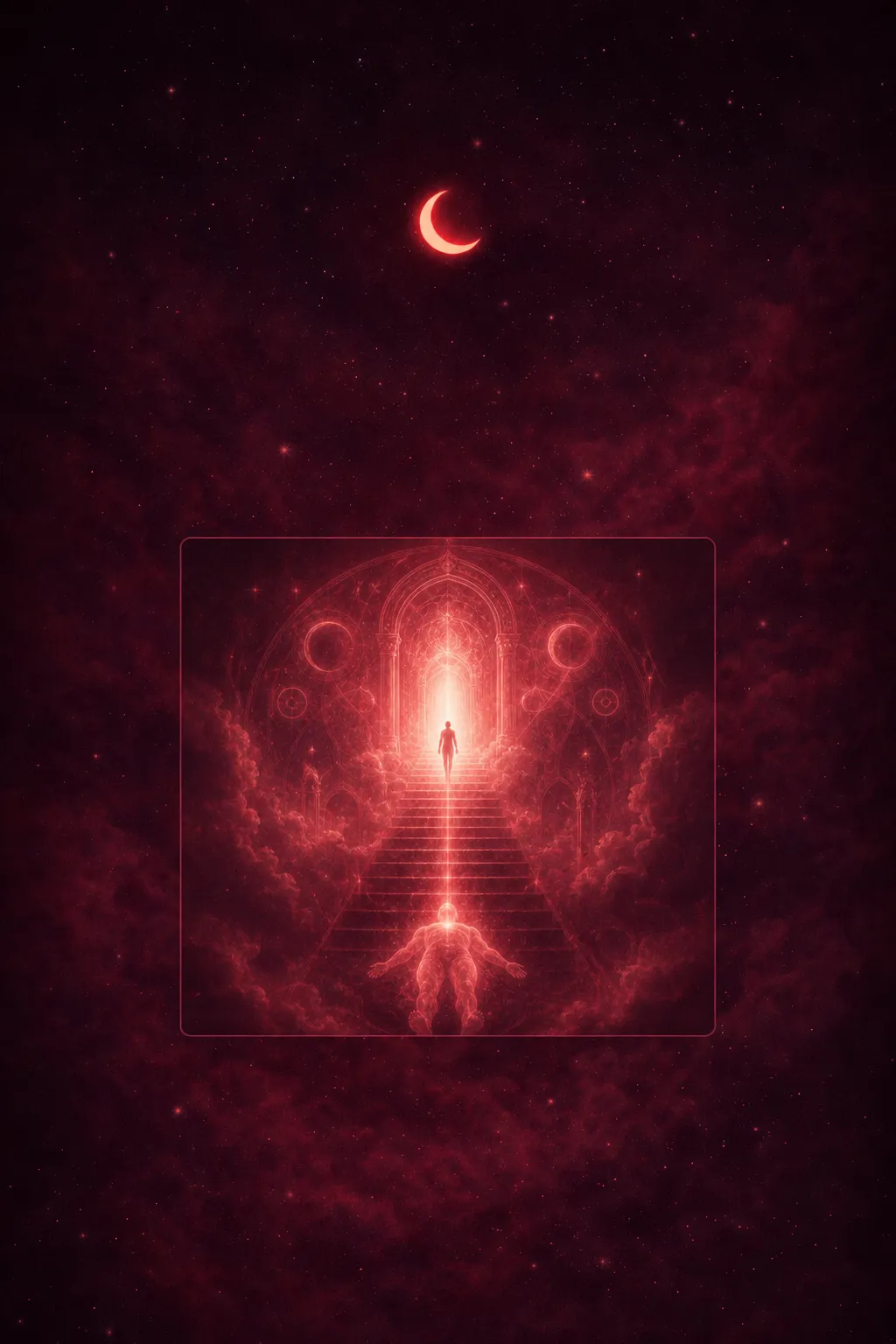

Dreaming of a near death experience often reflects a powerful inner call to transform, let go of the past, or confront deep-seated fears. It can signal that a major life change is approaching — or that part of your old self is fading to make room for something new. Rather than a literal warning, these dreams usually carry a message of renewal and second chances.
In under a minute you could read what your exact dream means for you, and see a picture of it. Free.
A dream still on your mind? Get your personal reading.
Describe your dream in a line or two. In seconds you get a reading of your exact dream, a picture drawn from your own words, and every symbol explained.
Free. No sign-up. Takes 10 seconds. Your dream stays private.
0%
Analyzing your dream…
Something went wrong. Please try again in a moment.
Your dreams deserve more than a dictionary
Common Near-Death Experience Dream Scenarios
Watching Yourself Almost Die
In this version, you observe your own near-death from a distance — hovering above the scene, watching your body below. It's disorienting in a way that lingers after you wake. This is one of the most striking forms of the dream, and it almost always points to a crisis of identity: some part of you is watching another part of you fade out.
The sensation is close to what many people describe in out-of-body dreams — that uncanny split between self as observer and self as subject. When this dream repeats, it's often a signal that you're emotionally detached from your own life, watching it happen rather than living it.
Was yours a sign? Find out.
Dying and Coming Back
You die — or come close enough to feel it — and then you return. You wake up gasping, or in the dream itself you're suddenly alive again, confused and raw. This is one of the most symbolically loaded scenarios in the nightmare category. It speaks directly to rebirth: something is ending, but the ending isn't final.
This dream often follows major life upheaval — a breakup, a job loss, a health scare. It mirrors the emotional arc of dying dreams but with a crucial second act. The return matters as much as the fall.
Seeing a Light or Tunnel During the Dream
The classic NDE imagery — a long corridor, a warm light at the end, voices calling you forward. When this appears in a dream, it rarely signals literal danger. It tends to surface when you're standing at a threshold you're afraid to cross: a decision you've been avoiding, a relationship you know needs to end, a version of yourself you're not sure you're ready to become.
There's something almost beckoning about this dream. It's worth paying attention to whether you move toward the light or pull back — that instinct tells you something about how ready you actually are for the change ahead. Dreams about the afterlife often carry the same threshold energy.
Near-Death Caused by Someone or Something Else
You're pushed, shot, drowned, or attacked — brought to the edge of death by an external force. This shifts the emotional weight significantly. Where watching yourself die is about identity, being brought to near-death by something else is about feeling threatened, controlled, or overwhelmed by forces outside yourself.
If you're being chased before the near-death moment, the dream is likely tracking anxiety — the thing pursuing you in waking life has finally caught up in your sleep. The threat feels real because emotionally, it is.
What this dream could look like
Tap an image to open it full screen
Example images. Only you can see what you write in Dream Book.
Psychological Interpretation
Freud would have read the near-death dream as a confrontation with the death drive — what he called Thanatos, the pull toward dissolution and stillness that exists alongside Eros, the drive for life. For Freud, dreaming of near-death wasn't about wanting to die; it was about the psyche wrestling with its own opposing forces, with repressed fears and desires that couldn't surface any other way. The dream becomes the stage where that internal war plays out.
Jung took a different angle. For him, a near-death dream is often an individuation signal — the psyche announcing that a transformation is underway whether you're ready for it or not. Death in dreams, Jung argued, rarely means literal death. It means the death of an old self: an outdated identity, a belief system you've outgrown, a role you've been playing too long. The near-death experience in a dream is the Shadow demanding to be acknowledged. Something you've buried is rising, and it's wearing the most dramatic costume it could find. This connects deeply to dreams of being in a coma — another Jungian threshold state.
But what does your version mean?
Calvin Hall's content analysis of over 50,000 dream reports found that dreams involving death and near-death experiences appear with striking regularity across cultures and demographics, and they cluster heavily around periods of life transition — adolescence, midlife, bereavement. Hall's research showed these aren't random nightmare noise; they're the dreaming mind's consistent response to felt vulnerability and change. Ernest Hartmann, whose emotional processing theory reframed how we understand nightmares, argued that intense dreams like NDE scenarios are the brain doing its deepest therapeutic work — taking a raw emotional charge and embedding it in a narrative so the waking mind can begin to metabolize it. The more frightening the dream, Hartmann suggested, the more significant the emotional material being processed.
Hobson and McCarley's activation-synthesis model adds the neurological layer: during REM sleep, the brain fires chaotically, and the cortex scrambles to build a story around that activity. Near-death imagery — tunnels, lights, the sensation of leaving the body — may partly reflect the brain's attempt to make narrative sense of unusual neural patterns. That doesn't diminish the meaning; it just explains why the imagery is so vivid and physically felt. The emotional resonance is real even when the neuroscience is mechanical.
Every dream you log starts to connect.
Dream Book keeps your dreams in one place and reveals the threads between them over time — your private dream journal. Free to start.


Cultural & Spiritual Meaning
In Western spiritual traditions, a near-death experience dream has long been treated as a visitation from the threshold — a message from whatever lies beyond the visible world. Medieval Christian interpreters read such dreams as divine warnings or invitations to examine one's life before it was too late. The dream wasn't a nightmare to be feared but a mercy: a chance to correct course. This is why astral projection dreams and NDE dreams often carry a similar reverent weight in Western esoteric traditions — both involve the soul briefly leaving its housing.
Ibn Sirin, the 8th-century Islamic scholar whose dream interpretations remain influential across the Muslim world, interpreted dreams of dying and returning to life as signs of spiritual renewal and repentance — the dreamer being given a second chance, symbolically, to realign with what matters. For Ibn Sirin, such a dream was not a bad omen but a generous one: the soul rehearsing its return to God, and waking with a clearer sense of what it owes the living.
A bad dream isn't a bad sign.
In many Indigenous traditions, near-death dreams are treated as genuine spirit journeys — the dreamer's soul crossing into another realm and returning with knowledge. The Lakota concept of the vision quest, for instance, involves deliberately seeking a kind of ego-death to receive guidance. In this framework, the near-death dream isn't a symptom of anxiety; it's an initiation. What you bring back from the edge — the feeling, the image, the sense of something glimpsed — is the message.
Related Dream Meanings
nightmares
Out of Body Experience Dream Meaning
6 min read

nightmares
Dying Dream Meaning: Transformation, Fear & Change
5 min read
nightmares
Afterlife Dream Meaning: Closure, Loss & the Unknown
5 min read

nightmares
Being Chased Dream Meaning: Anxiety & Avoidance
5 min read
nightmares
What Does It Mean to Be in a Coma in a Dream
5 min read
common dreams
Astral Projection Dream Meaning: What Your Dreams Reveal
5 min read

nightmares
Apocalypse Dream Meaning: Fear, Change & Inner Turmoil
5 min read
nightmares
End of World Dream Meaning: Anxiety, Change & Fear
5 min read
What to Do After This Dream
First: don't dismiss it. Near-death experience dreams carry emotional charge for a reason, and that charge is data. Sit with the feeling before you analyze it — was there terror, or was there something closer to relief? The emotional texture of the dream is often more revealing than the imagery itself.
Write down every detail you remember, especially what happened just before the near-death moment. The setup — who was there, where you were, what triggered the crisis — is often where the real message lives. Dreams like these are rarely about death. They're about the specific thing in your life that feels like it's killing you right now.
Ask yourself what is ending. A relationship, a chapter of work, a version of how you see yourself. Near-death dreams tend to arrive when change is already happening but you haven't fully acknowledged it yet. The dream is the acknowledgment.
If this dream keeps returning or the emotional residue lingers through your day, it's worth exploring with a personalized interpretation. Dream Book lets you describe your dream in detail and ask follow-up questions — so instead of a generic reading, you get something that reflects your specific imagery, your emotional state, and what's actually happening in your life right now.
Was yours a sign? Find out.
Understanding your near-death experience dream is the first step. The next is asking what it means for your life right now — that's where a personalized interpretation goes deeper than any dictionary.
Keep the ones that matter close.
The free app saves your most meaningful dreams and reads the signs across them — so a visit or a sign is never lost. Free to start.
People Also Ask
Dreaming of a near-death experience usually signals a major psychological or emotional transformation — something in your life is ending or shifting in a way that feels threatening. It's rarely about literal death and more often about the death of an old identity, relationship, or chapter. These dreams tend to cluster around significant life transitions.
Not typically. Across most cultural and psychological frameworks, near-death experience dreams are seen as transformative rather than prophetic. Jung read them as signs of individuation, and Ibn Sirin interpreted them as symbols of spiritual renewal and second chances. The intensity of the dream reflects the significance of the change you're moving through, not a prediction of harm.
The physical vividness — the tunnel, the light, the sensation of leaving your body — is partly explained by how deeply the brain engages during REM sleep. Hobson and McCarley's research showed the brain constructs intense narratives around strong neural activity during dreaming. Combined with the high emotional charge of mortality-related material, these dreams land with unusual physical weight.
Recurring NDE dreams usually mean there's an unresolved emotional situation your mind keeps returning to — something that feels existentially threatening in waking life. Journaling the details immediately after waking, paying attention to what triggers the near-death moment in the dream, and exploring the emotional context around when the dreams started can all help surface what your psyche is trying to process.
Curious what your dream would look like?