
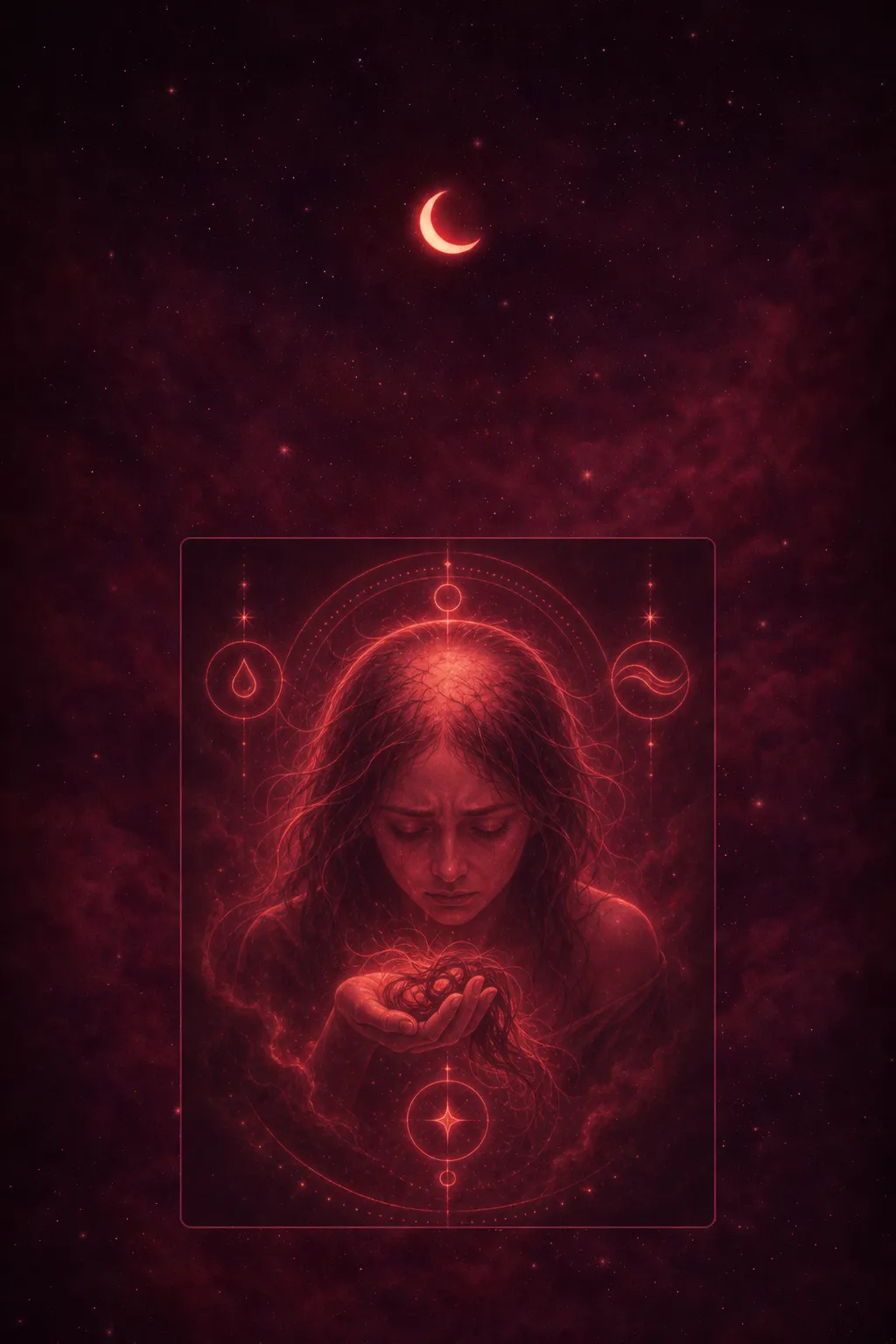

Dreaming about losing hair meaning centers on anxiety, loss of control, or fear of aging—your subconscious processing insecurity about personal power, attractiveness, or vitality during a stressful life transition that leaves you feeling vulnerable or exposed.
In under a minute you could read what your exact dream means for you, and see a picture of it. Free.
A dream still on your mind? Get your personal reading.
Describe your dream in a line or two. In seconds you get a reading of your exact dream, a picture drawn from your own words, and every symbol explained.
Free. No sign-up. Takes 10 seconds. Your dream stays private.
Add who was there and how you felt, and the reading will be about your dream.
0%
Analyzing your dream…
Something went wrong. Please try again in a moment.
Your dreams deserve more than a dictionary
Common Dream Scenarios: Losing Hair
The specific shape your hair-loss dream takes matters enormously — each variant points to a distinct flavour of anxiety or change your waking mind is working through.
- Hair coming out in handfuls or clumps: This high-distress scenario mirrors an acute sense of overwhelm — something in your life feels like it is slipping away faster than you can respond. Like the classic teeth falling out dream, it signals a spike in helplessness, often tied to a situation where control feels suddenly and completely out of reach.
- Discovering baldness or bald patches: Catching your own reflection and seeing thinning hair or a bare scalp speaks to fears around identity, attractiveness, or diminished standing — aging anxiety dressed in visual form.
- Hair shedding during brushing or washing: Loss woven into ordinary routine suggests chronic, low-grade stress — a slow drain on your energy or resources you may be half-ignoring in daily life.
- Others noticing or commenting on the loss: When the dream puts an audience around your thinning hair, social exposure and judgment are at the centre — shame about being seen as diminished or past your peak.
- Cutting or shaving your own hair off: A crucial distinction — chosen hair removal carries an agentic charge, suggesting deliberate transformation, shedding an old identity, or reclaiming control rather than surrendering it.
- Watching someone else lose hair: Projected concern for that person's wellbeing, or your own fear displaced onto a safer target.
- Hair loss tied to sickness imagery: When illness surrounds the hair loss, health anxiety or mortality concerns — your own or a loved one's — are likely driving the dream.
- Hair regrowing after falling out: A hopeful resolution signal — resilience reasserting itself, anxiety beginning to lift, or a sense that what felt permanently lost may yet be recovered.
But what does your version mean?
Across all variants, notice your emotional response inside the dream: panic points to acute overwhelm, while calm acceptance often signals that some part of you has already begun making peace with the change at hand.
What this dream could look like
Tap an image to open it full screen
Open a frame to see the details
Example images. Only you can see what you write in Dream Book.
The Psychological Reading: Control, Identity, and Anxiety
From a psychological standpoint, dreaming of losing hair is one of the mind's clearest distress signals — closely related to the classic dream of teeth falling out — and both belong to the same stress-dream cluster that surfaces when the waking self feels exposed or powerless. Hair functions as a deeply coded marker of vitality, youth, and social standing, so its loss in a dream typically reflects the subconscious processing a felt erosion of identity or control. Modern life amplifies this: chronic pressure around performance, appearance, and aging gives the sleeping mind plenty of raw material to dramatize as strands falling away in your hands.
Psychologically, the emotional texture of these dreams — anxiety, embarrassment, a quiet grief — points to underlying concerns about self-image and how others perceive you. The dream rarely predicts actual hair loss; instead, it maps internal states: a fear of decline, a sensitivity to shifting status, or a life transition that feels irreversible. For those with a faith background, there is also a subtler layer — a reckoning with the limits of human control and a need to surrender outcomes that feel beyond reach.
- Control anxiety: A spike in these dreams often coincides with major decisions, workplace pressure, or health worries — moments when helplessness is most acutely felt.
- Self-esteem processing: The dream can surface when self-worth feels contingent on external validation or physical appearance.
- Transformation signal: Not all readings are negative — losing hair can represent the subconscious clearing old identity structures to make room for genuine change.
Every dream you log starts to connect.
Dream Book keeps your dreams in one place and reveals the threads between them over time — your private dream journal. Free to start.


Cultural and Folk Traditions: What Losing Hair Has Long Signified
Across Western folk tradition, hair has carried deep symbolic weight long before modern psychology gave it a clinical name. In many European cultures, hair was seen as a seat of vitality and personal power — cutting it against one's will was an act of humiliation, while losing it unexpectedly was read as an omen of hardship or personal decline. This belief echoes biblical imagery, most famously in the story of Samson, where shorn hair meant the loss of divine strength — a resonance that still colors how many American Christians instinctively feel when this dream surfaces, associating hair-loss with a stripping away of protection or purpose.
Was yours a sign? Find out.
In mainstream Anglo-American folk belief, dreaming of hair falling out has traditionally been linked to worry about one's standing in the community — a fear of being seen as diminished, aging, or no longer capable. It sits comfortably alongside the dream of teeth falling out as one of the most universally reported anxiety dreams, and both share the same cultural undercurrent: the dread of losing something visible that signals health and social value to others.
- Loss of status or respect: Folk readings often tied sudden hair loss in dreams to a coming blow to reputation or authority.
- Aging and mortality anxiety: Traditional interpretation framed it as the psyche's honest reckoning with time passing and control slipping.
- Life transitions: In many folk traditions, hair dreams clustered around major thresholds — marriage, illness, job loss — moments when identity was genuinely in flux.
A bad dream isn't a bad sign.
Today these older cultural readings map neatly onto modern-anxiety frameworks: the dream tends to spike during periods of workplace stress, financial pressure, or identity uncertainty, suggesting that while the cultural dressing has changed, the core fear — losing visible control over how others perceive you — remains stubbornly constant.
Spiritual Meaning: Strength, Worth, and Letting Go
Within a US Christian framework, hair carries unmistakable biblical resonance. The story of Samson in Judges 16 is the most vivid example: his hair was the outward sign of his covenant strength, and its loss left him powerless and humiliated. Dreaming of losing hair can echo that same archetype — a felt sense that something sacred or sustaining in your life is being stripped away, whether that is confidence, purpose, or a role that once defined you. Yet Scripture offers a counterweight in Matthew 10:30, where even the hairs of your head are said to be numbered by God, framing personal worth as something that exists entirely beyond appearance or social standing. That tension — between the fear of diminishment and the assurance of being fully known — sits at the heart of what this dream may be surfacing spiritually.
From a broader spiritual perspective, shedding hair in a dream can also be read as an invitation rather than a warning. Many contemplative traditions view the release of outward markers of identity as a step toward deeper self-knowledge — a loosening of the ego's grip on how it needs to be seen. If waking life has you anxious about control or image, this dream may be gently pressing you to ask which parts of your sense of self are genuinely yours and which are simply performance. In that light, a dream about cutting hair and one about losing it unexpectedly may share a spiritual thread: both confront your attachment to the version of yourself the world sees.
Related Dream Meanings
body health
Teeth Falling Out Dream: Anxiety, Loss & Vulnerability
5 min read
body health
Cutting Hair Dream Meaning: Change, Loss & Control
5 min read
body health
Skin Peeling Off: Meaning and Interpretation
5 min read
body health
Bare Breasts and Other Breast Dreams: Nurture and Vulnerability
5 min read
body health
Dreaming of Nose Bleeding: Stress Overflow and Lost Energy
6 min read
body health
Bones Dream Meaning: Strength, Mortality & Hidden Truths
5 min read
body health
What Does It Mean to Dream About Wounds? Interpretation and Meaning
5 min read
body health
Breastfeeding Dream Meaning: Nurture, Care & Growth
5 min read
Practical Takeaways: What to Do After This Dream
Because hair-loss dreams belong to the same stress cluster as dreams about teeth falling out, waking up from one is a useful prompt to audit where you feel most out of control right now — not to catastrophize, but to get specific. Ask yourself honestly: What is changing in my life that I haven't fully acknowledged? Naming the pressure (a health worry, a shifting role at work, a relationship in flux) is the first step toward doing something about it rather than absorbing it as background dread.
- Track the pattern. Keep a brief dream journal for two weeks. Recurring hair-loss imagery almost always intensifies during high-stress periods — seeing the pattern on paper makes the connection concrete and less frightening.
- Audit your control. List what you can genuinely influence versus what you cannot. Small, deliberate actions in the "can" column — even minor ones — help restore the sense of agency the dream signals is missing.
- Check your self-image habits. If the dream carries strong embarrassment, consider whether your self-worth is too tightly tied to appearance, status, or others' approval. A practical step: deliberately do something that affirms your competence independent of how you look.
- Address the body, not just the symbol. If real stress is disrupting sleep, exercise, or diet, those physical anchors are worth restoring — they directly reduce the anxiety that fuels this type of dream.
But what does your version mean?
Think of the dream less as a warning and more as a dashboard light: uncomfortable, but genuinely useful information about where your energy and attention need to go.
One dream is never the whole picture.
The free app remembers your dreams, draws them, and connects the threads over time — so the next one means even more. Free to start.
People Also Ask
Spiritually, dreaming of losing hair often signals a loss of personal power, vitality, or confidence. It can indicate a period of transition where old beliefs are shed to make way for growth. Some traditions view it as a warning to protect your energy and focus on rebuilding inner strength.
Biblically, hair symbolizes strength and glory, as seen with Samson. Dreaming of hair falling out may represent a loss of divine favor, spiritual weakness, or a call to humility before God. It can also signal a season of testing, urging the dreamer to seek renewed faith and surrender to a higher purpose.
Hair in dreams spiritually represents personal power, identity, wisdom, and connection to the divine. Healthy, flowing hair suggests confidence and spiritual vitality, while tangled or damaged hair may reflect inner conflict or blocked energy. Pay attention to the hair's color and condition, as these details carry important spiritual messages about your current life path.
Yes, hair loss dreams are strongly linked to waking anxiety, stress, or fear of losing control. They frequently appear during major life changes such as career shifts, relationship struggles, or health concerns. Rather than a literal prediction, the dream reflects your subconscious processing insecurity and urging you to address underlying worries before they escalate.
Curious what your dream would look like?