

Dreaming about a nosebleed typically means you are experiencing emotional exhaustion, loss of vital energy, or overwhelming stress in waking life, as the nose symbolizes intuition and life force, suggesting you may be pushing yourself too hard, sacrificing too much, or facing a situation that is quietly draining your personal power and inner resources.
In under a minute you could read what your exact dream means for you, and see a picture of it. Free.
You read what it can mean. But what did yours mean?
General meanings stop here. In the free app, tell Dream Book your exact dream and get a reading that actually makes sense for you.


A dream still on your mind? Get your personal reading.
Describe your dream in a line or two. In seconds you get a reading of your exact dream, a picture drawn from your own words, and every symbol explained.
Free. No sign-up. Takes 10 seconds. Your dream stays private.
0%
Analyzing your dream…
Something went wrong. Please try again in a moment.
Your dreams deserve more than a dictionary
Common Nosebleed Dream Scenarios and What They Mean
The specific details surrounding a nosebleed in a dream shift its meaning considerably. When your own nose begins bleeding, the dream is most directly pointing to personal stress overflow — somewhere in waking life, pressure has built past the point your mind can quietly manage. Ask yourself honestly where you are losing energy, time, or composure. A sudden nosebleed with no apparent cause amplifies that anxiety further, reflecting a fear that something will break without warning — the modern dread of losing control before you even see it coming.
- Bleeding that won't stop: A prolonged, uncontrollable flow signals deep helplessness — a problem or obligation that feels genuinely beyond your power to contain or fix.
- Nosebleed in public: The social setting adds layers of shame and exposure. Much like dreams about teeth falling out, this scenario taps into fear of being judged or seen as weak at a critical moment.
- Someone else's nose is bleeding: Your attention is on another person's strain — concern for a friend, family member, or colleague who may be quietly struggling.
- Blood staining your hands or clothing: Guilt or felt responsibility clings to the scene; you may sense that a stressful situation has left a mark on your integrity. This detail echoes the broader unease found in dreams centered on blood more generally.
- Nosebleed following a punch or impact: Conflict is at the root — feeling attacked, wronged, or forced to absorb the consequences of confrontation. If the aggressor in the dream is pursuing you, it may overlap with the anxiety of being chased.
- Bleeding stops and relief follows: A hopeful sign. Accumulated tension is releasing, and the dream may be signaling that a turning point is near.
But what does your version mean?
Across all these variants, the core question the dream is pressing you to answer is the same: where, right now, is something in your life reaching a breaking point — and do you feel equipped to meet it?
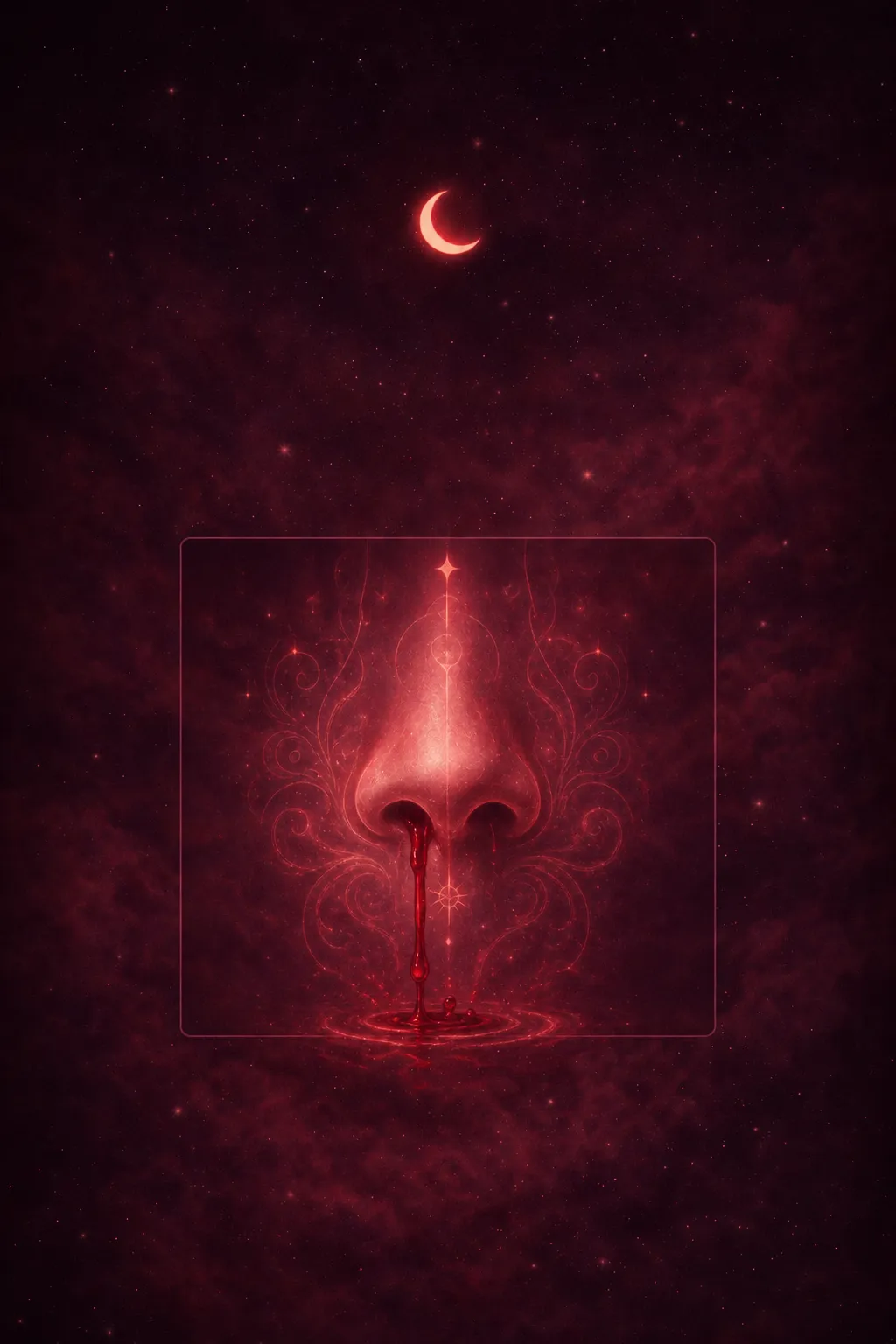
What a dream about a nosebleed could look like
Tap an image to open it full screen
Example images. Only you can see what you write in Dream Book.
The Psychology Behind a Nosebleed Dream
From a psychological standpoint, dreaming of a nosebleed is the subconscious mind staging what it cannot quietly articulate: internal pressure that has finally exceeded capacity. Much like blood as a broader dream symbol signals vitality and emotional life, a nosebleed specifically dramatizes an involuntary release — the psyche "bleeding off" tension the way an overloaded system vents heat. In an era of chronic overcommitment and always-on connectivity, this image often surfaces during periods of genuine burnout, when the dreamer's reserves of energy and focus are running dangerously low.
The loss-of-control dimension is equally significant. Bleeding from the nose is conspicuous, embarrassing, and impossible to simply will away — and that helplessness maps directly onto waking fears about composure crumbling in public or a deteriorating situation slipping beyond reach. This dynamic closely echoes the anxiety captured in dreams about teeth falling out, where a sudden, visible physical failure exposes the dreamer to shame and judgment. Self-image anxiety threads through these dreams too: the visible, physical flaw others can clearly see mirrors a deeper worry about being exposed as overwhelmed or inadequate. For those with a faith background, this vulnerability can prompt honest self-examination — an acknowledgment that human strength has limits and that surrendering control is not failure but humility.
Psychologically, the dream may also point toward suppressed emotion finally demanding an outlet. Key questions worth sitting with after this dream include:
Was yours a sign? Find out.
- Where in waking life are you absorbing more stress than you openly admit?
- Are unspoken feelings — frustration, grief, resentment — building without any healthy release?
- Is persistent health anxiety or unaddressed fatigue manifesting as bodily imagery while you sleep?
- Are you overextending yourself to the point of genuine depletion?
General meanings end here. Read your own dream.
Describe your dream in a line or two. In seconds you get a reading of your exact dream, a picture drawn from your own words, and every symbol explained.
Free. No sign-up. Takes 10 seconds. Your dream stays private.
0%
Analyzing your dream…
Something went wrong. Please try again in a moment.
Your dreams deserve more than a dictionary
Every dream you log starts to connect.
Dream Book keeps your dreams in one place and reveals the threads between them over time — your private dream journal. Free to start.
Cultural and Folk Readings of Nosebleed Dreams
Across many Western folk traditions, blood appearing unexpectedly from the body has long been read as a warning sign — a message from the body, or from fate, that something unseen is pressing too hard against ordinary life. A nosebleed in particular, because it happens without warning and is difficult to hide, carries a cultural shorthand for exposure: the moment composure gives way in public. In that sense, dreaming of one taps into a very old collective anxiety about losing face and losing control simultaneously, fears that feel especially sharp in today's high-performance culture where stress is worn as a badge but breakdown is treated as failure.
Within US Christian folk belief, blood has a dual weight — it signals both sacrifice and warning, and an unbidden bleeding in a dream can be intuitively read as a nudge toward honest self-examination, much like broader blood dream symbolism is traditionally linked to life-force and spiritual accountability. The culturally absorbed instinct is to pause and ask what is being spent, and whether the cost is sustainable. Folk tradition also draws loose parallels with dreams of teeth falling out, another image of the body betraying composure without permission — both are read, across cultures, as signals that something in waking life has slipped beyond comfortable control.
- Height and altitude: The colloquial phrase nosebleed seats quietly colors how many dreamers interpret the image — a sense of being elevated beyond one's comfort zone, out of one's depth, or straining to hold a position that demands too much.
- Health-literal overlay: Because real nosebleeds are widely associated with high blood pressure and stress, waking culture reinforces a health-anxiety reading, nudging the dreamer toward a check-in on physical as well as emotional limits.
- Loss of composure as social shame: Folk intuition ties an uncontrolled nosebleed to embarrassment and vulnerability made visible — a reminder that self-knowledge includes knowing when to step back before the pressure breaks through.
Spiritual Meaning of a Nosebleed Dream
Within a broadly Christian spiritual framework, blood carries profound weight as a symbol of life itself. Leviticus 17:11 grounds this directly — "the life of a creature is in the blood" — which means a dream of blood escaping involuntarily can feel, on a spiritual level, like witnessing one's God-given vitality slipping away under pressure. Rather than reading this as an omen, many believers find it more useful to treat the image as a quiet prompting: an invitation to examine how faithfully they are stewarding their energy, time, and wellbeing. The dream of blood in any form tends to carry this dual edge of warning and reflection.
A bad dream isn't a bad sign.
A nosebleed dream, in this light, speaks less to punishment and more to attention. If modern life has pushed you past reasonable limits — overcommitment, chronic stress, the relentless pressure to perform — the spiritual read is that something deeper is calling for rest and renewal. The loss of composure that a sudden nosebleed represents mirrors the soul's signal that self-neglect has gone too far. This is not fatalistic; it is corrective. Those who also experience dreams of teeth falling out alongside similar imagery often find both pointing to the same underlying anxiety about losing control of one's strength and vitality.
- Stewardship reflection: Are you treating your body, mind, and spirit as resources worth protecting?
- Renewal cue: The dream may be nudging you toward prayer, rest, or intentional slowing down.
- Loss as warning, not verdict: Spiritual traditions generally read such imagery as a call to change course, not a sealed outcome.
Related Dream Meanings
body health
Teeth Falling Out Dream: Anxiety, Loss & Vulnerability
5 min read

body health
Blood Dream Meaning: Loss, Vitality & Transformation
5 min read

nightmares
Being Chased Dream Meaning: Anxiety & Avoidance
5 min read
body health
Cutting Hair Dream Meaning: Change, Loss & Control
5 min read

body health
What Does It Mean When You Dream About Losing Teeth
5 min read

body health
Hair Falling Out Dream: Loss, Insecurity & Change
5 min read
body health
Pregnancy Test Dream Meaning: New Beginnings & Anxiety
5 min read
body health
What Does It Mean When You Dream About Bleeding
6 min read
What to Do After a Nosebleed Dream
Because this dream consistently signals pressure that has exceeded your coping threshold, the most useful first step is a straightforward stress audit. Before the feeling fades, jot down the two or three areas of life that currently feel out of your hands — work deadlines, a strained relationship, financial strain — and rank them by urgency. Simply naming them moves you from helpless alarm toward deliberate action, which is exactly what the dream is nudging you toward.
- Check your physical baseline. Recurring nosebleed dreams can shadow real health anxiety. Rule out the obvious: are you sleeping enough, staying hydrated, and taking regular breaks? Sometimes the subconscious borrows a bodily image because the body is genuinely run down.
- Identify one thing you can control today. The core theme here is loss of control — so restore a small, concrete sense of agency. Say no to one optional commitment, schedule a genuine rest block, or have a conversation you have been postponing.
- Track the pattern. If this dream recurs, note what happened the day before each instance. Patterns across even three or four entries often reveal a specific trigger — much like dreams involving blood more broadly tend to cluster around periods of sustained emotional depletion.
- Notice what the dream exposes about vulnerability. A nosebleed is hard to hide, and that embarrassment is data. If the dream involves witnesses, consider whether you fear being seen as overwhelmed — a feeling that also surfaces in dreams about teeth falling out, where loss of composure plays out just as visibly.
But what does your version mean?
Finally, resist the urge to dismiss the dream as random. Treating it as useful feedback — rather than a bad omen — keeps you in the driver's seat and turns a jarring night image into a practical early-warning system for stress you might otherwise ignore until it breaks through in waking life.
One dream is never the whole picture.
The free app remembers your dreams, draws them, and connects the threads over time — so the next one means even more. Free to start.
People Also Ask
Spiritually, a nosebleed often symbolizes a release of suppressed energy, emotional tension, or personal power. It can indicate that you are losing vital life force through stress or conflict, or conversely, that a healing purge is underway. Many traditions view blood as the seat of the soul, making this a sign of deep inner transformation.
Dreaming of someone else bleeding suggests you feel concerned about that person's wellbeing or sense they are being drained emotionally. It can also reflect guilt, empathy, or a fear of losing someone close, much like dreams about being chased that centre on vulnerability. The relationship you have with that person in waking life usually shapes whether the symbol carries a warning or a compassionate message.
The Bible does not address nosebleeds directly, but it treats blood as sacred and life-giving, stating that 'the life of the flesh is in the blood' (Leviticus 17:11). A nosebleed dream viewed through a biblical lens may therefore point to a sacrifice, a covenant being tested, or a call to guard your spiritual and physical vitality carefully.
Within a Christian framework, dreaming of a nosebleed can symbolize spiritual warfare, vulnerability to sin, or an urgent need for prayer and renewal. Because blood carries deep redemptive meaning in Christianity, the dream may be nudging you to seek healing, confess hidden burdens, or trust that divine grace can restore whatever strength you feel you are losing.
Curious what your dream would look like?