
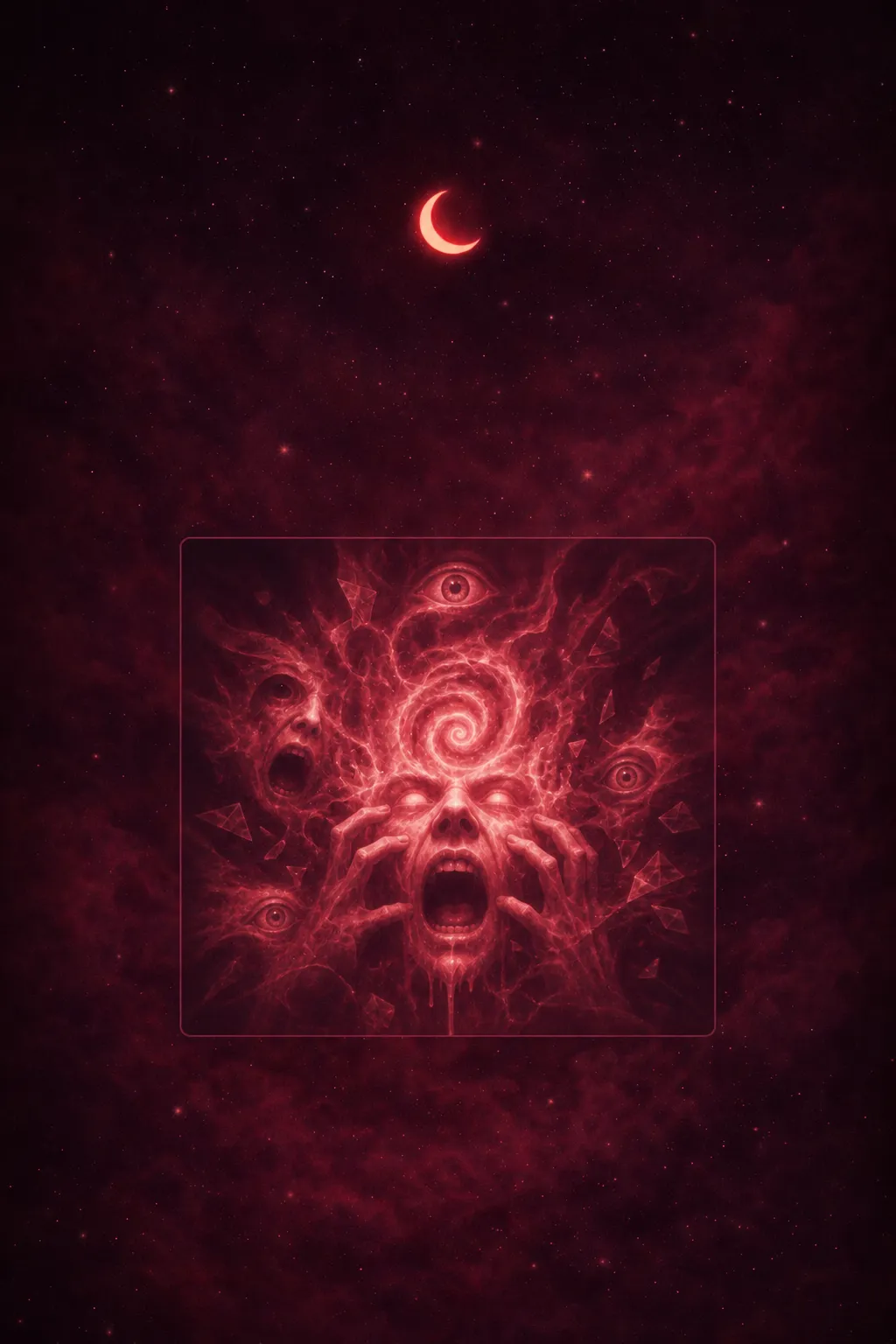

Going crazy in a dream typically means your waking mind is overwhelmed by stress, repressed emotions, or a fear of losing control, and your subconscious uses the dramatic image of madness to signal that unresolved pressures urgently need your attention before they destabilize your sense of identity or emotional balance.
In under a minute you could read what your exact dream means for you, and see a picture of it. Free.
Bad dream? See exactly what you dreamed — turned into a picture.
Just describe it and Dream Book paints your dream as a real image, plus a reading of what it means for you. Free, and it takes under a minute.


A dream still on your mind? Get your personal reading.
Describe your dream in a line or two. In seconds you get a reading of your exact dream, a picture drawn from your own words, and every symbol explained.
Free. No sign-up. Takes 10 seconds. Your dream stays private.
0%
Analyzing your dream…
Something went wrong. Please try again in a moment.
Your dreams deserve more than a dictionary
Common Dream Scenarios and What They Mean
Because "going crazy" dreams tend to cluster around the same core fears — losing control, being misunderstood, or simply hitting a wall — the specific scenario you find yourself in sharpens the message considerably.
Dreaming that you feel yourself going crazy
The most frequent variant, and the most direct. Your waking life is likely pushing you past a sustainable limit — overwork, a major transition, or accumulated stress that has nowhere to go. The dream is less a warning about your sanity and more a pressure gauge signaling genuine burnout.
A bad dream isn't a bad sign.
Dreaming that others believe you are crazy or refuse to believe you
The threat here is social, not internal. You may feel dismissed, invalidated, or unheard in a real relationship or workplace dynamic — your perspective treated as irrational when, to you, it makes complete sense.
Dreaming of acting irrationally and being unable to stop yourself
This scenario often carries a strong undercurrent of shame. An impulse, habit, or emotional reaction feels bigger than your ability to manage it, and the dream exaggerates that helplessness into full loss of self-control.
Dreaming of being confined to an asylum or psychiatric ward
Feeling trapped and powerless, with control handed over to an external authority, is the dominant theme here — sometimes reflecting a situation at work or home where your autonomy has quietly eroded.
Dreaming that a loved one is going crazy
Watch for caregiving strain or a relationship that feels increasingly fragile. The dream may reflect worry about someone's wellbeing, or a fear that the connection between you is becoming harder to hold together.
Dreaming that everyone around you is irrational and you alone are sane
A strong signal of alienation — your values, instincts, or worldview feel at odds with your environment, leaving you isolated and chronically misunderstood.
But what does your version mean?
Dreaming of manic laughter or euphoria tipping into madness
Paradoxically joyful on the surface, this variant usually signals repressed tension finally breaking through. The relief is real, but the dream frames it as dangerous — reflecting ambivalence about letting go.
Across all these variants, the common thread is the question of self-knowledge and control: how much do you trust yourself, and how much do you feel that trust is currently justified?
What this dream could look like
Tap an image to open it full screen
Example images. Only you can see what you write in Dream Book.
Psychological Meaning: When Your Mind Turns the Pressure Inward
From a psychological standpoint, dreaming of going crazy is your subconscious staging an honest audit of your stress load. The imagery of madness functions as a saturation signal — the mind's way of announcing that accumulated pressure has exceeded your perceived coping capacity. In an era defined by productivity demands, digital overload, and constant change, this dream is strikingly common precisely because so many people maintain a polished outer composure while quietly running on empty underneath. The dream doesn't mean you are losing your grip; it means your inner life is urgently asking to be heard.
At a deeper level, the dream often reflects identity destabilization — a gnawing fear that the self you present to the world no longer matches who you actually feel yourself to be. Emotions that have been suppressed or dismissed in waking life (grief, rage, longing, dread) tend to resurface in dreamscapes as chaos or madness, because the psyche won't allow them to be ignored indefinitely. Carl Jung would frame this as shadow material demanding integration: the "crazy" figure in the dream is not an enemy but an unacknowledged part of yourself seeking recognition. A Christian psychological lens might interpret this similarly — an invitation to honest self-examination rather than performative control.
- Control anxiety: A self-narrative of competence cracking under pressure or unwanted change.
- Suppressed emotion: Feelings denied in daily life surfacing as disorienting imagery.
- Health anxiety: Sometimes the dream mirrors a genuine worry about mental well-being — worth taking seriously, but not reading as a literal diagnosis.
- Shadow integration: An invitation to acknowledge the parts of yourself your waking persona works hardest to conceal.
General meanings end here. Read your own dream.
Describe your dream in a line or two. In seconds you get a reading of your exact dream, a picture drawn from your own words, and every symbol explained.
Free. No sign-up. Takes 10 seconds. Your dream stays private.
0%
Analyzing your dream…
Something went wrong. Please try again in a moment.
Your dreams deserve more than a dictionary
Every dream you log starts to connect.
Dream Book keeps your dreams in one place and reveals the threads between them over time — your private dream journal. Free to start.
Cultural and Traditional Perspectives on "Going Crazy" Dreams
In everyday American English, "going crazy" long ago crossed over from clinical language into casual idiom — people say it to mean overwhelmed, overstretched, or simply at the end of their rope. That linguistic shift matters for dream interpretation: when the phrase already lives in your waking vocabulary as shorthand for stress, dreaming it back to yourself often reflects the relentless pace of modern life rather than any deep fear of mental illness. Folk wisdom has always recognized a connection between frantic daily living and restless, alarming dreams, and that tradition holds firm today.
Within US Christian cultural memory, losing one's mind carries echoes of biblical figures who wandered or broke under unbearable pressure — yet the same tradition frames such moments as turning points toward restoration rather than permanent ruin. From that angle, the dream carries a cautionary but ultimately hopeful undertone: a nudge to slow down, seek counsel, and trust that stability is recoverable.
Was yours a sign? Find out.
A notable cultural shift now shapes how many people read this dream symbol. Growing mainstream openness around mental health — therapy becoming normalized, burnout openly discussed in workplaces and on social media — means the stigma once attached to "crazy" imagery is softening. Today the dream is less likely to feel shameful and more likely to be read as a culturally legible distress signal, one that many people around you would recognize and validate. Key cultural takeaways include:
- The idiom's everyday use ties the dream tightly to overload and stress rather than literal instability.
- Folk and religious traditions frame breakdown imagery as a call to pause and seek support, not a verdict.
- Reduced mental-health stigma encourages treating the dream as useful self-knowledge rather than something to suppress.
Spiritual Meaning: The Battle for a Sound Mind
From a spiritual standpoint, a dream about going crazy often surfaces as a signal that the soul is carrying more than it was meant to bear alone. Within a US Christian framework, this kind of dream can be read as an invitation to revisit a foundational promise: the assurance in 2 Timothy 1:7 that believers are given not a spirit of fear but of power, love, and a sound mind. When the dream strips that soundness away, it may be prompting you to ask where, in waking life, you have quietly stopped leaning on that resource.
Philippians 4:6–7 takes the message further, offering a direct antidote to mental turmoil: bring your anxieties forward in prayer, and a peace that exceeds ordinary understanding will stand guard over heart and mind. For someone carrying chronic stress or a creeping sense that everything is slipping out of their hands, this verse reframes the dream not as a verdict but as a nudge — a prompt to surrender the weight rather than white-knuckle control over outcomes.
- Spiritual battle framing: The dream may reflect an internal conflict between the desire for self-sufficiency and the need to release control through faith or surrender.
- Burnout as a spiritual signal: Many traditions treat emotional saturation as a sign that the spirit needs rest, community, or renewed purpose — not merely better time management.
- Self-knowledge: Spiritually, the dream can serve as honest inner counsel, revealing where unaddressed fear has quietly taken root and inviting a more grounded, faith-rooted response.
Related Dream Meanings

nightmares
Losing Control: Meaning and Interpretation
5 min read

nightmares
Being Chased Dream Meaning: Anxiety & Avoidance
5 min read

common dreams
Falling Dream Meaning: Insecurity, Fear & Loss of Control
5 min read

nightmares
Car Accident Dream Meaning: Loss of Control & Fear
5 min read
nightmares
Can't Wake Up Dream Meaning: Trapped & Overwhelmed
5 min read

nightmares
Airplane Crash Dream Meaning: Loss of Control & Fear
5 min read

nightmares
Rape Dream Meaning: Vulnerability & Loss of Control
5 min read

nightmares
Deceased Visiting Dream: Closure, Guidance & Grief
5 min read
Practical Takeaways: What to Do After This Dream
Before anything else, treat the dream as useful data rather than a disturbing omen. It is your mind flagging a genuine stress threshold — so the first move is a quick honest audit of your current load. Ask yourself where, right now, you feel the least in control: a deadline, a relationship, a financial pressure, or simply a schedule that has no slack in it. Naming the source is the first concrete step toward addressing it.
- Do a control inventory. List what you can influence today versus what you genuinely cannot. Focusing energy on the first column reduces the helpless feeling that feeds these dreams.
- Build one small recovery window into your day. Burnout-driven dreams tend to ease when the nervous system gets consistent, brief breaks — even ten minutes of deliberate quiet counts.
- Talk it out. The secondary fear in this dream is being judged as unstable. Saying it aloud to someone you trust — a friend, a therapist, a pastor — often dissolves more anxiety than any solo strategy.
- Track recurrence. If the dream repeats over several nights, treat that pattern as a louder signal, not background noise, and consider whether professional support is warranted.
A bad dream isn't a bad sign.
The overarching message is reassuring: this dream rarely predicts anything — it reports something. Use it as a prompt to recalibrate before the pressure it is pointing to becomes harder to manage.
If it keeps coming back, the app helps you understand the pattern.
Log each recurring dream and the free app shows you what's underneath — calmly, over time. Free to start.
People Also Ask
Dreaming about going crazy often reflects overwhelming stress, emotional exhaustion, or a fear of losing control in waking life. It may signal that your mind is processing anxiety or pressure you have been suppressing. Rather than a literal warning, it typically urges you to slow down and address your mental and emotional wellbeing.
Dreams involving repeated warnings, vivid feelings of dread, or scenarios where you lose control of your mind deserve attention. These may reflect genuine stress, unresolved trauma, or important emotional signals. Dreams that disturb your sleep consistently or leave a strong emotional residue after waking are worth reflecting on or discussing with a professional.
Yes, sleep apnea disrupts normal sleep cycles, particularly REM sleep, which is when vivid dreaming occurs. Frequent oxygen drops and arousals can trigger intense, chaotic, or frightening dreams, including feelings of losing your mind. If your disturbing dreams come alongside snoring or fatigue, a sleep evaluation is strongly recommended.
Many people believe a spiritually significant dream feels unusually clear, emotionally powerful, and stays with you long after waking. Recurring themes, symbolic figures, or a strong inner sense that the message matters are common signs. Reflecting prayerfully, journaling the dream, and seeking guidance from trusted spiritual counsel can help you interpret its meaning.
Curious what your dream would look like?